I know this is a writing blog, though I have on occasion expressed political opinions, mostly asides. At times, though, things happen that I have to write about.
First, for context, my father was a soldier in World War II and until the early 1960s. He imbued in me a respect for the people who put their lives on the line for their country. Granted this respect was limited to the U.S. military; he was a complete anti-fascist. I suspect that was because of what he’d seen. Although he was in action only from mid-1944 through May 1945, he saw enough that he couldn’t talk about it. Above all, he showed me that in World War II, the people who put their personal lives on hold to resist authoritarianism deserve that respect.
We Americans know the significance of December 7 1941, the date, per President Franklin Roosevelt, “that will live in infamy.” The Japanese military attacked the U.S. Navy fleet moored in Pearl Harbor, Hawaii. Several vessels were severely damaged in the surprise attack and some sank, in particular the U.S.S. Arizona, which took 1,177 of the 1,514 crewmen down with it. The bodies, most of which were vaporized when the ship’s magazine exploded, were left in situ. The bodies that divers could see in the mangled superstructure couldn’t be removed because of structural danger.
In 1950, a flagpole and a plaque designated the wreckage as essentially a military cemetery. In 1958, President Eisenhower signed legislation for a memorial on the site. Construction began in 1960, funded in part by a benefit concert given by Elvis Presley. The USS Arizona Memorial opened to the public in 1962.
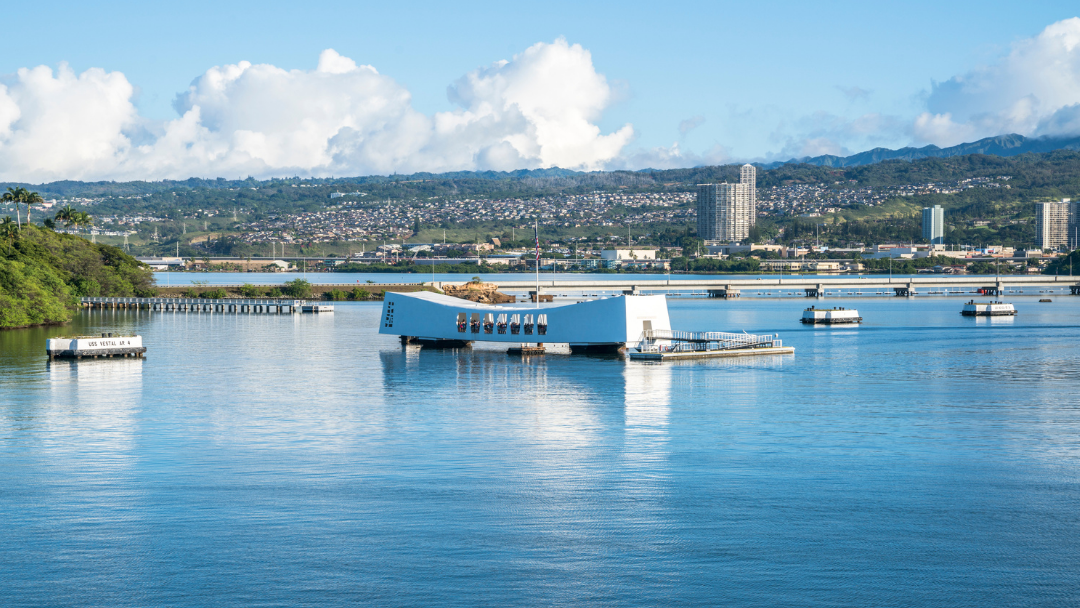
The white structure sits directly over the wreckage, and the memorial today is run by the U.S. Park Service and the U.S. Navy. People who want to visit gather at a Park Service facility where they are reminded that this is the burial place of hundreds of sailors and that respect and decorum are expected at all times. Note that the wreckage of the USS Utah is also on this site.
Fast forward 40-some years to the early 2000s. My ex (before he was my ex) and I were vacationing on Oahu and decided that this memorial was something we both wanted to see. We drove there, bought the tickets, and were escorted into a large room along with 143 other people.
A Park Ranger gave a brief history of the memorial and reminded us it was the “final resting place” of hundred of sailors. The 145 visitors were mostly Americans with lots of children among them. I’d say 15 to 20 of the visitors were Japanese, who sat together as a group. As we waited to board the U.S. Navy boat that would shuttle us to the memorial, many of the Americans pointed to the Japanese and muttered things like, “Are they here to gloat?” “They shouldn’t even be allowed to come here.” I could feel my temper rising, but I reminded myself about . . . respect. Respecting the fact this was a memorial.
We all hustled onto the boat for the 10-minute journey to the memorial. A group has 10 to 15 minutes to “explore and reflect” before returning to the boat for transport back to land. (A trip happens every 15 minutes.) I’ve been to Arlington Cemetery many times and experienced solemnity and silence despite hundreds of visitors there. I expected the same at this visit to the USS Arizona Memorial. Indeed, in the pre-trip lecture by the Park Ranger, she emphasized silence.
What a contrast among those visitors.
The Americans let their kids run and scream back and forth on the interior of the memorial.
The Japanese visitors stood along the rail on the side of the memorial where you can look down and still see oil seeping from the wreckage. They stood with hands pressed together, eyes closed, heads bowed in a typical Buddhist prayer stance. Not one of them said a word as kids ran wild behind them.
How could it be that citizens of the same country that executed the surprise attack on Pearl Harbor be more respectful than citizens of the country that suffered the attack. Both my ex (a vet) and I were dismayed and talked about it a lot after we left. We were embarrassed, not that anyone could see that, but we were. And we were a bit ashamed.
I’d almost forgotten about this vignette until this past week when we learned that the U.S. Attorney General “VIP snorkeled” around the sunken USS Arizona in August of 2025. The fact that it took nine months to become known tells me the AG’s staff knew the optics were bad.
I don’t care that the U.S. Navy approved it or that Navy SEALS invited him, it was desecration. It was crass and tacky and lacking class, and when I heard about it that humiliation I felt in the early 2000s came back. One person commented on Threads what summed it up for me: “What’s next? Eighteen holes of golf in Arlington Cemetery?”
This is a member of an administration that speaks of the military as “warriors” and “war fighters” but yet takes a VIP swim around what is essentially a cemetery of fallen sailors.
Excuse my Irish, but it’s un-fecking believable.
I’ve said so many times in the last 16 months that I’m glad my dad isn’t here to see anything about this. He would be so upset. I guess I’m the one who speaks for him now.
What the highest law enforcement official in the land did was shameful.
Shameful.
Note: Of the 337 sailors who survived the sinking, 45 have subsequently had their ashes interred in the Arizona with their comrades. This practice started in 1982. National Park Service divers place the internment box in an area of the Arizona call Barbette No. 4, where the remains of other sailors were found.

