Why Do I Write?

Possibly the second most-asked question for writers, after “Where do you get your ideas?”, is “Why do you write?”
 
I’ve reposted the meme about (paraphrased) “writing is like breathing; if I don’t do it I die” several times. A bit dramatic, of course, but I’ve spent so much of my life writing, I can’t imagine doing anything else. When I got a job as a reporter on an aviation magazine, it was a died-and-gone-to-heaven moment: They paid me to write about what I loved, airplanes.
 
I write because it’s how I communicate best. Often, the spoken word fails me, but the written word never has.
 
I write because I feel deeply about the world around me. When I saw genocide in the Balkans, I had to write about it. When I saw a disproportionate number of black men killed by police, I had to write about it. When I see injustice, racism, sexism, etc., I have to write about it.
Writing for me is catharsis. I’ve exorcised the demons of my father’s suicide and my mother’s alcoholism by writing them into my fiction. As I said, when the spoken word fails me…
 

How I Got Started

I started writing stories in elementary school with my weekly list of spelling words. You remember–the exercise where you had to use each correctly in a sentence. My sentences comprised a story, usually about horses.
 
One year for Christmas, I got an alphabet, rubber-stamp set, and I set about printing a newspaper for my neighborhood–based on what I heard my mother and her friends talking about at the kitchen table. I hand-printed, letter-by-letter, a half dozen copies and left them on doorsteps. Needless to say that didn’t go over well with my mother because I’d essentially repeated her gossip. The rubber stamp set mysteriously disappeared.
In high school, my English teacher caught me writing fan fiction in her class. She confiscated my notebook but gave it back to me the next day. “Keep writing,” she said, “just not in my class unless it’s an assignment.” My very first spy story she accepted as an assignment for class. My first book of short stories, Rarely Well-Behaved, I dedicated to her.
In college, I was the first non-English major to be published in the literary magazine–my first published sci-fi story. (It sucked, as I discovered when I found it thirty-plus years later.)
I had a break in writing after college when I taught school for a few years. I got a job as an editorial assistant for an aviation insurance consortium, and that led to my dream job writing about airplanes and aviation for the FAA. While I wrote articles and briefing papers and white papers and studies and regulations and manuals and congressional Q&A, I still wrote fiction at home.
But it was a long, long drought of having my fiction published–more than thirty years. So, I decided it was time to retire and write for myself.

The Big Mo Builds

That first year after retirement, nothing got published. I remembered how much I disliked those rejection notifications, but I kept at it. First came a story in a start-up lit mag; then, another. Publication in an anthology. Placing well in a contest. Another anthology. More lit mags. Another contest.

In between were agent rejections, self-publishing some short story collections, small publisher rejections, and a few more agent rejections.

Still, all this has made me feel I’m on the edge of something I’ve wanted my whole life, something that’s about to happen. I’ve always said if I could simply get my stories in people’s hands they would find something to like about them, that they would want more.

In the midst of all this, I stopped being the writer others said I should be and became the writer I’m supposed to be.

Why do I Write?

Because it lets me be vulnerable and forces me to be authentic.

What more can you ask of life?

Pick a Cover, Any Cover – Update

Actually, I only want you to pick one of two (now three) choices. Easy, right?

A couple of months ago, I mentioned I’m trying a new type of promotion for my work–giveaway short stories. I have two in print: “Spymaster” and “Blood Cover.” Using canva.com, I came up with great covers for them, which I’ll share in an upcoming post. I have a third story about ready for printing, and this cover is proving to be a challenge. That might be because of the subject matter.

Writing from Current Events

I characterize myself as an “historical/political thriller” writer, meaning my works use history and current events as a basis for the fictional story. With these giveaway stories, I’m practically in present day, i.e., they have been prompted by news items I’ve seen this summer.

For example, “Spymaster” is based on a series of real events where American diplomats in Europe and Moscow have been harassed allegedly by the Russian security services (think, the old KGB). “Blood Cover” is about the perils of living in a theocracy with harsh methods of punishment.

The next giveaway short story to come out is called “Best Served Cold,” and it involves something that invokes either sympathy or ire, the Black Lives Matter movement.

Cultural appropriation aside, I write stories essentially where the characters tell me to write them. Sometimes those characters look or are completely unlike me. I believe a straight person can write about gay issues, a black person can write white characters and vice versa, that cisgender writers can write trans characters, etc. However, it is incumbent upon us to be authentic to all our characters and not to devolve into stereotypes.

I had a painful experience a couple of years ago where a contest-winning story was pulled from publication because I, as a western white woman, had dared to write a story wherein the protagonist was an aboriginal man from Australia. I had carefully and thoroughly researched as I wrote, and that aboriginal man “dictated” his story to me. Someone complained I wasn’t following Australian cultural guidelines, and the publication’s editor caved to a single person’s criticism and removed my story. (Joke’s on them. That story was later published in an anthology.)

All that being said, I was skeptical of my ability to write a story about the murder of a black man without offending anyone. But, sometimes writers have to offend. I did my research, I drew on distasteful things I’ve witnessed in my life, things that have made me angry but which I, as a white person, thought it best to be silent about.

That’s the thing. Silence is tacit acceptance of injustice. So, I wrote the story, “Best Served Cold,” and I took measures to make certain it was authentic.

“Best Served Cold” Back Cover Copy

To help in your choice–coming up in a bit–here’s the back cover copy for “Best Served Cold” to give you an idea what it’s all about:

Nathan Hempstead has long been the United Nations Intelligence Directorate’s cyber-guru. A hack, a tracking app, anti-eavesdropping tech, you name it, he can do it. For nearly four decades he’s worked in an environment that not only honored his genius but also kept him free of bias and racism and let him indulge in his favorite pop-culture fandom, Star Trek.

A critical Directorate mission fails because a dictator’s access to social media didn’t get blocked as planned. In fact, Nathan didn’t bother to show up to monitor the operation. The Directorate’s operational head, Mai Fisher, wants answers, not only for why the mission failed but why a critical employee, and a friend, let her down.

In his office Mai finds Nathan, seething with anger he directs at Mai, but when she presses him for what’s wrong, he has a cardiac emergency.

In hospital Nathan tells Mai about a son he thought no one else knew about and how that son had become another statistic in a deadly standoff between law enforcement and black men.

Mai knows how to get revenge; she’s done it before. Nathan, however, doesn’t want her help. He already has a plan, and it involves the most unlikely ally in the world.

Nathan teaches Mai the subtlety of an old Klingon proverb: “Revenge is a dish best served cold.” She comes to understand, as well, that black lives do matter.

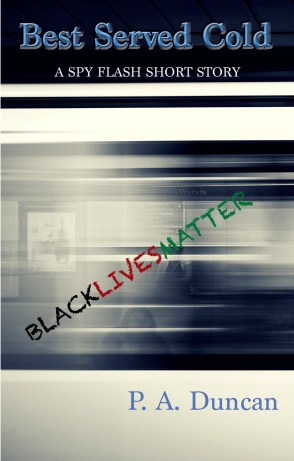
“Best Served Cold” Cover Possibility 1
bsc-cover-1-blog

Cover Possibility #1


Let me give you some background on why I picked this as a possibility. I liked the sense of movement, the blurred background, the indistinct human figures. I could write a dissertation on why, but that’s not the point.

The “BLACKLIVESMATTER” overlay is supposed to be graffiti-like, but I’m not one hundred percent happy with how it turned out.

I’ve used blue on the title and my byline to imply cold. I didn’t really want a cover which implied warmth, given the subject matter and the allusion to that famous Klingon proverb.

What I like about it is its modernity and mostly, the movement aspect. That appeals to me for some reason.

What do you think?


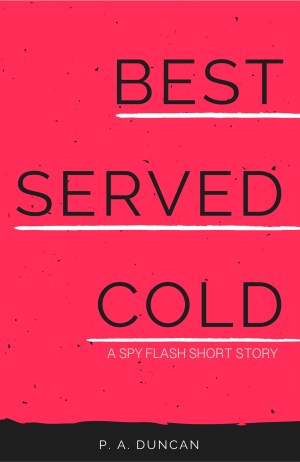
“Best Served Cold” Cover Possibility 2

This possibility has a number of things going for it. It’s bright and stark.
bsc-cover-2a-blog

Cover Possibility #2

There’s a scene in the book where someone likens the flow of blood over asphalt to how the ocean flows over sand, and I thought this implied that.

The red on the cover isn’t quite blood red, and, unfortunately, it’s something I can’t change.

The warmth of the cover color contrasts with the title. You don’t look at this and feel cold.

However, the meaning of the “best served cold” proverb is that you’ll enjoy your revenge if you let some time pass, i.e., that the person won’t know what hit them when revenge comes. It’s not a cooling down period; it’s to make the revenge “hotter.”

What do you think?


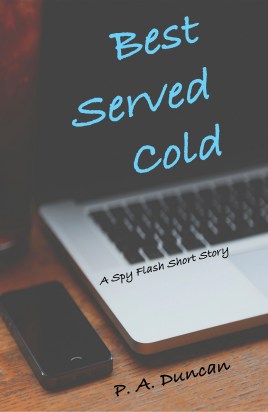
New! “Best Served Cold” Cover Possibility #3

It’s great when you have friends who are real graphic designers, unlike moi, who is a hopeless wannabe. Thanks to Becky Muth, here’s a third possibility you can vote for:
bsc-cover-5-front

Since computers and hacking figure in the story, this may be the ideal cover for this story.

It’s stark, like the story, has a bit of an air of mystery about it, and ties in more obviously than cover possibility #2 (or #1).

I have a new favorite. What about you?


You Pick the Cover

In the comments below, tell me which cover you like and why. Here’s why you should vote: I’ll pick a winner at random from the commenters and send you a copy of the three giveaway short stories when they’re all in print.

What do you have to lose? You get to express an opinion and have a chance to win free stuff!

I look forward to reading your comments.

Writerly News!

One Contest Win; One Second Place

I learned last week that my short story, “Reset,” about a father and daughter who set out to prove the Warren Commission wrong, had won first place in the Blue Ridge Writers Golden Nib Fiction Contest. “Reset” is one of those stories, which in the writing, becomes something close to you, and I was so proud it won this contest.

I’d always said I wasn’t going to be one of those writers who milks her dysfunctional family for material, but almost every story I’ve written that’s won a contest or been published has had some aspect of my family in it. The best laid plans…

“Reset” now goes into the state-wide Golden Nib contest, and I have my fingers crossed. It’s a good story. It will also appear in the ongoing anthology, Skyline 2017, which should be out in December. (I’ll be on a Virginia Festival of the Book panel in 2017 about the anthology–if the panel proposal is accepted. I have my fingers crossed for that, too.)

The poem I wrote about here a few weeks ago, “Verses for Orlando,” won second place (second-freaking-place!) in the Blue Ridge Writers Golden Nib Poetry Contest. I. Had. A. Poem. Come. In. Second!

It won’t go to the state-wide contest, but it will also appear in Skyline 2017. I. Will. Have. A. Poem. Published!

I’m very excited. You may have noticed.

How about you? Do you use things from your life and background in your writing? Are they some of your best stories or not?

Unexpected Praise

MNE FCEight months or so ago, a friend from UU bought my novella, My Noble Enemy. Her husband was about to have surgery, and she wanted something to read in the waiting room. I warned her it was about a man dying of cancer, but she said that was okay. A week later, I learned her husband had unexpectedly died of complications from the surgery, and I was worried that my novella was the worst possible thing she could have read. I figured she probably hated it and me for writing it.

When she returned to UU the week after her husband’s funeral, she sought me out and told me reading My Noble Enemy had helped her through her husband’s last hours and that it had given her comfort because the character in it who died was surrounded by the people he loved and who loved him. I was stunned and humbled.

Yesterday, all these months later, she told me the story still resonated with her as she continues to undergo her grief process, that she still needed the message of loyalty and compassion I wrote.

I am still stunned and humbled by such praise, and it’s the best thing anyone has ever said about my work. I’ve always said I don’t write for money or acknowledgement but because I have stories I want to tell, that need to be told. That story was the right one at the right time for at least one person, and that’s all I need.

How has something you’ve written resonated in an unexpected way? I’d love to know.


Getting Your Name Out There

Haiku 366-191 to -208 will come soon, but today I thought I’d get back to a post about fiction and the struggle of every indie author–getting people to give your books a chance.

I’ve ranted before about the quality of some indie publishing, but as I’ve read more and more of it, I’m finding the truly awful (i.e., unedited, misspelled, and grammatically deficient) is fast becoming a minority. Add in Barnes and Noble, that behemoth of traditional publishing, will allow indie published work in its stores (at last), and the writer, who decides to forego the traditional and often demoralizing hunt for an agent and a publisher, is getting R-E-S-P-E-C-T. This is especially heartening for those who took the time and effort to publish a polished product and who didn’t succumb to the coveted “published author” title at all costs.

So, before this becomes a rant: join a critique group, hire a professional editor (for all stages of editing), design or purchase a professional cover, hire a proofreader, and, if you’re not familiar with a book’s interior design, hire someone who is.

Now, onto “getting your name out there.”

An Unexpected Find

I’ve always believed my books about my spy characters would be successful if I could “get them out there” where people could see the depth of the characters, the timeliness of the subject matter, and the pains I’ve gone to for an intriguing story. I’ve done the bookmark thing, the postcard thing, the purchase-an-ad thing, the book signing thing, the open mic thing, but what more could I do without bankrupting myself?

At Virginia Festival of the Book this past spring, I came across a local fantasy writer who’d purchased a table at the book fair. I almost walked past because I’m not much of a fantasy reader. However, on one corner of her table were several small (as in thin) books with a sign that said “Free.”

“Free?” I asked the author.

“They’re short stories featuring my characters and aspects of the mythology I’ve built,” was the reply.

“And you give them away?”

“Bookmarks and postcards get thrown away. When someone’s done with one of these, they won’t throw them away. They’ll give them to a library or a used book store, and that’s exposure. Hell, maybe they’ll even keep them.”

I must have stood there gaping with the shock of “why hadn’t I thought of that” because she picked up two of the “booklets” and handed them to me. “Enjoy,” she said.

Back home when I unpacked my goodie bag from the festival, I came across the two booklets and sat right down to read them. The author was right. They were engaging, a quick read, but complete, well-crafted short stories and certainly piqued my interest for her longer works.

But life moves on, and I put them aside and forgot about this unique marketing idea.

Imitation and Flattery

After polishing off the edits on a couple of draft novels, which I hope to have ready for the demoralizing agent hunt (Yes, the dream is still alive in my head.) later this year, I decided I wanted to go back to writing some short stories, not the flash fiction I’ve been delving into for years, but a true short story of 7,000 to 8,000 words. I’d come across an article in The Washington Post about Russian security services allegedly harassing diplomats in Europe and Moscow–juvenile pranks mostly, but they were escalating. The Russian government, of course, disavowed any participation on its part, but those of us who’ve studied that country throughout its iterations knew better.

The result: a 7,500-word short story called, “Spymaster.”

And the booklets from the Festival of the Book came back to mind. What if (a writer’s favorite question) I used CreateSpace to make that short story into a booklet to give away at book signings and over events. At CreateSpace, it’s free to publish, and the size of the booklet means ordering copies for my personal use will be a minimal investment.

Imitation, after all, is the sincerest form of flattery.

The story is with a beta reader/editor right now, but while I’m waiting for the feedback, I went ahead and designed a couple of cover possibilities.

If you’ve never heard of Canva, it’s a great online tool for designing a number of graphic art pieces, from Facebook page headers (go to https://www.facebook.com/unspywriter and have a look at one I did for my author page using Canva) to Instagram posts. Canva has templates for ebook covers, including Smashwords and Kindle. Most of their artwork is free, but even the ones you pay for start at a dollar a piece. Unlike another good resource for professional covers, http://www.selfpubbookcovers.com/index.php, where once you buy a cover, it’s taken down and not sold to anyone else, with Canva you risk having the cover you choose used by someone else. Of course you can customize it. I remove all the sample text on the Canva cover, download it as a .jpeg, and further customize it in Photoshop. Canva’s selection of free graphics is limited compared to SelfPubBookCovers, but I managed to find a few that appealed to me and fit the theme of the story, “Spymaster.”

“Spymaster” Cover #1

SPYMASTERThis cover appealed to me because one of the critical scenes takes place in a forest in Eastern Europe. What it’s lacking is color. The story has dark elements, but not quite this dark.

It fits the story but to me has limited appeal in getting someone to pick it up and look at it.


“Spymaster” Cover #2

SPYMASTER3This cover also appealed to me because of a specific theme in the story. Again, it’s black and white. While it’s certainly intriguing and I know people who would pick up a book with a cover like this, it lacks color. I experimented with other fonts and putting the type in different colors, but that didn’t quite work either.


“Spymaster” Cover #3

Spymaster 2The final choice appeals to me visually, has excellent color, and is very evocative. It doesn’t directly relate to a scene in the book, but it screams “intrigue” and “mystery.” I know I’d pick up a book, even a free one, with this cover. Of the three choices, this is certainly the one I’m leaning toward.


But what do you think? Which cover appeals to you and why? Let me know in the comments below.