Politics Wednesday – From Emmett to Trayvon

I was too young to remember Emmett Till. In fact I’d never heard of Emmett Till until the early 1990’s when I read Lewis Nordan’s Wolf Whistle, a novel based on what happened to Emmett Till. Till was a fourteen year old black youth from Chicago, IL, visiting family in Mississippi and not attuned to the racial protocols in the South in 1955. He spoke to a white girl, an offense that got him killed. His killers mutilated his body hideously, so much so everyone encouraged his mother to have a closed-casket funeral. “No,” she said, “let them see what they did to my boy.”

If you Google “Emmett Till” and click on the Wikipedia article, you’ll see a picture of Emmett taken the Christmas before he died. You’ll see a smooth-faced, handsome kid, sporting a man’s hat at a jaunty angle on his head. If you scroll down, you’ll see what his mother wanted the world to see, and it’s tough to look at; but don’t you dare look away.

Till’s death didn’t stop the wave of violence against blacks in the 1950’s or 1960’s, but it put a face to it. Till was a diminutive young man, small for his age and no match for the two, grown men who kidnapped him, beat him, gouged an eye out, shot him, then disposed of his body in the Tallahatchie River after they tied a seventy-pound cotton gin fan to his neck. Months after their acquittal, his murderers admitted to the killing in an interview; double jeopardy prevented a re-trial.

Today, what happened to Emmett Till is abbreviated to KWB–Killed While Black–and too many of us think, “That was the past. That doesn’t happen anymore.” Flash forward almost sixty years to a time when Emmett, had he lived, would likely have grown grandchildren, and hear the name Trayvon Martin.

Trayvon was murdered and buried before we ever learned how he died. We may be past the time where Trayvon could be executed for speaking to a white woman; however, he couldn’t survive a walk to a convenience store and a return to a “gated community.”

I’ll digress for a moment and say I abhor gated communities. The thought of putting up a gate to keep out the riff-raff is medieval. Oh, the homeowners would never say “riff-raff,” but, wink, wink, you know what they mean. When I was looking for a house after retirement, someone recommended a community in Haymarket, VA, near where I grew up, so I went to have a look. I had an appointment with a realtor, but the rent-a-cop at the gate wouldn’t let me inside unless he Xeroxed my driver’s license. I refused and left. When the realtor called later to find out why I stood her up, I said, “I didn’t know it was a gated community.” “What’s wrong with that?” she asked. “They’re fucking elitist.” Digression over.

Trayvon was allowed to be in that gated community; his father was visiting someone who lived there. They had been watching a basketball game, and the seventeen year old, probably needing a break from the adults, walked a short distance to a convenience store to purchase an Arizona Iced Tea and a box of Skittles. It was a rainy, February afternoon in Florida, and Trayvon wore a hoodie.

Trayvon committed the “crime” of being a young, black man dressed in a hoodie while walking in a gated community in a state where you can say anything short of shooting someone in the back is self-defense and get away with it. Trayvon had the misfortune of piquing the attention of a self-ordained neighborhood watcher and wannabe cop who followed him after a 9-1-1 Dispatcher told him not to, who apparently accosted Trayvon, and who, though he out-weighed Trayvon by more than 100 pounds, was so frightened of that can of tea and that box of candy that he put a single 9mm round in Trayvon’s chest. Trayvon’s body was drug-tested; the shooter wasn’t. The shooter claimed self-defense, and the cops looked at a dead, young, black man in a hoodie and decided no arrest was in order.

We all know the shooter’s name, but I’m not acknowledging him as a person right now. Yes, my religion tells me to appreciate the inherent goodness in every person, and eventually I’ll forgive. The name we need to have on our lips every minute of every day until the shooter is behind bars is Trayvon Martin. White or black, or any color in between, sit your children down and tell them Trayvon’s name. Tell them Trayvon was a good kid, a good student. Tell them he loved airplanes and wanted to be an aviation mechanic. Tell them he played football and loved basketball. Tell them he was murdered because he was black. What? You don’t want to tell your children that? Tell them anyway.

Because Trayvon has to be the last one. Do you understand? The last time this happens.

Spring – Time for the Virginia Festival of the Book!

If you’re in the Northern Hemisphere, the Vernal Equinox (aka Spring) begins at 0114 Tuesday, March 20. My Celtic ancestors called it Ostara (in truth, the Christians may have “borrowed” that name and turned it into Easter) and celebrated the fact it was time to plant, that the earth was being reborn. Anyone who has watched the daffodils and crocuses pop up lately, it indeed seems like a rebirth.

For writers, it can mean emerging from our dark, wintery writing caves into a world of light and inspiration. Yeah, that may be pushing it. As I was weeding my flower bed yesterday, I wasn’t inspired at all.

There is a spring event–and I’m sure this was planned–that will kick-start your winter-dulled writing senses, and that’s the Virginia Festival of the Book (VFTB). From March 21 – 25, not just Virginia writers will come to Charlottesville, VA, to celebrate “The Book.” I can’t think of a better way to start off the Spring. And, with the exception of several lunches with speakers, it’s free.

Once again, much like the multiple panel choices at AWP three weeks ago, I have a busy schedule of indulging my love of books and writing for four days.

VFTB offers something for everyone–from the fledgling scribbler to the established author, for poetry fanatics, lovers of historical fiction, writers of creative non-fiction and history. The list approaches being endless. If you click on the link above, you can scroll through the schedule for each day and see I’m not exaggerating. I’ll have to pack snacks and water, because I haven’t left myself much time for lunch.

These panels are not particularly craft-focused, as in a “how to” workshop, though hearing the publishing stories of panel members and how they approach writing is certainly instructive–and inspiring.

Then, there’s the book fair. Truthfully, I can’t add many more books to my shelves until I winnow and donate to the local library, but that never stops me. Where the AWP Book Fair seemed to focus on small press publishers and literary magazines, the VFTB Book Fair is wonderfully eclectic–there’s something for everyone. Just expect to exceed your book-purchasing budget for the year.

I like the fact that something that celebrates books–and by association, their writers–is free. VFTB is produced by the Virginia Foundation for the Humanities, a non-profit organization, which provides grants and funding for educational and cultural activities around the Commonwealth. I’m not affiliated with either organization, other than as a citizen of the Commonwealth who benefits from their work, but I’ll still make a pitch for donations. I want the VFTB to be around for my book-loving grandchildren to enjoy.

I’m sure most every state has something similar to VFTB, but as a true Virginian (i.e., born here) I have to brag on this one. Try it. You’ll love it.

Friday Fictioneers Go to the Dogs!

I hope the title gets your attention. It’s all about the inspirational photo for today’s Friday Fictioneers–the weekly explosion of creativity restricted to 100 words. We’ll get to that in a bit.

I signed up for my first week-long writers’ workshop, the Tinker Mountain Writers’ Workshop in June at Hollins University in Roanoke, VA. It’s a pretty intense schedule, and I’ve signed up for a fiction workshop taught by Pinckney Benedict (Miracle Boy and Other Stories, published by Press 53). I went to his reading at AWP and was enthralled. If I get his workshop (you have to pick a primary and two alternates, in case your primary is full), I know I’ll learn a lot. I’m looking forward to it and can’t wait for June to get here.

When I saw today’s inspirational photo from Madison Woods, I felt very nostalgic for the dogs of my childhood. How could you not love this face?


But, of course, my love of dystopia took over. Here’s a 100-word story I call–

“The Last Dog on Earth.”

Yeah, I have an image to maintain, you know. And all this you see? It’s mine. I’ve peed on every tree, rock, and blade of grass, and no one would dare set paw here.

This is my gig—sitting here, surveying all that’s mine, looking cool. I trained myself not to chase squirrels or gulp my food. Not cool. I’m beyond puppy behavior anyway.

I get a herd now and then to show off my skills. They’re robots, though, and programmed, so it’s not quite the same. But what the hell? You gotta give the tourists what they expect.
——————–
For more snappy, 100-word fiction go to Madison Woods’ blog. Please read all the offerings, leave a comment (writers love it when you love our works), and consider joining us. I warn you, though. It’s addictive, but it’s a sweet addiction and costs you nothing.

Politics Wednesday – Shared Responsibility

At some point in a not-too-distant future, we may pay a high price for waging a war based on lies.

Reams have been written on the problems of multiple deployments into combat zones, and the psychology on this is not a flawed science. Post-traumatic stress disorder is the rule, not the exception. Studies have shown even one combat tour, even a single fire-fight, in a high-fire zone can foster PTSD, and the military culture and, in some cases, the American tendency to turn a face away from mental disorder, leave our soldiers, sailors, and marines without support or acknowledgement.

This weekend when I heard of the Army staff sergeant who left his base, walked to a nearby Afghan village, and systematically executed sixteen people, including nine children, I was horrified and angry. When I learned he was on his fourth deployment in a combat zone, my anger returned to the people who got us into a two-war situation in the first place. This staff sergeant, who returned to his base and surrendered, is allegedly (innocent until proven guilty) responsible for the physical event, but in a way I hold the Bush Administration just as responsible.

Whether some of my fellow Liberals accept it or not, there was a case for action in Afghanistan in the aftermath of 9/11. However, I preferred Special Operations over “Shock and Awe.” As we’ve seen, the case for a war in Iraq was based on false intelligence and out-right lies. It emerged from the deranged philosophy of neo-conservatism and American exceptionalism and a perversion of global manifest destiny. And for Halliburton’s profit margin.

And now we have a thirty-eight year old man who suffered traumatic brain injury in a Humvee roll-over back on duty in Afghanistan after an evaluation wherein a diagnosis of PTSD may or may not have been covered up because treating PTSD is expensive. And of course the media has to get some “let’s blame the woman” in the mix, speculating that a message the sergeant’s wife sent him shortly before his apparent rampage “set him off.”

The Afghan villagers want the staff sergeant to be given to them, but with the Taliban returning to supremacy there, we all know what that justice would be like. The Army is considering a court martial on site at his base in Afghanistan, which would certainly give the Afghan people small assurance. Because this could be a military death penalty case–very rare indeed–I would rather it happen here in the states and with more transparency than a typical military trial.

I also wish he’d have sitting with him in the dock Bush, Cheney, Rumsfeld, Wolfowitz, et. al. There should be shared responsibility for this latest murder of innocents.

I’m sure there are troglodytes out there who consider any Afghan–even a child–an enemy and who will try to justify the unthinkable. I can only ponder about what my father would have thought of this–the man who, for a time, was responsible for guarding WWII war criminals. He would have been disappointed in this soldier, but he would have been outraged at the circumstances that put him in that time and place and mental state.

When we first went to war in Iraq, I wondered how many Timothy McVeigh’s we were creating. Now I wonder how many military men and women are here, at home, operating with a hair trigger. What we need to say to them is “It’s not your fault.” The best thing we can do for them is acknowledge PTSD without being afraid and make certain our Senators and Representatives find the funds to restore their normalcy.

Yeah, that’s going to happen.

Re-Reading

One of the first books I received as a gift was Black Beauty by Anna Sewell. I was six or seven, already in love with horses thanks to my Dad, and I think I read it in one sitting, which probably went well into the night under the covers with a flashlight. I re-read that book so often, the front cover fell off. Literally, and it was a hardback. I still have the book, though I haven’t re-read it in a couple of decades or so. Hmm, maybe I’ll remedy that soon.

Over the years, there have been works of fiction I’ve read and re-read, from Pride and Prejudice and Jane Eyre to The Left Hand of Darkness and Slaughterhouse Five and many others in between. Re-reading something I love is like comfort food–you know it’s going to taste good, and you know you’re going to eat all of it, but each time is a different experience.

This month for a book club I belong to, I re-read Margaret Atwood’s A Handmaid’s Tale. As I re-read, I realized when I first read it in 1985, it was as a woman’s rights activist. Her dystopian tale of a theocracy in America reinforced the feelings and fears I had then. Sadly, we’ve come back around full circle to the things that make a society, as described in A Handmaid’s Tale, possible, even probable, but that’s not the topic for today.

I realized, as I re-read this book, I was regarding it more with a writer’s eye, which makes sense. In the past two plus years I’ve been focusing more on the craft of writing than anything else. So, I noticed how Atwood opened the story with it already tightly wound, i.e., she starts “in the present” and unfolds the story with hints and flashbacks. In the beginning her descriptions are sparse, but as the story moves forward, the people, the settings, the threads of the story all become richer and fuller. The book’s “ending” is up for grabs–it could end happily or it could be a disaster; it’s up to the reader.

At least, that’s what I came away with the first time I read it. The book actually concludes with “A Historical Note,” which I apparently ignored the first time around, likely because I thought I was in the midst of the history in 1985. The historical note is a continuation of the story, and it’s a bit more optimistic than what you think the real ending is. In the historical note you discover what you’ve just read is a diary or memoir of sorts discovered almost as if it were a relic in an archeological dig. I realized what some criticized as the “herky-jerky” pace of the novel was incredible story-telling. The protagonist was on the run, putting down facts and events as she remembered them. This was an instance where linear story-telling would have made the novel a bore.

In that re-reading, then, for a political book club, I learned a valuable writing lesson. I remembered as well why that book resonated with me twenty-seven years ago and grasped why, this time, it left me a little depressed because, well, the more things change, the more they stay the same.

Which books do you re-read? What is it about a particular book that makes you go back again and again–character, plot, setting?

Friday Fictioneers – I’m Back!

As much fun and as much as I learned at the American Writers and Writing Program Conference last week, I really missed doing my 100-word story for Friday Fictioneers. Moreover I couldn’t wait until Wednesday rolled around to see the picture, and, wow, the story popped right into my head. I almost couldn’t wait until Friday.

For a review of a chapbook I purchased at the conference click on: Book Review – Betty Superman.

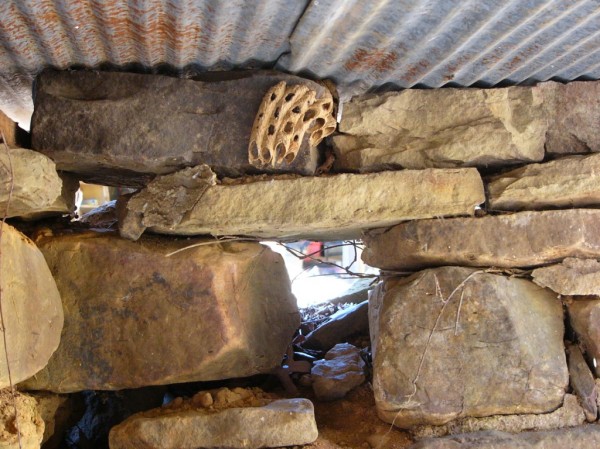
Here’s the inspiration photo from Madison Woods:

The following story is dedicated to friends who served in Vietnam. By the way, in the story I use a term which some may find offensive, but it is a historically accurate term used by U.S. soldiers in that war.

Reluctant Sojourn

I never liked working on the plumbing in an older house. The cellars and crawlspaces were damp; their fetid smell stirred memories best kept hidden. I needed this job, so I went in.

The day was cold. Fear made me sweat, and the corrugated ceiling put me back in the box where Charlie kept me during my reluctant sojourn in the Hanoi Hilton, the old one, not the Hanoi Hilton Opera there now, a real hotel.

I kept my eyes away from the air hole. If I looked, Charlie would be looking back, like he does in my dreams.

———

For more 100-word stories by Friday Fictioneers, go to Madison Woods’ blog and have a read.

Politics Wednesday–No KO, Again

Willard M. Romney was certain he’d score a knock-out on Super Tuesday yesterday, and, once again, he had to settle for a split decision. In the key primary–and national election–state of Ohio, Romney beat Rick Santorum by just one percentage point. Santorum won Tennessee and Oklahoma, Newt Gingrich won Georgia (not a surprise), and Romney’s hope to lock up the nomination so he can concentrate on President Obama was dashed. Yay!

Romney spun it well, but so did Santorum. And Gingrich again, as he did after Florida, gave what sounded like a victory speech–victory as in “I’m in Bizarro world where multiple third and fourth places mean I won.” Ron Paul, well, you didn’t hear a peep from him, but he’s still there, like the loony relative you don’t send invites for family functions, but he somehow finds out and shows up.

What the results show is that Romney, the pretend conservative, has difficulty winning in the deep south. His Florida and Virginia wins aside–he and Paul were the only Republicans on the ballot in the Old Dominion–Romney has trouble appealing to the voters who traditionally go for candidates to the right of Ivan the Terrible. This could mean the primary battle will extend through the spring and into the summer, if Santorum continues to do well in southern states. Gingrich and Paul show no sign of dropping out of the race any time soon, even though it’s coming down to a Romney/Santorum bout.

I initially thought, yes, let it be Santorum; Obama will cream him. Besides, there’s no way people will vote in Rick Santorum as President. Then, I remembered I felt the same way about George W. Bush, and America elected him. Twice. Granted, Santorum’s social, economic, and policy positions make W look like a, well, Massachusetts Moderate, but if the Republican base can get motivated and if progressives stay home in a huff, Santorum could… No, I won’t put it in print. Just thinking about it will give me dystopian nightmares.

Romney, I believe, will be the nominee, after a long, protracted process that will leave him emotionally spent, and the President will be fresh as a daisy. The polls look good for the President now, but it’s March. We’ve got eight months to go, and we can’t take a single thing for granted. As the Republicans disinter the rotting corpse of the War Against Women and flail its stink about, we need to remember that few Republicans with national presence denounced Rush Limbaugh’s odious words about Susan Fluke; we need to remember that Republicans brought up the Blunt Amendment, which would allow any employer to not cover any medical procedure or medication for any one for any reason. (That was defeated, thank goodness.)

I can’t list all the things we need to remember come Election Day in November, but as a progressive who has been disappointed by some of the President’s policies, I know he has my vote. The alternative is just too dark and reactionary to consider.

—————

One of my readers who thinks I’m an “ultra-feminist” (I am, but it doesn’t bother me.) can stop reading here, so his blood pressure doesn’t elevate.

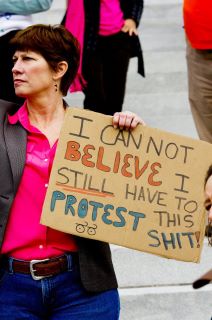
The shenanigans of the Virginia Legislature–personhood bills, trans-vaginal ultrasounds, etc.–have made national news. Our reactionary-laden legislature seems determined to return us to the 1950’s in terms of many things, chief of which is women’s right to decide what to do with their bodies. It’s something men do without thought–who to fuck, when to fuck, whether to use protection or not–and for some reason don’t want women to do. To protest the legislature’s actions, several hundred men and women held a silent protest this past Saturday at Virginia’s capitol building in Richmond. Several of them stood on the Capitol’s front steps. The governor claims he didn’t send in SWAT, but it’s obvious he did. The police arrested people who were doing nothing except sitting and standing, handcuffed them, and locked them in a bus for nine hours for something that is normally a ticketable offense. (Hello, America; wake up and smell the police state.)

Last weekend at the Richmond protest, there was one sign that said it all for me, that reflects my sense of deja vu, my feelings about having to fight–yet again–to make sure women have the same choices men do, and here it is:

Inspiration

The interview question a writer of any renown hates to hear is, “Where do you come up with your ideas?” or some variant thereof. That’s a process difficult to explain, so it’s easy to say, “From my family,” or “From life.” But those answers are a bit glib, perhaps disingenuous to someone who sincerely wants to know how you do it to enhance their craft.

Every writer has to answer that question–or not–from his or her own background. When I was getting some counseling after my father’s death, the therapist suggested journaling. Yes, I journal-ed before journaling was cool. She told me to, as one presenter at AWP advised, “vomit words on the page.” Many of those journal items became stories in my collection of short stories, Rarely Well-Behavedwhich was published in 2000. Other stories in the collection, however, just “came to me.” Yeah, that’s a technical term.

When I write short stories I’m a bit of a seat of the pants writer. I start with a picture, a word, or a snippet of conversation I’ve overheard and expand on it. I let it go wherever it wants, and sometimes that works. My short story “Trophies,” published in the February issue of eFiction Magazine started out as a writing exercise inspired by hand-fishing–from the fish’s point of view. Then it moved to a character with aspects of my brother and my father, and that character did something that a friend’s stepfather did years ago. In the end, the catching-fish-from-the-fish’s-POV got canned (a good thing), and the story got refined and published.

Sometimes the seat of the pants approach doesn’t work. Last year, I wrote a short piece about a tree that falls on a house, in response to a writing prompt from a magazine. The tree’s falling brought out pent-up emotions in a suburban community not unlike where I lived in Northern Virginia. Those hidden emotions boil over, and a slaughter occurs. I workshopped it and got some good feedback, then one person just went off on why I’d written such a “stupid mess.” I was going for quirky, psychological horror, but he excoriated the story, me, and why I’d ever thought I was a writer. Threw me for a loop, I’ll tell you. I haven’t been able to look at the story since, even though I thought it was a good piece of flash fiction. Who knows? Maybe I’ll overcome the clench in my stomach and have a second look at some point.

Almost every Friday, I write a 100-word story inspired by a photograph posted by Madison Woods, and since I’m a more visual person, I generally get more inspired by looking at something than by a word or a phrase. When I see the picture, the story plays out in my head, which is cool, but my mother used to think it was weird.

I’ve learned a lot about craft from the workshops I’ve attended at writing conferences, including the recent AWP conference, but I’ve also filed away conversations I overheard in Kitty O’Shea’s, physical descriptions of some of the unique people I observed, and a great talk I had with a cab driver on the way to O’Hare on Sunday. All fodder for the imagination.

Life, death, friends, family, your physical surroundings–all of them can have a story that needs to be told, so tell it.

What inspires you? Are you a story planner or a seat of the pants writer? Do you see the story in your head, or does it just come from the fingers on the keyboard?

AWP Day 3

As you read this, I’ll be making my way to O’Hare to head back to the Shenandoah Valley. I loved being in Chicago. It’s been a long time since work took me there for a two-week period, but I’d forgotten how much I love city skylines. Yesterday, we had low clouds and snow flurries, and it was cool to see the tops of skyscrapers disappear into the clouds. Lake Michigan was gray and chilly looking, but as much as I love my mountain view at home, Chicago is a beautiful city to gawk at.

I loved being around so many other writers–overhearing the bar conversations was a high point of my day. Writers talk about their characters as if they were real people, and I was glad to see that wasn’t eccentric. They talk about craft and rejections and where is the idea for their next book going to come from–all the things that I can relate to, and that’s comforting. But, let’s see how Day 3 went for me.

BTW, if you get to Chicago, go to Kitty O’Shea’s, an Irish pub in the Hilton on Michigan Ave. Great pub food, great beer, great Irish history decor. I had lunch there every day and wish I could transport it to the Valley.

“Connecting with Readers via Your Website and Social Media” appeared, on paper, to be a promising seminar for first thing Saturday morning. I’m not as self-conscious about technology or social media as many of my contemporaries. I was too much of a Trekkie for that. I built a computer in the early 1980’s and was on-line with CompuServe (remember that) at about the same time. Still, social media was something I initially regarded as being for “the young folks.” (Amazing how we reach the point where we sound like our grandmothers, isn’t it?)

I started using Facebook for the typical reason a white female over 50 does—to keep up with her grandchildren. Then, I moved to where they live, but I stayed with Facebook because I found that writers had Facebook pages, and I could pretend to be friends with them. I consider myself still a dabbler in both Facebook and Twitter, though I’m learning how to use each to better benefit for my writing life. I’ve blogged for a couple of years now, and I rather like “following” on Twitter some of my literary icons—Salman Rushdie, Margaret Atwood, Neil Gaiman, and so forth.

Since I’d like to be more than a dabbler in social media, I went to this seminar eager to pick up useful tips. And I did—from the last panelist. When a seminar on how to use social media starts with a panelist who tells you she turned down the offer twice before accepting, that she has a YouTube channel which she doesn’t update, that she doesn’t Tweet and doesn’t update her Facebook page, and has a website that she generally ignores until a book comes out, you begin to think it might be a waste of time. I’m leaving off the names of the panelists for a reason.

Indeed, several of the first few panelists confessed their fear of, distaste for, and dread of websites and social media. One said very little on the topic but used the opportunity to do a reading of a self-indulgent essay about seeing the wild ponies from Chincoteague—then alluding to the fact his walk along the poop-laden beach was in Maryland. (It’s Virginia.) His social media connection was that a Facebook follower had mentioned his work had taken on a depressing tone and that make him examine his work. Really? That was it?

The final panelist, whose time had been shortened by the others’ going over time and not understanding how to use the laptop provided to display websites on a screen, was the only one to give practical tips and suggestions:

  • Use only the social media you’re comfortable with; don’t try to do it all
  • What social media you do us should be a facet of your personality; just remember nothing you say is private
  • Use Facebook and Twitter as your water cooler if you work from home; they help to keep you from being insular
  • Recognize you might discouraged by posts and Tweets from other writers about their success; don’t be bitter or jealous but be fulsome with your congratulations–you never know the connection you might make
  • The more you give–compliments, praise, congratulations–the more you get from social media
  • Since it’s so easy to create a website, do it now! Even if you haven’t sold a book yet, do book reviews of others’ work, link to writing websites or writing contests or even other writers’ sites
  • If you love an author’s work, use social media to connect and tell him or her so
  • If you’re not comfortable with social media, make certain you approach publishers who will help you, not reject you because you don’t have a platform

Next year, he should do the whole panel, and that would improve its practicality. My first, small disappointment of the conference.

I’m avoiding the Book Fair today because I’ve no room left in the single suitcase I brought. As it is, United is likely to charge me an overweight fee for it in addition to its usual $25 rip-off, I mean, baggage fee.

Because a computer problem at my hotel kept me from printing out my boarding passes and the subsequent 20 minutes on the phone with United Airlines, all the afternoon sessions I wanted to attend were SRO, or sitting room only as well. I didn’t want to subject myself to that indignity, so another quiet afternoon writing, followed by packing to go home. Is it time for that already? I just got here. I’m having too much fun, and now I have to go home? As far as I’m concerned this could go on a few more days—or someone needs to invent that time machine so I can go back and attend all the seminars I wanted to attend in the same time block.

Yep, I’ll be in Boston next year for AWP13.

AWP Day 2

Because I exhausted myself on Day One of AWP, I decided to ease up on Day Two and spend a lot of time (and money) in the Book Fair. I did start the day with two seminars, on opposite ends of the literary spectrum.

“The Fiction Chapbook–A Sleeper Form Wakes” was nothing less than fascinating. For those of you who don’t know what a chapbook is but don’t want to Google it, it’s a small, self-contained book originally produced to fit in the pocket. They started out as the precursors to the printed, bound book we would recognize today, but as societies became more literate and wanted to show off that fact, novels became the rage. Chapbooks became a form of publishing poetry. My high school English teacher loved chapbooks, and when we had the poetry unit in American Literature, we had to make a chapbook of our poems. Since I’m not a poet, I probably tossed it away as soon as I got a grade on it. Silly me.

Chapbooks have now become a hot, new way to publish short fiction in limited runs. That makes them popular for for-profit presses as well as an excellent way to introduce an author to an audience. Chapbooks are especially ideal for flash fiction. The panelists–Nicole Louise Reid, Eric Lorberer, Diane Goettle, Kevin Sampsell, and Abigail Becket–are all publishers of chapbooks and are enthusiastic about this new direction in publishing. Their enthusiasm must have been contagious because I stopped by their tables in the Book Fair and bought four chapbooks: Field Guild to Writing Flash Fiction, edited by Tara L. Masih; Betty Superman, by Tiff Holland; I Take Back the Sponge Cake by Leon Erdrich and Sierra Nelson; and an anthology of chapbooks, They Could No Longer Contain Themselves by Elizabeth J. Colen, John Jodzio, Tim Jones-Velvington, Jean Lovelace, and Mary Miller. I’m looking forward to delving into them.

The next seminar I went to sounded right down my alley. I love apocalyptic writing. From Harlan Ellison to Margaret Atwood, I savor these stories of what would happen to us as humans were the unthinkable to happen. “Apocalypse Now: A Multi-Genre Reading of Apocalyptic Literature” featured two prose writers and two poets who have written about the end of the world. The poets were Brian Barker (The Black Ocean) and Judy Jordan (Hunger), and the prose writers were Pinckney Benedict (Miracle Boy and Other Stories) and Kevin Brockmeier (The Illumination).

I’m not known to collect poetry, unless it’s Seamus Heaney, but Barker’s reading, from The Black Ocean, of his poem, “Gorbachev’s Ubi Sunt from the Future That Will Soon Pass” was so dramatic, I went right to the Book Fair and bought it. The same with Miracle Boy by Benedict. And I got them both signed.

Jordan’s reading of a long poem about the time she was homeless was, she admitted, not technically apocalyptic, but the raw dread the poem evoked could have portrayed the end of the world. It was transportive. Brockmeier brought us the unusual concept that whatever has happened to the world makes our pain shine literally from us. He only read an excerpt, but it was easy to envision how the illumination could become too bright for us to look at.

The Book Fair could stand alone. I never knew there were so many literary magazines and specialty publishers, and, so, there are twelve new books to add to my already-laden shelves. But, where else could you find a fascinating book entitled, From Three Worlds: New Writing from Ukraine?

Then, my feet said, enough, and I retired to my hotel room to do exactly what this conference is all about–write.