Dr. Frankenstein, I Presume

Yesterday, I had a long talk about writing–its joys and frustrations–with another local writer friend of mine. She was talking about a character she created and a certain aspect of his life and how she didn’t set out to write him that way, that it was just “there.”

“He told you who he was,” I said. (No, I’m not usually that profound.)

I’ve had this conversation with other writers or heard or read other writers who say the same thing–a character you create somehow becomes his or her own entity and proceeds to tell you, “I’d really do it this way. No, no, no, I’d never say/do/believe/want that.” That character leads you down plot paths you never anticipated, but that’s the way it’s supposed to be. Merely, our constipated brains need the liberation provided by creating a fictional character who is our alter ego.

My main character–an Englishwoman who is a spy–gets to say things I’d never say, and I’m known for being outspoken. When your character can let loose with something society and propriety require you to keep quiet about, that alleviates a lot of pent-up frustration and keeps it from exploding at an inappropriate time. See, having your characters talk to you can be a good thing.

How do you know they’re speaking to you? When you’ve written something you think is the way you want the story to go, but then you’re pulled back to the keyboard and end up rewriting or revising or tossing out words until that story has set off in a different direction, and it’s for the good–that’s when your characters tapped you on the shoulder and said, “I think you need to reconsider.”

I struggled for a long time to find the ending for my trilogy about a domestic terrorism event, and it just didn’t come. Oh, the various attempts were good endings, but none of them was The Ending, the way the series was supposed to conclude. Then, the death of the person on whom one of the characters in the trilogy is based gave me that ending. It was as if the fictional character finally got through to me and said, “You’ve been avoiding the reality that this was the only way it could end.” And he was right.

We think we create our characters from whole cloth, but the truth is we take pieces–the good and the bad–from every person we’ve ever known or loved or disliked. We stitch them together and give them our own life-force, and they are as real to us as any flesh and blood person. They have to be. Otherwise, a reader would never be interested. They come from within us. They’re our “children.” We speak to other writers of them as if they were real and sitting around the table with us. We defend them and their actions to members of our critique groups/agents/editors. We think of them at odd times. We anticipate getting back to the story so we can see them again. We see something happen and know how our characters would react to it. They are our waking and sleeping companions, often our best friends and harshest writing critics. We are the ones who shout in triumph, as they rise from the laboratory tables in our minds, “It’s alive! It’s alive!”

How about it? Do your characters speak to you? If so, leave a comment and tell me about a time when they did.

———-

Writing Work Schedule Update:

Things are actually still going according to schedule, even with having had a nasty cold last week. On “Submission Friday” I send in two book reviews and two author interviews to a fiction magazine. This week, on the Editing/Revising days, I’ll concentrate on proofreading and finalizing the re-typed (and edited) manuscript of my collection of short stories, Rarely Well Behaved, which I’m re-releasing as an
e-book this spring–or earlier.

Two For One!

Aren’t you lucky? Today, you not only get a 100-word flash fiction, but, at no extra charge, you get a little writing lore as well.

Yeah, I wouldn’t do well writing for infomercials, would I?

Here’s today’s Friday Fictioneers inspirational photo:

And here’s a piece I call, “Winter Wonderland.”

I wasn’t sure if it were safe to go out yet, but the dog, cooped up for so many days, was insistent. I tried to keep him close, but dogs wander. Still, I understood. Cabin fever had grasped me, too.
The blanket of snow seemed muted beneath the still-gray sky but was so beautiful compared to the four walls where we’d hunkered down. There were no tracks except ours.
The dog bounded toward the road. I slogged after him, my cries loud in the still air, echoing off the trees.
You don’t go far from home in a nuclear winter.
———-
Yes, I’d gone a few days without any apocalyptic writing. 😉 Now, here’s your bonus–a brief discussion about a writing tool I can’t be without.
Even after teaching English, being a journalist and an editor, and writing since I was ten, there are certain aspects of English grammar where I still falter. Lie versus Lay. Which versus That. Those are my particular downfalls. I’ll write them one way, decide they’re wrong, write them the other way, then discover I was right the first time.
Who wants to go pull the dusty, old English Grammar Reference off the shelf? Not I. I use a small tome that has been on or near my myriad writing desks for the past forty years–The Elements of Style by William Strunk, Jr., and E.B. White, or as it’s colloquially called “Strunk and White.”
“Make every word tell,” was Cornell English professor William Strunk, Jr.’s advice to his students, one of whom was E. B. White, ofCharlotte’s Web fame. Strunk wrote the first The Elements of Style in 1918 and made it obligatory for his students. It wasn’t until after Strunk’s death that E.B. White, writing in The New Yorker, told the world about the “forty-three page summation of the case for cleanliness, accuracy, and brevity in the use of English.” White was asked to edit a re-issuance of the volume to bring it into modern usage. That was about sixty years ago, and this “little book,” as White called it, is still an indispensable aid to writers from high schoolers toiling over term papers to the rest of us who hope to be considered accomplished.
My well-thumbed copy, which helped me write features and editorials as a reporter and countless government reports, is still packed away with my work “stuff,” so I had to replace it with this fairly fresh copy (below). Strunk and White pares down the sometimes vague structures of English grammar to the basics of language usage and composition.
 
It has almost doubled in size from the forty-three page volume White extolled in The New Yorker and now has a glossary and an index. It’s original outline remains much the same as Strunk’s version from the early part of the previous century: Elementary Rules of Usage, Elementary Principles of Composition, A Few Matters of Form, Words and Expressions Commonly Misused (my personal favorite), and An Approach to Style. (I love the perfection of those section titles.)
Strunk and White is great for writers who hate grammar–notice they don’t use the word–because it has condensed the whole, arcane grammatical schema into a pocket-sized reference. You could call it “Style Basics” and be accurate, but “The Elements of Style” is just, well, stylish.
My new copy cost me ten dollars in a book store, but consider it an investment. Big box and independent book stores will order you a copy upon request. You can get a used copy from Amazon for as little as seven dollars or from free to $2.99 in the Kindle Store–though the Kindle version is the original Strunk work. Go for the Strunk and White version. If you’re a Nook person, the price and the version is the same. A used copy from Barnes and Noble can be as low as three dollars.
Considering the state of some of the indie published books I’ve been reading to review, every person who calls him- or herself a writer should own one of these and use it. Then, you won’t be disingenuous when you call yourself an author.
I have no financial interest in The Elements of Style or with its publishers. It’s just a darned good writing book.

Politics Wednesday

It was coincidence that my writing work plan sets Wednesday as politics blogging day, and the first such blog of 2012 comes the morning after the Iowa Caucuses. Coincidental but serendipitous. That throwback to the days of smoke-filled rooms, the caucus, left plenty to talk about.

First, Willard M. Romney got a win he can’t really puff his chest up about, and he appeared to be somewhat muted on the Wednesday morning gabfests. I believe that eight-vote margin is one of the smallest in election history, especially for a national office. The other bad news Romney has to take away from this is that, after essentially four years of campaigning, he won the same percentage of Iowa Caucus votes as he did in 2008. On paper, it’s a victory, but it must leave the taste of ash in Romney’s mouth.

Though he came in second, Rick Santorum is the real winner. He did in a few weeks what Romney took four years to accomplish–get twenty-five percent of the votes. A month ago, Santorum was in the low double digits, and he gained a lot of ground and even led by more than 100 votes on occasion throughout the evening. Of course, he gained that ground by appealing to the basest instincts of the white voter–by fronting that stereotype that black people don’t want to work and by doing his best imitation of Tim Tebow without bending a knee.

Ron Paul. What more can be said about him? He wants you to have the right to drink raw milk if you want. I grew up on a farm. I’ve drunk raw milk, and, Mr. Paul, you don’t want to know the crap (literally) that’s in raw milk. Paul wants to withdraw within our borders, have no foreign entanglements, and let everyone within those borders fend for themselves. He’s no fan of Lincoln because Lincoln got us into an unnecessary war. WTF? I say that a lot about Ron Paul. Yes, he’s grandfatherly. Yes, he sounds like the eccentric uncle who only comes to visit on holidays and upsets everyone, but one-fifth of the Iowa voters like his vision for America. And that’s scary.

And, can you imagine, Newt Gingrich got relegated to a somewhat distant fourth place? How dare they? How dare they ignore someone of his self-declared intellect? But you just wait. He’s not going negative. He’s just going to tell the truth. (Cheers and applause) His truth, of course, which is somewhat detached from our everyday reality. As a former federal employee, I remember Newt’s fit of pique when he and other members of Congress had to exit Air Force One from the rear stairs–he shut the government down because President Clinton wouldn’t acknowledge Gingrich’s odd notion he was the co-President, not Hillary. His suck-up to Santorum and his “watch out, I’m coming to get you” riff to Romney was pure, nasty Newt.

The Village of Texas is getting its other idiot back. How nice for them. It’s hard to believe there is actually a Texas politician who can make W look like a Rhodes Scholar, but, good old Rick, he proved there was. Perry brought nothing original to this campaign, and it serves no point to waste any more blog space on him.

I wonder how Michelle Bachmann feels this morning after all that praying for a miracle from the entity she knows makes miracles. I guess she didn’t pray hard enough because the miracle didn’t happen. She essentially came in dead last, since Huntsman, Cain, Roehmer, and “No Preference” together garnered less than one percent of the votes, and none of them campaigned in Iowa. As of this writing, she has canceled her trip to South Carolina for that upcoming primary and will hold a press conference later today. At least I won’t have to listen to her carping about being disrespected because she was a woman. The hypocrisy of someone who has done all she could to reverse or disdain the accomplishments of the women’s movement who then uses sexism as an excuse for her personal shortcomings just astounds me. I hope she’s back in Minnesota for good.

The real winner in my opinion–and others more knowledgeable than I agree–is, ultimately, President Obama. Many people think Romney is the “most electable” Republican choice when paired against the President. I think the square jaw and the whitener-enhanced smile only go so far, especially for someone whose profession was to shut down companies and move jobs overseas, for which he received tremendous remuneration. When it comes down to the person who represents my values, it’s President Obama. Mind you, I’d like to have a talk with him about a few things, but the hope and the change still do it for me.

Here’s the most telling thing. If you haven’t noticed, none of the candidates refer to the President by his title–it’s Obama or Barack Obama. Now, trust me, I had trouble uttering the words “President” and “Bush” together, but I always tried to say “The President.” (Or President Shrub when I was really pissed.) This refusal to acknowledge the President’s status is indicative of a privileged (because they’re white) section of society–they just can’t wrap their heads around the reality of someone in the White House who is not white.

What I took away from the Iowa spectacle was a post-caucus interview with a white man in his fifties. When asked why he voted for Romney, he said, “He’s the best one to beat [slight hesitation and the beginning of a sneer] Mister Obama.”

That says it all. Unfortunately.

———–
Writing Work Schedule update:

Monday afternoon:

  • Edited the review for Linkage: The Narrows of Time Series (Volume 1) and sent interview questions to the author
  • Drafted a review of Loki and Sigyn: A Love Story
Tuesday:
  • Morning: edited a short story called “The Drink” and sent it to an on-line critique group I’m in (got very constructive comments so far)
  • Afternoon: pulled out my 2009 NaNoWriMo manuscript and reviewed it to see if, with a few name changes, it could be a good candidate for a Kindle Publication
Wednesday:
  • Morning: Blog on politics (see above)
  • To do for the afternoon: work on editing/revising a novel (depends on how tired and sore I am from coughing)

Set That First Draft Aside

I’ve been doing a lot of reading of indie published books lately (or, if you’re a stickler for terminology, self-published books, but terminology adapts, by the way). I have a list of eight of them I’m going to review, and, unfortunately, it’s been a mixed bag of quality. Oh, the stories have been decent; getting to the story through the morass of bad grammar and punctuation has been the hard part. Part of the problem is I’ve been both an English teacher and a magazine editor. What, to some apparently, may be unimportant details, to me are essentials of language. If those fine details–commas, word usage, grammar–aren’t present, I get distracted–and frustrated–by what I consider elementary school-level errors.

It’s too easy to attribute this to lack of education, but the authors involved–on their blogs or on social media–seem to have had a decent education. Then, it hit me, as I was helping a friend with a manuscript, these works read as if the authors had published their first drafts.

That’s the seduction of indie publishing. It is very empowering, on one level, to eliminate all those filters (agents, editors) who don’t get your fiction, who don’t see you as a money-maker, who have to take a cut of your royalties, etc. I believe publishing is evolving, but for indie publishing to get any sort of professional acknowledgement from traditionally published authors, you can’t publish your first draft.

First drafts, of course, are necessary. First drafts are the place where you finally get on the page that story that’s been rattling around in your head for a long time. It is an accomplishment in and of itself to do that–one of the reasons I like National Novel Writing Month. I can come up with something completely new at least once a year. Have I published any of the manuscripts I wrote the past four Novembers? No. They’re first drafts of what will be good works later. After proofreading and editing. When I finish a NaNoWriMo project, I set that draft aside for a good six months or more before I pick it up again. In the meantime, it’s never far from my thoughts, but I’d never, ever see the holes in the plot or the un-obvious typos if I started the edit immediately after finishing the first draft.

Whether you’re pursuing traditional publishing or indie publishing, the process is to set the first draft aside for the amount of time it takes to make it fresh when you look at it again. When you publish your first draft and start seeing those five stars on Amazon (which your mother and all her friends have put there) and read the comments like, “We need more of [insert character name here]!” resist the temptation to write a sequel in a weekend and publish it raw.

Cultivate a friendship with a local high school English teacher or newspaper editor or even a friend from school you know got good grades in English. Let them proofread your work for the typos, punctuation problems, grammar, etc. You can accomplish some of this yourself by reading your work out loud–at home, preferably, unless you like people at Starbucks staring at you and wondering if they should call the cops. (In reading this post aloud, to this point I’ve found a half dozen typos, now fixed.) But nothing beats a “fresh” set of eyes.

Then–and this has been something hard for a lot of indie authors to accept–hire a developmental editor. Yes, you get a higher percentage of royalties if you self-publish without all that traditional publishing detritus, but you’ll get better reviews and more sales if a reader/reviewer can’t tell the difference between your book and a traditionally published one. That takes work. That takes commitment not just to telling a good story but presenting a good story.

I have an indie writer friend who consistently produces a good first draft–in the sense of proper punctuation, grammar, and usage–and the story is decent as well. Recently, she sent a copy of her first draft of a new novel to her editor, and now she’s in the midst of a total rewrite. You may say, “See, that’s what’s wrong with editors, and that’s why I don’t want one.” However, this writer understands the editor’s purpose–to make it better–and she’s excited about the major revision because she knows she’ll have something beyond a good, first draft. She’ll have an outstanding novel.

So, set that first draft aside for a while. Resist the temptation to publish it until it’s polished. Get a tougher skin when your proofreader/editor suggests changes (being part of a critique group helps with this). Don’t be suckered in by seeing your words in print until what you’re trying to say is in its best shape.

Be a writer, not a hack.

————
I set out my writerly resolutions for the new year in a recent post: http://mymusings-maggie.blogspot.com/2011/12/resolved-to-write.html. So, periodically, I’ll provide an update because I know you’re just dying to know.

Writer Work Schedule Update:

  • Sunday: Started reading one book to review (which inspired this post) and finished another
  • Monday morning: Blogged on writing (see above)
  • To do Monday afternoon: Edit/Revise a review of Linkage: The Narrows of Time Series (Volume 1) by Jay J. Falconer and get it ready for submission to eFiction Magazine

Post-Holiday Friday Flash Fiction

The Friday Fictioneers took Christmas off, and the break was obviously inspirational for our Flash Fiction guru, Madison Woods. She found an amazing photo to spark our 100-word flash fiction. Here it is:

And here’s my exactly 100-word story–with the bonus that it features one of my regular characters and the espionage organization she works for.
“Fly on the Wall”
Mai Fisher had always been dubious when The Directorate’s R&D Department wanted to show her some new spy gadget. The Subcutaneous Personal Tracking Module, which made her feel like a tagged dog, was the one that had damped her enthusiasm.
The tech held the “Fly on a Wall” on his finger for her to see, his broad smile fading as she gave him the skeptical, raised eyebrow.
“Nanotechnology?” she asked.
“Yes. Cutting edge,” he replied.
“You know, every piece of sci-fi I’ve ever read says nanites are going to take over.”
“That would never… Ouch!”
“What?”
“It bit me!”

Story Review – “Final Statements”

“Final Statements” by A. J. O’Connell (Independent Ink Magazine, December 20, 2011, 2,286 words) is something of a psychological study. A late-thirties divorcee has moved back in with her mother–no surprise there–but the daughter, Roxanne, has a fascination with a Web site that lists the final words of executed criminals.

Roxanne has taken over her slovenly mother’s house and begun renovating it without her mother’s permission. The only off-limits place is the door to the basement, the site of her long-dead father’s workshop, which Roxanne’s mother still forbids her access.

At first, it’s easy to see Roxanne’s mother’s concern–her adult daughter makes a ritual of reading the words of executed murderers when the Web page gets updated every month. Roxanne curls up on the couch, a pint of Ben and Jerry’s in hand, laptop open, and don’t you dare disturb her. She studies the executed man’s picture and rolls the last words over and over in her mind, noting that the ultimate words are usually, “I’m ready.” Her mother sits at the dining room table playing Solitaire the old fashioned way, with a deck of cards, and tosses barbs over her shoulder about her daughter’s odd obsession. By that point in the story, you begin to wonder just what Roxanne’s issue is with the dying words of the executed.

Then you find out, and I’ll never hear the phrase “the apple doesn’t fall far from the tree” the same way, ever again.

This is a short, tight story with a good twist at the end–very Hitchcock-esque–and I recommend it.

Book Review – WEIMAR VIBES

In his novel Weimar Vibes (228 pp, $0.99 from Amazon) Phil Rowan has written a topical story about a frightening near-future that we, here across the Pond, see reflected in the campaign slogans of politicians who have misappropriated the term “Tea Party.” In the England of Weimar Vibes, rising unemployment and falling economies turn many people away from the usual political parties toward someone who can restore order, address moral failings, and make Britain great again. Sound familiar? It should. Rowan, who knows his history, reflects Weimar Germany in his title on purpose.
Into this power gap comes a neo-Nazi named Oskar Kerner, who exploits peoples’ fears and innate biases. Again, sound familiar? His followers call him “Der Fuhrer,” and instead of being repulsed by his skinhead acolytes, the average Briton begins to think order of any kind may be acceptable.
Kerner’s following in the U.K. piques the interest of the Home Office, who seek some way to discredit him. To do this, they recruit, improbably, a near-alcoholic, down-on-his-luck journalist named Rudi Flynn.
Drink and a failed marriage (his ex-wife is in a mental institution in Alabama) have wrecked Flynn’s career, and the only place he can find employment is on a Murdoch-like tabloid. The Home Office convince him to pretend to espouse Kerner’s beliefs (Flynn and Kerner were college classmates), get into Kerner’s organization, then discredit him. This is the stuff of many an espionage novel, and, since that’s what I write, I was eager to read Weimar Vibes.
However, rather than using Flynn to discredit Kerner, the Home Office people decide Flynn can be a more moderate alternative to Kerner. They begin to dictate his articles, script his appearances on talk shows, write his speeches, and develop his PowerPoint presentations. What doesn’t come across well is why Flynn, who has liberal leanings, agrees to act the part of a reactionary. None of the typical counterintelligence reasons are there—money, blackmail, a cleared criminal record, family held hostage, etc. The only possible reason is that Flynn’s motivation is patriotic, but Flynn’s behavior doesn’t convince me of that.
As a result of the Home Office’s manipulation of him, misadventure follows Flynn everywhere. His house gets fire-bombed. He’s blown-up, but survives, during an appearance on British TV where a trio of lefties do nothing but call him a Nazi. Indeed, the extreme right wingers come across in Weimar Vibes as having more depth than the leftists, who, in Rowan’s tale, are no more than name-calling, establishment toadies.
Flynn also elicits the worst from women—they either seduce him or attack him, sometimes both, which makes the women characters in this story shallow. It seems Flynn believes women universally use false rape charges against men they disagree with. Flynn fears this from almost every woman of opposing views he encounters, and the one woman who articulates the false charge, he did assault, though not sexually, by shoving her head in a toilet. Yet, somehow, we’re supposed to believe her actions were worse than Flynn’s.
Though he claims to still love his mental-case ex, Flynn is in love with a friend’s wife. That doesn’t stop him from having anger sex with a house guest or fantasizing about then sleeping with his Home Office handler. When Flynn finally consummates his lust for his friend’s wife, the language is that of an adolescent male: “I’m on the carpet and Julia’s smiling down at me. [sic] Her glorious breasts descend like archangels from paradise.” Yeah, had to read that a couple of times to make sure that’s what it said.
Up to the point of Flynn’s recruitment and infiltration of Kerner’s inner circle, I found this a mis-punctuated but believable story. Then, all of a sudden, Flynn is in demand, advising Prime Ministers and Presidents. That was too much of a leap. Then, there were a couple of other things that didn’t sit well with me.
For example, Flynn’s therapist is named McVeigh. An American audience won’t be able to accept a therapist whose name is the same as the worst American domestic terrorist in history. I flinched every time I read the name. Also, after the bomb attack at the British TV studio, Flynn is guarded by a “cop with an AK-47.” I wondered about that choice of weapon by the British police, so I Googled “weapons used by the British police.” They prefer H&K carbines and automatic rifles (as do many American and European police forces). All right, I’ll concede, perhaps, Home Office had hired a “security consultant” whose weapon of choice was an AK-47 or Flynn didn’t know a Kalashnikov from a Heckler and Koch. But still.
Rowan wrote Weimar Vibes in first person present, which I find hard to sustain (as a writer or reader) through a novel-length work. Rowan mixes his tenses on occasion, and Flynn’s point of view sometimes becomes too omniscient—especially where women’s lustful thoughts about him are concerned. Also, at times you just can’t tell whether Flynn is thinking or speaking, since Rowan frequently misses an open or close quote.
I eventually got over the missing Oxford commas (aka Harvard commas, aka serial commas) in Weimar Vibesbecause Rowan is British. Oddly enough, the Oxford comma isn’t standard usage in the U.K. However, a comma before the “and” connecting two, independent clauses is. Mr. Rowan leaves that out, also, as he does the periods after Mr. and Mrs. or quotation marks on numerous occasions. Then, there were the single ‘quotes’ instead of the proper double “quotes” around dialogue. For a former editor, such things detract from the appreciation of the story.
All of which is too bad, because Weimar Vibes is, as I said, a story that can serve as a warning to those who think the extreme right wing anywhere has a point. An editor or, at the least, a copyeditor would have made this good story a great one. Rowan’s writing is very visual, and he can incorporate or extrapolate both history and current events into his story seamlessly. His just-in-the-future Britain was spot-on reminiscent of Weimar Germany, and the parallel continues throughout the novel to the very end.
Yet, as England is crumbling around him, Flynn has dinner with his lover Julia, and they talk about whether to go to the Caribbean or India. I wanted to like Rudi Flynn, but, after a while, I couldn’t sympathize with him. Whether it was his narrow-minded view of women or his inability to stand up to his capricious Home Office handlers, I don’t know. I felt he—and Rowan—had something important to say, but I grew tired of supplying the proper punctuation in my head.
Some indie authors think a good story will shine through bad grammar or lack of proper punctuation, but that’s a pipe dream. Even if you’re not a former editor, a reader wants a packaged story—both well-written andaesthetically pleasing. If indie authors want to have their work appreciated by a mainstream audience, then that work has to be in a state where the audience can’t tell whether it was indie or traditionally published.
So, if lack of punctuation or “loosing their jobs” doesn’t bother you (but I hope they do), you’ll probably findWeimar Vibes a less frustrating read than I did.

Whither to Write?

In the tiny townhouse in Northern Virginia where I lived before I retired, for years I was tethered to a single place to write–an upstairs “bedroom,” which I declared my office, with a chunky, Dell desktop. I think prisoners in SuperMax have a bigger cell than that 10′ x 10′ space, but, boy, was I productive there. With my stereo blasting whatever music I was into at the time, I wrote a trilogy and the somewhat fleshed-out skeletons of three more novels.

When I purchased a laptop, I became rather bohemian–at least what passed for that in the Yuppie Capital of the Free World–and could write in book-store cafes (loved Olssen’s in Old Town) and coffee shops, not to mention any room in the house, on the road for work, on vacation, etc. Re the latter: It helps to have a supportive partner, and I did. He got that I needed space to write and didn’t begrudge it.

I’m happy to say I can write almost anywhere, whether using a laptop, a Moleskine reporter’s notepad, or a spiral notebook. Sometimes a notebook is good, especially when you’re people-watching to get ideas for characters. You could be writing a grocery list and no one knows you’re jotting down what’s being said or how someone acts.

There comes a time, though, in any writer’s life where you need to focus on a particular writing project to the exclusion of all else. When that time comes for me, it can’t be in a coffee shop or working in the gift shop at the R. R. Smith Center in Staunton. I have to be in seclusion. On the Myers-Briggs scale, I’m a very high (as in off-the-scale) E, meaning I’m energized most and best by external stimulus. When I need to focus on a writing project, the latent I, meaning I prefer to do a Greta Garbo, emerges.

I’m lucky in the house I bought after retirement to have a primary and a secondary writing area, which I use alternately depending on how strong the “I” becomes.

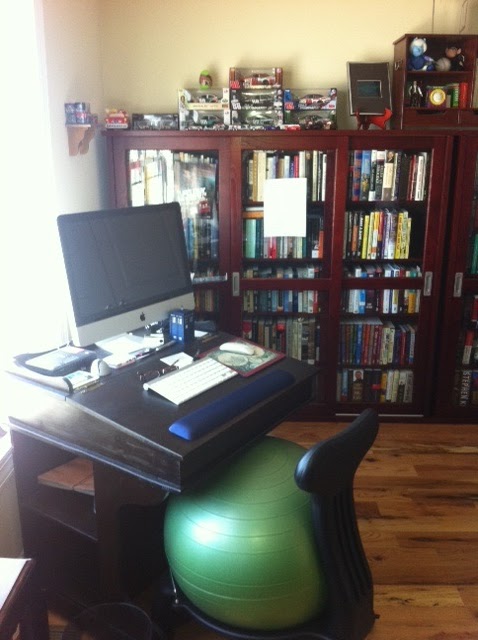
The primary area is my home office, which you can see here (above):

It has a lot of advantages–actually, it has the most advantages. You see my bookcase of reference books (U.S. history, world history, writing), which are at hand. (And, yes, you see the odd juxtapositions in my life: my NASCAR collection next to my Star Trek collectibles.) It has my really powerful iMac and my comfy ergonomic chair. Just to the left, out of the picture, is my satellite radio, which can bring me a constant stream of inspirational music. That, too, can be an interesting and eclectic mix–from heavy metal (Rob Zombie and Nine Inch Nails) to Celtic (Irish Rovers and Tommy Makem) to opera.

As many advantages as this wonderful room has, it has a major distraction–this amazing view of the Blue Ridge Mountains (below). And, yes, I took the shot through the window for verisimilitude. I can be in the middle of something and glance out the window and get completely lost in the wonderful place where I chose to live.

Curtains, you suggest? Uh, why would I cover that up? The tiny office in the old townhouse looked out onto the parking area in the cul-de-sac, so that was rarely a distraction. The view above can figuratively or literally pull me out of my chair to go outside.

Which can be good for clearing the cobwebs with a nice walk, but it happens too often.

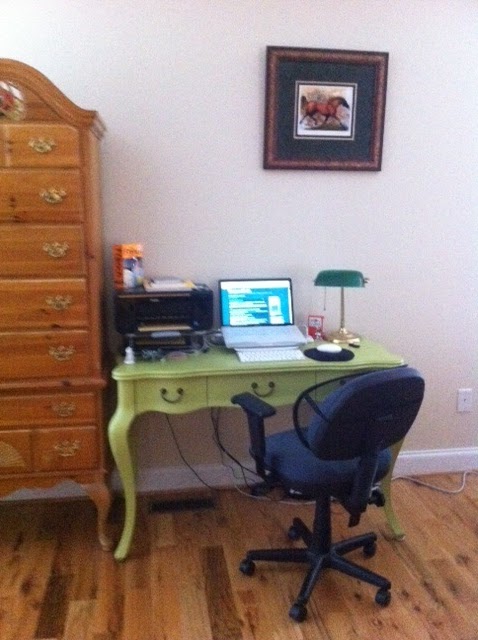
On many occasions, then, I retire to my secondary writing area, well away from any commanding views.

This area (above) is a nook in my bedroom, where I can’t be distracted by the outdoors. The view is the wall, or the nice artwork above, but that’s hardly as alluring as the Blue Ridge Mountains. There is a television in that room, but my back is to it, and it has a decent selection of music channels. I have to have some background noise–always have, much to the consternation of parents who couldn’t understand that homework could be done while singing along with the Beatles.

The disadvantage of this writing area is that if I need something from one of the reference books, that means a trek across the house (oh, horrors) to obtain it. Of course, there’s always The Google. (What toys were popular among pre-teens in 1989? Why, I’ll Google it.)

Wow, what a dilemma, you say, voice torqued by sarcasm. I know. But the secondary writing area, where I am, as I write this, is the least distracting. I often end up here, like a troglodyte in a dim cave, but the productivity is welcome.

Keeping track of versions of the same work on two computers? That’s a whole, other issue.

In the meantime, find your writing place, the one where you’re most productive, where the words come unbidden, and live there.

(Note: I used my two favorite words ever in this post. Can you find them?)

My Book Review List

Last week I guest-posted on Madison Woods’ blog about reviewing books, as in, I would like to review more. Three people contacted me right away, and I’ve purchased their books to review.

As other writers follow me on Twitter, I’ve identified several of their works I’d like to read and review. Then, a high school friend of mine pops up on Facebook with a link to her series of books, and I decided I wanted to read and review that as well.

So, I’ve managed to commit myself to review seven books by mid-February. What was I thinking?

However, just the other day, I blogged about establishing a writing/reading schedule for myself in the new year, and I hope that structure will help me keep my promises.

And, in the order I’m supposed to read them, here are the seven books:

Weimar Vibes by Phil Rowan, a thriller (love the thrillers)
Linkage: The Narrows of Time Series, by Jay J. Falconer, sci-fi (love the sci-fi)
The Lucky Boy by Caroline Gerardo, literary fiction
Admissions by Michael Ribisi, a romance (not so into the romance genre, but this intrigued me because it’s a romance written by a man)
Loki and Sigyn: A Love Story, by J.L. Butler, fantasy (again, not a big fantasy fan, but if it’s unique, I’ll give it a try)
Red Mojo Mama by Kathy Lynn Hall (a mashed genre of romance, thriller, and paranormal)
Scorpio Rising by Monique Domovitch, a romance

Some of these–I’m not sure which yet–I’ll review and submit the review to eFiction Magazine, which publishes indie fiction and likes book reviews of indie-published books (or self-published books, if you prefer; to me, six of one, half dozen of another). Others I’ll review in my blog on a separate page.

Yes, I’ve always been an over-achiever, or, better put, a take-on-more-than-I-can-chew achiever.

Wish me luck.

Versatile Blogger Award

Madison Woods, whose blog for me is a must-read, nominated my blog for the Versatile Blogger Award. This was delightful and surprising, and I’m grateful.

What’s the award, you ask? Well, the award is being nominated by a fellow blogger. Once you’re nominated, you pay it forward by nominating fifteen more bloggers–ones who entertain or support you. When you’re nominated, you do the following:

Nominate fifteen fellow bloggers.
Inform the bloggers of their nomination.
Share seven random things about yourself.
Thank the blogger who nominated you.
Add the Versatile Blogger Award logo to your blog post.

I think I’ll go from the bottom up.

Here’s the logo (above).

Thank you, Madison!

Seven random things about me–ack, I hate these, but here goes. 1. I’m a knee-jerk, bleeding-heart, foaming-mouth liberal. What? You didn’t know that? 2. Even six and a half years later, I still struggle with being single. 3. I’m hopelessly, ridiculously in love with Brandon, Ollie, and Emory, my grandkids. 4. I drive a Mercedes E320 with the license plate “SPYWRTR.” 5. I love airplanes. They’re the one thing that’ll stop me in my tracks to watch until I can’t see them anymore. It’s been that way since I was four. 6. I live in the best small city in Virginia. 7. If I couldn’t write, there’d just be no point to existence.

You’ll just have to trust me that I’ll notify everyone of their nominations.

And, last, but not least, here are the fifteen bloggers who entertain, inspire, and encourage me, in no particular order of preference–this is how they show up in my Bookmarks list:

1. Perpetual Folly
2. Welcome to Exeter
3. Lindsay’s List
4. Transition Voice
5. Addicting Info
6. Left Leaning Liberal Lady
7. Melissa’s Life–Answering to 42
8. Women’s Literary Cafe
9. Arthur Dobrin’s Weblog
10. Legal Lacuna
11. The Weird, the Wild, and the Wicked
12. Thoughts Over Coffee
13. Six Sentences
14. Michael Moore
15. Madison Woods

I hope you’ll take a look at each and follow them. You’ll be inspired, entertained, and encouraged.