Learning to Be “Write-Brained”

I posted recently in an on-line writers forum about a class I was taking on how to get published. Someone commented, “Honey, one of these days you need to stop taking classes and just write.”

Well, duh. Except that I can do both at the same time. (And, by the way, a month after finishing that class, one of my short stories got published.)

You can continue to sharpen your writing by writing, but it sometimes helps to get refreshers along the way. I was an editor for eleven years, but I took a grammar or copyediting refresher every couple of years just to sharpen my skills.

So, when I saw The Write-Brained Network’s information on “A One-Stop Workshop for the Serious Writer: A Roadmap from “How-To” through “I Did!” I couldn’t resist. Add in the fact that it was twenty minutes away in my old college town, how could I not go? The deal-sealer was one of my favorite authors, David Robbins, on the bill. His War of the Rats, about the siege of Stalingrad, was so historically accurate and vivid, you felt as if you were there. The End of the War, told from the Russian soldier’s point of view as the Red Army entered Berlin in 1945, was particularly meaningful to me because my Dad was in on that from the American side.

The workshop began with tips on redlining your writing given by Robbins. He’s a very engaging speaker, and the redlining tips he gave are what we’ve heard before but need to remember—watch your POV, “Show, Don’t Tell,” don’t use redundancies, cut the modifiers, etc. He provided his unique perspective, however, and gave specific examples to bring the points home. When he said, “Write what you know is a lie,” he had me. The story and the telling of it, Robbins emphasized, are separate. You can take a great story in your head then ruin it by the poor telling. I think he should have stopped there because he went on to diss several contemporary writers, some in his genre. I think that’s called “biting the hand…” I mean, perhaps at his next conference, David Baldacci or Dan Brown will point out what he dislikes about David Robbins’ writing. Just sayin’.

The next session made me glad I hadn’t sent in a first page to be critiqued. When I saw that offered, I figured you’d send in a page and you’d get it back marked up. Oh, no. The page got read aloud, followed by an instant critique by Robbins and Tiffany Trent, who writes young adult fiction. Granted, the writer’s name wasn’t read aloud, but you could tell by the squirming when someone was on the grill. Critiquing is always a helpful exercise, but I think this could have been improved by separating the first pages by genre, then having someone familiar with the genre provide the critique. A colleague with me at the workshop was braver than I and submitted a first page. This author, who’s sold two books, writes in a genre where the reader expects flowery words and setting a sense of place and time before delving into the story. Of course, the two panelists skewered it, but neither was familiar with the genre. I also think this would have been better one-on-one, rather than in public. Yes, yes, I know others can learn from a colleague’s critique, but the whole exercise left me queasy.

“Getting Noticed, Getting Paid: How to Build a Platform and Freelance Your Way to an Audience,” was a panel consisting of a writer friend of mine, Cliff Garstang, and Bridgid Gallagher, a freelance and young adult writer, who has a web site, Inky Fresh Press, for new writers to learn the business. Both Garstang and Gallagher emphasized the importance of social media in developing your brand and in increasing your sales. Garstang in particular emphasized the importance of separating personal social media and the social media platform for your work. This was a very meaningful panel—showing how Facebook and Twitter friends who aren’t writers can still help in publicizing your work by mentioning it to their followers. Very practical and down to earth.

After lunch we had a “Query Clinic.” Similar to the first page critiques in the morning, you sent in a query letter, which was again read aloud and publically critiqued by two literary agents, Dawn Dowdle of the Blue Ridge Literary Agency and Lauren MacLeod of Strothman Agency. Again, I think this was an exercise better done one-on-one. However, both this and the first page critiques show that getting published and/or getting an agent to represent you is highly subjective. In particular, trying to find the right agent using a reference list is almost impossible. You have to click, as was proved in a later session.

Two authors—Trent and David Kazzie—and two agents—Dowdle and MacLeod—were the panelists for “Traditional Publishing, Self-Publishing, and E-Publishing.” Kazzie self-published an e-book at the same time he got an agent for a traditionally published work. The consensus of this group was a resounding “no” to self-publishing. The exception was Kazzie, who emphasized, quite rightly, that if you are going to self-publish, you need to adapt some of the aspects of traditional publishing—a copy editor, an editor, a good graphics designer. When one of the panelists said, “I don’t really know much about self-publishing,” but then went on to pontificate against it, I wondered why that person was on the panel to begin with. One of the things not covered was the difference between self-publishing and e-publishing, which most of the panel considered the same. Stephen King has e-published—meaning his work is available for reading on a Kindle or a Nook—but that’s different from self-publishing.

The final panel was MacLeod and Jodi Meadows, one of McLeod’s newest clients, talking about the Author/Agent Relationship. This was an excellent panel, demonstrating just how important it is to have the proper representation. MacLeod and Meadows obviously clicked and just as obviously like each other. MacLeod is enthusiastic about Meadows’ work, and they seem to have the perfect agent/author relationship. That alone gives hope and a better understanding of the process of acquiring the right representation.

With the exception of Robbins and Garstang, most of the talent (on the stage or in the audience) at this workshop was from the YA genre. I have nothing against YA, and I know my path is not that way; but a better mixture from other genres would have made an excellent workshop perfect.

I know I may seem critical of some of the elements of this workshop, but I’m, at least, constructive. Overall, it was money and time well-spent. I love being around other writers, people who understand just what it is to be a writer. The Write-Brained Network understands as well and provided a top-notch workshop with a lot to absorb in a day. Kudos to Write-Brained Network Coordinator Ricki Schultz and her team for a worthwhile day.

September 11, 2001

My first attempt to acknowledge this significant anniversary of an horrific event was far too self-indulgent to post. However, the emotions I had suppressed from September 11, 2001, began to come to the fore in the past two weeks. I wrote them down and will deal with them. Just not here. That would trivialize the deaths of thousands.

The closest I was to anything that happened on 9/11/01 was three miles–the Pentagon was just across the Potomac River from Washington, DC, where I worked for the Federal Aviation Administration. My actions that day and in the weeks after were those of support, and perhaps later I can tell that story.

People often remark that 9/11/01 was such a beautiful day–bright, sunny, cloudless–and that something so horrible shouldn’t have happened on such a glorious day. The fact is, the hijackers kept an eye on the weather; the horrible terror they perpetrated was easier on a visual flight rules day. How might things have changed had that day dawned cloudy and dreary.

The scenario the terrorists opted for could have cost tens of thousands of lives, and some have sighed in relief that it was only 3,000 or so. That is survivor guilt, that is the expostulation of someone relieved they were no where near New York City, Arlington, VA, or Shanksville, PA, that day.

I know the emotion of ten years without a loved one, and it heals; it gets better; but the hole never closes. I was an adult when I lost my parents nearly thirty years ago, so I can’t relate to losing a parent when you’re ten or fifteen or two. The lost opportunities to see school plays, sports events, weddings, births of grandchildren are weights hard to bear.

I hated the fact that religious zealots used as an instrument of destruction the industry I’d given most of my life to preserve, and yet, as I reviewed the pilot records for each of the hijackers, I saw typical men who trained typically as pilots. Nothing jumped off the page to shout “Terrorist!” Life is never that simple.

“Why?” is the question still asked about 9/11/01. As with other acts of terrorism, like, say 4/19/95, we take the easy, un-intellectual route–the perpetrators were evil. We never look beyond, into the black box of the psyche of terrorism so we can stop the next 9/11/01. We react. Restricting the carriage of liquids on board an aircraft, taking your shoes off at the TSA checkpoint, getting groped by perfect strangers doesn’t really prevent anything. It’s a false security. To me it’s a bitter reminder that we gave up freedoms to feel safe. Not be safe. Just to feel as if we are protected. We never once, as a nation, as a government, stopped to reflect on which of our policies or actions contributed to this.

You see, terrorism doesn’t happen in a vacuum. We like the neat package of “Oh, they were evil! That’s why they did it.” We know how and who and where. We’ll never know, nor do we want to, why.

If we want to honor those who died ten years ago today–from the people on Flight 93 who took their destinies into their own hands to the first responders who gave full dedication to their duty to those who died merely because they came to work that day–let’s re-dedicate ourselves to public service, to re-creating a nation of the people, by the people, for the people.

Staunton Jams

There are many positives to living in a small city, chiefly you have all the amenities you had in a larger one, just on a more manageable scale. I loved living in Alexandria, VA, where I was minutes away from all the dining and activities in Old Town and, when the traffic wasn’t a bitch, twenty minutes away from work and the Capital of the United States. Washington, DC, always invigorated me–still does–but the years of mismanaging traffic and growth made me seek something less complex for retirement.

Staunton, VA, fit the bill: a relatively stable population, a good local economy, magnificent views of the mountains, farmers markets where the food really is local, and plenty of cultural amenities. Several weeks ago, I decided on a whim one Thursday to go see “Hamlet” at the American Shakespeare Theatre right in downtown Staunton. I got a remarkable seat, within arm’s reach of the stage, which would not have been the case had I attempted the same at the Kennedy Center or even Arena Stage.

The area is also proud of its “roots music,” in fact, music of any kind. Staunton’s “main” street, which is really Beverly St., boasts many restaurants that feature excellent music. One restaurant has an outdoor concert area, which backs on condominiums in the old YMCA building. A few residents have complained, but I say they need to lighten up and enjoy the music. (Interestingly, the people complaining about the music, which is mostly bluegrass or folk, are “immigrants” to the area like myself. The difference is, I like loud music.) In the summer, in an area of the city called “The Wharf” because, I believe, there used to be a somewhat navigable river there, Staunton hosts “Shakin'” on Thursday evenings. These are all local bands or from nearby, and they always draw a crowd. Why, there are even carriage rides around Staunton–just like Old Town.

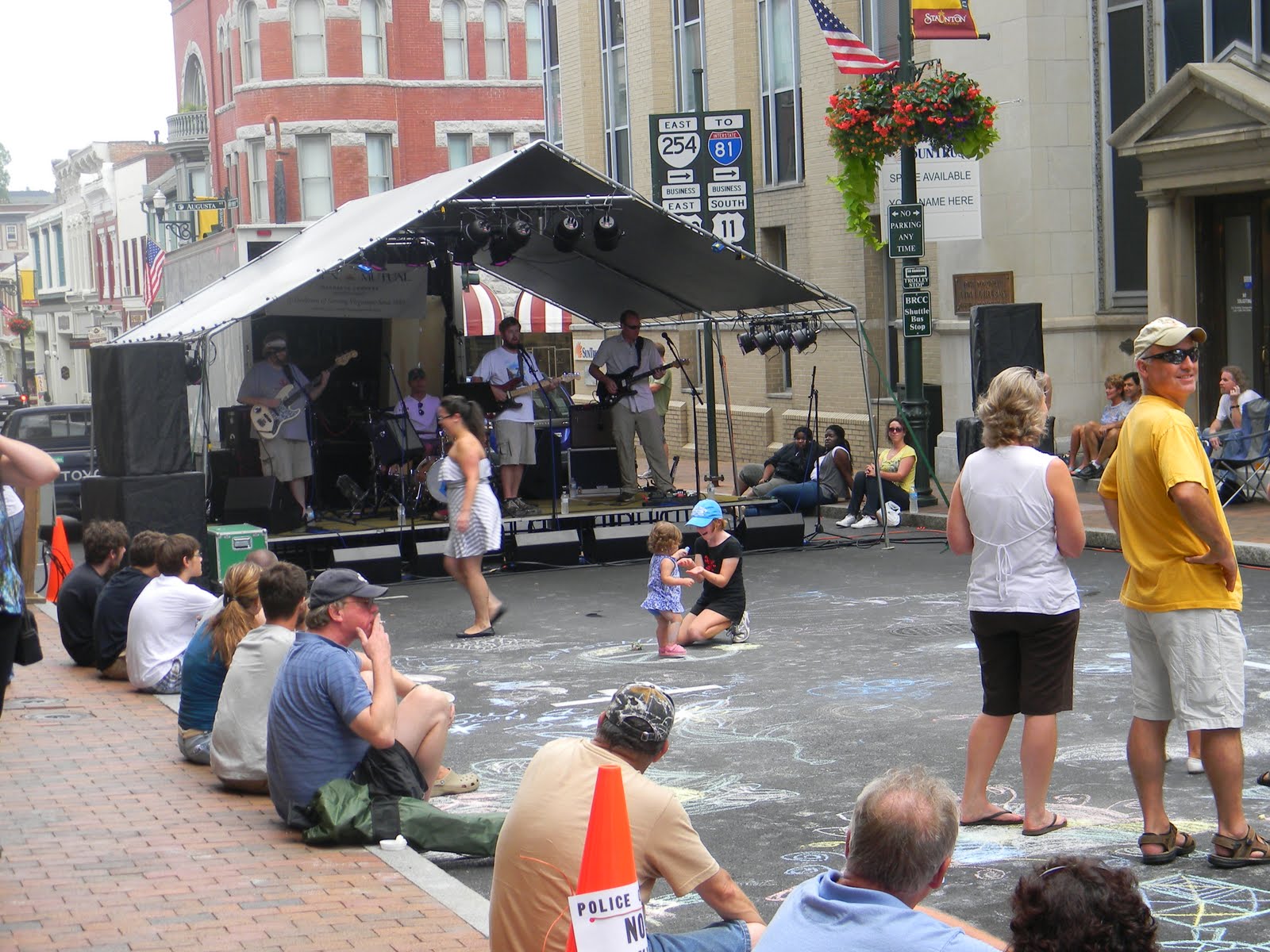
The unofficial end of the outside music scene in Staunton is “Staunton Jams.” Local officials cordon off a block of Beverly street, and from noon until ten at night bands rock the downtown. They range from headbangers (yes!) to new age to cover bands, and they are all good. Imagine blocking off a similar space in Old Town. When that is done for parades in Alexandria, the gridlock backs up miles on the Capital Beltway. In Staunton, that block was easy to circumnavigate, and there was no gridlock. I was able to park a block away, which wouldn’t have been the case in Old Town or DC.

I love my new city, and I hope I don’t turn into an anti-growth NIMBY, but all the things that appealed to me about living in Alexandria and near DC are here, but I can actually enjoy them without battling traffic and crowds. I’d just like it to stay that way, so if that makes me a NIMBY, I’ll deal.

Here are some pictures from Staunton Jams.

This is the extent of blocking off the street. In Old Town or DC
this would mean saw horses, jersey barriers, police tape,
and SWAT.
The stage is ground level, easy for the acts to move in and
out, but also great for interacting with the bands, who didn’t
mind if you shouted requests at them.
Yes, you could get this close to the stage, and in
this picture you can see some of the great downtown architecture.
The children had fun with sidewalk chalk, in this case,
road chalk. The children had lots of activities, and in
addition to taking a seat on the curb, you could bring your
own chairs to sit on–that would never go over in security-
conscious DC.

Rape is Rape

I’ve been a feminist since before I heard the word. When I did hear it, I said, “Oh, so that explains me.” Even then, there were certain feminist concepts I had to grow into. One of those was, “Believe a woman when she says she’s been raped.” This was usually followed by many anecdotes of women who were victimized twice, once by their rapists and then by the justice system who was supposed to be their advocates. I was a bit skeptical. After all, police and the courts are our friends, and I’d heard women in college threaten boyfriends with a cry of rape in order to assure their fidelity or in a fit of post-frat party conscience. I hadn’t yet learned about how the patriarchy socializes young girls with self-loathing. But I digress.

In the early years of my feminism, I didn’t give the rape issue much energy. Focus on equal pay, equal access to jobs, etc. Those were the things important to me as a working woman in a male-dominated profession.

Then, I was raped.

I wish I could say it was the stereotypical slavering madman who accosted me in an alley (though why would I be there?) or followed me from my car. No, it was the man with whom I’d been in a relationship for several years. He was a cop. Now, the occasional use of his handcuffs was mutually stimulating–the  occasional use. All of a sudden it had to be every time, and when I finally said I didn’t want that, I got forcibly handcuffed and dragged to the bed. And raped.

There were days of denial. I didn’t even tell my best friend. If she reads this, this may be the first time she’s heard of it. It was my flight instructor I confided in because he was a big-brother type, and he was furious. He was a policeman, too, and he was the one who told me I had to go to the police department in the location where it happened.

The officer who took my statement–and never processed it–was bored and surly. It couldn’t be rape because he was my boyfriend, and why had I waited days to report it. Obviously, I was pissed at him, so I was making this up. I was wasting valuable police time, and what if, in wasting that time, some woman really got raped. After that dead end, I went to my boyfriend’s department in a different jurisdiction and reported it. I got the same treatment and was also told that cops sometimes need to blow off steam. That’s all it was. Blowing off steam, and I needed to understand the difference between that and rape. I now knew the difference, but I also saw pursuing this was useless.

The good thing I did do was not see him again as part of a relationship. He was friends with my parents, so there were occasional encounters where he expressed puzzlement at why we weren’t together anymore. My mother adored him, and dating him was probably another of my futile attempts to please her. I even fantasized telling my father and imagining my ex-boyfriend’s reaction to the business end of one my father’s guns. But that would mean telling my father his daughter had done things he couldn’t approve of, and I couldn’t do that. To see the disappointment on his face, before his anger, would have been almost as bad as the rape. So, I let it go. I never told anyone else, except the man from the next relationship I was in who showed me what love and love-making truly were.

I reveal all this because today a New York City prosecutor requested that sexual assault charges be dropped against former IMF chief Dominique Strauss-Kahn. This after his alleged (I have to say that) victim begged them to proceed. Because this hotel maid lied on an immigration form by saying she was gang-raped (sometimes the only way women from some areas of the world can get political asylum), because a recording of her speaking with a jailed boyfriend was mis-translated, Mr. Strauss-Kahn walks free. Well, free to face two civil suits from the hotel maid and a woman in France, the daughter of a Strauss-Kahn friend who charges that he assaulted her.

The hotel maid has been on television, and her name has been used with her permission, but I won’t use it. To me, she’s still a victim. Lying to get into a country to make a life for you and your child is not the same as lying about rape. They are not mutually inclusive. And she was obviously far braver than I because she has spoken out about her assault.

Strauss-Kahn’s attorneys strip away the hotel maid’s dignity when they continue to claim the “act” was consensual. The DA is uninformed when he says her stories about what she did in the minutes after the assault are “inconsistent.” I was nearly incoherent for days, so I can understand why she may not have been consistent. She has been consistent about the details of what happened, and so, to me, she should have had her day in court–not to prove she’s a victim but to show that women who have been sexually assaulted should be protected by the justice system not vilified by it. Yes, I know she’s already filed a civil suit, but not until the DA’s office made noise about her credibility.

So, women in or traveling to New York, if you’re going to be raped, make sure it isn’t someone rich and powerful; make sure you’re not poor and working a job where if you speak up you could get fired; make sure you’re white and born right here in America; and make sure you have plenty of witnesses so you won’t be accused of “he said/she said.”

Once again, something I thought we as a modern, civilized culture had put aside rears its disgusting head (and I’m not even talking about making victims pay for their own rape kits). I’ll say it in as few words as possible:  Rape is rape.

The Only Easy Day Was Yesterday

I’m an Army brat through and through. I’ve watched my share of Army-Navy football games with my Dad and rooted for the “right” side. My first flight instructor was an Army helicopter pilot of the Vietnam era who enjoyed challenging Navy pilots to bar fights while I cheered him on. I’m basically anti-war, but I love my Army. I admire people who serve in any of our armed forces. I won’t devolve into cliches here, but, okay, freedom isn’t free, yadda, yadda. Oh, I have my issues with the military because it takes kids and turns them into killing machines, and sometimes it forgets to turn them off. However, I owe my existence–and you do, too–to everyone who served in World War II and saved the world from the most base villainy ever seen.It was only a few months ago we learned that “U.S. Special Forces” had killed Osama bin Laden. My ears perked up at “special forces,” because I have a tremendous amount of respect for them. We ask them to do disgusting things for the country, and they do it without question; most of the time, it makes us safer. (I’ve settled the ethical issues internally and really don’t want to debate them.) Special Forces are the elite, and, frankly, I’ve always felt that if we’d turned the war in Afghanistan completely over to them in the beginning, it would be over now, but for that whole Iraq distraction. I quickly “got over” the fact that it was Navy Seals, not Delta Force, not the Rangers, who stole into Pakistan in the dark, did the deed on bin Laden, and safely evacuated.

“Seal Team Six” became an everyday word. I even had a water treatment system solicitor come to my door a few days’ after all the bin Laden publicity and, when he saw he wasn’t making the sale, pulled the “I’m a former Navy Seal” line on me. Trust me, if he was a Navy Seal, I was, well, someone younger, stronger, and fiercer.

Then came the news over the weekend of the shoot-down by the Taliban of a Chinook helicopter carrying members of Seal Team Six (including a specially trained Seal dog), an Army aircrew, two Airmen, and several Afghan commandos. At first it seemed like a non-military event because what military wants to admit that the rag-tag Taliban could bring down a U.S. helicopter. Just ask the former Soviets how naive that concept is. After the admission that the helicopter had been shot down, some weekend anchors heard “Seal Team Six” and started mourning the crew who had taken out Osama bin Laden, not realizing that a Seal Team has several hundred members. I will admit when I first heard someone say that I wondered what idiot officer (Dad was a career non-com) had put the team members from the bin Laden raid back in a country where keeping secrets isn’t easy. Some anchor then compounded the idiocy by “thanking goodness” it wasn’t the same team. Idiot.

I’ve tried all weekend to come up with words to express my feelings. I feel every loss in both these wars. When the Washington Post prints pictures of the fatalities, I look at each picture. I read each name and home town. No war since World War II has touched my family in that way. Cousins came through Vietnam and Desert Storm physically unscathed, so I felt I owed that to the families who suffered the ultimate loss, an acknowledgement of their sacrifice. I’m a born Virginian (yes, there is a distinction), and Seal Team Six is based in Virginia Beach, VA. In that way, it was a home-state loss, and Virginia will step up and comfort these new widows and fatherless children, these parents who have lost sons who gave the last full measure of devotion.

The Seals would say they were just doing their job. In this instance it was rescuing some Army Rangers who had been pinned down in a Taliban stronghold. Had it all gone successfully, the two groups probably would have met up in the Green Zone and traded jabs about how the Navy had to come to land and rescued the Army. There would have been a lot of macho posturing I have little patience with, but everyone would have understood you don’t leave your people behind, regardless of which service they belong to. And the Rangers would have begrudgingly given the Seals their due. Begrudgingly.

Instead, there will be too many funerals, too many flags pressed into the shaking hands of next of kin, too many 21-gun salutes, too many playings of Taps. Too many tears will be shed, too many nights will be spent alone in a bed meant for two. There will be too many nightmares where children wake wanting their Daddy. In the past ten years, there has already been too much of this, but that’s another matter. Right now, families and a country will come together to mourn and, then, carry on. The Seals would expect nothing less.

The title of this post is an unofficial Seal motto. How apt for the weeks to come as bodies are identified and sent home to be honored and laid to rest. For the families, it can only be a mantra.

Just the Facts

I’ll preface this post by saying I don’t have any fiduciary interest in Google.

Several years ago at a Women in Aviation International conference, I purchased a book about a fictional female pilot “from the dawn of aviation!” I read the back cover blurb and thumbed through the book, and it looked like a good read. So, I bought it and started reading it on the flight back. It was a decent book, and the aviation aspects were accurate–something important to me; I’ve walked out of movies when they got the aviation bits wrong.

About midway through the book, the heroine, after losing a lover in an aircraft accident decides to drive to Newport, RI, from New York City to rethink her career choice. The time period was the early 1920’s, and, at least, I thought, the writer didn’t make the easy mistake and say our heroine flew into Newport’s airport, which didn’t exist then. A few pages later, the writer describes the heroine’s reaching the foot of the Newport bridge and slowing down because the height of the bridge had always intimidated her. Wait, what?

I was lucky that my then-spouse was always supportive and understanding of my obsession with writing. When I got off the plane, did I greet him with an embrace and a kiss appropriate to having been apart for five days? Uh, no. He was born and raised in Newport, RI, and I had heard plenty of stories from his mother about how as a teenager in the late 1950’s, he’d always managed to miss the last ferry from Jamestown Island in Narragansett Bay to Newport. (The Newport Bridge now spans the Bay from Jamestown Island to Newport.) The first words from my lips were, “When was the Newport Bridge built?”

“In the 1960’s,” he replied. “Why?” (It opened on June 28, 1969, by the way. I Googled it.)

I spent the walk to the car and drive home ranting about how that author could make such a stupid mistake. I didn’t bother to finish the book.

Yeah, I’m a hardass about some things, and, yeah, it’s fiction; but when a writer drops you into a real place for a fictional story, shouldn’t he or she try to get it right, dramatic license notwithstanding? In some ways, science fiction or fantasy writers who create their own worlds have it somewhat easier. If your world is completely fiction, nitpickers like me won’t nitpick. No one is going to question the accuracy of the worlds created by J.K. Rowling or George R.R. Martin. Well, except maybe fanboys and fangirls who think they know Hogwarts or the world of A Game of Thrones better than Rowling or Martin, respectively.

Google was only a couple of years old when the Newport Bridge boo-boo happened, but the public library system has always been a great source for fact-checking. Or, whatever happened to picking up the phone, calling the Newport city offices, and asking, “When was your bridge built?” It was obvious that, at some point, the author had been to Newport, parts of which still look like it did in the 1920’s, and decided that her heroine should have a reaction to that impressive bridge–forty years too soon.

Because I’m an historian, I’ve always approached my fiction–especially when I write about actual events–as a research project. You know, three sources and the whole bit. If it were allowed, I’d probably footnote. A lot of what I write about happened ten, fifteen, twenty years ago. Before Google, I spent a lot of time in the history sections of various libraries where I lived. The bibliography in one book usually gave me a list of others I wanted to read. When I couldn’t find a book I needed in the library, I purchased it. Before Amazon.com, even that was sometimes difficult to do.

Then, along came Google. If I wanted to find out what a rebellious British teenager was likely to wear in the 1970’s, I Googled it. Who was the Secretary General of the UN in 1962? I Googled it. You get the picture. (And I won’t even get started on how Google Earth can put you in a place where you’ve never been.) Just recently, I was editing a manuscript that involves a real event from early 2001. One character has a disability, and, when I initially wrote the MS some six months before, I thought, “Hey, wouldn’t it be cool if he motored around on a Segway?” So, I wrote it that way. During the edit, though I was reasonably certain of my memory, I decided to Google it. The event in the MS takes place in February 2001. The Segway wasn’t introduced until December 2001. I had my Newport Bridge moment, thankfully before publication.

I once bought an expensive map of Belgrade, Yugoslavia (now Serbia), so I could write a three or four page car chase scene using correct street and place names and be accurate about one-way streets. Even then, I found someone who had actually been to Belgrade and was familiar with the city to review it for any obvious errors.

Of course, this isn’t to say my writing has no mistakes of this ilk. I’m sure there are lots, but the point I’m trying to make is, with the Internet, research is quicker and easier (just verify anything you find in Wikipedia), and I can eliminate the obvious gaffes. You’d think those Newport Bridge moments would be a thing of the past. Yet, recently I read something which mentioned an area of the country I am very familiar with. The writer’s physical description of this area didn’t jive with my memory, so I went to Google Earth to check it, and my memory of the area was accurate. The story wasn’t. I was able to check that particular fact in Google Earth in a matter of seconds. Why couldn’t the writer?

I mean, I know that in the heat of words flowing, you don’t want to stop and Google what to you may be a minor aspect of a bigger story. I’ve been there, and, darn it, but that Segway sure seemed like a good idea.

Thank goodness I Googled it.

To Boldly Go

To Boldly Go

I’ve always been a bit anal about split infinitives–just ask the writers who worked for me on the magazine I edited–but I’ve also always been forgiving of the particular split infinitive in the title of this post. Recognize it?

“Space: the final frontier. These are the voyages of the Starship Enterprise. Its five-year mission: to explore strange, new worlds, to seek out new life and new civilizations, to boldly go where no man [or one] has gone before.”

I’m a child of the space age. Where Sputnik created fear among members of our government, I was utterly fascinated. My lifelong love of space and flying came from Superman comics. I knew there were other planets with people on them. After all, hadn’t Jor-el and Lara put little Kal-el into a rocket and sent him to earth where he became Superboy then Superman? When Yuri Gargarin, Alan Shepherd, and John Glenn made their flights, I was completely hooked on the space program. In third grade I announced, with enthusiasm, I was going to be an astronaut. My classmates and the teacher laughed and taunted me for the rest of the year about my ridiculous statement. After all, girls couldn’t be astronauts.

I’m certainly glad that’s not true any more, but it took years for me to discover that along with those hot-shot, male pilots who became the Mercury Seven, there were women pilots who underwent the same training and in some cases exceeded the performance of the men–the Mercury 13. I’ve had the privilege of meeting several of them, and they were and are amazing women. They were ready, willing, and able to go, until a single congressman’s sexism dashed their dreams.

When I learned to fly, it wasn’t farm fields and towns I flew over. I was hurtling through the universe to other worlds. Flying got me as close as I could to space, and it wasn’t very close, but I reveled in it. Flying led to my job on an aviation magazine, and that job got me a press pass from NASA. I was there on April 12, 1981, when Columbia, STS-1, made the first trip to orbit. I trooped around with the reporters to all the photo ops, including taking pictures of the STS on its launch pad at night. Though I got eaten alive by mosquitos, it was a sight I’ll never forget.

I felt much better about being in awe of everything when I saw veteran space reporters as excited as children when that ship left earth, carrying with it my dreams of mining asteroids, building bigger, faster ships in orbit, establishing a permanent space station, everything that had made my imagination reel. I can still hear the roar of those rockets, feel the vibration of the ground, and see how the bright sky was made brighter.

I was home “sick” from work on January 28, 1986, with my eyes glued to the television to watch Challenger, STS-35, carry the first “everyday” citizen into space, a history teacher named Christa MacAuliffe. In that moment the humiliation of a third grader faded. A teacher, a history teacher, which I had once been, was going into space, but my dream didn’t die with her.

On my day off on February 1, 2003, I was rushing back from the grocery store to get home in time to see Columbia, STS-107, land–I tried to watch as many of the launches and landings as I could–when the report came over the radio of Columbia’s break-up in flight as it passed over Texas on its way to Cape Canaveral. I had to pull my car to the side of the road and wait until I was no longer overcome.

On July 8, 2011, in Florida on vacation and amid all the talk of the last Shuttle flight, I was in a car on the way to the Auto Train station in Sanford. Had it not been a cloudy day, we might have seen the plume of spent fuel marking that last flight into space. The space age has given us many advancements, and so in a car with a Smart Phone that looked so much like the communicators on Star Trek, I watched the countdown and the launch live. It wasn’t the same, but I could say I was there, that my fascination with STS had come full circle to a reluctant closure.

But I couldn’t watch today when Atlantis, STS-135, landed for the last time. I know we as humans will go on to explore space both in government ventures and private ones, but the thought of that incredibly beautiful glider never breaching the atmosphere again then returning to make a pinpoint landing was too much. The Shuttles were first and foremost aircraft, and, unlike the awkward but perfectly engineered Mercury and Apollo capsules, the Shuttle was something I could relate to as an aviator. It, too, was complex, one of the most complicated pieces of machinery in the world, but when I studied its controls and systems, I could see myself in the cockpit.

The 135 flights of STS resulted in innumerable accomplishments. Satellites placed in orbit have opened our eyes on the universe and shown us the toll we humans have taken on our planet. The Shuttle systems themselves, notably fly by wire and satellite navigation, are now standard on modern transport aircraft. Space medicine has led to improved patient care and treatment of diseases.

For those who think space flight is a waste of resources, I ask you, how can you limit our desire to explore? People have tried, like those who warned Columbus he’d fall off the end of the earth, but we persist as a people, as humans “to boldly go.” Every exploration on this world has resulted in casualties, and to stop exploring dishonors those who sacrificed. We have to look forward and outward.

I won’t see it, but some of the children who watched STS’ last flight will walk and live on Mars. Not long after that, cosmologically speaking, their children’s children will see a planet outside our solar system with their own eyes. And that’s something to look forward to.

Godspeed to Enterprise (the test vehicle that never made it to space) Columbia, Challenger, Discovery, Atlantis, and Endeavor. You will always fly in my dreams.

Review of July 2011 eFiction Magazine

I stumbled across eFiction Magazine a little more than a month ago when I was looking for more periodicals to have on my Kindle. eFiction’s calling itself an “indie fiction” publication made me think back to the 1980’s when indie music was the rage. Punk and grunge musicians who couldn’t score mainstream recording contracts began to start their own labels, something made easier by the fledgling digital age. Similarly, indie (or independent) fiction tends towards new or emerging writers whose voices may not necessarily fit a specific, mainstream genre. (In reality, anyone who has self-published could consider their work indie fiction.)

eFiction takes this a step further, with on-line forums where contributors, aspiring contributors, and the editorial staff interact. I’ve never seen another on-line magazine do this, or print magazine, for that matter. They may be out there, but I’ve never seen it. I find it refreshing.

The July issue was downloaded to my Kindle while I was standing in some line at Walt Disney World, but I didn’t get a chance to “open” it until the Auto Train ride back to Virginia. And it was well worth the wait. I’ve finished the first three stories, which I’ll discuss a bit more below, and as with the June edition, my first, they were stories I know I’d never see in a literary magazine. For one, the stories are a bit unclassifiable, genre-wise. They have elements of horror or speculative fiction or fantasy, but you’re always left questioning if that’s the case or if you’re simply looking into another reality.

Take “Ozark Pixies” by Madison Woods. A woman is convinced she’s seeing pixies around her rural home, and her husband is about ready to call the “white coats” on her. One day she sees a pixie at the side of a road and wants so badly to prove to her husband that she’s not crazy that she hits it with her car. She only intends to stun it, but it’s mangled so badly she thinks she’s killed it. It’s when she shows her husband the mess she’s brought home that he really thinks she’s gone off the deep end. The woman takes the pixie to her barn, where the pixie recovers enough to latch onto the woman’s ear. The woman and the pixie come to an understanding, and the pixie convinces the woman to eat a carrot-like root the pixie digs up. The root turns out to be hemlock, and the woman is slowly being paralyzed. She begs the pixie’s forgiveness and for an antidote, and the pixie gives what could be forgiveness then places some seeds in the woman’s mouth and disappears. The story ends with the woman thinking, “I knew there was no remedy for hemlock. But she knew things I didn’t.” So, fantasy (pixies), horror (being slowly poisoned to death by a pixie), or suspense (was the woman really just hallucinating)? I’ve read it twice and can’t classify it, but that’s what made me like it.

The zombies in “A Bad Zombie Flick” by Nathanial Chambers are quite familiar to me–commuters moving in lockstep toward work. I lived that for too many years. I even related to the nonconformity of Chambers’ protagonist, who, though a new stock broker, still drives an old tank of a car and scoffs at the other commuters marching forward as one. Yet, we get a hint that things are not quite right when the man picks up his morning newspaper off the lawn. The lines for the columns are there but no words. He shrugs it off as a printing problem and heads to work. The next hint we get is when he’s in line at his favorite coffee shop and looks around at the blank faces of the people waiting in line for their turn with the barista. He notices, like the cars on the road, everyone moves forward precisely the same distance at precisely the same time. Now, the folks in line at my local Starbucks gave pretty vacant stares until that first hit of Caramel Macchiatto, but something about these folks leads our protagonist to declare when he’s before the barista that he no longer wants coffee. But he gets coffee, and in a nightmarish way that has to be read to be appreciated. Here’s a taste:  “The line moves, not forward but toward me. I can hear chairs scraping behind me and the shuffling of feet coming in my direction. I see two men at the doors; they appear to be standing guard. Panic seizes me. They are on me in seconds.” Afterwards, he gets back into his car and notices he has now fallen in step with everyone else–he moves his car the same distance the same time as everyone else and sips coffee from his travel cup exactly when everyone else does. Is this horror–the coffee scene in the shop could lead you to think it is–or fantasy because of the element of conformity taken to the unreal? Or did he merely fall asleep in the coffee shop and dream it all?

“Little Sisters” by Myra King tells the story of three sisters with a focus on the one their parents decided to name Myron. Myron is looking back on her life in her 90th year. She has broken her hip and contracted pneumonia and is in hospital recovering but thankful she has “no one left to mourn me.” I get the impression she is in a ward if not for indigent patients then certainly for people who have limited funds for health care. With her is a 15 year old pregnant girl on bed rest, and the knowledge that another older woman died overnight. The young girl is feeling guilty for not having spoken to the woman who has died. When the young girl begins to cry, Myron remembers how one of her sisters would cry every night. Then, she remembers she was her father’s last hope for a boy, hence “Myron,” and how her father tried to turn her into a boy by giving her boys’ toys. At first she delighted in the attention, but when her father had her collect caterpillars, which he then killed one by one despite her protests, she wants no more of him. Her father no longer paid her attention, and we suspect we know who was responsible for the drowning of her kitten, one he’d given her for her birthday. He turned his attention instead to another of her sisters, and the type of attention is more than obvious in this chilling account: “Father’s attention turned to my sister Roslyn, but he didn’t try and make her a boy. Later, with the sickening wisdom of hindsight, I knew it was more of a woman he was trying to shape.” Watching the young girl’s boyfriend come to visit her and discuss the problem pregnancy makes Myron remember how her mother died giving birth to her, then how a fire kills the father, leaving Myron and her sisters to the mercy of the foster care system. None of the sisters ever married. Myron became a nurse to “relieve the suffering of others while Margaret gave her life to care for Roslyn.” A coughing fit overcomes her and she hears “voices of comfort. Familiar voices. I sink back into the pillows, close my eyes, listen to those words, our three little sisters song once more played to the tune of my memories and the faltering of my breath.” Of the three stories, this is the one I could classify definitely as literary fiction, but it’s written in a way that engages you and makes you hope there will be people left to mourn you.

There are more stories in the July issue, but I’m savoring them. Slowly.

They Call it “Magic Kingdom” for a Reason

When I was a kid, my Sunday night ritual was to watch The Wonderful World of Disney. I begged to go to Disneyland, but for my family, going to California was the equivalent of interplanetary travel. I didn’t get to Disneyland until I was an adult in the mid-1970’s, and, boy, I took advantage of being at a conference in Anaheim. Back then you had tiers of tickets, and each tier would let you into progressively more rides. I went all out and got a ticket for every ride. And there I was, the only adult without a small child on all the rides (even the tea cup one), but, damn, I had the best time of my life.

Disneyland was, and is, compacted into a relatively small space compared to the sprawling Disney World complex outside Orlando, FL. In that way, Disneyland is cozier and doable in a day. Disney World is almost crass in comparison, reachable only by bus or other transportation if you stay at one of their “resorts” (Disney doesn’t use the word “hotel.”), and even taking one park a day, you can’t do it all. I know. I just spent the better part of six days there.

Disney World, to me, has always represented commercialism, tacky souvenirs, and overpriced everything, not to mention a Pollyanna-ish view of the world that’s stuck in the 1950’s. When Disney bought up a bunch of land near my hometown with the plan to build an American History park (complete with slave auctions in the 19th Century section), I was among those who lobbied against it. Of course, the Disney company had the last laugh. After abandoning the project, they sold the land to developers, and now about a gazillion cookie-cutter houses occupy the space, and the traffic we worried about is 10 times worse.

My previous experience with Disney World consisted of brief visits on weekends while I attended my agency’s management school in Palm Coast, FL. My training schedule put me there each year usually in mid-December or early January. (I know. The sacrifices.) That meant no lines. At all. So, when I decided to accompany the “grandkids” and friends to Disney World the week before the July 4 holiday, I had pretty much decided the time in Disney World was penance to make me appreciate St. Augustine Beach more.

But watching two-point-five year olds’ faces in the “It’s a Small World Ride” or seeing them hug the characters (sorry, “cast members”) with abandon, all my disdain fell away. (Me to Ollie: “Do you think we’ll see Mickey Mouse today?” Ollie: “Mickey is ebrywhere!” I mean, how freaking adorable is that?)

Oh, I hated the crowds. I hated the heat. I hated, detested, abhorred the lines. Maybe Disney pumps psychotropic drugs into the air you breathe to make you conform, but I had a good time. I had a great time. I spent too much money (Disney brainwashing), but it was a once in a lifetime occasion because those three kids will only be two-and-a-half and five months old (respectively) once; this was their one and only “first visit.” I know they’ll be back, probably multiple times, but the first time was, well, magical.

Two Steps Back

I have tried my entire life to overcome my legacy as a Southerner. Now, there are good things about being from the South, but we seem to have a hard time kicking our racism habit. We do stupid things then blink our eyes in feigned innocence and proclaim we had no idea. Yes, you did. Sometimes we take things that try to mitigate our former ignorance and decide to make them ours. We just don’t get it.

Who is the “we” I’m talking about? Some white people who can’t or won’t move out of the 19th or 20th Century as far as racism is concerned.

After the Brown v. Board of Education ruling from the U.S. Supreme Court in 1954, many jurisdictions in Southern states closed their public schools to thwart the intent of the ruling. This happened in my home town. Because all public schools were closed, the segregated, African American schools were, too. The difference was white families pooled resources, formed “private academies” which held classes in the former public school buildings, hired the former public school teachers, and education went on much as it would have as a public school. African Americans who could afford it moved to jurisdictions that didn’t close their public schools, but most black communities tried to hold classes in church basements or private homes, without the resources the private academies had, i.e., a wealth of trained teachers, current textbooks, and extracurricular activities.

I attended one of these “academies” for several years, but at the time I didn’t understand the implications. To me, it was just school. My education certainly didn’t suffer. When I entered public school in the 6th grade, I was reading at a higher grade level, my math skills were two years ahead, and most of the 6th grade was a repetition of what I’d already been taught. Though I received a more than decent education, I’m not advocating these “academies.” The point is African American families didn’t have these options, and by the time public schools were re-opened, many African American students were academically far behind their white peers. Some never caught up.

In 2004 my home state, the Commonwealth of Virginia, had one of those rare moments of insight. After receiving a gift from an estate of one million dollars, the Commonwealth established the “Brown v. Board of Education Scholarships” for those who missed out on educational opportunities when the public schools were closed. Let’s recall who actually “missed out” on a chance for an education? Not me, and not all the white kids in the “academies.” I’ll concede that there were some white children who did not attend the makeshift academies, but they were few.

Since the inception of that scholarship, 70 have been awarded–some (and the Commonwealth won’t say how many) have gone to whites. The administrator of the scholarship fund indicates that both white and African American children lost the opportunity to go to school and so both should be eligible for the scholarships. Indeed, she wants to get the word out to whites so they can take advantage of it. I think she has her proportions skewed. The vast majority of people who “lost the opportunity” for an education were African American, and I believe that’s where the scholarships should go. As I said, I didn’t lose a chance for an education nor did the great majority of my classmates, and, consequently, I don’t deserve such a scholarship. I would never dream of even applying for one.

One of the African American recipients of the scholarship raises a good point. What if one of the scholarships went to a member of a family who supported segregation? That, to me, would be a slap in the face to those who fought and bled and died for equal opportunity. The person who thought up the scholarship indicated he certainly had African American, not white, students in mind. He indicated he had a hard time accepting that white children’s education suffered. I agree.

So, this post is titled, “Two Steps Back.” What’s the other step? I find this so outrageous, I don’t know if I can write much about it without elevating my blood pressure. Someone setting up the Republican Leadership Conference in New Orleans this past weekend hired “comedian” Reggie Brown, an Obama impersonator. Brown came on stage in his Obama persona and proceeded to tell racial joke after racial joke. The attendees hooted and laughed, but when he switched to dissing the slate of Republican Presidential hopefuls, he got booed and booted from the stage.

I’m sorry, when is it acceptable for anyone to make racial jokes? Some talking heads on morning TV tried to spin it as the audience expressing disapproval of Brown’s schtick, but, come on, if you hire an Obama impersonator for a mostly white, very conservative group, you knew exactly what you were getting. And if you watch the YouTube video of the event, you’ll see the audience thought he was hilarious until he started in on making fun of Republicans.

These are the days when my optimism about a post-racial world wanes. Sadly, neither of these backward steps surprises me.