Dead or Alive

A friend of mine wrote a short story a few weeks after September 11, 2001. In the story, Osama bin Laden is about to go on trial–a civilian trial, by the way, since the whole military tribunal mess hadn’t yet occurred–but his attorney argues successfully that bin Laden can’t get a fair trial in America. The fictional judge reluctantly agrees and releases bin Laden into the streets of New York City then sits in his chambers and listens to the people exact their revenge.

An insightful and thoughtful story, but one that was fiction. The reality we know now is that had we captured bin Laden alive, we would have remitted him somewhere and eventually tried him before a secret military tribunal. There is no doubt what the outcome of that trial would have been. In the meantime, however, no American would have been safe anywhere in the world. An exaggeration? Remember when the United States admitted the exiled Shah of Iran for cancer treatment? Employees of our embassy in Tehran became pawns in that clash of wills for more than a year. Remember, too, the failed hostage rescue attempt that left U.S. aircraft in a hostile country to provide intelligence to the Iranians on who inside their country had helped the U.S. More than anything else, the failed Operation Eagle Claw assured Jimmy Carter wouldn’t get re-elected.

The reality is, as much as I believe in justice and rule of law, neither of those mattered to Osama bin Laden. We were the “other,” the non-believers, unworthy in his eyes. He gave no quarter, and, I suspect, he would have wanted none. Though I would have preferred we had afforded him that, he died as he lived, and he can no longer be the monster under the bed, the boogeyman in the closet, that Republicans have held up as an excuse for suborning our Constitution in the near decade since September 11, 2001. In some aspects, this was the only way to take the burden of his actions off America’s back. They have weighed us down far too long.

We will find the closure temporary and fleeting, but some closure is better than living with the mythos of bin Laden indefinitely. It is disturbing, though, that while they had the White House, the Republicans invoked bin Laden’s name to justify all sorts of sordid acts; yet, they were the ones who stopped the operation in Tora Bora that would have captured him in 2001. There were tastier fish to fry in Iraq. The President who initially explained his feelings about bin Laden by alluding to Old West Wanted: Dead or Alive posters, soon moved on and didn’t think too much about the man who approved a “martyr operation” that cost the lives of 3,000+ Americans on a bright, beautiful September day.

In the year of the 10th anniversary of September 11, 2001, we have a President thought by some to be unseasoned, too soft on terrorism, too equivocating. Despite that, he asked for options, received three, and picked the most risky. It’s failure would have been his own Operation Eagle Claw, and he could have kissed any hope of re-election goodbye. But the execution was nearly flawless, and I think that for a nanosecond as bin Laden looked on the Navy Seal who put two bullets in him, he knew an American had put him to death, as he had put Americans to death. There is satisfaction in that coming full circle. There is closure in that.

As the daughter of a re-conn soldier from World War II and the cousin of one of the first Green Berets, I acknowledge our Special Forces as some of the best military in the world. I doubt any other special forces could have accomplished what Seal Team 6 did. Behind them they had good intelligence, obtained in an “old-fashioned” manner by time-honored tradecraft, not the torture so gleefully discussed in the previous Administration. And though we didn’t know about it until after the fact, they carried the hopes of the American people with them. Now, we can finally say, to some extent, and not be laughed at, Mission Accomplished.

And yet, I do not rejoice in Osama bin Laden’s death. Am I glad he’s gone? Yes. By not rejoicing, I’m one-up on him because he undoubtedly rejoiced in any American’s death at the hands of an Afghan or Iraqi or any other member of the religion he subverted for his own ends. I’m not so naive to think his death is the end of al Qaeda. Al Qaeda is a concept, not something tangible we can destroy irrevocably. We have, however, diminished its importance and standing. Coupled with the Arab Spring, we are moving toward reducing al Qaeda, and Osama bin Laden, to a footnote in history.

Let’s not forget, however, who created Osama bin Laden. In the 1980’s, so deep in our Cold War paranoia, we moved heaven and earth to deal a defeat to the Soviet Union. We armed an insurgency, used their religion to unite and motivate them, to make them zealots, encouraged young Arab men from other countries to go to Afghanistan to fight the godless Soviets. We promoted jihad. We created our own mercenary army of religious fanatics, and Osama bin Laden was among the ranks. So, why were we surprised when our creation turned against us?
What Really Motivates the Birthers?

Just coincidentally a week or so ago, I was looking for something in my desk and came across an envelope with my mother’s handwriting on it. Just one word–“Important.” I had a vague memory of seeing it when I was going through papers after her death, so I decided to open it. Guess what I discovered? A Certificate of Live Birth.

For some reason I needed a copy of my certificate of live birth in 1990 and sent for it. The certificate itself is a Xerox on elaborately bordered, special paper (manufactured by the American Bank Note Company, no less), which bears the words, “Certification of Vital Record.” It was produced by the Commonwealth of Virginia, Department of Health, Division of Vital Records. At the bottom right is the seal of the Virginia Department of Health. At the bottom left is a raised version of that same seal. In tiny print at the bottom, it reads, “This is to certify that this is a true and correct reproduction or abstract of the official record filed with the Virginia Department of Health, Richmond, Virginia.” That’s followed by the photocopied signature of the then State Registrar.

It has a birth number and all sorts of interesting statistical information. Of particular note is box 15 “Birthplace (State or foreign country)”. Typed in is the word, “Virginia.” Not, Virginia, USA; just Virginia. As certified by the doctor attending, a Dr. Jones–hmm, that sounds like a made-up name, doesn’t it–it even includes the time of birth: 2:20 a.m.

All of this bureaucratic information, the birth number, the raised seal, even the facsimile of the original record, etc., is reminiscent of the Certificate of Live Birth for Barack Hussein Obama, which I’ve viewed at Politifact.com, a 2009 Pulitzer Prize winner, by the way. However, according to Donald Trump and other birthers, there is a question as to whether I was really born in Virginia, because for them, a certificate of live birth doesn’t cut it.

I guess my mother and father conspired before my birth to make me a bureaucrat in a Federal agency, so they submitted false information to the Commonwealth of Virginia so it would appear I was born there. How devious is that?

Then, deeper in the envelope, I found a 1976 version of my certificate of live birth. Though the middle portion of this version is the exact same record as the 1990 version, the whole certificate is a Xerox. Uh, oh. I now have two versions of my certificate of live birth. Highly questionable. The information on both versions match to every letter and comma, but two versions? I better not run for office–I have my own conspiracy in the making.

Then, there’s the whole matter of one citizen verbally abusing another citizen over the production of a “long form” birth certificate. I went to Virginia’s state government Web site and searched for “long form birth certificate.” No hits. Apparently, either of my two versions of my certificate of live birth is a long form birth certificate because it’s the only birth certificate Virginia issues.

I am still amazed that we’re discussing this in America. I’ve written before about how my mother and her family came to America when she was very young and how a town in Virginia “adopted” them, got them SSN’s, and any other government form a citizen would need. So, yes, I’m an anchor baby, apparently. The fact that my mother wasn’t a citizen didn’t come to light until the late 1970’s when she and my father were supposed to go to the Soviet Union at the request of the U.S. Department of Agriculture for an agricultural expo. She simply refused to apply for a passport, and my father finally figured it out and decided it would be way too complicated to get her “established” as a citizen. They didn’t go. Several flags got raised, but my mother was never investigated. She even served several times on juries. The difference, of course, was my mother looked like the majority of people in the country at the time she immigrated. She was European and white, not of African descent and dark, like our President.

And that, my dear Watson, is the crux of the matter and the answer to the question I posed in the title of this post. Would anyone be questioning the validity of President Obama’s certificate of live birth if he were as white as Sen. John McCain? Of course not. McCain was born in the Panama Canal Zone when his father, on active duty in the military, was stationed there. That should hold the same concern for the ignorant Tea Baggers who raise the issue of the President’s birth, but it doesn’t. (By the way, children born overseas to American citizens, whether on active duty in the military or not, are U.S. citizens, but you have to dig into the law to know that, and we all know the Tea Baggers only go for the superficial.)

Most people and the media, as usual, have tried to overlook the overt racism in Trump’s and the other birthers’ claims, saying it’s just politics as usual. No, it’s not. Every time Trump or Bachmann or the half-governor of Alaska or any of the other self-aggrandizing publicity hogs mentions that the President may not have been born here or questions why he doesn’t produce that elusive long form birth certificate, call them on their racism. Point out exactly what they are–so insecure we have a President who doesn’t look like them that they have to resort to childish finger-pointing and bullying. They are racists, plain and simple. That, not patriotism, is their sole motivation.

SWAG Writers Poetry Fest!

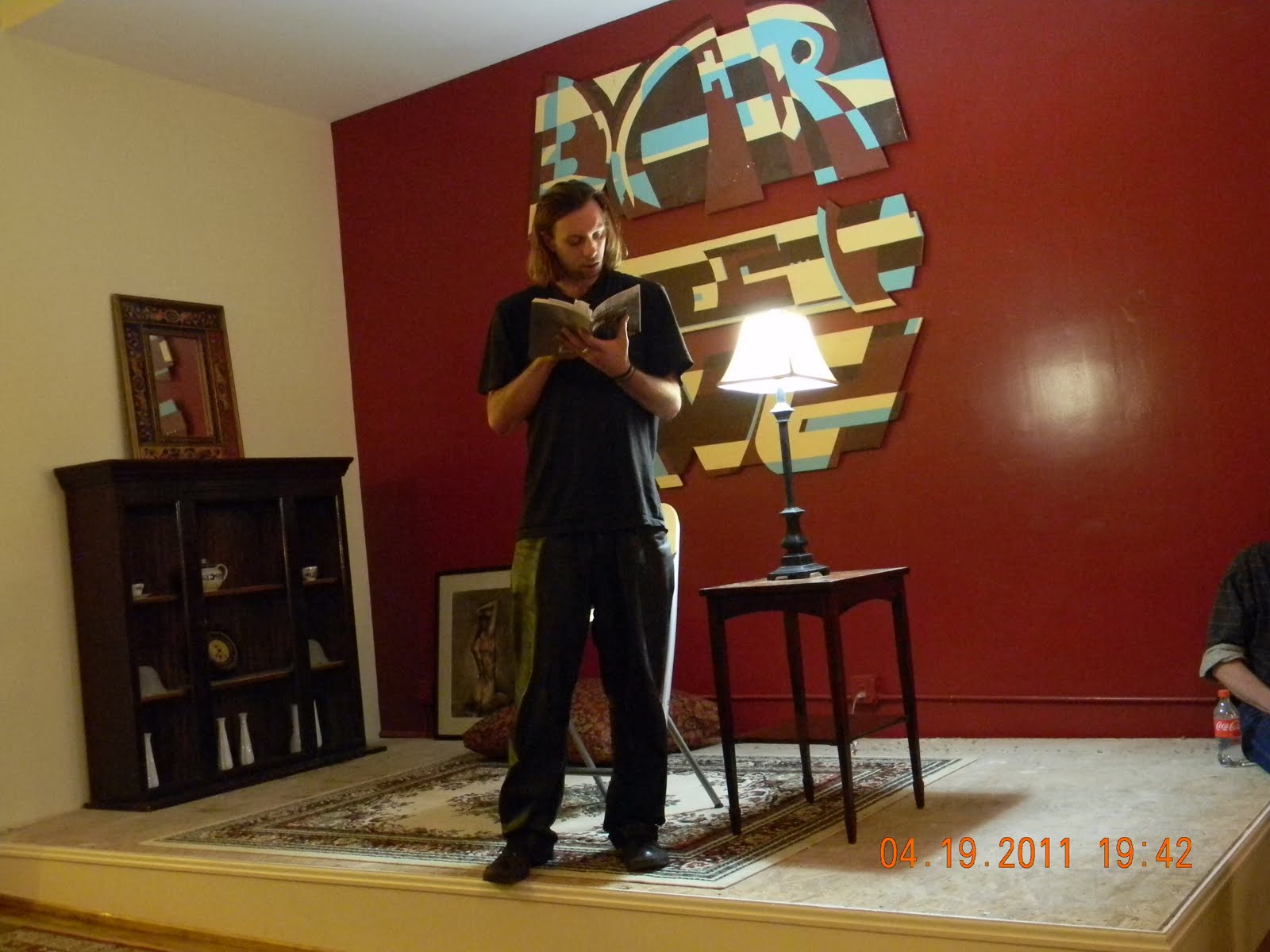
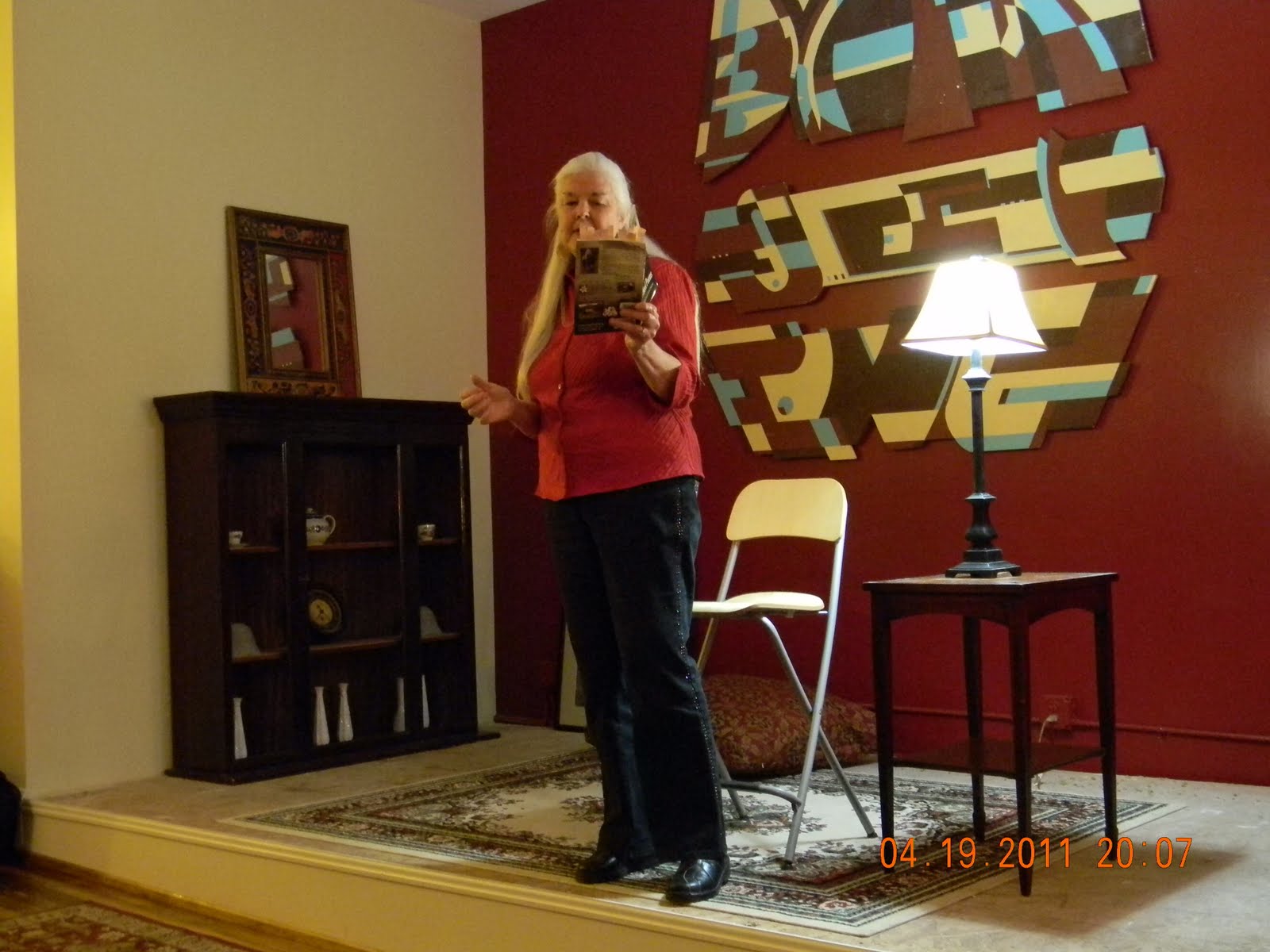
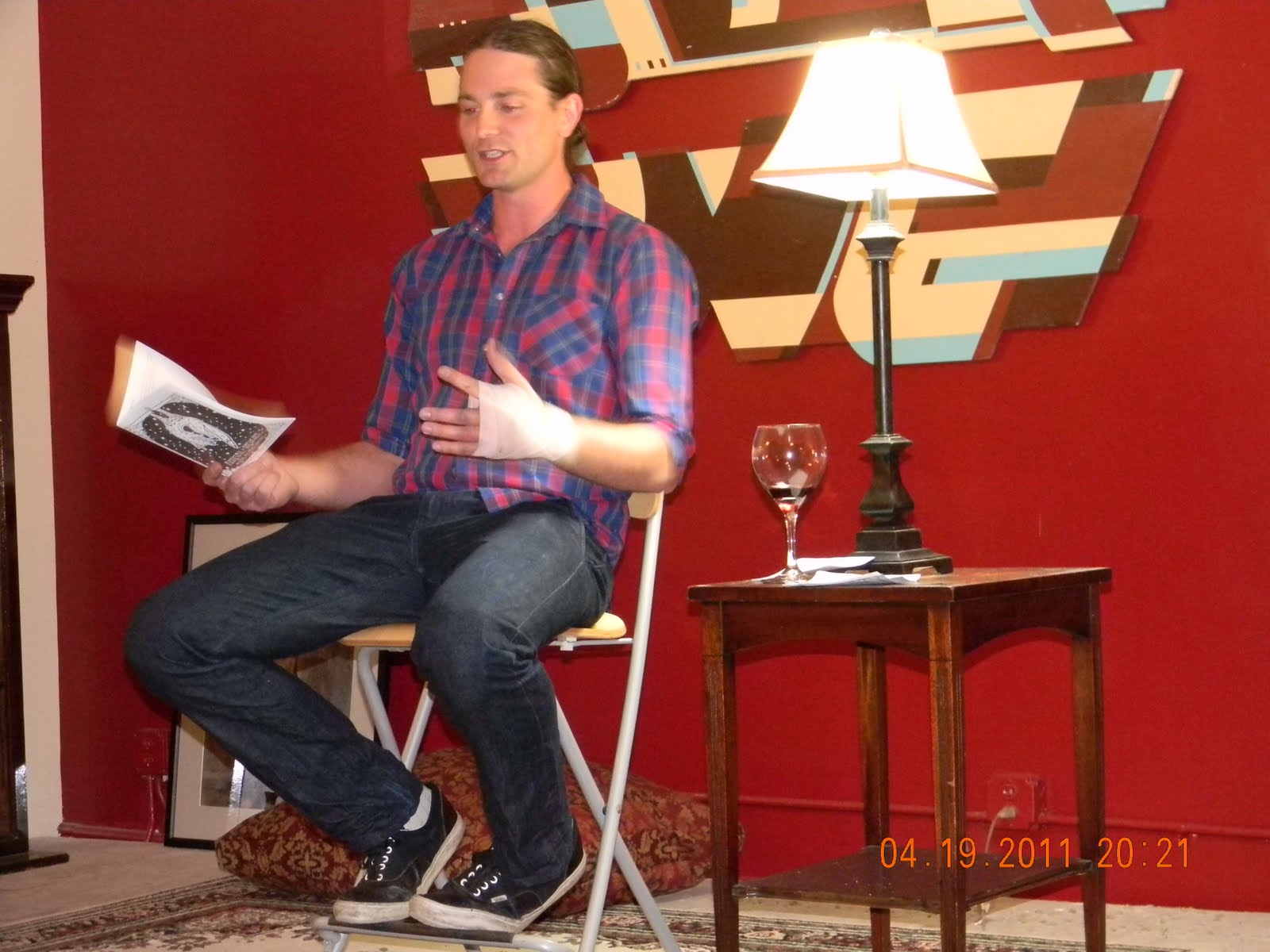
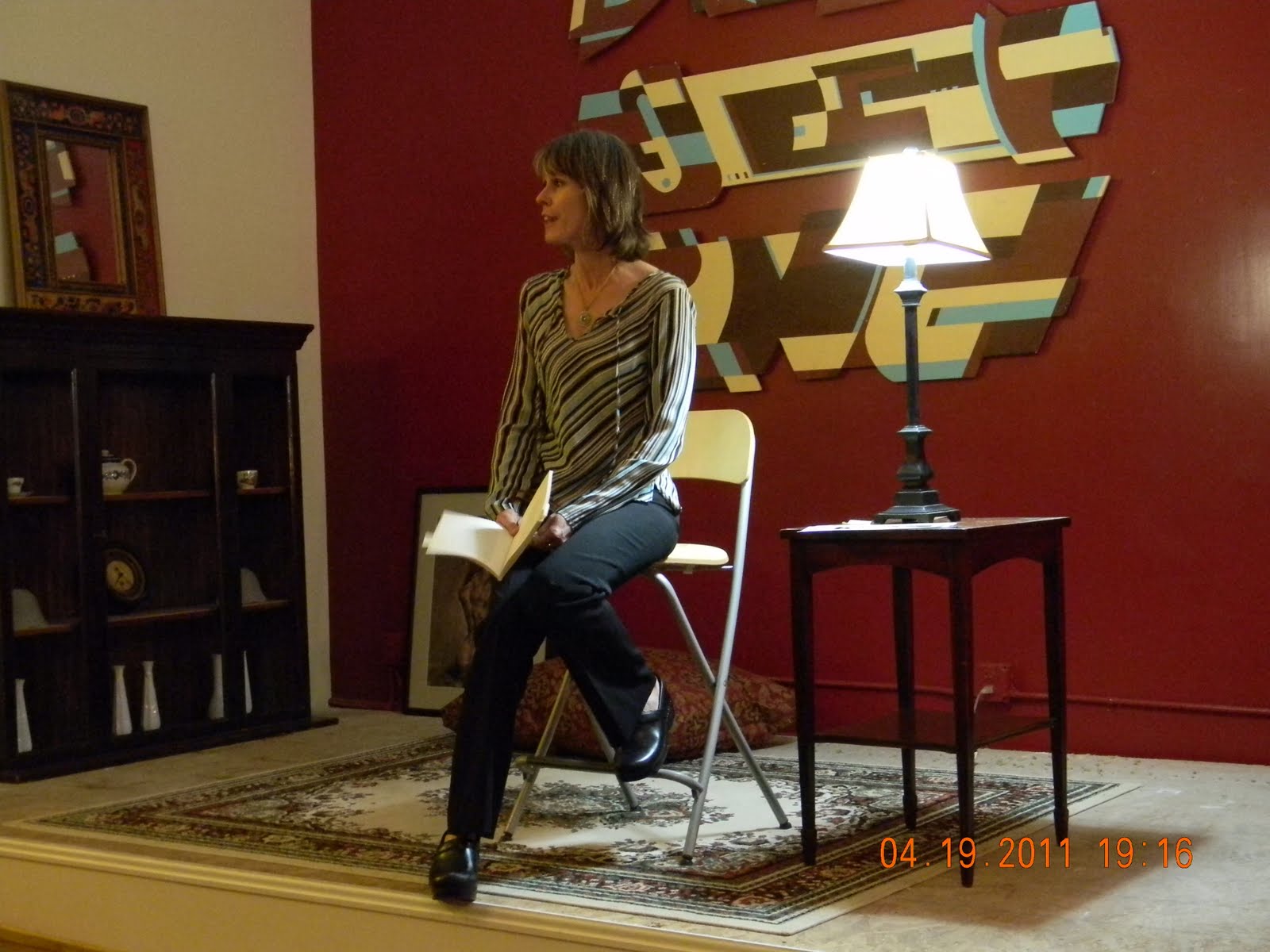
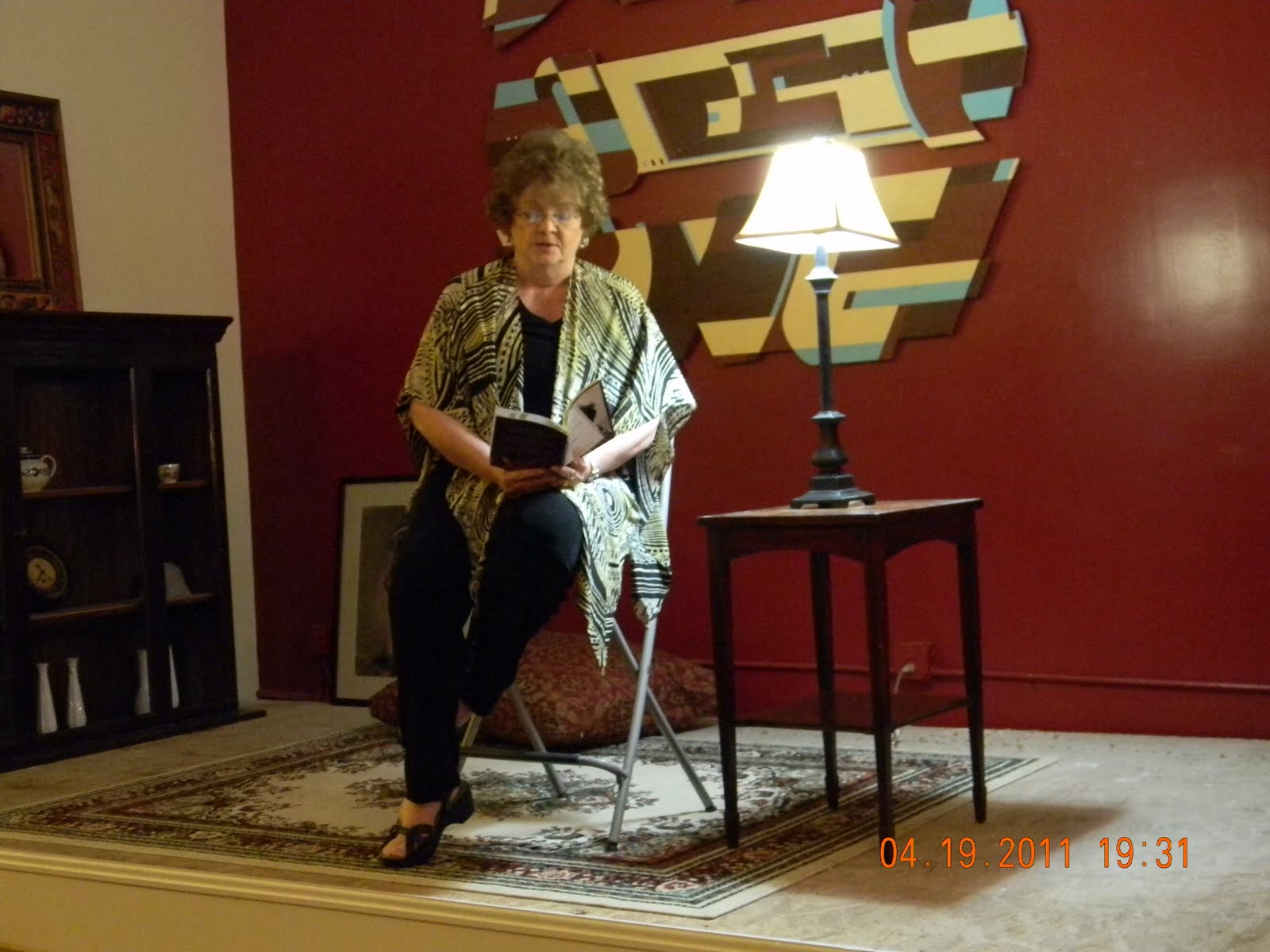
Here’s a pictorial blog today on last night’s great Poetry Fest sponsored by SWAG Writers.

The featured poet was Sarah Kennedy, an Associate Professor of English at Staunton’s Mary Baldwin College. She read from Home Remedies, one of her six books of poetry. Home Remedies contains poems based on real persons from 17th and 18th Century Ireland and Wales. Very evocative to my Irish half.

Local poet Lauvonda Lynn Meade Young read from her first book of poetry, Just a Woman. We women in the audience who are her contemporaries–we could certainly relate to her poems! Wonderful glimpses into the life of a woman who isn’t “just a woman.”

Shea Anthony is a local poet from Fishersville who read from The Forgotten Theatre, one of his two books of poetry. Reminiscent of musicians Jim Morrison, Kurt Cobain, and Trent Reznor, Shea got us all participating in his reading. A great contemporary voice. And, let’s face it, anyone who does a poetry reading in the Valley in black leather pants deserves our attention!

Elizabeth Doyle Solomon often gets inspired while driving the roads of the mountains and the Valley. When that happens, she jots the first few lines on the steering wheel, then finds a place to park to write the rest. Hence, she read from her second book of poetry, entitled, appropriately, The Steering Wheel Poems. Her poems celebrated the wildness of nature around us and lamented how easily we pave over those places of beauty.

Lorraine Rees from Charlottesville read from her second book of poetry, Goodbye Zoo. Her poem about a college ethics professor who hits on all his female students was amusing but full of pathos–and very authentic. She describes herself as the one who “got away.” Great insight.

Paul Somers rocked and rolled us with energetic readings from his first book of poetry, Animal Insight, and from several as yet unpublished poems. Later we talked about how he uses humor in his poems to illustrate serious aspects of his life in rural North Carolina. Deeply profane and poignant.

The last, but not least, poet of the evening was Linda Levokove, who read from her first book of poetry, Walk on the Heart Side. Her poems are glimpses, earthy and explicit, into romantic relationships. I related to these most of all because her poems seemed as if they were written expressly for the most important relationship of my life and captured my sense of loss. Overall, though, they so vividly portrayed the wonders of a deep relationship, I could remember all that was good, and I thank her for that.

And let us not forget our hosts for the evening, The Darjeeling Cafe in Staunton, VA, and our master of ceremonies, SWAG Writers founder Cliff Garstang, author of the award winning linked short story collection, In an Uncharted Country.

Not Intended to be Factual Statements

Imagine what life would be like if, every time we say something stupid, we could just shrug and say, “I didn’t intend that to be a factual statement.” Then, everyone who heard the stupidity would just smile and say, “Sure, no problem. Of course you didn’t intend that to be a factual statement.”

That begs the question, what is a non-factual statement? Why, I think everyone from my grandmother to my old English teacher to a priest or two I had respect for would say, “It’s a lie.”

Those of us on the left–excuse me, we liberals–have been the only ones up in arms about Sen. John Kyl’s  (R.-AZ) pontificating on the floor of the Senate about how 90% of what Planned Parenthood does is abortions. Once Planned Parenthood pointed out to the media that the percentage was more like three, Kyl’s spokesperson indicated to the media that Kyl hadn’t intended that to be a “factual statement.”

Oh, I see. Even if you accept that politicians lie–and they do–that admission by Kyl’s spokesperson, the glibness of it, is disgusting. Set aside the disrespect against an organization which has done more for women’s health than the nail on John Kyl’s pinky. I knew and know women–myself included before I joined up with Uncle Sam and got health insurance–who went to Planned Parenthood for medical examinations and tests exclusive to women. I know women who went to Planned Parenthood to be diagnosed and treated for sexually transmitted diseases because if they went to their hometown doctors it would be too embarrassing. And yes, I know a few women who went to Planned Parenthood to get a referral for an abortion because that was the only way they could afford it.

Planned Parenthood doesn’t push abortion, but if a woman asks for one, Planned Parenthood makes no judgements but does make certain she gets a safe procedure. And everything else you go to Planned Parenthood for–routine medical screenings and cancer tests–you get treated like a human being, a person, not just a group health plan number.

Kyl was pontificating to make a political point and to advance his and the Republicans’ social agenda. (Mr. Boehner, where are those jobs y’all ran on and promised?) But, apparently, he also has sway with the Congressional Record. When the edition came out reflecting the Senate proceedings on the day Mr. Kyl made his unintended factual statement, the transcript didn’t reflect the 90% figure. The entire statement was edited to make it almost innocuous. Well, thank goodness for C-SPAN. We can still view the video, unless Kyl somehow manages a judicious edit of that, too.

So, what’s my long-winded point?

Politicians lie, but lately Republican politicians and potential Republican Presidential candidates have dropped some whoppers on us. We shouldn’t shrug this off as more of the same. We should be worried.

I could say, “I didn’t intend any of the above to be a factual statement,” but that would be a lie.

P.S. Something I thought I’d never say–way to go, Gov. Jan Brewer. She of the draconian and unconstitutional immigration bill showed amazing good sense in vetoing Arizona’s birther legislation. Will wonders never cease?
_____________________

And this post’s homage to National Poetry Month acknowledges the other half of my heritage. Last post I printed a Seamus Heaney poem (and managed, with my bad typing to misspell his last name). Here then, enjoy Robert Burns’ “Lament for Culloden.”

The lovely lass o’ Inverness,
    Nae joy nor pleasure can she see;
For e’en and morn, she cries, “Alas!”
    And aye the saut tear blin’s her e’e:
“Drumossie moor, Drumossie day,
    A waefu’ day it was to me!
For there I lost my father dear,
    My father dear and brethren three.


“Their winding-sheet the bluidy clay,
    Their graves are growing green to see;
And by them lies the dearest lad
    That ever blest a woman’s e’e!
Now wae to thee, thou cruel lord,
    A bluidy man I trow thou be;
For monie a heart thou hast made sair,
    That ne’er did wrang to thine or thee.”

Not So Bad After All

The local writers group I belong to–Staunton/Waynesboro/Augusta Group of Writers, aka SWAG–had its first open mic night on April 13. Six local writers–self included–read prose and poetry before maybe 12 people. The restaurant we were in, The Darjeeling Cafe, is awaiting its last government hurdle before opening to the public, but we could have a private party and “donate” money for a glass of wine. All completely above board.

The small crowd made getting up in front of some perfect strangers and reading my prose easier. The nice glass of Shiraz helped, too.

My first public reading was a decade ago, when a neighbor threw a book party for me to celebrate the publication of Rarely Well Behaved. The neighbor wanted me to read a particular story, her favorite, which included the use of the n-word by specific characters. It was essential to the story, not gratuitous, but it’s easier to write that word in the context of a fictional story than to read it aloud. I solved that by reading very fast, which meant people kept asking me to slow down. Next, I had a book signing and reading at a local Barnes and Noble. Again, the audience was people I knew, and I picked a different story, but I was still nervous.

What if they hated my work?

That’s the “what if” question that dogs my writing still and is probably what holds me back from pushing my work on agents and lit mag editors. For some reason it doesn’t matter that people read my work and compliment me and find positives in what I’ve written. I focus way too much on the fact that one person may hate it. I’ve long since given up changing my writing to please everyone else and write to satisfy my creative needs, but that insecurity drags me back.

For last night’s reading, I picked a story from Rarely Well Behaved, entitled, “When Gramma Came to Call.” The story is based on a dream, and though, on the surface, it appears to be a ghost story, it isn’t. I had a certain amount of comfort with it; it’s one of the less controversial of my stories. The audience laughed at the funny parts, commiserated when it got serious, and gave me a hearty round of applause. One person stayed behind after the evening was over to discuss it. It was a positive experience. I mean, I knew no one would likely boo me off the stage–we’re very polite here in the Valley–but there’s always the possibility you’ll put someone to sleep.

I know these are the things I have to do to be considered a “real” writer–do public readings, shamelessly plug my book, submit my work to places that will possibly print it (or reject it), encourage other writers by supporting their efforts to do the same. I’m just not a person who takes rejection well, and I can hear my therapist’s voice now telling me to separate the personal and professional. That’s hard to do when writing is for every writer a reflection of self, a glimpse into what goes on in our addled little heads.

So, next month at the next open mic night, I’ll be back up in front of strangers, baring my soul, and it’ll be fun.
_______________________

For National Poetry Month, here’s one of my favorite Seamus Heaney poems:

Requiem for the Croppies

The pockets of our greatcoats full of barley…
No kitchens on the run, no striking camp…
We moved quick and sudden in our own country.
The priest lay behind ditches with the tramp.
A people hardly marching… on the hike…
We found new tactics happening each day:
We’d cut through reins and rider with the pike
And stampede cattle into infantry,
Then retreat through hedges where cavalry must be thrown.
Until… on Vinegar Hill… the final conclave.
Terraced thousands died, shaking scythes at cannon.
The hillside blushed, soaked in our broken wave.
They buried us without shroud or coffin
And in August… the barley grew up out of our grave.

Demystifying Literary Magazines

Part of one’s growth as a writer is the whole submission/rejection/ submission/rejection cycle you undergo. If you’ve got thick skin and confidence in your craft and work, those rejections roll off your back. If you’ve got thin skin, a boatload of insecurity baggage, and confidence in your craft and work, every rejection slashes a rip in that skin, from which your ego flows.

I think it’s obvious which category I fall in. I have gone years between submissions because rejections of good stories without explanation is too depressing. Trust me, I understand the role of an editor. I was one. I know a lot of subjectivity is involved in making a decision about what to accept or reject. And I didn’t have the time either to give every aspiring aviation writer a detailed critique about why an article wasn’t appropriate for my mag. It’s just different when you’re on the receiving end of a rejection.

I also understand that a lit mag’s submission guidelines are deliberately vague and excruciatingly specific. They have to be specific about genre, word count, etc., because it’s no good to send a 10,000+ word paranormal romance story to a straight literary magazine whose guidelines specify 4,000 words or fewer. The vague part comes in when the guidelines describe the type of story the mag is looking for. Then, obscure words like “edgy,” “fresh,” or “distinctive” hold sway. I sometimes think that lit mag editors should say what they don’t want because, let’s face it, we all think our work is edgy, fresh, or distinctive. In some ways, I would almost rather hear, “Your story sucks,” than “I enjoyed reading your story, but it’s not for us.” The question that brings to mind is, “Okay, why?”–especially when you’ve hit the word count, you’ve followed the guidelines, and you know it’s a good story; otherwise, you wouldn’t submit it in the first place.

So, when I saw a Sunday afternoon seminar entitled “Demystifying Literary Magazines” offered by WriterHouse in Charlottesville, VA, I decided to exercise my new WriterHouse membership and attend. (Another great thing about being retired–you can join all those writer groups you didn’t have free time for when you slaved away in an office.) Another deciding factor was that Cliff Garstang, a writer friend from Staunton, was one of the panelists. He was representing his on-line literary magazine, Prime Number. Representing Meridian, the literary magazine of the University of Virginia’s MFA program, were Hannah Holtzman (Editor) and Lee Johnson (Fiction Editor). The panel’s moderator was Sarah Collins Honenberger, WriterHouse member and author of Catcher, Caught.

Honenberger asked the panelists to describe their magazines’ mission and vision, how they handled submissions, and the “brass tacks” of running a literary magazine. The Meridian editors explained that its mission/vision shifted with the editorial staff, which changes regularly as MFA students move through the program, but they were in agreement that the overarching vision was to print fiction and poetry that “takes a risk.” Unfortunately, what they meant by “takes a risk” wasn’t articulated. Garstang was more helpful in that he indicated what he wouldn’t take–work with bad grammar, work that’s been “done before.”

The discussion branched off into whether literary magazines were for other writers only or for the general reading populace. Meridian Fiction Editor Lee Johnson parried with, “Being by and for writers isn’t a bad thing.” But both magazine editors indicated the hope is that writers, of course, read their magazines and submit but that non-writers enjoy the content as well.

Did the seminar demystify literary magazines? Yes, in that the panelists described the underlying process for their individual magazines, something not so apparent when you read the submission guidelines on-line. I’d also have to say no to an extent, in that no one would admit that process concludes with a subjective judgement. It was, however, a worthwhile way to spend a Sunday afternoon, and even tidbits of knowledge go a long way on the writing journey.
__________________

For National Poetry Month, here’s a little poem a friend sent me to show that my disliked first name has a place, perhaps dubious, in literary history:

Phyllis by Thomas Randolph

Poor credulous and simple maid!
By what strange wiles art thou betrayed!
A treasure thou hast lost today
For which thou can’st no ransom pay.

Well, I’m no “simple maid,” so I figured out what he was talking about. Did you?

Quietly Arrayed

For years after my father’s death, I carried a copy of this poem, “Richard Cory,” by Edwin Arlington Robinson in my purse:

Whenever Richard Cory went downtown,
We people on the pavement looked at him:
He was a gentleman from sole to crown,
Clean-favored, and imperially slim.

And he was always quietly arrayed,
And he was always human when he talked;
But still he fluttered pulses when he said,
“Good morning,” and he glittered when he walked.

And he was rich–yes richer than a king–
And admirably schooled in every grace:
In fine, we thought that he was everything
To make us wish that we were in his place.

So on we worked, and waited for the light,
And went without the meat, and cursed the bread;
And Richard Cory, one calm summer night,
Went home and put a bullet through his head.

As a writer of prose, I’m hardly qualified to analyze poetry. Oh, in the variety of English and American Lit courses I’ve had, I studied the form and rhythms, memorized and recited poems for teachers who either dozed through 30+ kids reciting the same verses or criticized that the emphasis on particular words wasn’t quite right, presented Shakespeare soliloquies for final exams.

In my earlier post, “Discovering,” I highlighted some other poets and poems that were meaningful to me, and without getting too maudlin about this one, I thought I’d talk a bit about it as another homage to National Poetry Month. (Yes, I’ve been writing about writing a lot lately and not about “politics, society, and religion,” but don’t worry. I’ve got some socio-political religious commentary about burning books and its fallout roiling about in my head. Just be patient.)

I first read “Richard Cory” in high school. The English teacher walked in, put copies of the poem face-down on our desks, then told us to all turn them over and read. As some read faster than others, you began to hear a cascade of reactions. Then came the discussion. I remember one boy asked to leave the room. Apparently, the teacher had forgotten (or didn’t know) his father had shot himself, but in those days you didn’t run crying to your parents at every trauma. You sucked it up and went on.

“Richard Cory” has been analyzed as everything from a socialist take on modern capitalism, to a lament about the Great Depression, to sentimental sop. Some scholars have speculated that Cory must have had a physical issue–back then the only “acceptable” reason for suicide. Others have commented that despite that outward appearance of success and happiness, he led a lonely and empty life, and that’s what drove him to his final act. Since I was in my early stages of Marxism-Leninism, I probably considered Cory some depraved, exploitative capitalist who deserved what he got.

That poem was no more than a high school assignment for many years and forgotten; then, my father committed suicide one calm, summer morning, though not in the way Richard Cory did, not that any way is preferable. I was muddled for weeks after with that perpetual question, why. He left no note, and, of course, my brother and I, separately, decided it was our fault. Then, the poem “Richard Cory” appeared in the Washington Post. I don’t even know why it caught my eye or why I read it, but I did. In those four, short stanzas with the gut-punch ending, a burden left me.

This poem, more than any therapist who helped me, showed me there are some times when there is no answer to the question, “Why?” Theists, I’m sure, are certain there is an answer, but this poem gave me what I needed to go on.

And that is the power of poetry, that expression, so lyrically, of emotions we would otherwise quash or ignore. Let’s face it, some poetry is pap, and what I like someone else might think is pap. But “Richard Cory,” a short, succinct poem, saved my life, and I’ll just leave it there.
___________

If you’re in the Shenandoah Valley on April 20, please join the Staunton-Waynesboro-Augusta Group of Writers (SWAG) for our Poetry Fest at The Darjeeling Cafe in Staunton at 7 p.m. The featured poet reading her work is Sarah Kennedy. Local poets participating in the read include Lorraine Rees, Shea Anthony, Linda Levokove, Lauvonda Lynn Young, Elizabeth Doyle Soloman, and Paul Somers.

Discovering

“Writing a poem is discovering.” This from possibly one of the world’s greatest poets, Robert Frost, but to me, it best describes poetry. For me, writing a poem is discovering I’m not a poet. All my attempts sound like limericks, really bad limericks. As does any adolescent girl, I wrote lines and lines of it, mostly about horses or Paul McCartney or Paul McCartney and horses. The same English teacher who encouraged and guided my prose was quite candid about my poetry–stick to reading it.

Sad to say I’m no poet, seeing as I’m half Irish. Ireland–where bards were held in the highest esteem. Wandering bards were always given a place to stay, the best food, the best bed, and, occasionally, the lady of the house. All they had to do was take out their harps and recite their poems, great and fanciful tales of Irish kings and warriors. It’s a wonderful heritage.

“The minstrel boy to the war has gone,
“In the ranks of death you will find him.
“His father’s sword he has girded on,
“And his wild harp slung behind him;
“Land of Song! said the warrior bard,
“Tho’ all the world betrays thee.
“One sword, at least, thy rights shall guard,
“One faithful harp shall praise thee.”
(From “The Minstrel Boy,” by Thomas Moore)


Though I was no poet in high school (still aren’t), I loved memorizing poetry and reciting poems like a bard. Poe, Longfellow, Byron, Burns, Browning, and later, as an adult, Eliot, Heaney, Angelou, ah me, what wonderful words. I think the Irish part of me liked hearing poetry as opposed to reading it. I can read poetry now and have to re-read it several times to “get” it. But, if I hear it or read it aloud, it opens to me instantly.

I consider Poe to be like a utility player in baseball–he wrote prose, he wrote poetry, he founded a couple of literary genres–but his poetry was lyric and visual and emotional. And that, to me, is what good poetry does–you feel, you experience, as if you were in the poem.

“But our love it was stronger by far than the love
“Of those who were older than we-
“Of many far wiser than we-
“And neither the angels in heaven above,
“Nor the demons down under the sea,
“Can ever dissever my soul from the soul
“Of the beautiful Annabel Lee.”

(From “Annabel Lee,” by Edgar Allan Poe

Presidential inaugurations have served to be an opportunity for millions to appreciate the country’s greatest poets. I remember the pictures of a young and vital John F. Kennedy shielding the eyes of Robert Frost from the sun as he read. Frost had composed a poem for the event, but his aging eyes and the poem’s length made him change his mind. Instead, he recited the brief “The Gift Outright.”

“The land was ours before we were the land’s.
“She was our land more than a hundred years
“Before we were her people. She was ours
“In Massachusetts, in Virginia,
“But we were England’s, Still colonials,
“Possessing what we still were unpossessed by,
“Possessed by what we now no more possessed.
“Something we were withholding from our land of living,
“And forthwith found salvation in surrender.
“Such as we were we gave ourselves outright
“(The deed of gift was many deeds of war)
“To the land vaguely; realizing westward,
“But still unstoried, artless, unenhanced,
“Such as she was, such as she would become.”

And in 1993, the magnificent Maya Angelou spoke to all of us but especially to those of us who believed in Clinton’s “Don’t Stop Thinking About Tomorrow” campaign theme.

“Do not be wedded forever
“To fear, yoked eternally
“To brutishness.
“The horizon leans forward,
“Offering you space to place new steps of change.
“Here, on the pulse of this fine day
“You may have the courage
“To look up and out and upon me, the Rock, the River, the Tree, your country.
“No less to Midas than the mendicant.
“No less to you now than the mastodon then.
“Here, on the pulse of this new day
“You may have the grace to look up and out
“And into your sister’s eyes, into Your brother’s face, your country
“And say simply
“Very simply
“With hope Good morning.

(From “On the Pulse of Morning,” by Maya Angelou)

Today, you can take any song, remove the music, and you have poetry.Read Dylan (Bob, that is.). Read Cobain. Rap emerged from an African-American tradition of exchanging rhyming insults called “doing the dozens.” Put aside any prejudice you may have about Eminem and watch the movie “8 Mile.” There’s a wonderful scene where the mostly black workers at a metal stamping plant are outside on their lunch break. Two of them start back-and-forth rhymes about the quality of the food from the food truck, which then evolve into statements about the lack of opportunity and equality in 1990’s Detroit.

Haiku with its Zen-ness can summarize in those three short lines thousands of thoughts and ideas. Writing haiku is an amazing talent, and I love how visual they are. So to prove I’m no poet, here’s something I wrote when I was having prose writer’s block.

Laboring
Blocked writer moaning.
Ideas breech in the brain.
Where is the midwife?

Seamus Heaney came to me in my 40’s, and I wondered, “Oh, you incredible man, where were you all my life?” He took The Troubles on first-hand and sacrificed his popularity in parts of Ireland and England, but his words resonated. He wrote poetry about prehistoric times and modern times, did an amazing translation of Beowulf, and won the Nobel for Literature. Of him, the NY Times Book Review said, “Anyone who reads poetry has reason to rejoice at living in the age when Seamus Heaney is writing.” His poem, “Digging,” about watching his father work at hoeing the garden and reflecting on his own work of writing is something I think about every day:

“Between my finger and my thumb
“The squat pen rests.
“I’ll dig with it.”

(If you’re in Staunton, VA, on April 20, join those of us in SWAG–Staunton, Waynesboro, Augusta Group of Writers–for our Poetry Fest in celebration of National Poetry Month. At the Darjeeling Cafe, 7 p.m.)

And Yet Another New Name

I wrote earlier in the year about wanting my blog to be taken more seriously, so I dispensed with the catchy, alliterative name, “Maggie’s Musings.” I thought about using “Rarely Well Behaved,” after the title of my book but decided that would be too confusing. Besides, I’d discovered by then people had misquoted Laurel Thatcher Ulrich. The correct quote is “Well behaved women seldom make history.” So, the blog became “Seldom Well Behaved.”

Yeah. Positively exciting. Look, it was the best I could come up with at the time, but I’m not a fan of it. In the three months since I changed the blog’s name to Seldom Well Behaved, I haven’t really come up with an alternative.

I like to change things around–I’ve never had the fear of change that can paralyze the accomplishment of anything from a new blog title to repealing Don’t Ask, Don’t Tell. My ex would come home after a trip and often find furniture moved around. One time I swapped the living room and the dining room, and even now in a brand new house, every few weeks I make some sort of little change–rearranging photos, moving lamps among the tables. The women out there understand; it’s not something we can articulate. It’s just something we do.

That being said, why is re-naming a blog so difficult? I’ll admit titles have never come easy to me. Many times I’ve written a story, given it to someone to read, and asked him or her what I should name it. However, titling a work has become easier over the years. I’ve reached the point where the story or the novel “tells” me its name. Now, if the blog would just cooperate, I wouldn’t be wasting a post whining about it.

So, let’s wind this up. A couple of weeks ago I ordered an iPad2, and because I did so on-line (rather than stand in line at a store) I got free engraving. My first iPod, a Nano, is engraved with “Deed not Creed,” a reflection of my commitment to Ethical Culture and trying to live an ethical life. What to engrave on the iPad2 came to me easily and also from an earlier post when this blog was called Maggie’s Musings. When I wrote about the six-word memoirs project I concluded the post with my six-word memoir, “I never took the expected path.” That sums up my life so succinctly that it even surprised me with its brevity and appropriateness–whatever others expected of me, I did just the opposite. If my parents were still here, they would be nodding their heads vigorously in agreement. It’s not a bad thing; it’s just me.

Welcome, then, to Maggie’s Musings, aka Seldom Well Behaved, and finally, Unexpected Paths.

A Woman for all Seasons

I had to take time to process that we lost Geraldine Ferraro, and I still find it hard to believe that the vibrant, active woman who stood toe-to-toe with George H. W. Bush in the Vice Presidential debate (She belonged there, and she knew it.), who sparred brilliantly with the idiots at Fox News, who told multiple generations of women that a woman as President was achievable, is gone.

The utter excitement I felt when Walter Mondale selected her as his running mate was beyond words for me. Yet, it’s still amazing to me that even in 1984–that infamous year–having a woman running mate wasn’t just a novelty, it was a first. She maintained her dignity through all the sexist hoopla, the nasty political cartoons that lampooned her gender, the bogus campaign slogan “Fritz and Tits,” and she was an excellent campaigner. I wasn’t as excited about Mondale as I was about Ferraro, but I thought at last we have our foot in the door at the highest levels of politics.

I was furious with Barbara Bush–frankly, I’ve never been an admirer–during her interview with Connie Chung. The whole tenor of the interview was an unspoken “how dare this woman challenge my husband.” When asked what she thought of Ferraro, the first woman on a Presidential slate, Bush could have, should have said, “What a tremendous step forward for women!” What she actually said was, “I can’t say it, but it rhymes with rich.” Bush insisted she meant witch, not bitch, but I think we know exactly which she meant. To her credit Bush indicated years later that she had apologized to Ferraro about the remark.

Ferraro had a life of public service, starting as a teacher. After becoming a lawyer, she was an assistant District Attorney in New York. She created a special victims unit that handled cases involving crimes against children and the elderly as well as sexual abuse and domestic violence cases. First elected to Congress in 1978, she rose quickly in the Democratic party and earned the reputation of being an outspoken critic of Reagonomics. Passage of the Equal Rights Amendment was something for which she fought tirelessly, even in the face of obvious defeat. She had hope before it became pop culture.

Ferraro brought energy to that 1984 campaign, but she and Mondale were up against the incumbents Reagan and Bush. However, she treated every speech and every event as if she and Fritz Mondale had a chance. In probably the sleaziest act in that campaign, when her opponents’ party didn’t want to attack her head on and appear sexist, they went at her through her husband’s financial affairs. (It turns out he did have some shady business dealings, namely fraudulently obtaining financing for a real estate venture. He pled guilty and served 150 hours of community service. A later indictment and trial for bribery resulted in acquittal.)

After that campaign Ferraro brought her energy and drive to journalism and other issues, especially human rights. She tried twice to become a senator from New York. One race was dogged again by questions about her husband’s finances, and she lost by a narrow margin. On another occasion she lost in the primaries for the nomination. Speculation was that she had stayed away from politics too long, but that was when politics in this country started to become particularly nasty. I think she was too good a person to lower herself to that kind of mud. In 2008, she was a Hillary Clinton supporter and advisor, but when she pointed out that America could accept an African-American President more than a woman President, charges of racism arose. As with many things, her remarks were taken out of context, but it cost her a place in Clinton’s campaign and the vast contributions she could have made to the Obama Administration.

Geraldine Ferraro was intelligent, dedicated, and did not suffer fools lightly. She was a woman I admired greatly, and I had the privilege of attending several functions where she was the speaker. I will never forget her sense of humor, her outrage at injustice, and her steadfast support of her ideals. This is a loss to all Americans, but especially to us “first generation” of political feminists who saw in her possible election such hope for the future, a future not yet fulfilled.

And a note to the half-governor of Alaska: You did not stand on her shoulders. She wouldn’t have let you. She would have taken you aside and pointed out just what your failings are; namely, you’re no Geraldine Ferraro and never will be.