James River Writers Conference 2012

As with anything that’s successful and grows, change can be upsetting to some. James River Writers had held its annual writers conference at the Library of Virginia for several years. As a first-time attendee at last year’s conference, I saw it was obvious the conference had outgrown the Library, wonderful venue that it is. Last minute room switching because some presentations were more popular than others meant clogged hallways and confusion.

The Greater Richmond Convention Center hosted this year’s James River Writers Conference (the tenth!), and I was pleased. Light, roomy, airy, the space almost made the conference seem small, but the meeting rooms were larger, as was the exhibit space. The conference fee this year included lunch for both days of the conference, which was very convenient, and the food wasn’t too bad either. Also, the conference was part of the Virginia Literary Festival this year, and it’s a good fit.

Still, there were plenty of people who lamented not being at the Library of Virginia, but some people just can’t handle change. I, for one, am pleased to see the success of James River Writers’ annual conference. It has the potential to be a showcase event for the Commonwealth–and heaven knows we need to emphasize our contributions to the arts since we’re stuck back in the 19th century in so many other areas.

I attended a total of six workshops over the two days, all good, but one in particular stood out: Writing Diversity. I almost didn’t go to this one, and am I glad I changed at the last minute. I had slated myself to go to “Publishing Industry Issues Demystified,” but when I arrived at the conference on Sunday morning, I realized this would probably be repetition of several articles/blogs I’ve already read on the publishing industry. “Your Day Job and Your Book,” wherein you learn how to apply project management concepts to writing, seemed too much like my old job, and “How to Survive a Plot Collapse” just didn’t sound appealing. So, “Writing Diversity” it was.

The description didn’t do this workshop justice: “Panelists discuss the importance of diversity in fiction and nonfiction, issues of cultural appropriation, and ways they write people of many ages, ethnicities, classes, and more.” It was a powerful discussion of why literature should reflect the make-up of society and a challenge to writers to write outside the boundaries we find so comforting.

The panelists were Jonathan Coleman, Camisha L. Jones, Malinda Lo, and Lila Quintero Weaver. They are, respectively, an older white guy, an African-American poet, an Asian who proudly describes herself as “queer,” and a Latina, who lived the life of a South American immigrant in rural Alabama. That’s probably the most diverse panel I’ve encountered in two years of attending writers conferences.

The panelists told us that by sticking to characters who reflect us (in my case, a middle-aged white woman), we limit our focus as writers, and in that aspect we limit our voice. There was understanding of the reluctance to write a character who’s gay but you’re straight, who’s ethnic but you’re not, but, as Malinda Lo said, you can overcome that by “doing your research.” Lo emphasized that the overall civil rights struggle is ongoing, especially for gay, lesbian, bisexual, or transgender people. “There is a need,” she said, “for stories where it’s okay to be gay, stories that normalize what we now consider the ‘other.'”

Most of the panel directed their remarks to writers of young adult or middle-grade fiction with an emphasis on showing those age groups strong characters who are like them. Jones said by doing this, writers “help people see one another’s humanity” through their stories.

A question from the audience encompassed what many of us were thinking: If you write about a character you’re not, will you be taken seriously? Coleman replied, “If your writing is good, if it’s your best work, you’ll be taken seriously. Just don’t over think it, and take a risk.”

Jones added, “Just because you’re white doesn’t mean you can’t write about diversity. I would like to see stories by white people about the pressure on them to conform to racism. That’s an important story to tell.”

Weaver said, “When you don’t see yourself reflected in literature, it’s not interesting to you. You have to have characters who look like all your potential readers.”

The final question engendered a passionate response from Lo. A writer indicated that she deliberately wrote characters for her middle-grade books so their gender and ethnicity were “ambiguous” and asked if that weren’t the better way, so any child could see themselves in the story.

“Say what a character’s race is,” Lo said, “because ambiguity reads as white. A character should not be a blank person.”

I could have gone to a day-long workshop on this subject with these panelists, and this was one panel whose challenge I’ve accepted. This panel and these writers, more than anything, made this conference a complete success for me.
Spy Flash – Week 25

Within the next week, I’ll have accumulated half a year of stories in response to Jennie Coughlin’s Rory’s Story Cube Challenge. (I got behind and combed two weeks into one story, which is why there will be twenty-five stories instead of twenty-six.) About three months into the Challenge, I decided I’d amass the stories into a collection and publish the collection via Kindle Direct Publishing. Short story collections are notoriously hard to be picked up by publishers, and add in the fact that these short stories are flash fiction and mostly fall in the “thriller” genre, and Kindle Direct was the only logical answer.

But Kindle Direct has helped in a revival of short stories for both traditionally published writers and self-published ones. Kindle Singles started out as essays, but many publishers, and authors, saw it was an easy to get a short story published. Many traditionally published authors come under pressure from their publishers to keep their name before the reading public between books, and Kindle Singles fit that bill as well.

But I digress. Once I started putting together the manuscript, I saw it had a certain incoherence if I left the stories in the order in which they appeared in this blog. I spent some time deciding when each occurred. For a few that was obvious because the story wouldn’t have context without the date. One story’s title is a date, after all. Once I assembled the stories in more or less chronological order, they had a certain flow. Good decision, that.

The novel in stories is quite popular lately. From Jennifer Egan (A Visit from the Goon Squad) to Molly Ringwald (When It Happens to You), novels in stories have made a mark. Writer friend Cliff Garstang’s new book, What the Zhang Boys Know, is another example of a novel in stories. Basically, each story can stand alone, and, in fact, most of Garstang’s twelve stories in this book were published separately in literary journals before the novel came out. For the work to be considered a novel in stories, each of them has to be a piece of a larger or overarching story arc.

Can you have a novel in flash fiction stories? We’ll see.

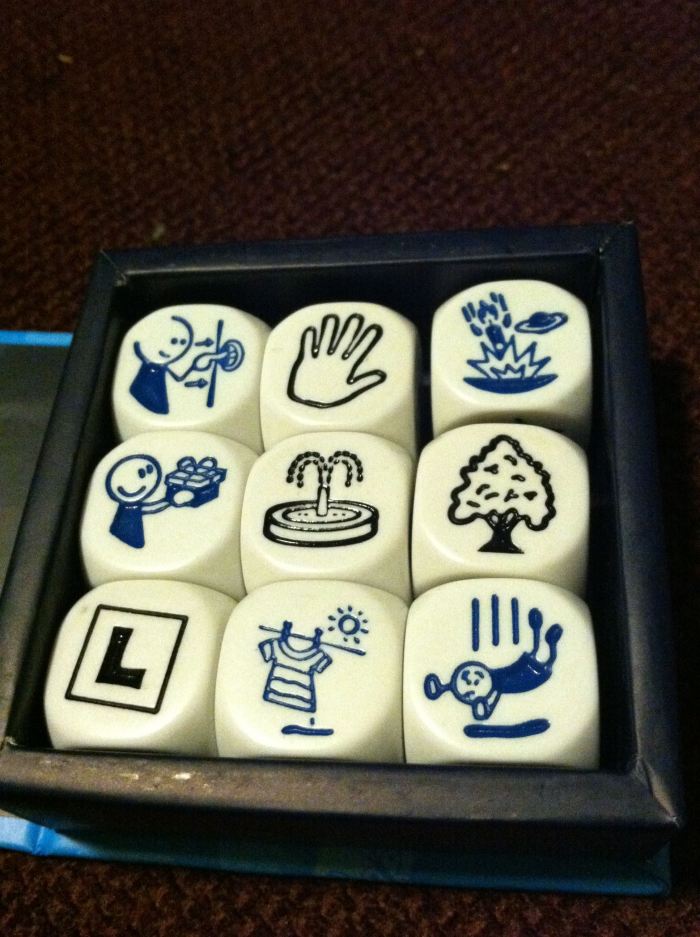
This is last week’s roll of the cubes: 

This is what I saw: l. to r. – ringing a doorbell; a hand; a UFO attacking (this one was tough); gifting/giving a present; a water fountain; a tree; the letter L; clothes drying/clothes hanging on a line; falling.

As a lot of my fiction does, the story, “Closure,” involves a recent historical event, which becomes obvious early if you remember your recent history.

As usual, if you can’t see the link on the title “Closure” above, go to the top of this post and click on the Spy Flash tab then select the story from the drop-down menu.

A Writer’s 10 Commandments

Several months ago I found “The 10 Commandments of Fiction Writing” inWriter’s Digest magazine. The list so resonated with me that I printed it out and taped it to a bookcase right next to my writing area. In the months it’s been there, I’ve glanced at the list from time to time, not necessarily for inspiration, but for affirmation. Writers always question why we do what we do, especially when the acceptances are few and the rejections many—or like me, when you find the whole rejection process so ego-bending, you get anxiety attacks when you contemplate submitting work. Glancing at these brief “commandments” helps focus me at times, mocks me at times, but reminds me a lot of the time that I can’t be anything except a writer.
Here they are with a few thoughts of my own.
I
Take yourself seriously
Sometimes hard to do when you don’t see the success you think you should have. I think part of taking yourself seriously is to do things that successful writers do—read, hone your craft, learn from your failures, continuously study writing. You have to write to be serious about writing.
II
Act like a professional.
That means not sending snarky e-mails back to a magazine or agent or publisher who rejected you. You can’t burn any bridge, narrow as it may be, you’ve built. It also means not stalking agents at writing conferences, insisting your manuscript will make you both rich. By the way, I’ve never done either of those things, but I’ve seen them happen, and I’ve been on the receiving end when I was an editor. For me, acting like a professional means be a professional writer. Check that spelling, use proper grammar (dialogue involving an uneducated person being an exception), master punctuation. When I was an editor, nothing said “unprofessional” to me more than a misspelled, ungrammatical, mis-punctuated mess. “You’re the editor; you’ll fix it,” wasn’t an excuse I’d accept.
III
Write your passion.
Note this didn’t say, “Write what you know.” It means write what stirs you, what inspires you, what makes you sit down at the keyboard and write. Your passion is all your own. No other writer will feel about that passion the same way you do. You may share the object of that passion, but yours is unique. No one can write about it as you do, so do it.
IV
Love the process.
For me, there’s nothing like the times I write when the words pour out as if they’ve taken control of my fingers on the keyboard and insist I make them take form. Then, I’m head over heels in love with the process. When the words hide in my head and refuse to stand in the light of day, loving the process is harder. That, however, is part of the process, so perhaps this one should be, “Love/Hate the process?”
V
Read—a lot.
It never ceases to amaze that people who call themselves writers don’t read a variety of other writers. They stay within a shared genre or limit themselves by reading only fiction or only nonfiction. As I look at the books in my bookcases or on my Kindle, the only word to describe my reading interests is “eclectic.” Some might say eccentric, but I’m going with eclectic. My life is a perpetual struggle to balance the two loves of reading and writing—when I’m doing one, I feel guilty not doing the other. A literary triangle, perhaps? One thing that has disciplined me is joining a couple of book clubs, one in person for nonfiction, one on-line for fiction. Peer pressure does have an influence.
VI
Stick to a schedule.
This is my biggest struggle. I genuinely try to write a little or edit something every day. “Try” being the operative word. When I retired, it was to devote more time to writing, and I have, but it hasn’t been the daily exercise I wanted it to be. I’ve tried setting specific days or times, but other things (i.e., life) pop up. I won’t be content until I’m “working” regularly at writing.
VII
Be critical of your work.
Let’s face it, not everything we write is gold. Trust me, it isn’t. I look back on my collection of short stories published more than a decade ago and realize, though the guts of the stories are good, I wasn’t ready to be published. I won the publishing contract in a contest, it had a deadline attached, and I took that bait and swam with it. I didn’t have the time to be critical about it, and that’s why I need to have something else, something I have been more critical of, published. As much as I’m glad I had the opportunity to be published, I don’t want that one book to be my only writing legacy. I’m about to start a writing critique group, an offshoot of the local writers group I belong to, and I hope that will help not only in being more critical of my work and in receiving constructive criticism but helping others, too.
VIII
Develop thick skin.
So, maybe a person who already has insecurities shouldn’t become a writer? I’m still amazed when someone tells me he or she likes what I’ve written. I know I like what and how I write, but I know I’m not for everyone. Frankly, the rejections are why I rarely submit work. I haven’t yet learned to separate the writing from the person. A rejection of a story I’ve written is a rejection of me. Intellectually, I know that’s not the case, but emotionally I can’t help it. The only way to overcome that, I know, is to keep submitting because one day the rejections will stop.
IX
Trust your editors.
When I was a reporter for an aviation magazine, my editor was a frustrated author. He’d published a novel in the 1950’s that won some awards and recognition but had nothing published since. This meant when he was my editor in the 1970’s, he rewrote everything. The first time it happened I thought my article sucked so much that I’d be fired, so I went to him for a critique. Oh, no, my article was fine, good even; he just wanted all the articles in the magazine to sound as if he’d written them. The light bulb came on—I wasn’t a reporter; I was a glorified researcher. That experience makes it hard for me to trust editors, and yet I know the time for me to continue to be my own editor is past. Trust has to start sometime. When I became the editor of that same aviation magazine, I had a “happy to glad” rule—if happy was the right word, I wouldn’t change it to glad without a damned good reason. The reporters who worked for me responded better to that than total rewriting, so I did learn something after all.
X
There are no certainties.
Ain’t that the truth? Not every manuscript is destined to be published, much less a best-seller, but we still play the odds. That’s because there’s no certainty it won’t be published either. It’s the uncertainty that keeps us writing.

National Short Story Month – Harlan Ellison’s “A Boy and His Dog”

We’ve probably had short stories in oral form since humans began to speak and told fanciful tales, but the “official” origins of the modern written short story are in the 19th Century when magazines could be printed rather cheaply. The short story in these publications became very popular and fueled the magazine industry from then until now. The magazines printing those early short stories weren’t technically literary magazines because they contained other, non-literary material. The 20th Century saw the rise of the literary magazine as we know it today, chock full of short stories, essays, poetry, and author interviews. But this isn’t National Essay Month (though I’m sure there is one), so throughout this month, I’ll blog about the short stories of particular interest to me.

There’ll be no specific order to the stories I’ll write about–no Top 10 lists–just ones that mean something to me. So, for me, the only logical starting place is Harlan Ellison’s “A Boy and His Dog.” This story is from Ellison’s story collection, The Beast Who Shouted Love at the Heart of the Worldpublished in 1969.

Ellison is primarily a short story writer, mostly in the Science Fiction and speculative arena, where he’s won just about every award in that field and a few literary awards as well. In the 1970’s and 1980’s he would regularly go to a book store in Los Angeles, pick a first line from a collection submitted by patrons of the store, sit down, and begin to type. Each page, typos and all and with no editing, would be taped to the front window of the store. People would stop and read or go inside and watch the process. Ellison is known for being an egoist and an all around difficult person, volatile and vocal about fools he doesn’t suffer lightly, but I met him at the World Science Fiction Convention in the early 1970’s, and he was perfectly cordial to me. After spotting me, gawking as he “debated” with his good friend Isaac Asimov, he took me aside and spent a good half hour alone with me, talking about writing and encouraging me to “keep at it.” It’s something I’ll never forget.

I could pick any of his hundreds of short stories, but “A Boy and His Dog” was the one that gave me the biggest “kick in the gut” when I read it. It takes place in a post-nuclear war world where men and their dogs roam a desolate landscape scavenging for shelter, food, and women. Vic, the Boy in the title, travels with Blood, a dog who is telepathic, the result of a pre-war experiment. Blood’s talent is “sniffing” out females for Vic to rape. Vic is able to “score” more women because of Blood’s talent and their ability to communicate silently.

A pretty dark and horrific premise, but as with most of Ellison’s stories, there is a comeuppance. Blood leads Vic to Quilla June, whom Vic rescues from mutants called Screamers. When she shows Vic she’s willing to have sex with him, Vic is confused, and Quilla June tells him of a paradise where he can have all the willing women he wants. Quilla June has been send to the surface by her father to seduce men and bring them to the “downunder” for breeding purposes. Vic is eager to go with her, but a suspicious Blood tries to dissuade him from following Quilla June. However, Vic is, well, thinking with his lower head. Vic descends into Quilla June’s underground Utopia and leaves Blood alone topside.

Quilla June’s world is quirky and rather like the Amish on acid. Everyone wears mime makeup, dresses like a 1950’s farm town, and people who don’t conform get sent to the “farm,” a euphemism for execution. One of the reasons downunder women go topside to bring men back is that so many get sent to the farm for the merest of reasons. When Vic arrives, Quilla June and 34 other women are set to “marry” Vic, but to Vic’s surprise there is no sex. He’s, um, tied down and attached to a machine that extracts his sperm, and his “wives” will be artificially inseminated. The town’s odd moral code, however, doesn’t allow unwed mothers, so the women have to marry before being inseminated. Quilla June knows that once Vic’s sperm has produced 35 pregnancies, he’ll be sent to the farm. Because she hasn’t enjoyed her deception–and she’s basically rebelling against the tyrannical rule of her father–and because she now loves Vic, she breaks him out, and they head back to the surface.

Ever loyal, Blood has not strayed from the point where Vic went underground. When Vic and Quilla June find him, Blood is badly injured and starving, near death. Quilla June gently encourages Vic to leave Blood, but Vic realizes he has only survived in his post-apocalyptic world because of Blood’s wisdom. He’s faced with a choice–the love Quilla June has for him alone or the loyalty of his faithful dog, who first and foremost needs food.

At the end of the story Blood is feeling much, much better and is no longer hungry, and he and Vic resume their travels.

A grim ending and not for the light-hearted, but it is gripping. Ellison moves easily from the violent, gruff, raucous, rapacious world of the surface to the artificial, gentile, cultured, and deadly world of the downunder. The changes in language and writing style reflect each world. The reader is left to wonder which is the worse of the two worlds, and the decision isn’t easy. What looks inviting about the downunder is in some ways more of a nightmare than the devastated civilization above. We don’t even cringe at Vic’s choice, because he’s a child of that nuclear holocaust, which occurred when he was small. Survival is all he’s ever known, and he did whatever he needed to until he met the restraining guidance of Blood. It is Blood who is the hero in a story that shouldn’t have any.

If you read “A Boy and His Dog,” you’ll not only look twice at the wolf inside your house; you’ll also want to read more Ellison. He’s a curmudgeon, but he writes like a son of a bitch.

Not So Bad After All

The local writers group I belong to–Staunton/Waynesboro/Augusta Group of Writers, aka SWAG–had its first open mic night on April 13. Six local writers–self included–read prose and poetry before maybe 12 people. The restaurant we were in, The Darjeeling Cafe, is awaiting its last government hurdle before opening to the public, but we could have a private party and “donate” money for a glass of wine. All completely above board.

The small crowd made getting up in front of some perfect strangers and reading my prose easier. The nice glass of Shiraz helped, too.

My first public reading was a decade ago, when a neighbor threw a book party for me to celebrate the publication of Rarely Well Behaved. The neighbor wanted me to read a particular story, her favorite, which included the use of the n-word by specific characters. It was essential to the story, not gratuitous, but it’s easier to write that word in the context of a fictional story than to read it aloud. I solved that by reading very fast, which meant people kept asking me to slow down. Next, I had a book signing and reading at a local Barnes and Noble. Again, the audience was people I knew, and I picked a different story, but I was still nervous.

What if they hated my work?

That’s the “what if” question that dogs my writing still and is probably what holds me back from pushing my work on agents and lit mag editors. For some reason it doesn’t matter that people read my work and compliment me and find positives in what I’ve written. I focus way too much on the fact that one person may hate it. I’ve long since given up changing my writing to please everyone else and write to satisfy my creative needs, but that insecurity drags me back.

For last night’s reading, I picked a story from Rarely Well Behaved, entitled, “When Gramma Came to Call.” The story is based on a dream, and though, on the surface, it appears to be a ghost story, it isn’t. I had a certain amount of comfort with it; it’s one of the less controversial of my stories. The audience laughed at the funny parts, commiserated when it got serious, and gave me a hearty round of applause. One person stayed behind after the evening was over to discuss it. It was a positive experience. I mean, I knew no one would likely boo me off the stage–we’re very polite here in the Valley–but there’s always the possibility you’ll put someone to sleep.

I know these are the things I have to do to be considered a “real” writer–do public readings, shamelessly plug my book, submit my work to places that will possibly print it (or reject it), encourage other writers by supporting their efforts to do the same. I’m just not a person who takes rejection well, and I can hear my therapist’s voice now telling me to separate the personal and professional. That’s hard to do when writing is for every writer a reflection of self, a glimpse into what goes on in our addled little heads.

So, next month at the next open mic night, I’ll be back up in front of strangers, baring my soul, and it’ll be fun.
_______________________

For National Poetry Month, here’s one of my favorite Seamus Heaney poems:

Requiem for the Croppies

The pockets of our greatcoats full of barley…
No kitchens on the run, no striking camp…
We moved quick and sudden in our own country.
The priest lay behind ditches with the tramp.
A people hardly marching… on the hike…
We found new tactics happening each day:
We’d cut through reins and rider with the pike
And stampede cattle into infantry,
Then retreat through hedges where cavalry must be thrown.
Until… on Vinegar Hill… the final conclave.
Terraced thousands died, shaking scythes at cannon.
The hillside blushed, soaked in our broken wave.
They buried us without shroud or coffin
And in August… the barley grew up out of our grave.

My Day Two–VA Festival of the Book

There are few things that will get me out of bed before 0700 on a Saturday morning, but a book fair will do it. My Day Two at the Virginia Festival of the Book was going to start at the Book Fair at 0900. I hit the road a little before 0800, stopped to get my favorite road breakfast from Starbucks, and then I was on my way to C’ville.

The atrium of the Omni Hotel was a sea of books and authors. Cliche, I know, but it was. What was very heartening to see were the number of African-American authors showcasing their work. Virginia hasn’t quite “gotten there” yet, but we have come a long way. I decided to stop by the James River Writers table. That’s the organization sponsoring the contest one of my novels is in. I just wanted to say thanks for the encouraging e-mail I got from JRW–yes, I’m sure all the finalists got an encouraging e-mail, but it was especially encouraging to me. I introduced myself, and the person there blurted, “Oh, your book is in the contest! Congratulations! We’re so excited you stopped by!” Yes, I’m sure they said that to every finalist who stopped by, but it was nice they remembered me. They were so boisterous, in fact, people stopped and took notice, and the JRW folks pointed to me and said, “She’s one of our novelists!” Nothing like a little ego boost to start the day!

Both panels I picked that day were moderated by a writer friend of mine, also from Staunton, Cliff Garstang. (Cliff’s award-winning book of linked short stories is In an Uncharted Country.) Cliff is a voracious reader and lover of the written word, and he brought his enthusiasm for his art to both panels. The first, Death: Another Time, Another Place, focused on murder mysteries and featured John Connolly (Nocturnes, Bad Men), Alan Orloff (Diamonds for the Dead), Deanna Raybourn (Dark Road to Darjeeling), and Paul Robertson (Dark in the City of Light).

Connolly, being an Irishman with the gift of gab (aren’t we all?), was a great opening “act” for the panel, and he discussed how an Irishman writing about Ireland had been done before. So he came to America to be an Irishman writing about Maine. I had read one of his books some years back, so I picked up Nocturnes, a collection of short stories with a supernatural bent.

Orloff draws on his Jewish background for his featured book and familiar places–to me–in the Washington, DC metro area for his mystery. He has recently started a mystery series featuring a stand-up comedian. He also described his writing process–a substantial outline that he fills in. Quite the engineering approach, but he is an engineer.

Raybourn’s featured book was the latest in her Lady Julia Grey series that take place in Victorian England. A former teacher with degrees in history and English (like me), she picked the Victorian Era she said because she wanted all that proper repression “with the evil peeking out from behind the curtain.” Her humor and characters reminded me of Elizabeth Peters’ Amelia Peabody series, so I decided to try Dark Road to Darjeeling.

Robertson’s book, Dark in the City of Light, is about the Franco-Prussian War, but what I enjoyed about his talk was that he does the same thing I do–take real characters and a true story and weave a mystery about them. Whereas he focuses on the 19th Century, I’m in the 20th, but it’s the same concept. So, I added Dark in the City of Light to my bookshelf.

All the authors were so willing to chat afterwards that I found it rather refreshing. Connolly and I chatted about my Irish grandmother, then Raybourne and I talked about the challenges of teaching when you know you weren’t really cut out for it. The good day just kept on going.

The afternoon panel moderated by Cliff was Historical Fiction. As I’ve said, I guess what I write is historical fiction, just focused more on current events than far in the past. I had a question already framed about the importance of research, but Cliff was way ahead and posed it to the panel. Paul Robertson was a repeat from the morning, joined by Brenda Rickman Vantrease (The Heretic’s Wife), Lenore Hart (The Raven’s Bride), and George Minkoff (The Leaves of Fate.)

Vantrease’s featured book was her third with the concept of freedom of thought and religion. She took a real person associated with Sir Thomas More and made that person’s wife (whose name is lost to history) the protagonist. She also showed More in an accurate light. Many people choose to ignore that he burned  at the stake a lot of people he considered heretics.

Minkoff has spent years working on a trilogy which takes place in England and America around the time of the Jamestown Colony. John Smith, Powhatan, and Pocahontas are key characters, but accurately portrayed. Minkoff has also studied the language of the time and has his characters speak like true Elizabethans. It was obvious the tremendous amount of research he’s conducted to produce this trilogy, but he emphasized the point that you research to put yourself in the time and place, you read book after book for that knowledge, but you don’t just regurgitate what you’ve read. The research gives you the voice.

Hart, named for the Lenore in Poe’s “The Raven,” decided not to ignore that connection she had with Poe, but she didn’t want to write historical fiction with Poe as the main character. “Done to death,” she said. She opted instead to write about Poe from the point of view of his dead wife–the lamented Lenore and Annabel Lee of his poetry. She read from the first chapter of The Raven’s Bride, a scene where Mrs. Poe goes to hospital to see her “Eddie,” and it takes her a few minutes to realize she’s a ghost. I’d already purchased Robertson’s book, so I added Hart’s to my collection.

It was a great two days of books and writers. I love being around writers, especially those who’ve enjoyed initial success. They are so accepting of fans and other aspiring writers, so much so that for next year I can see myself on the other side of the table, maybe signing my book. Yep, I can’t wait ’til the next Virginia Festival of the Book.

Virginia Festival of the Book

Enough of the politics and disaster blogging. Let’s write about someting exciting for a change–like writing.

Since Wednesday, Charlottesville has been hosting the 17th Annual Virginia Festival of the Book. It’s four and a half days of books and writers and panels about writing and publishing. Great stuff. (For a look at the events and history of the Festival, go towww.vabook.org.) The Festival covers all prose genres and poetry, and if you buy tickets in time you can listen to luncheon speakers like Kathy Reichs and Jim Lehrer. Apparently, you needed to buy those tickets last year because by the time I got to the Web site in early February, the events were sold out. I could only live vicariously through people I overheard talking about them in the hallways.

On Friday, I picked two panels to attend: Novels about Novelists and Worlds of Danger.

The Novels About Novelists panel was held at WriterHouse, whose mission is to “promote the creation and appreciation of literature and to encourage the development of writers of all levels by providing affordable, secure workspace and meeting space, high quality writing instruction, and literary events for the public.” (For more info on WriterHouse, go to www.writerhouse.org.)

The three authors and their books were Martha McFee (Dear Money),John McNally (After the Workshop), and Carolyn Parkhurst (The Nobodies Album).

McFee’s book is about a successful novelist who decides she needs to make more money and so decides to give up writing to be a bond trader. McFee herself described it as “an intersection of commerce and art with a focus on commerce over art.” An interesting premise to be sure, but I wasn’t that interested in reading about someone giving up art to become a money-grubbing capitalist. However, McFee read a portion from Dear Money that perfectly showcased society and media in New York City–it was a spot-on caricature of the “ladies who lunch” in present-day Manhattan. McFee explained that her protagonist does feel as if she’s betraying her art, almost as if she’s having an illicit affair. It allowed McFee to explore how it would feel to give up writing but not really do it.

In After the Workshop, McNally wrote about an aspiring writer who graduated from a prestigious writing workshop, only to stay in that city and work as the meeter/greeter who shepherds other writers around the city when they come to teach at the workshop. That much, McNally indicated, was autobiographical; however, with several books published he has no further relation to his protagonist. McNally read a passage describing his protagonist’s encounter with an agent–wildly comic but poignant at the same time. McNally described the writer in his novel as someone who continually questions his talent and everything else about his life. That one was a purchase for me, because I’m always questioning whether I can really do this (writing) or not.

Parkhurst’s topic in The Nobodies Album was the most intriguing–a successful novelist who decides to re-write the endings to all her published works while having a personal crisis with her son. Parkhurst described the draw on her creativity when she had to create two endings (original and revised) to several non-existent novels. She remarked that some people at readings don’t believe her when she says these novels don’t really exist–they want to know where to buy them! That one was a purchase as well.

In the discussion afterward, the moderator pointed out, in each book, the novelist-protagonist was not writing. Parkhurst replied, “That isn’t very exciting–a novel about a novelist writing!” What is interesting, she explained, is exploring what keeps us from writing. The moderator also pointed out that in writing about novelists who aren’t writing, there really is a lot about the craft of writing in the books.

Worlds of Danger featured authors whose books were about fear. Pearl Abraham (American Taliban), Carla Buckley (The Things that Keep Us Here),and Sheri Holman (Witches on the Road Tonight) called on different aspects of fear. Abraham described her novel as “how did we get from ‘we have nothing to fear but fear itself’ to fear 24/7” after 9/11. Buckley’s idea came to her during the hype around the H5N1 possible pandemic a few years back. Holman’s book is basically about fearing your past.

Abraham’s book is loosely based on John Walker Lind, the so-called American Taliban captured by the CIA during the initial war in Afghanistan. Lind is now in prison for joining a terrorist organization but was almost put on trial for the murder of a CIA contractor even though he was nowhere near that event. Buckley, who is married to a scientist, came up with her novel concept after her previous nine mysteries had failed to get published. She and her husband had moved from a community where they were well-established to a new city where she had no friends or community support–at the height of the H5N1 crisis. In the midst of wondering what she would do to protect her children if the pandemic did happen, the idea for the novel came to her in a nightmare. Holman calls on folklore from the Appalachians and a former late-night horror movie show host to examine how our past creates fear for our present. The selections these authors chose to read convinced me to buy all three.

Book total on my day one at the Festival: five. Oh boy, here comes the trade-off–write or read?

Tomorrow’s post: Report on my Day Two at the Festival–the Book Fair and two more panels.