Time Flies When You’re Having Fun

When you cultivate a group of writer friends and ask them to read and critique stories and manuscripts, an important obligation as a good writer friend is to reciprocate. So, when one writer friend who gave me excellent feedback on my work in progress asked me to do the same for hers, I jumped at the chance. I’d seen the first two chapters of her WIP in my last two workshops at Tinker Mountain and had been eager to read more.

I was so eager, in fact, when I picked up the MS yesterday morning, I didn’t put it down all day–which is why Monday’s post is happening on Tuesday. But it’s great when something lives up to your expectations. When my friend’s book gets published–and it will–this will be my first experience with the evolution of someone’s work other than my own, and it’s a humbling experience. Humbling, in that I felt honored she asked me to read it, that she values my opinion.

Here’s the thing. She doesn’t expect sycophantic raving about how good it is. (Trust me, though, it is that good.) She wants a writer’s eye and honest criticism, which she’ll get from me. Again, I got that from her, and I’ll return it in kind. And I’ll get a little thrill when I buy my copy, knowing I helped in some small way. So looking forward to that.

And new topic. I’ve been working on the next set of stories for Spy Flash 2. (In case you didn’t know it, last year I published a collection of my espionage short stories, Spy Flash. To read all about it, scroll to the top of the page, click on the Published Works tab, then click on Spy Flash from the drop-down list. You can click through to purchase it from Amazon.com, and, oh, by the way, if you buy the paperback, you can download the Kindle version for free. Commercial over.) One thing which has stood out for me is the way odd words unconsciously work their way into a story.

One story had an inordinate use of the word “just” and not the adjective, as in a “just cause,” but the adverb, as in “at this moment” or “in the immediate past.” Okay, one or two usages, maybe, but I found this usage in a couple of sentences per paragraph. I don’t remember typing them; it was as if they “just” appeared. Of course, that’s not the case. The word popped into my head–quite a few times, apparently–and I wrote it. In most cases, there was no need to substitute a better word; deleting “just” made the sentence stronger.

A few weeks ago, I had the same thing happen with the word “always.” Ack! Where are these crutch words coming from?

I suspect because I do a lot of “pressure writing,” i.e., meeting deadlines and word count goals I’ve mostly set for myself, they filter in, and I let that happen because subconsciously I know they’ll come out in the wash, or edit. What surprises me, though, is how often they show up.

And now I’ll bring this back around to the original topic. This is why having a group of writers who’ll critique you with honesty is important. They won’t let you get away with “just” and “always” or whatever crutch word creeps into your work. If you don’t have a group, find one or create one. Social media are great for this. Part of the joy of writer conferences is meeting and networking with many different types of writers from all over. Social media allow you to form critique groups without having to be face-to-face, and, even then, there’s FaceTime and Skype.

Don’t fear the critique. Embrace it. And watch out for those crutch words.

Line Editing Blues

Well, not blues actually, but that caught your attention, didn’t it?

One of my beta readers for the novel I’ve been working on exclusively this summer not only sent comments back but a line-edit of the manuscript as well. And here’s the lesson learned: No matter how great an editor you are (and I have thirty-plus years’ experience editing other people), you cannot use yourself as your final editor. This beta reader didn’t find many typos (my bane), but she did find overuse of words, overextended dialogue, and over-explaining. However, those incidents of “overage” weren’t pervasive, just here and there, and I can make those fixes, easy-peasy.

Her general comments as well were good, and here’s another lesson. There is one suggestion she made, with which, right now, I disagree. It’s the merest hint of a new relationship for one of the characters at the very end of the work, and since I’m a sucker for happy endings (I didn’t get one), I don’t want to cut that. Don’t get me wrong. I respect this writer’s opinion, but for now I’m leaving it as is (maybe a little editing to make it even more subtle, though). I am, however, open to cutting it completely based on additional feedback.

When you’re open to feedback from others, especially people whose writing you respect and admire, you’ll be pleasantly surprised how their comments/edits improve your work. When I saw this beta reader’s line-edits, I smacked my forehead so often I may have given myself a concussion. They were obvious, so why didn’t I see them?

Duh, because it’s my work, and don’t you know my words are all gems?

Except when they aren’t. That’s why we’re word-blind for our own stuff. You can edit and revise, revise and edit, and then someone else still points out something you need to fix. These aren’t “happy to glad” edits; they tighten the work, they make the story more tense and intense, and they improve the overall product. I am forever grateful, and she and the other beta readers will be high on the list in the Acknowledgement section of the published work. When this novel gets published (I’m being positive, here), I know it will be in large part because these fellow writers helped make it publishable.

So, Indie authors, the next time you decry the use of professional editing and/or the use of beta readers because you think they’ll ruin your stellar work, think again. Let’s open our minds to the possibility they can make a good work brilliant.

Obsessive Manuscripts

Well, I finally finished the line-edit of the rewrite of my rough NaNoWriMo 2012 manuscript. Actually, it was two line-edits: a mark-up of a printed copy of the MS, and an on-screen edit after I’d incorporated the first set of line edits. I reached the point where I was tweaking the tweaks or making what, as a magazine editor, I used to call “happy to glad changes.” Enough was enough. I stopped editing and sent a copy off to four writer friends who had agreed to be beta readers.

So, what did I learn, aside from remembering not to do “happy to glad” changes?

Well, for one thing, I found I can re-write a 400-page manuscript in two months’ time, but only if I do little else except that.

Excessive use of dialogue tags is great for padding your NaNoWriMo word count but tedious when you’re editing.

A manuscript can take over your life. You think about it when people are talking to you about something else. You dream about it. You bore other people explaining about how you decided to cut a whole chapter because it didn’t really add to the story. It intrudes when you’re trying to write about something else, and you feel guilty when you’re paying attention to it and not other writing projects. Then, you feel guilty when you’re working on other writing projects and not it. It (the MS) obsesses you; you’re obsessed with it; it’s an obsession.

And that’s a good thing.

I suppose.

No, no, it is, it is. Really. But, even after you’ve sent it off to the beta readers, you still think you should be editing it. Nothing big comes to mind. No plot holes except those you’ve already found, but it’s hard to be patient and wait for the betas’ comments.

I have to say, though, I’m really, really proud of this manuscript. I like the characters, the story, the settings, the twists and turns. I’m glad what started out as a suggestion in a comment on a 100-word Friday Fictioneers story turned into a 385-page, fully developed novel not involving spies and guns and intrigue.

Don’t get me wrong. I won’t ever stop writing about those things. Rather, the change of pace was challenging, and I hope I met the challenge. We’ll see. It’s another of those things you have to be patient about.

Did I mention I’m not a very patient person? I’m more the “why wait for it when you can go out and get it done” kind of person. (Of course, as anyone who knows me will allude to, I’ll think it to death before I act on it.) I’m more than eager to get this MS before some agents, but I also want those agents to see the best possible manuscript; so, patience it is.

Sigh.

Friday Fictioneers Work up a Storm!

I actually feel a bit odd not having a writing conference to go to this weekend. In fact, I don’t have another one until October, which will close out my year of writing conferences/workshops until January of next year, when it all starts all over again.

This week and this weekend will be consumed with my line edit of the rewrite of the draft of the novel whose excerpt went over very well in this past June’s Tinker Mountain Writers Workshop. Several of my classmates from that workshop and the 2012 one have agreed to read the MS and provide feedback, so I hope to get that process started next week.

And I haven’t forgotten I need to do an in-depth post on last weekend’s “A Gathering of Writers” in North Carolina.

I am worried, though, that I’ve been so focused on editing/revising (which is important, don’t get me wrong) I’ve not been able to do much original stuff of length. I love flash, and I’m always inspired by the prompts from the two flash exercises I participate in weekly. Rather, I need to expand a little and go back to pieces that are longer–considerably–than 100 or so words. After all, NaNoWriMo is just two months away, so I need to get into the habit of at least 1,700 words–a day!

Friday Fictioneers LogoToday’s Friday Fictioneers photo I’m sure has inspired many different genres, but for some reason it led me to one of my favorite genres to read–the ghost story, i.e., the subtle ghost story. Don’t let the title, “Socratic Method,” put you off. As usual, if you don’t see the link on the story title in the line above, scroll to the top of the page, click on the Friday Fictioneers tab, and select the story from the drop-down list.

A Little Respect for NaNoWriMo

During the critique of my novel excerpt in my Tinker Mountain workshop, I mentioned I’d completed the rough draft during National Novel Writing Month, and a small discussion ensued. The instructor, Fred Leebron, had a dim view of NaNoWriMo based on other workshops where people had submitted excerpts from their own NaNo works. Needless to say he wasn’t impressed.

Another workshop member sneered that NaNoWriMo emphasizes “quantity over quality.” That’s true, but it doesn’t necessarily mean quantity can’t become quality, I pointed out. I referred that person to the website, where the Office of Letters and Lights emphasizes editing and revising a NaNo draft, but I conceded you can lead a horse to water but can’t make it drink.

Later, during my one-on-one conference, Leebron admitted that he had a new respect for NaNoWriMo, given the quality of my work and another person’s workshop piece, also from NaNoWriMo. I explained that I do nothing with a NaNo draft for six months, then I pick it up and start revising. I also explained that the first twenty pages I’d submitted for the workshop had been worked and reworked during a writing retreat in May and honed especially for Tinker Mountain. The rest of the draft, I explained, needed a lot of work. Nevertheless, Leebron conceded he had new respect for NaNo but wished that every participant didn’t rush to publish or to submit to workshops before editing. I agree.

Of the two NaNoWriMo-ers in the workshop, I’m the seat of the pants writer. The other was an outliner. Now, I’ve done both, and, in fact, the only other NaNoWriMo MS I’m particularly proud of is one I meticulously outlined before November 1. Last year’s effort came from a germ of an idea in a piece of flash fiction I did for Friday Fictioneers. Either way works, but in some ways it’s the aftermath of NaNoWriMo that matters. The hype goes toward the build-up to November, to the daily word counts, and hitting that 50,000-word mark in thirty days. OLL can’t force you to behave like a professional writer and edit that MS–edit as in critically look at it and revise it into a polished MS. That’s up to the writer.

There are very few–I’d say negligible–writers who can go from a rough draft to a viable published work in those thirty days. For one, since the word count is what’s important, I’m finding that in my revision of last year’s MS, I’m eliminating about three-quarters of the dialogue tags. Using them for every line of dialogue is great for word counting but distracting when reading. Sometimes it’s the small things like that which distinguishes a professional MS from a rank amateur one.

So, I offer this challenge to fellow NaNoWriMo-ers: Do your part to enhance NaNoWriMo’s image in the literary world. Don’t publish that MS right away. Polish it. Edit it. Revise it. Run it through a critique group. Do whatever you need to do to make certain it reflects well on you as a professional writer. Making NaNoWriMo look good is just a pleasant side-effect.

Off to Retreat!

This week I’ll be at The Porches in rural, central Virginia at a writing retreat put on by one of my writer friends, Mel Walsh Jones. Since it’s my first writing retreat, I’m not sure what to expect, but I’m hoping I get a lot of editing and revising done on the rough draft I completed for last year’s National Novel Writing Month.

Mainly, I’m looking forward to getting away from all the distractions my house and home town can offer and communing with other writers and perhaps a bit with nature. So, a short post today, and I’ll write more about how the retreat went next week, after I return.

Heading in a New Direction

Off and on for the past fifteen years I’ve been working on my magnum opus–a multiple book series on an actual event of domestic terrorism. Fifteen years may seem like a long time, but for twelve of those years I had a full-time and demanding job plus an actual social life. That, and the research was not only extensive but sometimes mentally taxing.

I composited real people into fictional characters but stuck to the history as it’s known in public records. I changed the names to protect the innocent–and to disguise the guilty. I filled holes in the historical record with fiction, but fiction extrapolated from the research. In all that time, the only thing I didn’t change was the location of the event of domestic terrorism.

Until now.

I’ll digress a bit to again recommend that writers participate in critique groups. Not only do you get an honest appraisal of your craft, but you get the reactions of readers–both needed before you think about publication. Locate a critique group and join one. You’ll find it useful beyond measure.

Book one of this series is going through my critique group, and the comments and suggestions have been just what this series needed. And a key comment was about keeping the location historically accurate. When the critique group members started making suggestions about plot, I kept having to respond, “But the reality is this or that.” My critique group quite rightly pointed out that by sticking to the actual location, I was boxing myself in.

At first, the thought of changing all the references to the actual location was daunting. Book one isn’t an issue; it doesn’t even come up in that. It’s book two and three where the first veiled hints get dropped, and in book four that particular setting is critical. So, I debated long and hard with myself about whether or not to change it and came to the only logical conclusion.

I changed the location, moving it one state north then one state east. Sounds simple, right? Not. There are hundreds if not thousands of allusions to this location, including physical descriptions of buildings, locations of streets and landmarks, and dialogue. Doing  a global search-and-replace won’t cut it. It means yet another methodical and thorough edit.

And maybe that was the point all along.

All fine and good, but when you’re planning to publish the series so that book four appears in the month of the twentieth anniversary of said event, it’s not so convenient. Convenience, however, isn’t a consideration. The art and the craft of writing are the major considerations, so I’ll do it. I’ll grumble a bit–well, a lot–but I’ll get it done, in the knowledge it was the right decision for the story I want to tell.

An Early Holiday Present

December seems to be a month of publishing firsts for me–my first collection of short stories, Rarely Well Behaved (out of print) appeared in December 2000. I remember when the proof copy arrived as if it were yesterday. Never before had I held a real book with my name on it as the author. I had approved the cover (based on my suggestions) a Scan 2few weeks before, but to see it on the book was a whole different experience. As I flipped the pages and saw my words there, I thought perhaps I was dreaming.

When I “refreshed” the short stories in Rarely Well Behaved this past year and reissued them as two eBooks then paperbacks with new covers, I was pretty excited, but it wasn’t the same kind of feeling as holding your first published work in your hands.

I’m hoping the past is prologue for a whole new collection of short stories–short, short stories–coming out this month. (Fingers crossed that it won’t take me twelve years for the next book.)

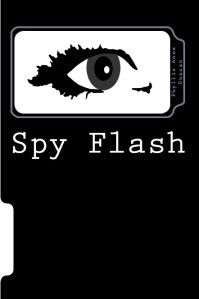
Spy Flash is a collection of flash fiction stories I’ve written over the past year in response to Jennie Coughlin’s Rory’s Story Cube Challenge. Each week Jennie posted a picture of a roll of a nine-cube combination of object and action Story Cubes, and based on those objects and actions, I wrote a story, usually of fewer than 2,000 words. There was some cube repetition, and I pounded my head on the desk a couple of times trying to think of different ways to use a pyramid, beyond the obvious.

About ten stories into the adventure, which I initially intended just to use to explore back story on the two main characters in my novels, I starting thinking about what to do with the stories. Somewhere along the line, I decided I would compile them into a collection of linked flash fiction. Even though I’m sure it’s been done, I thought that rather clever. (Hey, I’m an infrequently published writer; someone needs to brag on me.) I also thought the possible title clever as well. I mean, what else would you call flash fiction about spies except Spy Flash?

I then decided once the story count reached twenty-five, that’s when I’d compile them into a collection. I began the compilation again about ten stories in, and the first thing I noticed was that inserting them into the manuscript in the order I’d written them and published them on my blog resulted in massive incoherence. So much incoherence, in fact, I doubted the decision to compile them after all. They were linked in that they were about the same people in a specific profession, but because I had moved back and forth on the timeline of their careers, the vignettes were a jumble. For a while, I couldn’t come up with a solution. I liked each story individually, but I didn’t like the whole they made.

So, I set the idea aside awhile–always a good thing. I continued to write the stories, but I really felt as if I were just compounding the problem. Finally, when I had the twenty-five stories, I printed the manuscript and skimmed it. Still a jumble. Then, I had one of those forehead-smacking, “duh” moments and rearranged the stories in chronological order. Hello! The whole thing made sense now. It had a logical flow, and, if anything, the stories were even more linked. Then, I found if I added transitions and references to earlier stories, what had been a jumble of disconnected snapshots became a big, coherent picture.

Once I completed a revised draft of the manuscript, I realized I hadn’t been this excited about a work of mine since Rarely Well Behaved.

And the cover for Spy Flash? I wanted something dark and mysterious, something that conveyed spying as well as the less exciting aspects of espionage. What better than a black Spy Flash Cover 2.dofile folder and an all-seeing eye?

As of today, I’m waiting for the proof copy of Spy Flash to arrive, and I know when I hold it in my hands I’ll have that giddy feeling of accomplishment. I’m a much better writer twelve years down the road thanks to a lot of people, and I’ll be just as proud of Spy Flash as I was of Rarely Well Behaved. I’ll again rue that my Dad won’t see it and that my brother–the guy who hated to read but read my first book–won’t see this one.

For a long moment I’ll savor that feeling of “yay, me, look what I did,” then reality will set in–lining up book signings and arranging the publicity because, hey, I’m not John LeCarre or Alan Furst. I’m just Phyllis Anne Duncan, who’s pretty excited about the publication of her second, original book of short stories.

Dueling Manuscripts

Even though I crossed the 50,000-word goal for my NaNoWriMo project for this year, the first draft of the manuscript itself isn’t finished. There are two to three big scenes left to wrap the story up, and I have them mapped out in my head. I figured for the next few days I’d devote the time to fleshing them out completely.

Good plan, right? Just after I started NaNoWriMo this year, a different manuscript–from NaNoWriMo two years ago–finished its journey through my critique group. I got excellent feedback from that experience: no major plot holes but several very good suggestions on how to tie up a couple of threads. I took copious notes because I knew my focus would be on this year’s NaNoWriMo first draft. The plan was to pick the other manuscript up after November 30.

As a countryman of mine once wrote, “The best-laid schemes of mice and men go often awry.”

I woke early this morning with the critique group manuscript in mind. In fact it superseded everything on the calendar today, including a doctor’s appointment where the physician’s assistant kept asking me if I were listening to her. The rewrites I needed to do based on the suggestions were crystal clear, so clear, in fact, that during the time I normally reserve for morning coffee and the newspapers, I immediately wrote them down so I wouldn’t forget. All right, I thought, that should have put the nagging need to fix the 2010 manuscript to rest, because the “best-laid scheme” was still to pick this manuscript up after finishing the 2012 NaNoWriMo first draft.

But no, that wasn’t how it worked. I’ve spent the better part of the day going into the 2010 manuscript and fixing that thread. That meant adding/changing dialogue in eight or nine chapters then doing a quick review to make certain I hadn’t created other loose threads by weaving together the previous one.

Despite not adding to the 2012 word count–that will come later today–I’ve got that goose-bumpy feeling a writer gets when you know you’ve made a breakthrough on a manuscript. Now, this particular manuscript is the closest of any of the ones I have in various stages of completion to being ready to shop around. For that reason, I’m glad it was so insistent that I should drop everything (including the regular Monday morning writing blog and lunch, apparently) to get that fix made.

The truth is the remaining scenes for the 2012 NaNoWriMo wouldn’t turn out the way they needed to because of the distraction. Sometimes, though, distractions are good. If I’d ignored the need to fix that older manuscript, it would have colored my work on the current one. So, I gave into it. Bad writer planning? Bad craft? Maybe to some, but it’s obvious to me it was exactly what both manuscripts needed.

Now, let’s hope that all the other MSS stay quiet for the remaining eleven days in November!

Quashing the Inner Editor – For a While

This past Saturday I went to a National Novel Writing Month (NaNoWriMo) write-in in Harrisonburg, VA. Seven of us made it and commandeered a corner of Panera to have some writing fun–word sprints, where you write as many words as possible in a set amount of time, and the “no backspace” game.

The “no-backspace” exercise really suppresses your inner editor, and the exercise consists of writing and not backspacing or deleting anything, not even a typo. The person who can go the longest without backspacing is the winner. In the first go-round, I lasted six words; I made it to about 200 words the second time around, but, oy, what a mess!

The concept of NaNoWriMo is to write without editing yourself in the moment. That comes later. By not editing as you write, NaNoWriMo-ers believe you tap into creativity that pausing to edit disrupts. Writing purists may cringe at such seat of the pants writing, which does sacrifice structure to a certain extent, but I find it particularly liberating.

A few weeks ago at the James River Writers Conference I heard Tim Robbins explain his writing process. The reason years pass between his works is because he literally perfects one sentence at a time and doesn’t go back to revise when the book is done. When he finishes a book, he considers it edited and revised because of this rigid method.

I’m not dissing that sort of structure; in fact, I admire it, and, obviously, it works for him. I’ve always been the type of writer to get what’s in my head down on the page, then I go back and “fix” it–rather a middle ground between a seat-of-the-pantser and the dedicated structuralist.

When I’m not doing NaNoWriMo writing, which, by the way, is eleven months out of twelve, I typically start the next day’s writing with a review and rework of what I wrote the day before. That refines it for me and gives me a basis to begin the next part. It’s true I rarely work from a written outline, but I usually have the structure in my head. I’ve always jotted down notes and ideas for anything I’ve written, but I, personally, find a detailed outline confining. I haven’t adhered to one yet.

The free-wheeling aspect of NaNoWriMo is what appeals to me, to just sit down and write without second guessing a sentence or what a character says or whether this is the direction the story should go. I know I’ll go back and fix that later, and the very act of putting the editing and revising off for a period of time, unleashes my brain.

For example, I had a fairly detailed list of scenes I’d foreseen for this year’s project, but somewhere about a third of the way through getting those scenes fleshed out, a new direction emerged. Frankly, you can’t ignore that. You can’t limit yourself to an outline or a list of scenes and not be flexible. At least I can’t. If the idea pops up that I need to go over here and explore something, I have to go do it. I may end up tossing it out in editing and revising, but I have to write it when it manifests itself.

The NaNoWriMo project from 2009 wound up in an entirely different way than I ever intended. The idea came to me that I should kill off one of the two main characters I’ve written hundreds of thousands of words about, so I did. It was an amazing writing experience to explore the thoughts and feelings of the person left behind (and a great outlet for those same feelings after the break-up of my long-term relationship).

When I got to the revision stage, though, I knew it was wrong. I’ve joked the character tapped me on the shoulder and said, “It’s not my time, yet.” Purists scoff at the idea that characters speak to you or direct a story, but I know what I know. The character was right; I knew I wouldn’t be able to write more stories in the genre I’d chosen if he weren’t around.

That’s not a wasted manuscript though; I’m incorporating large portions of it into another plot. Another NaNoWriMo MS I’ve mined for short stories. Yet another, after editing and revising, just completed a trip through my critique group, and after another set of revisions, will be ready to see if someone is interested in publishing it. I haven’t touched the MS from last year (2011), but that’s on my list for projects in 2013.

This year’s? I’m so pleased about the direction it’s headed and the fact I decided to strengthen my literary fiction skill set, that it will be a 2013 revision project as well, probably toward the end of the year to get time and space between the writing and the revising.

NaNoWriMo is neither futile nor frivolous. It is, however, what you make of it. If you treat it as a creative way to develop a first draft, it can be very fulfilling. And great fun.

NaNoWriMo Update

This weekend, eleven days into the adventure, I hit the 30,000-word threshold. At the NaNoWriMo average of 1,667 words per day, by day eleven 18,337 words would have put me on track to finish with 50,000 on day thirty. Well, I’ve always been an overachiever.

The point is, without that artificial stimulus, that “imposed” deadline, I would never have written an average of 2,700 words a day. That’s worth it to me.