Getting Your Name Out There

Haiku 366-191 to -208 will come soon, but today I thought I’d get back to a post about fiction and the struggle of every indie author–getting people to give your books a chance.

I’ve ranted before about the quality of some indie publishing, but as I’ve read more and more of it, I’m finding the truly awful (i.e., unedited, misspelled, and grammatically deficient) is fast becoming a minority. Add in Barnes and Noble, that behemoth of traditional publishing, will allow indie published work in its stores (at last), and the writer, who decides to forego the traditional and often demoralizing hunt for an agent and a publisher, is getting R-E-S-P-E-C-T. This is especially heartening for those who took the time and effort to publish a polished product and who didn’t succumb to the coveted “published author” title at all costs.

So, before this becomes a rant: join a critique group, hire a professional editor (for all stages of editing), design or purchase a professional cover, hire a proofreader, and, if you’re not familiar with a book’s interior design, hire someone who is.

Now, onto “getting your name out there.”

An Unexpected Find

I’ve always believed my books about my spy characters would be successful if I could “get them out there” where people could see the depth of the characters, the timeliness of the subject matter, and the pains I’ve gone to for an intriguing story. I’ve done the bookmark thing, the postcard thing, the purchase-an-ad thing, the book signing thing, the open mic thing, but what more could I do without bankrupting myself?

At Virginia Festival of the Book this past spring, I came across a local fantasy writer who’d purchased a table at the book fair. I almost walked past because I’m not much of a fantasy reader. However, on one corner of her table were several small (as in thin) books with a sign that said “Free.”

“Free?” I asked the author.

“They’re short stories featuring my characters and aspects of the mythology I’ve built,” was the reply.

“And you give them away?”

“Bookmarks and postcards get thrown away. When someone’s done with one of these, they won’t throw them away. They’ll give them to a library or a used book store, and that’s exposure. Hell, maybe they’ll even keep them.”

I must have stood there gaping with the shock of “why hadn’t I thought of that” because she picked up two of the “booklets” and handed them to me. “Enjoy,” she said.

Back home when I unpacked my goodie bag from the festival, I came across the two booklets and sat right down to read them. The author was right. They were engaging, a quick read, but complete, well-crafted short stories and certainly piqued my interest for her longer works.

But life moves on, and I put them aside and forgot about this unique marketing idea.

Imitation and Flattery

After polishing off the edits on a couple of draft novels, which I hope to have ready for the demoralizing agent hunt (Yes, the dream is still alive in my head.) later this year, I decided I wanted to go back to writing some short stories, not the flash fiction I’ve been delving into for years, but a true short story of 7,000 to 8,000 words. I’d come across an article in The Washington Post about Russian security services allegedly harassing diplomats in Europe and Moscow–juvenile pranks mostly, but they were escalating. The Russian government, of course, disavowed any participation on its part, but those of us who’ve studied that country throughout its iterations knew better.

The result: a 7,500-word short story called, “Spymaster.”

And the booklets from the Festival of the Book came back to mind. What if (a writer’s favorite question) I used CreateSpace to make that short story into a booklet to give away at book signings and over events. At CreateSpace, it’s free to publish, and the size of the booklet means ordering copies for my personal use will be a minimal investment.

Imitation, after all, is the sincerest form of flattery.

The story is with a beta reader/editor right now, but while I’m waiting for the feedback, I went ahead and designed a couple of cover possibilities.

If you’ve never heard of Canva, it’s a great online tool for designing a number of graphic art pieces, from Facebook page headers (go to https://www.facebook.com/unspywriter and have a look at one I did for my author page using Canva) to Instagram posts. Canva has templates for ebook covers, including Smashwords and Kindle. Most of their artwork is free, but even the ones you pay for start at a dollar a piece. Unlike another good resource for professional covers, http://www.selfpubbookcovers.com/index.php, where once you buy a cover, it’s taken down and not sold to anyone else, with Canva you risk having the cover you choose used by someone else. Of course you can customize it. I remove all the sample text on the Canva cover, download it as a .jpeg, and further customize it in Photoshop. Canva’s selection of free graphics is limited compared to SelfPubBookCovers, but I managed to find a few that appealed to me and fit the theme of the story, “Spymaster.”

“Spymaster” Cover #1

SPYMASTERThis cover appealed to me because one of the critical scenes takes place in a forest in Eastern Europe. What it’s lacking is color. The story has dark elements, but not quite this dark.

It fits the story but to me has limited appeal in getting someone to pick it up and look at it.


“Spymaster” Cover #2

SPYMASTER3This cover also appealed to me because of a specific theme in the story. Again, it’s black and white. While it’s certainly intriguing and I know people who would pick up a book with a cover like this, it lacks color. I experimented with other fonts and putting the type in different colors, but that didn’t quite work either.


“Spymaster” Cover #3

Spymaster 2The final choice appeals to me visually, has excellent color, and is very evocative. It doesn’t directly relate to a scene in the book, but it screams “intrigue” and “mystery.” I know I’d pick up a book, even a free one, with this cover. Of the three choices, this is certainly the one I’m leaning toward.


But what do you think? Which cover appeals to you and why? Let me know in the comments below.

New Trilogy Debut – Book One: Mark of Four

Any student of ancient history knows science in its earliest iteration posited that everything around us was made of earth, air, fire, and water. Scientific progress has shown us the elements now number more than one hundred, but what if (oh, that favorite prompt for a writer) in a future dystopia the manipulation of earth, air, fire, and water are so important the government sends adolescents to special schools to hone their skills?

A teen, or Elemental, usually exhibits a talent for one of the four elements but can be taught to manipulate them all, though not to the same degree as their primary element. It’s rare that a person can manipulate all four equally, so rare, in fact, the person who can do that is marked for death. There’s a hunt for a mysterious object (or person?) called the Vale, a bad guy who makes you believe Voldemort is back and worse than ever, and a young woman experiencing all the usual struggles with her parents but has them amplified because of her burgeoning ability with the elements.

That’s a quick and dirty outline of the very complex Mark of Four, book one of the Guardian of the Vale series by Tamara Shoemaker. Shoemaker puts every writer to shame. Earlier this year saw the debut of book one of a different series by her, Kindle the Flame, which has, wait for it, dragons. Really cool dragons. And this from a person (me) who previously thought Tolkein and Anne McCafferty were the be-all for dragon-writing.
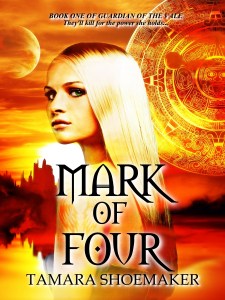
MoF CoverMark of Four is a quick read, though unfulfilling in the sense that when you reach the end you’re left wanting more. For me, because I’m not a big YA reader, the amount of teenaged boyfriend angst was a bit much, but the writing is crisp, concise, and comely. The story flows smoothly, and Shoemaker delivers a helluva punch at the end. If you’re into urban dystopia with a good mixture of urban fantasy, this is a series you’ll want to start.

This is where I pull you aside for the disclaimer. Shoemaker is a friend from a local writers group, but I asked to review Mark of Four and do an interview with Shoemaker, and she provided me a free ARC. Also, I recently hired her to do a line-edit on a novella of mine, and, well, her maiden name is Duncan, so we’re probably many times removed cousins. But, frankly, I only do reviews for people I know are good writers. Otherwise, it’s awkward.

So, on with the interview.

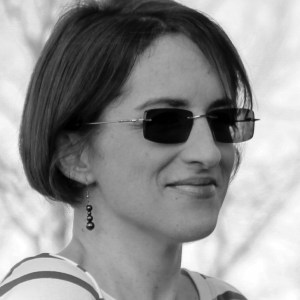
Just Who is Tamara Shoemaker?
Tamara

Tamara Shoemaker

Well, a writer, of course. She lives in the Shenandoah Valley of Virginia with her husband, three children, a few jars of Nutella, and a never-ending carafe of coffee. She authored the Amazon best-selling Shadows in the Nursery Christian mystery series and Soul Survivor, another Christian mystery. Her fantasy books include the beginning of the Heart of a Dragon trilogy: Kindle the Flame, as well as the upcoming Guardian of the Vale trilogy, of which, as I said, Mark of Four is the first book. (Oh, and it’s out today, by the way. Once you’re done reading here, shift on over to Amazon and buy it.)

The Interview!

MD: Earlier this year saw the release of Kindle the Flame, the first book in the Heart of a Dragon trilogy. Now, we have Mark of Four, book one of the Guardian of the Vale trilogy. What about the trilogy structure do you find appealing? How do trilogies fit your writing style?

TS: I love a good challenge, don’t you? Sure, it’s difficult to put a book together complete with character arcs and plot lines and no holes and no how-in-the-world-did-THAT-happen going on, but it’s a thousand times more challenging to extend that arc over three (or more) books. Each book has to have some sort of resolution or you’re going to have a very unhappy reader, and you still have to have enough unanswered questions to hook the reader into continuing to the next book.

I find it super hard to make all these elements flow together seamlessly, but the exhilaration that comes when I feel like I’ve completed it successfully is hard to beat—similar to the birth of my children. The high at the end qualifies the struggle.

Plus, I get so involved in my world-creation that I just can’t stop building the story. No one wants to say goodbye to a good friend. My characters live and move and breathe right next to me, day in and day out and through the nights for the entire writing process, so when it’s time to put the book down and declare it done, I miss them—they leave a hole in my life where they had lived so continually before. So I can’t confine them to only one book. Even keeping them within three books is pushing it.

I’m sure I’ll probably be one of those authors that has a million spin-off books about the same world as the main trilogy, mainly because I miss my characters so much.

MD: Mark of Four to me read dystopian, with elements of fantasy and sci-fi; Kindle the Flame is pure fantasy. What is the allure for you in writing both types of fiction? Which is “easier” or more seamless? Which genre makes you “stretch” as a writer?

TS: I’ve always been a fantasy reader. When I was a kid and making my way through C.S. Lewis’ Chronicles of Narnia, and later, when I dove into Tolkien’s Lord of the Rings, I was laying a foundation for myself that absolutely cemented my love of the magic, the edges of reality, the worlds apart from ours. Who wouldn’t want to open their closet and step into a snow-filled winter wonderland?

The thing I love about writing fantasy, whether it’s dystopian or urban or pure fantasy is that the limits are non-existent! The only rule is that that the story must make sense within itself. Anything can happen as long as the world you’ve created accepts it. There are no do’s and don’t’s—Well, if you’re going to have a homicide scene, there’s got to be a medical examiner; oh, you don’t want to include a medical examiner? Well, then you’ll need to cut the scene… and on and on.

I keep looking at the differences between Kindle the Flame and Mark of Four. I wrote Mark of Four first, a couple of years ago, and Kindle the Flame, I wrote last November. I’ve had beta readers of both tell me that while Kindle the Flame was the better “technically-written” book, Mark of Four produced a better concept and connected with them more. It may have been just a matter of preference, I don’t know, but both of these writing styles challenged me dramatically. Kindle the Flame was my first foray into pure fantasy, and Mark of Four was my first into urban/dystopian. Either way, I grew as I built on the foundation I’d laid for myself as a writer and as I figured out how to build a world beyond the one in which we live.

MD: When writing on one series, have you ever gotten it confused with the other? Have you extensively outlined each series? For example, I find myself having to go back and refresh myself on the sequence of events or character appearance, etc., constantly in my series. How do you keep them straight? Do you have a mental technique for “checking out” of one series while you’re working on the other? Do you miss one set of characters while concentrating on the other set?

TS: I have to laugh. I’ve found, countless times, my ability to be working on a book, and suddenly stumble across a section where I drop my main character’s name in favor of another book that I had been recently working on. It never fails. When I was working on Mark of Four, I kept inserting “Rayna” instead of “Alayne.” (Rayna had been my main character in Pretty Little Maids.) When I was working on Kindle the Flame, “Alayne” from Mark of Four kept cropping up in place of “Kinna.” Before I complete any manuscript, I have to do a search for out-of-place names to make sure they don’t make it onto the final pages.

That said, I don’t really have a tried-and-true method to check me out of one series and into another. Often, I will spend the first fifteen minutes of my writing time reading back over the chapter on which I’ve been working to get me back into the mind-set, but often that elusive “I’ve arrived” point where the words just flow from my fingertips doesn’t come until I’ve been writing at least an hour. And in my life, at this point, an hour of consecutive writing time is hard to come by. For months, I feel like I’ve written piece-meal. I don’t care for it, but I do what I can until I can figure out how to get life to calm down a little.

Not that it’s going to. My three children ensure that. However, if I can get these fantasy trilogies down and published, I’ve decided to only do one project at a time after that. This coming out with two fantasy trilogies simultaneously is equivalent to birthing two sets of triplets at the same time. It’s… terrifying. 🙂

MD: Which writers are your fantasy influencers? Dystopian influencers?

TS: I fell in love with The Hunger Games trilogy, and I really enjoyed Divergent, though I didn’t like the second two in that particular trilogy. A lot of the elements in Mark of Four were inspired by some of what I enjoyed in those books. Primarily, though, Harry Potter has been my main inspiration in any fantasy I write. There was something so fascinating and epic about the interwoven, complicated back-story of Harry’s past. Tolkien will always be an inspiration to me; the world-building in his trilogy has forever fastened itself into my imagination, and grappling hooks couldn’t remove it. So, here’s to you, Tolkien, Collins, Rowling, and Roth.

MD: In both series but in Mark of Four in particular, you have characters making the transition from the YA age group to the New Adult age group. What about this age and the transition appeals to you? What, if any, are the drawbacks to writing that age group?

TS: There’s something about stepping into a new stage of life as a fresh-faced innocent that really appeals to me. High school into college is a huge deal; you’re essentially putting your eggs into the world’s basket and jumping off the cliff hoping for a perfect omelet at the bottom. The Guardian of the Vale trilogy spreads a little over two years, so by the time it closes at the end of book three, Alayne is nineteen, and in the two years of the story has lived a lifetime. I love the journey and the discovery of maturity–from the fresh-faced to the wisdom of experience. It’s riveting.

If there is a drawback to writing YA, I’ve felt, at times, that it would be so much easier if Alayne could just settle down a little, use a head that has had thirty years of experience thinking through things, but that’s not who she is. So she pulls me into her seventeen-year-old mind, and I get to relive the ups and downs and angst and flip-flops of that period of my life all over again.

But it makes it more real to the reader. It would be hard to connect to a seventeen-year-old who carried the wisdom of an elder. There’s something about the silly, shallow, sometimes flighty roller-coaster of it that connects to my past (and even occasionally, my present, but don’t tell anyone). 🙂

MD: In your words, what about your work makes it appealing to those of us much older than the age group you write about?

TS: One of the things I love about the reviews I’ve gotten on Kindle the Flame thus far and the advance reviews on Mark of Four are the ones that say, “I don’t normally read fantasy, but I loved this one.” Something in my work appealed to these people that didn’t particularly seek out this genre or the age group that is the target audience. I like to think there are themes that resound with all of us, young, old, and in between—the confidence that comes when you figure out who you really are, the importance of things like family and friendship and loyalty and love. When those themes are in my books, even when they’re being experienced by a teenager, older and younger will still connect with those themes, because they’re an experience of life, throughout life.

MD: Mark of Four, for me, had elements of both the Divergent series and Harry Potter. Was that a deliberate homage or a happy accident?

TS: Haha, you got me! When I wrote the book, I had only recently read Divergent, and of course, I’m a life-long (or at least years-long) fan of Harry Potter. After I read Harry Potter, I thought, whimsically, if I were to ever write a book, I’d want to put a school in it. Hogwarts, to me, was the fascinating place that was the center of Harry’s story, and I wanted to create a school that would be the central crux of whatever story I was going to tell.

Of course, my story went far wide of Hogwarts, and took on a new shape as I explored the possibilities of what it would be like to have “Elementals” control one of the four elements (air, fire, earth, water), and a school that would train these fledgeling teens how to perfect their craft. It was loads of fun to come up with class names (Points of Motion-Stop, Water-Currents, Throw-Casting, etc.) and the settings for them.

MD: Without giving too much away, what is the take-away message from Mark of Four and the Guardian of the Vale series?

TS: When Alayne enters the story at the beginning of Mark of Four, she’s a clueless seventeen-year-old who has a strained relationship with her mother and is struggling with identity. Who is she and why is she who she is? By the end of book three of Guardian of the Vale, confidence has bloomed within her. She knows who she is and her purpose for being there. She’s met her fears head-on and has conquered them.

To me, that’s one of my favorite parts of her character arc; it’s inspiring. It inspires me to be confident in who I am, and I hope, at the end of the day, that Alayne can be an inspiration for her readers.

Inspiration

Shoemaker’s characters and her writing are inspiring, as is her work ethic and how she juggles her writing with a growing family. She is a writer worth getting to know.

Follow her on social media:

Twitter: @TamaraShoemaker
Website: www.tamarashoemaker.org
Facebook: www.facebook.com/tshoebooks

The Year of Writers Conferences Redux

A new year brings a new round of writers conferences and workshops. The first for me is the Roanoke Regional Writers Conference at Hollins University in Roanoke, VA. I tried this one-day conference last year and was amazed by the depth of the too-short workshops, but I’m back for more this year.

Hollins University is also the site of the week-long writing workshop I attend, Tinker Mountain, but this one-day event is rather like an appetizer for that.

The keynote speaker is Virginia novelist Sheri Reynolds, and among the workshops are ones for non-fiction and fiction, YA, self-publishing, marketing, and getting an agent. Yes, some of these are topics you see at any writers conference, large or small, but sometimes it’s the different perspective on the issue which is most helpful.

I’m looking at attending Dan Casey’s “Telling Stories: The Greyhound Bus, the Swedish Gal, and the Flophouse in Seattle” first thing on Saturday morning. Casey’s workshop last year was hilarious and educational, so I’m looking forward to this presentation.

Next I think I’ll attend Sheri Reynolds’ workshop, “Dreamwork for Writers: Using Your Dreams to Deepen Your Story.” I love incorporating my odd dreams into my writing, so this workshop should be fascinating.

I’ll close out the morning with some non-fiction work in Bill Kovarik’s “Who Killed the American Newspaper and Where do we Go from Here?” Since I’ve done freelancing for my local paper, and I’m still enough of an old fogey that I start the day by reading two actual newspapers I can hold in my hands, I think this will be an interesting and topical discussion.

After lunch, and because I’ve never thought of doing a YA novel, I’m going to attend Tiffany Trent’s “Science Fiction and Fantasy in YA.”  This is a growing genre, and, who knows? Maybe I’ll get inspired, even though I think with The Hunger Games and Divergent series, we may be reaching the apex of this trend.

I’ll end the day with “The Rebellious Essay,” a workshop hosted by Cara Ellen Modisett. I do some political blogging I consider a bit rebellious, so maybe this will move it to the next level.

A full day of workshops, networking, and connecting with writer friends–I’m looking forward to getting back into the writer conference groove.


Non-Fiction in a Fiction Critique Group?

Sounds like a contradiction in terms, doesn’t it? A couple of years ago, I started an off-shoot of my main writers group, SWAG Writers, for critiquing fiction. We began with six people, and after the first meeting we ended up with three regulars. One person was accepted into a graduate program and moved. One indicated she really had nothing prepared to critique, and the third didn’t take well having her grammar and punctuation corrected. But they were all writers of fiction.

The three of us stumbled on for a while, but it wasn’t working well, so we disbanded. Two of us continued to exchange our work online, but we became so accustomed to each others’ work, we realized we couldn’t give it that “other eyes” assessment.

Fast-forward a year, count in some new additions to SWAG, and, huzzah, we have six people again. I learned a bit from the earlier experience. Before we met for the first time, I asked everyone to submit to each other a couple of pages of their work, so we could all decide whether the experience would be beneficial to us; then, we met to critique those two pages. That’s when we discovered, gasp, one of the members is writing a biography.

SWAG is open to all writers in the area–poets, lyricists, fiction writers, non-fiction writers, even crossword puzzle designers. But, clearly, the poets and fiction writers outnumber the non-fiction writers. A few of the poets get together informally, and here we had the re-constituted fiction critique group. There is, however, nowhere else for the non-fiction writer to go. So, we thought, what the heck, let’s give it a go.

A couple of us have experience with non-fiction. In fact, since I got a job as a publications assistant with an aviation insurance consortium in 1976, most of my editing and writing experience has been in non-fiction, specifically in the technical aviation safety area. I was a reporter on and editor of an aviation safety magazine, and for a little more than a year, I wrote non-fiction feature articles for my local newspaper. I have a lot of experience editing non-fiction, not the least of which is my degree in history. Another member of the critique group is a newspaper editor. (She is in the group to have her fiction critiqued, however.)

No problem, you say. Not a problem exactly–editing fiction and non-fiction have similar approaches (grammar, punctuation, etc.), they both tell a story though one is strictly fact-based and has to have the references to substantiate those facts. Now, yes, if you write historical fiction, you have references out the wazoo. The difference is you don’t have to cite them. Yes, you can put a list at the end of your book, but, trust me, the readers hardly ever look there. In a non-fiction piece, particularly a biography, just about everything you say has to have a citation.

When I review or critique a fiction piece, I involve myself completely in the story and characters. In a biography, you can do that too, especially with the current fashion in non-fiction writing, which is to make it “read” like a work of fiction–good characters, action, conflict, etc. Non-fiction writing is still scholarly, but now it just doesn’t sound like it.

Still, and I can’t quite put my finger on it, critiquing fiction and non-fiction is different. When I read the fiction pieces for the upcoming meeting, I was caught up in the characters and the conflict in the stories. When I read the non-fiction piece–which is a rough draft with references listed but not cited–I found myself making notes like, “how do you know this,” “how can you prove that,” etc. I needed the citations, even though I recall from writing my own monographs and senior theses that you usually put those in on the final draft.

I’ve been focusing on my fiction the last four years, the writing there of, that is. It’s a bit of a head-shake for me to break that habit and get back into reviewing and evaluating non-fiction, and unrelated to aviation at that. I just hope I can be of use to that biographer, that my fiction brain can make the abrupt adjustment.

Still, it’s a diverse group of writers, and I’m all heady with anticipation.

My Generation’s Day of Infamy

If you’re my age or older, even a little younger, you will remember exactly where you were on this day fifty years ago, what you were doing, what went through your mind when the news flash came from Dallas, Texas. I won’t go into detail about my feelings and reactions here because I’ve done that on my political blog, and you can read that by clicking here.

What I will say was this was an act we young babyboomers in some way never got over. It snatched our innocence and optimism away. If hope for the future could be taken from us so quickly, so easily, then what did the future hold? It was a despairing time, and I can still remember it with obscene clarity.

Friday Fictioneers LogoWhether she intended it or not, Rochelle Wisoff-Fields, who manages all of us Friday Fictioneers flash fiction writers every week (an admirable job because organizing writers is like herding cats), picked a photo with the briefest of echoes from that day. After you read my story, “A Conversation at the Site of Jennifer Juniors,” you may think it’s a stretch, even a long reach, but I just call it dramatic license. As usual, if you don’t see the link on the story title above, scroll to the top of the page, click on the Friday Fictioneers tab, and select the story from the drop-down list.

By the way, I was thrilled my story in the upcoming anthology “1 Photo, 50 Authors, 100 Words” was voted by the other contributors the best along with Rochelle’s story–we tied. It’s an honor to be in her company not only in the anthology but as a top story as well.

Some Historical Friday Fictioneers

Historical fiction is one of my favorite genres to read and to write. I have a degree in history and have maintained my love of history throughout my life. I write what the great Alan Furst calls the “historical thriller,” and I just finished reading a three-book series (with more to come) about a woman who becomes a spy for MI-5 in Britain during World War II. (It’s the Maggie Hope series by Susan Elia McNeal, and I highly recommend it for a glimpse into Britain during the Blitz and before the U.S. enters the war. Lots of accurate historical references and historical figures abound, behaving in ways you’d expect them to. McNeal has done her homework well.)

I have a couple of sticking points, though, with historical fiction. The history has to be accurate. You can take some dramatic license, yes, but it has to fit into the overall context of the history and the era. And the fiction within that context has to be believable. Am I a fan of the alternate history genre? Not particularly, though I have read some which have made the fictional version of history believable; otherwise, just call it fantasy and be done with it. Do I have a problem with the Steampunk genre? No. When it’s done well, the author takes the technology of a particular time period and creates perfectly believable machines, which may not appear in reality for another century. Is Steampunk truly historical fiction? Yes, in that the Steampunk author has to be well-grounded in the real history of the era to make his or her work believable.

So, accuracy and believability, and I’ve closed books and put them aside permanently when I’ve spotted an obvious historical gaffe. (And don’t get me started on aviation inaccuracies!)

Friday Fictioneers LogoToday’s Friday Fictioneers photo prompt put me right smack in the middle of a rush of nostalgia. I worked not too far from Union Station in Washington, DC, for many years, and I always loved going into that building. Architecturally, it is a marvel, and it had seen so much history. By the 1970’s it was almost a ruin, just a giant pigeon roost, and it took an act of Congress, literally, to get it back on its pinnings. Today it’s a classy shopping mall with several great restaurants and still an operating train station. If you’re ever in DC, make sure it’s a tourist destination for you. DC’s Metro Subway system has a stop there, making it easy to get to.

Union Station has seen so much history, it was hard to pick something specific to write about, even harder to confine it to 100 words, but I focused on the Serviceman’s Canteen. Open between 1941 and 1946, twenty-four hours a day the Canteen offered coffee and good food mainly to servicemen passing through Union Station but also to any passenger or even people off the streets of DC. It averaged three million customers a year. I can remember my father and several uncles commenting about stopping there for a five-cent meal. It closed permanently in May of 1946 mainly because its typical customer–a G.I. on his way to be shipped out–no longer trooped through the station in large numbers.

The Canteen attracted even high-society women in DC, who wanted to do something for the war effort, and my story, “Good Service,” acknowledges one of them. Did this happen? Not that I know of, but in the context of this woman’s history, it’s completely believable she could have done something like this. I know this woman had left DC in 1945, but for something important to her, I could see her returning. What is historically accurate is that this woman did indeed sell food to servicemen from the Serviceman’s Canteen.

As usual, if you don’t see the link on the story title in the paragraph above, go to the top of the page and click on the Friday Fictioneers tab. Then, you can select the story from the drop-down menu.

My Name is Phyllis, and I’m a Writer Workshopaholic

They say the first step is acknowledging you have a problem. In eight months this year, I’ve been to nine writer conferences and/or workshops. There, I’ve said it. I may be addicted to writerly things. Yes, I may be addicted to meeting other writers and learning from them or, more importantly, becoming friends with them. Yes, I may be addicted to picking up information or techniques to improve my writing. Yes, I may be addicted to making my craft, well, more artful. Yes, folks, I’ve got it bad, and I gotta have my fix.

What am I going to do about it?

Not a bloody thing. I think this is one addiction we can overlook. 😉

On Friday I got an email from WriterHouse in Charlottesville, VA. (I’ve written about this writer’s space before–a great place to write and a great provider of one or two-day or even longer workshops.) They had openings for a one-day workshop on Saturday–“Ready, Aim: Firearms in Fiction.”

Okay, a little diversion here. If you abhor guns and think they’re the physical manifestation of evil, don’t read any further, and have a nice day.

I read the description, and, even though I have a good familiarity with firearms and gun safety, I thought, “Why not?” As one of the workshop attendees, who is a gun safety instructor said, “You always learn something new.”

This turned out to be the kind of workshop I really like to attend–one where you bring work to be critiqued and where you get writing exercises. Thanks to the workshop instructor, Betty Joyce Nash, and the other attendees, it was a great day learning about the importance of fitting a weapon to a character and how to research to make certain you get the details right. Three of us were very knowledgeable about gun safety and the mechanics of guns. The third was a novice, who left the workshop ready to go to a gun range and get some instruction in safety.

Even the three writing exercises were informative. First, we selected a picture of a person from a collection supplied by Ms. Nash, then we had to write a bio or expository scene about the person in the picture and include a gun. After reading aloud and critiquing each other’s work, we went over some examples from literature where authors included guns in their work, how successful they were, and whether the gun was necessary or superfluous to the story.

The second writing exercise involved keeping in mind the bio/expository scene we’d written before while we wrote about the first time we each became aware of guns. Again, we read what we’d written aloud and critiqued each other’s work. Another workshopper and I decided to directly link the two exercises, and it became obvious we both had stories in the works.

After lunch, we each read a portion from the stories we’d brought with us–the story had to involve a gun, easy for me, since I mostly write about spies–and critiqued them. I had the efficacy of these workshops proved to me when I finished reading my excerpt and another participant said, “I want to read the rest of that!”

Finally, we had the third, free-writing exercise–two people arguing about money with a gun in the room. (And I forgot to mention, the instructor also participated in these exercises, and we got to hear and critique her work as well. I liked the fact she didn’t set herself apart.) Then, we had a free-ranging Q&A about guns and about writing and publishing. I’m so glad my schedule is flexible enough to able to do last minute writing things like this.

Again, if you’re close to Charlottesville, check out WriterHouse. It’s very inexpensive to join and has different kinds of memberships so you can get exactly what you need from them. I know I certainly do.

A Hot and Steamy Friday Fictioneers

I’ll wager that got your attention, but my only meaning is the heat wave we’ve been experiencing here on the east coast. Yes, summers in the mid-Atlantic are supposed to be hot and humid, but this goes beyond that to oppressive. Makes me want to return to the wonderful seventies in Oregon. (And did I luck out there–I spent a week there between two heat waves. I must have racked up some particularly good karma.)

Friday Fictioneers LogoThe heat leaches energy and creativity from every pore of your body, and though I had a concept right away for today’s Friday Fictioneers photo prompt–the bicycle had been placed just so to signal someone–I wasn’t sure how I wanted it to go. A pre-arranged signal for an elopement? An indication to a roommate to stay away a while longer? A warning of an unwanted guest?

Each of those sounded pretty intriguing, but my thoughts came back to a place I’ve dealt with in fiction before–The Balkans in the 1990’s, the scene of some of the worst genocide based on religion since World War II.

Many aspects of the civil war in the Balkans baffled historians and diplomats, namely, how could people who had lived together peacefully for centuries suddenly turn on neighbors, even family members by marriage? That was the aspect played up most in the western press. What we didn’t often see were the selfless acts of courage by one ethnic group to protect the other. I’ve tried to pay homage to that in “Band of Brothers.”

If you don’t see the link on the story’s title, then scroll to the top of this page and click on the Friday Fictioneers tab. Then, you can select the story from the drop-down list.

Tinker Mountain Days Four and Five

The craft lecture on Thursday was by my workshop instructor, Fred Leebron, and was entitled, “Achieving Complexity in Narrative.” Fred had said his workshop didn’t need to attend because we’d already heard it, but most of us did show up. And a good thing, too. The second time around you realize all the things you missed the first time.

Though Fred had some interesting things to say about plot (“Plotting can be a literary straightjacket–it makes you think as if all stories have already been written.”), he emphasized his standard points about how to make your fiction transport the reader into your world and to resonate with the reader, i.e., go on beyond the end and stick with the reader. Fred then described the various ways to create the complexity needed to both transport the reader and have your work resonate with him or her, and it can be anything from judicious line editing, to multiple POVs and narrative arcs, and many more until, he says, “you get to the end of your narrative after exhausting all the possibilities.” Exhausting all the possibilities is the point where you can finally begin to revise.

The craft lecture concluded with an exercise we could take home with us to help with characterization, an exercise designed to develop the “shades” of a character: Describe what the character is most ashamed of, what haunts him/her the most, when he or she came close to doing someone harm, when he or she was the most humane, what he or she wants the most, and what he or she doesn’t want at all. You may never use the answers in a story, but you’ll understand the character better and make him or her layered and complex.

Day Four’s workshop session focused on dialogue and the various ways you can layer time in a story with dialogue, enlarge the cast of characters, and reveal things a character doesn’t know. Tension, important to story structure, can be both created and enhanced by dialogue that contradicts, is passive aggressive, ignores, or even agrees with.

Day Five’s craft lecture was on screen-writing, and I’ll write something on that later. The final day’s workshop session began with a discussion of drafts of our work. “The first draft,” said Fred, “is what the character wants. The final draft is what the reader wants.” I’d never quite thought of it that way, but essentially that is the case.

The rest of the time before the final critique of the week was a free-wheeling Q&A about writing–using substory, flashbacks and flashforwards, when to use dreaming (“economically,” says Fred), and how to give your endings “bite.”

After the last person’s critique, it was time for goodbyes. The week flew by and, for me, is immeasurable in terms of what I learned. Fred Leebron gives you a lot to think about and not just for the five days of the workshop; for the rest of your writing life. I’m already looking forward to next year!