Dueling Manuscripts

Even though I crossed the 50,000-word goal for my NaNoWriMo project for this year, the first draft of the manuscript itself isn’t finished. There are two to three big scenes left to wrap the story up, and I have them mapped out in my head. I figured for the next few days I’d devote the time to fleshing them out completely.

Good plan, right? Just after I started NaNoWriMo this year, a different manuscript–from NaNoWriMo two years ago–finished its journey through my critique group. I got excellent feedback from that experience: no major plot holes but several very good suggestions on how to tie up a couple of threads. I took copious notes because I knew my focus would be on this year’s NaNoWriMo first draft. The plan was to pick the other manuscript up after November 30.

As a countryman of mine once wrote, “The best-laid schemes of mice and men go often awry.”

I woke early this morning with the critique group manuscript in mind. In fact it superseded everything on the calendar today, including a doctor’s appointment where the physician’s assistant kept asking me if I were listening to her. The rewrites I needed to do based on the suggestions were crystal clear, so clear, in fact, that during the time I normally reserve for morning coffee and the newspapers, I immediately wrote them down so I wouldn’t forget. All right, I thought, that should have put the nagging need to fix the 2010 manuscript to rest, because the “best-laid scheme” was still to pick this manuscript up after finishing the 2012 NaNoWriMo first draft.

But no, that wasn’t how it worked. I’ve spent the better part of the day going into the 2010 manuscript and fixing that thread. That meant adding/changing dialogue in eight or nine chapters then doing a quick review to make certain I hadn’t created other loose threads by weaving together the previous one.

Despite not adding to the 2012 word count–that will come later today–I’ve got that goose-bumpy feeling a writer gets when you know you’ve made a breakthrough on a manuscript. Now, this particular manuscript is the closest of any of the ones I have in various stages of completion to being ready to shop around. For that reason, I’m glad it was so insistent that I should drop everything (including the regular Monday morning writing blog and lunch, apparently) to get that fix made.

The truth is the remaining scenes for the 2012 NaNoWriMo wouldn’t turn out the way they needed to because of the distraction. Sometimes, though, distractions are good. If I’d ignored the need to fix that older manuscript, it would have colored my work on the current one. So, I gave into it. Bad writer planning? Bad craft? Maybe to some, but it’s obvious to me it was exactly what both manuscripts needed.

Now, let’s hope that all the other MSS stay quiet for the remaining eleven days in November!
Quashing the Inner Editor – For a While

This past Saturday I went to a National Novel Writing Month (NaNoWriMo) write-in in Harrisonburg, VA. Seven of us made it and commandeered a corner of Panera to have some writing fun–word sprints, where you write as many words as possible in a set amount of time, and the “no backspace” game.

The “no-backspace” exercise really suppresses your inner editor, and the exercise consists of writing and not backspacing or deleting anything, not even a typo. The person who can go the longest without backspacing is the winner. In the first go-round, I lasted six words; I made it to about 200 words the second time around, but, oy, what a mess!

The concept of NaNoWriMo is to write without editing yourself in the moment. That comes later. By not editing as you write, NaNoWriMo-ers believe you tap into creativity that pausing to edit disrupts. Writing purists may cringe at such seat of the pants writing, which does sacrifice structure to a certain extent, but I find it particularly liberating.

A few weeks ago at the James River Writers Conference I heard Tim Robbins explain his writing process. The reason years pass between his works is because he literally perfects one sentence at a time and doesn’t go back to revise when the book is done. When he finishes a book, he considers it edited and revised because of this rigid method.

I’m not dissing that sort of structure; in fact, I admire it, and, obviously, it works for him. I’ve always been the type of writer to get what’s in my head down on the page, then I go back and “fix” it–rather a middle ground between a seat-of-the-pantser and the dedicated structuralist.

When I’m not doing NaNoWriMo writing, which, by the way, is eleven months out of twelve, I typically start the next day’s writing with a review and rework of what I wrote the day before. That refines it for me and gives me a basis to begin the next part. It’s true I rarely work from a written outline, but I usually have the structure in my head. I’ve always jotted down notes and ideas for anything I’ve written, but I, personally, find a detailed outline confining. I haven’t adhered to one yet.

The free-wheeling aspect of NaNoWriMo is what appeals to me, to just sit down and write without second guessing a sentence or what a character says or whether this is the direction the story should go. I know I’ll go back and fix that later, and the very act of putting the editing and revising off for a period of time, unleashes my brain.

For example, I had a fairly detailed list of scenes I’d foreseen for this year’s project, but somewhere about a third of the way through getting those scenes fleshed out, a new direction emerged. Frankly, you can’t ignore that. You can’t limit yourself to an outline or a list of scenes and not be flexible. At least I can’t. If the idea pops up that I need to go over here and explore something, I have to go do it. I may end up tossing it out in editing and revising, but I have to write it when it manifests itself.

The NaNoWriMo project from 2009 wound up in an entirely different way than I ever intended. The idea came to me that I should kill off one of the two main characters I’ve written hundreds of thousands of words about, so I did. It was an amazing writing experience to explore the thoughts and feelings of the person left behind (and a great outlet for those same feelings after the break-up of my long-term relationship).

When I got to the revision stage, though, I knew it was wrong. I’ve joked the character tapped me on the shoulder and said, “It’s not my time, yet.” Purists scoff at the idea that characters speak to you or direct a story, but I know what I know. The character was right; I knew I wouldn’t be able to write more stories in the genre I’d chosen if he weren’t around.

That’s not a wasted manuscript though; I’m incorporating large portions of it into another plot. Another NaNoWriMo MS I’ve mined for short stories. Yet another, after editing and revising, just completed a trip through my critique group, and after another set of revisions, will be ready to see if someone is interested in publishing it. I haven’t touched the MS from last year (2011), but that’s on my list for projects in 2013.

This year’s? I’m so pleased about the direction it’s headed and the fact I decided to strengthen my literary fiction skill set, that it will be a 2013 revision project as well, probably toward the end of the year to get time and space between the writing and the revising.

NaNoWriMo is neither futile nor frivolous. It is, however, what you make of it. If you treat it as a creative way to develop a first draft, it can be very fulfilling. And great fun.

NaNoWriMo Update

This weekend, eleven days into the adventure, I hit the 30,000-word threshold. At the NaNoWriMo average of 1,667 words per day, by day eleven 18,337 words would have put me on track to finish with 50,000 on day thirty. Well, I’ve always been an overachiever.

The point is, without that artificial stimulus, that “imposed” deadline, I would never have written an average of 2,700 words a day. That’s worth it to me.


Thanks, Mom

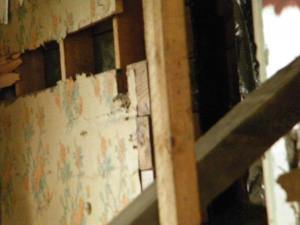
The project I’m working on for this year’s NaNoWriMo is based on a Friday Fictioneers, 100-word story from several months ago. This was the photo prompt:

And here is the story:

Amontillado

“That wallpaper’s stuck to the wood,” the contractor said. “If you want it gone, you’re gonna have to take the wood down then drywall.”

We’d hoped to save the old walls. They lent such a rustic feel to the place, but the ancient wallpaper wouldn’t budge. Drywall wouldn’t be the same, but what can you do?

To save money we did the demolition ourselves. With pry-bars we had fun, imagining we ripped away annoying people.

It was all great fun until the last corner, when the boards came away and we saw the tiny bones wrapped in a baby blanket.

I had a lot of positive comments on the piece (and, yes, someone did mention I used the word “fun” twice within a couple of lines), and several people suggested I expand it into a longer story or even a novel. I appreciated the confidence in me, but I put it out of mind until I was on a train trip to New York. The story kept coming back to me, and I started jotting notes. It wasn’t long before I had four pages of them, some snippets of dialogue, and a concept for what was obviously a novel.

However, I had a couple of writing/editing/revising projects I was deep into and didn’t want to start anything new back in the spring, but I kept the notes close by, added to them over the months, did a little research (part of the story takes place during World War II), and decided this was perfect for NaNoWriMo. So, I’m off and running–just over 12,000 words in four days.

As an historian, I love researching other times, but this project has another significance for me. Many who know me well know my relationship with my mother was problematic at best, traumatic at worst. She was a teenager to young adult during World War II, worked in a uniform factory, and wrote to a lot of soldiers whose convoys passed through her home town. She would talk about the homefront of World War II as if it were her personal playground, and she often referred to it as the best time of her life. (Yep, Mom wasn’t particularly thoughtful of others; it was always about her.) Her stories, though, have given me a lot of background detail that I can include in this project. So, in a big way she can contribute to my writing other than as a model for a nutcase character.

It’s probably good that she’s gone, though, because she’d be pissed as hell to recognize any of her life stories in anything I wrote. You see, no one was allowed to talk about her except her, but thanks anyway, Mom.

And something a little off-topic here: Tomorrow is Election Day, and it is the civic duty of every eligible voter to vote. Find a way to do it. It’s important to our democracy.

Friday Fictioneers and NaNoWrimo!

You know, if I planned better, my 100-word stories for the month of November would go toward the NaNoWriMo word count. But, alas, no. Friday Fictioneers was a nice break from grinding out nearly 1,700 words.

And even though Hallowe’en was two days ago, this week’s Friday Fictioneers offering, “A Ghost’s Tale,” is a bit of an homage to that spooky time of year. If you don’t see the link on the story title, click on the Friday Fictioneers tab at the top of the page and select “A Ghost’s Tale” from the drop-down menu. To read other Friday Fictioneers stories, click on the icon at the bottom of the story page.

Countdown to NaNoWriMo

National Novel Writing Month begins in just under nine hours where I live, but it’s already kicked off in other parts of the world. For those who don’t know, National Novel Writing Month–or NaNoWriMo–is a pure fun project where you write a 50,000-word novel draft in thirty days. You “win” by reaching at least 50,000 words on or before 2359 on November 30. You can download web badges, get pep talks by video, enjoy local write-ins, and generally have a good time writing.

The Office of Letters and Light is the non-profit that sponsors NaNoWriMo to highlight the art and craft of writing and to raise money for school programs to encourage kids to write.

An excuse to write and donating to a great cause, and NaNoWriMo lives up to its tag line: “Thirty Days and Nights of Literary Abandon!”

Many writers have turned their NaNoWriMo novels into published work–after editing and revising, of course. Some, unfortunately, have self-published their work immediately after writing and omitting the key steps of editing and revising, but that shouldn’t detract from the fact it’s very liberating to sit down and just write for writing’s sake for thirty days, knowing revising and editing can wait for a calmer time.

I almost didn’t participate this year because I’m prepping two other manuscripts–one for a contest and one to publish in December–but I managed to get both MSS ready ahead of schedule, despite having a cold.

So, I’ll have leftover Hallowe’en candy for snacks, plenty of coffee, a fully charged laptop, and an idea I came up with back in the spring that I can now flesh out. I’ll crank Sat Radio or my iPod up to full volume and put a “Do Not Disturb” sign on the door.

And I’ll write, and it’ll be fun, until the end of the day and the word counter hasn’t hit 1,667. (To get to 50,000 words in 30 days, you have to write at least 1,667 words per day.) Plus, I’ll be an election officer on November 6, so no writing that day, unless it’s all over quickly and the poll numbers add up.

If you’ve never NaNoWriMo’ed before, give it a try. It’s never too late to subject yourself to such exquisite torture.