My Three Rs: Rereadin’, Rewritin’, and Revisin’

Some days you have to choose–blogging versus spending quality time with the grandkids and one of your BFFs. Yesterday, the grandkids and the BFF won. So, no blogging, though I did spend a couple of hours in the evening working on the novel rewrite/revision.

I have about forty pages left from the original, rough draft to rewrite/revise. In the process I’ve added about 10,000 words to a manuscript, which was “just” 63,000 words to begin with. I’ve been told 60,000 to 70,000 words is a good length for an MS you’re going to shop to agents. Of course, I’ve also been told, at a different writing conference, that 100,000 words is tops for such an MS. So, who knows?

I think this first revision will end up at about 76,000 words, give or take a thousand. That doesn’t bother me, since the next step–after letting the MS gel a while–is to do a line edit. That should bring me back closer to 70-72,000 words, which I think is enough to tell a story in two time lines.

Why did I add words in a rewrite? Well, that happens sometimes, especially after time has passed since you wrote the draft and a re-read shows you scenes, which have no context. The actions, dialogue, setting, etc., seem to have just fallen from the ether onto the page. The context has to be there, or the reader will spot the disconnect right away. Sometimes the additional material has to be there to make a character two- or even three-dimensional. Other times it’s because what is obvious to the writer isn’t always to the reader. Yes, readers like it when you give them just enough for them to make the leap of logic; however, you can’t give them a chasm to jump. Readers are not Evel Knievel.

Here’s an example: A character in this novel is obsessed with the unborn child of her own son, killed in World War II. It wasn’t enough to just state this. I needed to show examples of this obsession, and this led to a scene of a frenzied woman going to the house where her daughter-in-law has sought refuge from her and making a scene. And of course, I had to write other scenes to show this tendency so that the final scene had context and was believable. Also, of course, those scenes may not stay, but at the time I needed them to understand this character better. You can’t condense until you have the context of the characters, the plot, even the setting.

Another example: Since I made up a town in the Shenandoah Valley, I had to give it a history, some of which is based on three different towns where I’ve resided, as a child, a teenager, and an adult. The history is great–I both researched and relied on my memory, and I’ve created what comes across, to me, as a real place. However, again, how much of that history is essential to the overall story in the novel remains to be seen, but I needed that to fully realize this fictional town in my head.

Of course, this fixation on rewriting/revising means I’ve created very little original material, at least not novel length. I average two pieces of flash fiction a week, which keeps the writing brain engaged. I do, however, miss the process of sitting down and churning out a novel-length work.

Then, again, that’s what NaNoWriMo is for–and that’s only three months away.

Three months? I guess I better start thinking about something new to write.

The Last Friday Fictioneers of May

Okay, it’s the end of May. How could we be five months into 2013? Wasn’t it just New Years last week? Time flies when you’re writing.

I’ve had some good carry-over from last week’s retreat–Monday’s post on the retreat itself, a pretty killer political blog post on Wednesday (Click here if you’re interested; if you’re not politically to the left of Stalin, you won’t enjoy it, so you might want to skip it unless you are.), a draft of a new Spy Flash story, today’s Friday Fictioneers (of course), and several more scenes for a novel draft, which had a lot of plot holes. Plus some great writer talk with a writer friend. I love it when the giddiness carries on.

But…a week from Sunday it’s Tinker Mountain Writer’s Workshop, and I’m already doubting the twenty-pages I sent in for the Advanced Novel workshop. Is it advanced enough? Am I advanced enough? Will everybody else hate it? You know, the exact same feelings I had last year about this time.

Friday Fictioneers LogoWeek after week, Rochelle Wisoff-Field manages to find a truly inspiring photo, and today’s is perhaps one of the most intriguing. Yeah, I say that about each of them, but this one is so interesting, I’m sure the collection of stories will be eclectic and amazing.

Today’s story, “Put on Your Red Dress,” features my two characters from the Spy Flash short story collection, Alexei and Mai, on a little adventure to find… Well, you’ll have to read it to find out. If you don’t see the link on the title above, scroll to the top of this page, click on the Friday Fictioneers tab, then select the story from the drop-down list.

Second Thoughts on Entering a Contest

You think I wouldn’t be contest adverse after a successful contest experience this past weekend, but I am wondering if there’s a particular one I’d identified I should just skip. It’s the New Letters Literary Award, with entries due by May 17. Yep, Friday. The kicker is the short story to be entered should not exceed 8,000 words.

New Letters is the literary journal for the University of Missouri-Kansas City, and you get an actual monetary prize for a winning entry, and all entries will be considered for publication in the journal.

I don’t have any 8,000-word stories in the works right now. Everything I have is around 2,000 – 3,000. Yes, it says “not to exceed” 8,000, but I’m wondering if anything at the lower end of that number would even be considered. I did pull a chapter from a work in progress, which would make a decent stand-alone story, and it comes in at right around 3,000 words.

And, yes, I know I could write something original, and that’s usually not a problem for me to sit down and thrown out 5,000 or 6,000 words in a couple days’ time. But with five days left to refine and edit it until it’s presentable? I don’t know.

Over-analyzing much? Probably so, and mostly my fault for not paying attention to the deadline until May actually rolled around. However, you don’t win or get your entry read unless you roll the dice and enter. I’ve given myself until Thursday to decide if the entry I had in mind is in good enough shape to submit.

The next time someone says to me, “Oh, writing. What an easy job,” I’ll restrain myself from exploding. Still, if the process weren’t challenging, if it didn’t make you question yourself and your writing daily, hourly even, it really wouldn’t be worth it.

Weekend Updates

I’m walking on air! The short story, “Marakata,” I entered in WriterHouse’s 5th Anniversary Contest (500 words, theme: emerald) won third place. It was a blind judging, where an actor read aloud all the entries. During the break, while the WriterHouse staff counted the votes, I overheard several people talking about it: “Beautiful!” “Read like a parable.” “Very engaging.” “Marakata, I loved that one.” That will boost an author’s ego. Still, there were twelve other really great stories, so when “Marakata” was announced as the third place winner, I was delighted. My prize? A writing craft book entitled Steering the Craft, by none other than one of my all-time favorite sci-fi authors, Ursula K. LeGuin. A win-win.

Through Sunday, and in honor of National Short Story Month, you can purchase for your Kindle all three of my short story collections–Blood Vengeance, Fences and Other Stories, and Spy Flash–for free. You read correctly–free. Just go to my Amazon Author Page, and you’ll find them all there. You know your mother needs some new short story collections for Mother’s Day, right? 😉

Hopeless Friday Fictioneers Romantic

A good writing week. Well, any time I’m writing, it’s good. There’s one exception, though. I wanted to enter a contest whose deadline is May 17. The story can be up to 8,000 words, which, after all my flash fiction writing, seems like an enormous amount. I’m trying to adapt a chapter from one of my novels, but it’s not quite working out; however, I’ll keep at it until the deadline and make a decision then.

Tonight is the fifth anniversary of Charlottesville, VA’s WriterHouse, where you can find a quiet place to write and some excellent writing and publishing workshops. At tonight’s party, there will be a contest: You had to submit a 500-word story based on the theme “emerald.” (Emerald is the fifth anniversary gem stone and Pantone’s color of the year for 2013.) So, I’ll be there tonight for the live judging of my story, one of thirteen. An actor will read each story to the assembled masses, and then we vote. Fingers crossed they’ll like my little fantasy tale, “Marakata.”

Friday Fictioneers LogoA great photo today by Friday Fictioneer Ted Strutz brought back memories of various pick-up lines tried on me in bars. I remember one alleged Navy pilot who tried the “there-I-was-at-10,000-feet-with-MiGs-on-my-tail” approach, who then slid away after I questioned his aviation knowledge–he didn’t know I was a pilot. It was obvious he wasn’t after just a few sentences. Ah, good times.

For some reason Ted’s photo brought out the hopeless romantic in me and resulted in “If at First You Don’t Succeed…” Light and airy and very different from what I usually do, which is dark and dense, so I’ll need to go write some mayhem to restore the balance in the universe.

As usual, if you can’t see the link on the title above, scroll to the top of the page and click on the Friday Fictioneers tab. Then, you can select the story from the drop-down list.

National Short Story Month

May is the traditional month for college graduations, high school proms, renewing your garden or flower beds, but it’s also the “national” month for several issues:  Speech and Hearing, Lupus, ALS (Lou Gehrig’s Disease), Skin Cancer, Asian Pacific Heritage, and many, many more. People involved with or affected by these issues use the month of May to increase awareness of the topic and raise money.

May is also National Short Story Month. Now, I’m not trying to equate short story awareness with, say ALS awareness, but a literate society is one that strives to conquer disease and acknowledge diversity. An appreciation of the short story, whether as a reader or writer of them, is an essential part of being literate, of having an education.

Many writers–especially those of us who count short stories among our skills–look upon short stories as rather the red-headed step-child of literature. That isn’t altogether inaccurate. The big-name, traditional publishers won’t touch a collection of short stories unless you’re an equally big-name writer. In the past decade or so, some writers have come up with unique ways of “disguising” short story collections–linked stories (Jennifer Egan’s A Visit From the Goon Squad, Jennie Coughlin’s Thrown Out, and my own Blood Vengeanceor a novel in stories (Molly Ringwald’s When It Happens to You, Clifford Garstang’s What the Zhang Boys Know, and, to a certain extent, my book, Spy Flash.)

Those alternative approaches have had some success in getting the short story before the reading public. Small presses, like Press 53 in North Carolina, are more amenable to the publication of short stories, as are university presses, but short stories are almost a niche market.

In the past, short stories (which some believe have their origins in The Canterbury Tales, perhaps the first collection of linked short stories) were the venerated form of fiction, and in the short story’s glory days, hundred of literary and mainstream magazines featured short works. The novel was considered crass pulp fiction, and the short story was considered an art. Such noted writers as Kurt Vonnegut struggled to get his short stories published and often considered himself a failure for it, even as his novels assured his success and literary acceptance. As the novel reached its ascendence in the twentieth century, short stories survived in but a few literary magazines and the venerated New Yorker. Genre short stories–horror, science fiction, thrillers, crime–continued to flourish in limited markets. There are some, usually genre fans, of which I’m one, who believe it was genre short stories that saved the short story as a literary niche.

Interestingly enough, short stories have enjoyed a revival of sorts with the advent of the ebook reader. When you’re looking for something to read on your work commute, a short story is ideal. A short story is something you can begin and finish easily in a single sitting. When I used to commute to work, I’d often be frustrated that I’d reach just the most critical point in a novel when my stop came up. And, yes, there were occasions where I missed my stop because of that. Short stories are ideal for the eReader, either as collections or as singles.

What is the attraction of short stories? Why do those of us who call ourselves novelists indulge in the production of shorter work? Well, sometimes you don’t need 50,000-plus words to tell a story. Sometimes you can do it in 5,000, 3,000, or, with the advent of flash fiction, in less than 1,000 words. Some of us can manage a story in 100 words, and Hemingway once told a rich, poignant story in six words: “For sale. Baby shoes. Never worn.”

Though I consider myself a novelist, my only published work has been short stories, either in literary magazines or in my own collections. I write two to three short stories a week, usually flash fiction mainly as an exercise for my longer fiction. Face it, when you have to hone and cut words to meet an arbitrary word limit and still tell a complete story, that’s absolutely translatable to a novel-length work. In my year-long edit of a series of four books I’ve been working on, I managed to trim well over 100 pages, which didn’t need to be there in the first place. Had I not been practicing my short story skills under those word limits, I’m convinced that wouldn’t have happened, to the detriment of the work.

So, help out a short story writer in May. Buy a single, or, better yet, buy a collection of short stories and savor them. I happen to have three such collections available. Just scroll down the righthand column. A click on the book’s cover will take you to where you can purchase them. Don’t think of it as enriching me (because, really, it doesn’t pay me that much). Think of it as assuring the continuation of an essential form of fiction–the short story.

For an interesting article on the history of the short story, click here.

Life Gets in the Way

Last week was a slow writing week. I didn’t even get a chance to sit down and compose until Friday morning. Some spring clean-up, some things I’d been putting off around the house, babysitting, and other obligations intervened. That’s life, but by the time Friday rolled around I not only missed writing, I kicked myself for not making the time to write.

And the weekend of April 5-6 was certainly inspiring. I attended the Tom Wolfe Seminar at Washington and Lee University in Lexington, VA. Wolfe, a 1951 W&L graduate, is so admired by his classmates that they endowed an annual seminar in his name, which pairs Wolfe and another author for a weekend of panel discussions of the author’s work. W&L faculty also present a scholarly address on a particular work of the featured author.

This year the featured author was Jennifer Egan, a Pulitzer winner for A Visit from the Goon Squad. I’d read “Goon Squad” right before the Pulitzer announcement because I’d heard it was a novel in stories, something I was interested in exploring. Some of the stories intrigued me, though the PowerPoint story gave me a flashback to working days and countless, bad PowerPoint presentations. I wasn’t entirely sure what I thought of the book as a whole, though the writing was excellent.

Turns out Egan never intended that book to be a novel, in stories or otherwise. She knew she had this cast of interrelated characters, and she had decided to write a story for each character; but she wasn’t calling it a “novel” in her own head. Nor did she call it a collection of short stories, though that’s what she intended it to be. It wasn’t until the paperback edition came out that the words “A Novel” appeared on the cover, but that, Egan stated, was likely at the publisher’s instigation–as if “Pulitzer Prize Winner” wouldn’t boost sales.

In truth, I read the book over a period of several weeks, and I think it’s a work you need to finish in a single sitting or not over a protracted amount of time. Otherwise, you tend to forget the connections and the fact that a minor or barely mentioned character in one story is featured in another. So, this seminar, then, along with the two scholarly explorations by W&L professors Christopher Gavaler (“Goon Squad as Pulp Fiction”) and Jasmin Darznik (“The Art of Discontinuity: Time and Memory in Jennifer Egan’s A Visit from the Goon Squad“), brought the characters back to mind. And the connections clicked. “Goon Squad” is a book I recommend.

Egan’s speech–“Journalist as Novelist; Novelist as Journalist”–was thought-provoking as well. She admits she’s an “accidental journalist” and took advantage of a job offer from The New York Times Magazine to conduct research for her novel Look at Me. The emphasis on research as a journalist improved her lot as a novelist, Egan stated, and she lauded the recent trend in writing non-fiction along the lines of fiction and vice-versa. In all, a very inspiring talk, and Egan was self-deprecating; no swelled-head Pulitzer diva in the house.

This past weekend I attended a two-day workshop on Speculative Fiction by Edward M. Lerner and hosted by WriterHouse in Charlottesville, VA. It wasn’t so much a craft workshop as an in-depth explanation of what speculative fiction is, the elements of speculative fiction, its place in the current publishing market, and its related fandom. Lerner, who has co-authored with Larry Niven in addition to publishing several “hard” sci-fi novels on his own, is very knowledgeable of the topic and gave an excellent presentation with plenty of opportunity to ask questions. In truth, it was more of a refresher for me because I’ve read spec fic since I was a teen, but it did inspire me to give writing sci-fi a second (or third or twentieth) chance.

Why? Well, Lerner himself is a physicist, but he has written sci-fi books on nanotechnology, medical thrillers, and other non-physics topics through research and contacting subject matter experts. That approach doesn’t put it out of my wheelhouse, even though I’ve always thought I didn’t have the science chops to pull off writing sci-fi. However, the first story I had published in eFiction Magazine was sci-fi–“Without Form or Substance.” It was about time travel, but, unbeknownst to me until Lerner’s workshop, I used time travel as a trope. It was there and central to the plot, but the details of how it worked were unnecessary.

So, a great workshop for inspiration or, rather, renewing inspiration. If you live near Charlottesville, VA, give WriterHouse a look. In addition to providing space for actual writing, its workshops are always top-notch.

After all that, here’s hoping this week is more productive. I’d cross my fingers, but I need them to type.

#VaBook – Gone but Not Forgotten

Virginia Festival of the Book is aptly named, but after this, my third year of attendance, I think it more apt to title it “Virginia Festival of the Book–and Writers and Readers.” Though considerably less populated than the 12,000-person AWP Conference just two weeks before, the enthusiasm about books and their authors was just as intense. In truth, you don’t get many “readers” at AWP, but #VaBook (its Twitter hashtag) is the rare opportunity for writers and readers to mingle. In some cases, you’re a writer for one panel’s presentation then a reader for another. It’s a great showcase for writers across the country who have or whose books have Virginia roots.

My festival started on Wednesday evening with “The Ties That Bind: Family in Fiction.” Authors Wendy Shang, Lydia Netzer, Camisha Jones, Mollie Cox Bryant, and Cliff Garstang combined a discussion of this year’s The Big Read book, Amy Tan’s The Joy Luck Club, with their own works. I read that book before it was a best-seller on the recommendation of a co-worker, who is Asian and said it was as if Tan had written the friend’s biography. I found it a fascinating glimpse into a culture I knew little about, but the sometimes bizarre behavior of mothers was something I completely understood. The authors on the panel compared and contrasted how Tan used family to their use of family in their own works.

Thursday’s only session for me was “Fiction: The Art and Craft of Short Stories,” which I wanted to attend because I keep trying to convince myself there’s a future for short stories (why I’ve published three volumes of them). The panel members–Robert Day, Cliff Garstang, E. J. Levy, and Kurt Rheinheimer–are convinced the short story is undergoing a revival. Their various definitions of a short story were compelling:

“A short story is a piece of geography that spawns a character.” (Rheinheimer)

“A short story is a bomb going off.” (Levy)

“A short story focuses on a moment in time with a zoom lens.” (Garstang)

“A short story is a piece of prose fiction that has something wrong with it.” (Day)

The latter was intended to show that even short stories are never finished in the sense of revision and rewriting. The panel went on to discuss the writers who influenced them, the how and why of linked short stories, first person versus third person, and if an MFA helps your progression as a writer.

Friday was a full day for me, beginning with “Fiction: Forbidden Attraction.” Authors Maryanne O’Hara, Erika Robuck, Margaret Wrinkle, and Bill Roorbach discussed how they used captivation in each of their novels or were captivated themselves by the subjects they wrote about. In Robuck’s case, a photo of a young, Cuban girl on a dock where Hemingway hauled in his fishing catch prompted her to write Hemingway’s Girl. For Wrinkle, it was literal captivation–a novel about the taboo topic of slave breeding in the ante-bellum south. A wonderful discussion and great insights.

Next was “Fiction: Parallel Stories,” featuring authors whose novels involved two different but related timelines. I particularly wanted to attend this panel because a novel I have in rough draft involves stories in the present and in the World War II era. Dana Sachs, Tara Conklin, and Sarah McCoy discussed what compelled them to construct their works this way and the joy–and pitfalls–of research.

“Fiction: Journeys” was a panel on novels featuring road trips or metaphorical journeys by Sharon Short, Sheri Reynolds, Kathleen McCleary, and Kimberly Brock. They discussed the apparently insignificant germs of thought that inspired them, and the chemistry among these authors during discussion was fascinating and hilarious.

Unfortunately, I had to miss two other panels on Friday (“Science Fiction and Fantasy,” featuring the phenom Hugh Howey of Wool fame, and “Crime Wave: Friday Night Thrillers”) because I needed to go home and pack for an unexpected trip to Northern Virginia for a funeral. That also meant Saturday’s panels and the Book Fair I missed as well, but friendship supersedes all.

I was back Sunday in time for the only panel on which I was actually a participant–“The Magic of Words,” which was the launch event for the Blue Ridge Writers 2013 Anthology. My story, “Mourning,” appears in the anthology. Rita Mae Brown was the keynote speaker, and she gave an amazing off-the-cuff, quarter-hour dissertation on language. Fascinating. Then came the time for readings. I was fourth on the schedule, so enough time to work up a good set of nerves. Fortunately, Brown had been amusing as well instructive, so when I got a laugh out of her at the first comedic point in my reading, I relaxed. After the event, Brown came up to me and said, “Please tell me you’ll continue to write.” Yeah, floated a few inches above the ground all the way home.

I came away with a lot of good information and way too many books. Add them to the stack I brought home from AWP, and I’ll still be reading them by the end of the year. But that’s a good thing.

I can’t wait for #VaBook14! And who knows, maybe there’s a panel out there with my name on it!

AWP13 – Day Two

Boston’s snow today (eight to ten inches) was beautiful–from the inside looking out. I was ever so grateful that AWP is all in one building and I can walk to Hynes convention center, about a block and a half away from my hotel, entirely on sky-walks and through shopping malls. There’s something efficient about the states in the northern latitudes–by the time the snow stopped this afternoon, the roads and sidewalks were clear.

I started the morning off with “Purpose and the Practical in Historical Writing,” something of interest to me because I write the historical thriller, or so genre assigning says. The planned moderator Anne Keesey got held up by the bad weather, so Marshall Klimasewiski (Tyrants: Stories) managed the panel of Peter Ho Davies (The Welsh Girl), Emily Barton (Brookland), and Zachary Lazar (Sway). A great discussion of how they became interested in historical fiction, how to define it, and when to stop researching and write.

I slipped from the first session during the audience Q&A to head to a craft panel called “Art of the Ending,” or bringing your work to a successful conclusion. The room was already so full, the fire marshal once again wouldn’t allow anyone inside until some people left. That wasn’t happening, so I moved on to “This is Your Brain on Fiction.” This was an excellent discussion of how the human brain processes fiction. It turns out when a writer has done a good job, the brain reacts as if it’s seen something real. The moderator and panelists (Susan Hubbard, Brock Adams, Hillary Casavant, John Henry Fleming, and John King) gave their opinions on this, and where it was more for the neurologists in the room, it was food for thought. The brain just skips over cliches, for example, but describe something texturally, and it lights up.

As I walked to meet some writer friends for lunch, I passed Seamus Heaney in a hallway. He gave me a nod and a great Irish smile, and I think I kept my composure. I’m sure he nods politely to every middle-aged woman who gawps at him, but I’d like to think he saw the Irish in me. Still, it was the highlight of the day.

After lunch I dropped some things (translation–went shopping in the mall) off in my room and fully intended to head back for “Story Autopsy: How I Wrote a Novel in Three Days and Adapted It into a Movie,” but, well, I fell asleep. I did make it to “Style and Story: Balancing Form and Content in the Short Story.” The planned moderator, Jessica King, was also absent because of weather, but her replacement moderator never introduced himself. However, he did introduce the panel, Ted Sanders, Josh Cohen, and Susan Steinberg, all authors of short story collections and whose style has been deemed “experimental” by critics. The discussion of which comes first–form (chicken) or style (egg)–was lively and provocative, and each author read a bit from their work.

A little more shopping and it was back to the room to prep for tomorrow’s sessions:

0900 – 1015     A Room of Our Own: How to Make the Most of (or Create) a Writer’s Workspace
1030 – 1145     Women in Crime
1200 – 1315     Career Suicide
1330 – 1445     Numbers Trouble: Editors and Writers Speak to VIDA’s Count
1500 – 1615     Master of None: Surviving and Thriving without an MFA
1630 – 1745     Shadow Show: Writers and Teachers on the Influence of Ray Bradbury

An Early Holiday Present

December seems to be a month of publishing firsts for me–my first collection of short stories, Rarely Well Behaved (out of print) appeared in December 2000. I remember when the proof copy arrived as if it were yesterday. Never before had I held a real book with my name on it as the author. I had approved the cover (based on my suggestions) a Scan 2few weeks before, but to see it on the book was a whole different experience. As I flipped the pages and saw my words there, I thought perhaps I was dreaming.

When I “refreshed” the short stories in Rarely Well Behaved this past year and reissued them as two eBooks then paperbacks with new covers, I was pretty excited, but it wasn’t the same kind of feeling as holding your first published work in your hands.

I’m hoping the past is prologue for a whole new collection of short stories–short, short stories–coming out this month. (Fingers crossed that it won’t take me twelve years for the next book.)

Spy Flash is a collection of flash fiction stories I’ve written over the past year in response to Jennie Coughlin’s Rory’s Story Cube Challenge. Each week Jennie posted a picture of a roll of a nine-cube combination of object and action Story Cubes, and based on those objects and actions, I wrote a story, usually of fewer than 2,000 words. There was some cube repetition, and I pounded my head on the desk a couple of times trying to think of different ways to use a pyramid, beyond the obvious.

About ten stories into the adventure, which I initially intended just to use to explore back story on the two main characters in my novels, I starting thinking about what to do with the stories. Somewhere along the line, I decided I would compile them into a collection of linked flash fiction. Even though I’m sure it’s been done, I thought that rather clever. (Hey, I’m an infrequently published writer; someone needs to brag on me.) I also thought the possible title clever as well. I mean, what else would you call flash fiction about spies except Spy Flash?

I then decided once the story count reached twenty-five, that’s when I’d compile them into a collection. I began the compilation again about ten stories in, and the first thing I noticed was that inserting them into the manuscript in the order I’d written them and published them on my blog resulted in massive incoherence. So much incoherence, in fact, I doubted the decision to compile them after all. They were linked in that they were about the same people in a specific profession, but because I had moved back and forth on the timeline of their careers, the vignettes were a jumble. For a while, I couldn’t come up with a solution. I liked each story individually, but I didn’t like the whole they made.

So, I set the idea aside awhile–always a good thing. I continued to write the stories, but I really felt as if I were just compounding the problem. Finally, when I had the twenty-five stories, I printed the manuscript and skimmed it. Still a jumble. Then, I had one of those forehead-smacking, “duh” moments and rearranged the stories in chronological order. Hello! The whole thing made sense now. It had a logical flow, and, if anything, the stories were even more linked. Then, I found if I added transitions and references to earlier stories, what had been a jumble of disconnected snapshots became a big, coherent picture.

Once I completed a revised draft of the manuscript, I realized I hadn’t been this excited about a work of mine since Rarely Well Behaved.

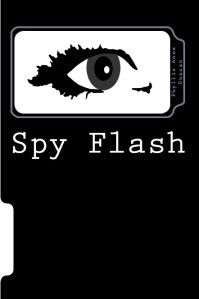
And the cover for Spy Flash? I wanted something dark and mysterious, something that conveyed spying as well as the less exciting aspects of espionage. What better than a black Spy Flash Cover 2.dofile folder and an all-seeing eye?

As of today, I’m waiting for the proof copy of Spy Flash to arrive, and I know when I hold it in my hands I’ll have that giddy feeling of accomplishment. I’m a much better writer twelve years down the road thanks to a lot of people, and I’ll be just as proud of Spy Flash as I was of Rarely Well Behaved. I’ll again rue that my Dad won’t see it and that my brother–the guy who hated to read but read my first book–won’t see this one.

For a long moment I’ll savor that feeling of “yay, me, look what I did,” then reality will set in–lining up book signings and arranging the publicity because, hey, I’m not John LeCarre or Alan Furst. I’m just Phyllis Anne Duncan, who’s pretty excited about the publication of her second, original book of short stories.