Reading and Writing

No, this isn’t a rant about the importance of the three R’s–reading, ‘riting, and ‘rithmetic–but a chat about the connection between writing and reading. They go hand in hand, and some of the most helpful advice any writer can hear is, “If you want to write, read.” I’ll add, “Read. A lot.”

Of course, you say, my shelves are lined with writing self-help books, and I’ve read them all.

I’m not knocking any of these books. In fact, one of my bookshelves groans with the weight of them. What I mean is, if you write fiction, read fiction. Let’s go a little deeper. If you want to write romance, read romance; if you want to write science fiction, read science fiction, etc.

In an on-line forum I belong to, someone recently posted, “I’ve decided I want to write science fiction!!! How do I go about that?” I responded that the aspiring writer should read Asimov, Pohl, Dick, Bester, LeGuin, Butler, Atwood, and so on. “No, no. I don’t want to read science fiction! I want to write it.”

I washed my hands of it.

You get your best writing instruction on technique, mechanics, and what people want to read by reading what you want to write. And I have to caveat that–read good, established writers of the fiction you want to write. I’ll suggest, for now, in the fledgling state of your writing in a genre, read traditionally published writers. There are exceptions to this, of course, but if all you read is unedited indie fiction, it will only reinforce negative writing habits. I’ve posted about this before, so I won’t repeat my indie-writers-must-proofread-and-get-an-editor riff.

Reading what you want to write can be instructive in another way. You can learn the valuable lesson that a particular genre is not for you. For example, I love mysteries of all kinds–from Agatha Christie to Janet Evanovich–but I’m not sure I could write one that wouldn’t be a re-hash of something a better mystery writer than I has already done. The same with sci-fi. That was what I wanted to write when I first set pen to notebook to write stories about Mr. Spock and Captain Kirk when I was a freshman in high school.

The sad truth was, and is, sci-fi is not my forte. Granted, my short story published in eFiction Magazine last year had a sci-fi background. “Without Form or Substance” is about a young professor who finds her dream job, only to discover it involves time travel. I found, because this was a character piece, I didn’t need to go into the scientific details of time travel, which I doubt I could pull off. I learned that from reading Octavia Butler and Ursula LeGuin, among others.

Of all the reading I’ve done in my life, it was the characters who stood out most for me or, rather, the way the particular writer developed and wrote a character. Most of what I read is character-driven, and as a result, my strength is in the characters I’ve developed. I wouldn’t have learned how to make them “real” people if I hadn’t read great, character-driven works by authors across many genres.

Balancing reading and writing can be a chore, though. If I want to devote the time I need to writing, I can’t read all day long, which I can do at the drop of a hat. I’ve shifted the brunt of my reading to the weekends, though I still read a little in the evenings or when I need a break from staring at the blank computer screen. When I’m reading something I enjoy, which engrosses me, it’s the hardest thing to set it aside. I’m currently reading And So It Goes: Kurt Vonnegut: A Life by Charles J. Shields. Not only is this a book about a writer, it’s a page-turner, and I regret every time I have to close the book and move on to something else I’m supposed to do.

Shields’ biography of Vonnegut is instructive on many levels. Not only do you see the mechanics of how to construct and research a biography, but you also get a glimpse into the life of a writer and how he wrote, what inspired him, and his struggle both to be published and to be accepted by other writers. I’ll give no more details than that because I want to review this book later.

I’ve found, for me, that when I hit a brick wall with something I’m writing, the best thing I can do is put it away. Then, I pick up a book and read.

What about you? What writers and what books have taught you how to write?

Settings

One of the things you learn in any fiction writing class is the importance of setting–a reader needs to be able to “see” where you’ve located your story. Sometimes writers can focus on the plot and the characters to the exclusion of setting. Sometimes setting can be just as important as memorable characters or a finely detailed plot.

When your work is a novel, unless it stays in one place for the length of it–like Agatha Christie’s Ten Little Indians or Murder on the Orient Express–you have to do some research if you’ve never been there. That’s a key component of the writing, because a reader might have been there and can spot the errors.

When John Updike got the idea for The Witches of Eastwick he had the perfect small town in mind–Wickford, RI. However, when he went to the town to research and people got wind of the plot–three witches in the 1970’s who take petty, and not so petty, revenge on neighbors–they threatened law suits if he used the name of the town. Updike let them think they won. The book’s title is The Witches of Eastwick, but if you read the description of Eastwick in the first few pages you recognize Wickford right away. And it was the perfect setting for this quirky novel about the devil coming to earth. (What would have been the difference had the Wickfordians not been such typical New England prigs? Maybe it would have been a tourist destination–it’s a quintessential New England town–instead of a town you drive through to get to the Newport beaches.)

I grew up in a rural area near a small town, so those are settings I’m comfortable with. I can tell from a story if someone has only seen a picture of a farm or gone to one. I spent a lot of my life in a large urban area and worked in the Nation’s Capital for the most part. I’ve spent a great deal of time in New York City, so I get the urban setting and am also comfortable setting a story in busy cities. I also like the juxtaposition of city and country–it’s something that’s never quite been overcome by urbanization.

I’ve done some world travel–a modest amount–to England, Scotland, and other places in Europe. I can insert any place I’ve visited in a story with ease. Some of my work is based in Eastern Europe, and that’s an issue. I’ve never been there, and, frankly, unless you’re a high-paid, commercial novelist, extensive travel to research your settings can be beyond the budget.

Atlases can give you maps and facts and figures–all good, of course–but Google Earth can put you there. Its “Street Views” options can put you in the city or town or countryside you want to write about. It’s still not as good as being there, but it can give you a starting point. The next point is finding someone familiar with the area to give you the personal touch or cultural memes for a setting. I had a friend who had traveled extensively with USAID, and he was always able to give me a good read-over for settings.

Some writers overcome the setting issues by creating completely fictional ones. Whether in fantasy, other genre, or literary fiction, that can eliminate any setting errors or hard feelings from the locals. For his collection of linked short stories, In an Uncharted Country, Clifford Garstang created Rugglesville, VA. For her first book of linked short stories, Thrown Out,  and an upcoming series of novels, Jennie Coughlin created Exeter, MA. Both constructs are real; you can “see” yourself in either place. They feel real. Even in fantasy or science fiction, if you create your own world, people still have to be able to “walk” through it. It’s not enough to say “we’re on a spaceship” or “we’re in a fairy land.” The writer has to give the setting depth.

Which do you prefer–setting your work in known locales, or do you create your own world?

Friday Flash Fiction–and Good News!

Writing can be the strangest occupation ever, especially when you’re dealing with a prompt–a word or a picture
–someone else provides. Since I’ve been participating in Madison Woods’ Friday Fictioneers’ 100-word flash fiction, I’ve been amazed how one picture can evoke so many different responses. One person always goes for the romantic, another fantasy, and I’m the quirky one. That’s a nice word for it.

Many times I get the Friday Flash Fiction inspiration picture on Wednesday and think, how will I ever come up with something for this? Then, it just comes to me. I’ve always been more of a seat-of-the-pants writer–whatever pops into my head goes down on paper (or on the screen). I’m not a methodical outliner or plotter. I get an idea and ride it to whatever conclusion comes to mind. That’s the way I write. I don’t recommend it for the faint-hearted because sometimes even I don’t know where the story’s going. Like today.

Here’s the inspiration photo:

And here’s my 100-word story:

The Mess

The inspector thought, How could this happen? There are procedures in place. I’ve talked myself blue in the face about the importance of following procedures. One little slip and look what you have. A mess. This isn’t going on my record. I’ll make sure of that.

The security guard thought, Man, why now? A completely dull day, then fifteen minutes away from shift end, this happens. Everybody else will be at the bar, watching the game and the babes, and where am I? Cleaning up this mess.

The boy thought, I really didn’t mean to do that. Please let me go.


———–

To read other Friday Fictioneers’ stories, take a look at Madison Woods’ blog.
———-

And some really great news. My short story, “Trophies,” about a marriage saved by a near suicide and an unexpected death, will appear in the February Romance Issue of eFiction Magazine. I got the acceptance yesterday, and I’ve been giddy ever since. A great start to the new year!
This story was the first one I wrote using a creativity prompt called Rory’s Story Cubes. Check them out.

Why Bother?


The picture has nothing to do with today’s topic. Rather, this is the fourth day in a row of drizzle, freezing or otherwise, and overcast skies here in the Valley, so I needed a reminder that the sun is out there. Somewhere.

I ran into a member of my writers group at lunch over the weekend. He was deep into reading a book on ancient history as research for what he writes. He was so engrossed in the book, I stopped by his table to ask if the book were good.

“Oh, yeah,” he said. “It’s so good, I wonder why I bother to write.”

I’ve had those moments, and you have, too. You know it. You come across a line or a passage in a book, or you close a book upon completion, and your shake your head and murmur, “Why do I bother?” Somehow, those rare occasions weigh on your writing psyche more than all the common occurrences of reading something trite or mundane and knowing you can do better. Well, we know good writing when we see it, and, as writers, we have to stop and appreciate the good, even while acknowledging the bad.

When I’m in the process of editing or revising, I’ll come across something I’ve written that’s so good, I actually wonder if I wrote it. Of course I did, but it resonates with me the same way as a passage from Faulkner or King or Vonnegut or Atwood or some other famous author I admire.

Now, I’m not saying my words are gold because, believe me, I’ve come across some real stinkers in my own work–including a story that won the competition to be included in the college literary magazine. When I do, I cringe, but I immediately start to see how I can make it better.

Like any other organism or system in our bodies, our writing grows and evolves. In five more years I’ll be a much improved writer than I am now–and I’m far improved over the writer I was ten or even five years ago. The only way to improve is to write–and write some more. And listen to the feedback without being defensive. That’s hard, I know, but it’s all part of that growth.

Even then, I’m sure I’ll come across a passage in something by King or Vonnegut or Faulkner or Atwood, and I’ll think to myself, “Why do I bother?” But it won’t stop me.

Who’s the author who makes you want to close the laptop forever?

Deciding Not to Review

Because I’ve given the author of a book I was supposed to review the option of my not reviewing it, I won’t be mentioning the book or the author in this post.

I’ve always been a bit quixotic–I voted for George McGovern in 1972, after all. Lately, I feel as if I’m single-handedly tilting at the windmill of “not self-publishing before you proofread.” I don’t want to be like some writers and disdain other writers who have “indie published,” or self-published, if you will. If a writer comes to the decision that self-publishing is for him or her, I respect that decision, and I try not to be judgemental about it. My collection of short stories, Rarely Well-Behaved, technically, was self-published. I won the contract in a short story contest, so I like to think that the merit of the story got the contract. Even up against a submission deadline, I read each story over and over, trying to make the manuscript as perfect as possible. Of course, after the book came out, I found typos.

In a post earlier this month–“Put That First Draft Aside“–I wrote about what I think is the major pitfall of self-publishing, that you can write something and publish it almost immediately. Some indie writers want to skip the editor for fear that will change their work too much. The least you could do, then, as an indie author is not skip the proofreading. If you do it yourself, you have to put the work aside so it’s not so fresh you don’t spot obvious errors. The best proofreading is done by someone who has never seen the work before.

The book I was to review, requested by the author as a result of a guest blog-post I did, is a perfect example of lack of proofreading. The mistakes are all what I call elementary school grammar goofs, i.e., they are diversions from basic, not advanced, grammatical norms. Enclosing dialogue in quotation marks, comma usage, and subject-verb agreement are examples. In the first two paragraphs of this book, I found eleven punctuation, grammar, and usage errors, including using the word “hallow” when it was supposed to be “hollow.” Throughout the work, quotation marks are missing, as are dialogue tags, commas, and contractions, among others. When I read a sentence about a bodily function that was anatomically impossible, I gave up and e-mailed the author to explain why I couldn’t finish the book and didn’t want to review it.

Sounds like a cop-out, I know, but I was pretty frank, and detailed, in the e-mail; merely, I didn’t want to blast the book in a review, which, as an honest reviewer, I would have had to do. I could have done that, and the author would have received a nasty surprise. I’d rather explain, privately, why I couldn’t do the review, and treat the book as if I’d never read it.

All of which is a shame, because I could see glimmers of a thoughtful story. It’s too bad the barbed wire tangle of basic, grammatical goofs hid it.

Indie authors, I cannot say this enough: You can’t do a brain dump and immediately slap it up on Amazon or Smashwords and call yourself a professional writer. Writing is writing and rewriting and revising and rewriting and proofreading, then rewriting and revising all over again. Tedious, yes. Instant gratification, no, but with writing, that’s a good thing.

I ♥ My Writers Group!

I’ve written before about my great writers group–SWAG, Staunton/Waynesboro/Augusta Group of Writers–about how supportive everyone is, and how I’ve made lifelong friends from being a part of it. Wednesday evening was our monthly social hour and open mic night. This was also the first meeting after we got a nice spread in the Living section of our local Sunday paper. We had a full house of readers and listeners–and lots of first-time-at-SWAG readers. It was probably the best night we’ve had with lots of thoughtful work and lots of laughs.

Why are open mic nights important? I’ll admit when SWAG’s founder, Cliff Garstang, suggested last year that we start doing readings–out loud, in front of people–I was nervous. That’s a tough thing to do, to stand up amid acquaintances and a few strangers and read what you’ve written. And that first time last April, my knees were shaking, and my throat was dry. Afterwards, I remember wishing I’d had a writers group ten years ago when my collection of short stories came out. I did three readings and book signings back then, without a clue as to what I was supposed to do, and the feedback I got was that I read too fast for people to understand what I was saying. At SWAG, I’ve learned to slow down and get across what it is I’m trying to say, and that’s an experience I wouldn’t have had without SWAG.

So, doing open mic readings among friends can help build your confidence for when you’re on that book tour you dream about being on one day.

The other good thing about open mic is you pay a good deal of attention to the exact piece you’re going to read. We get five minutes, so the passage has to be tight, succinct, which means, beforehand, you’ll do some needed editing and revising you might not normally do. That’s always a good thing.

And here’s the best part–it’s great when open mic is over and someone in the audience comes up to you and tells you he or she enjoyed what you read and begins to ask questions about your work. You feel like an honest-to-God writer when that happens. It’s great.

Building confidence, honing your editing skills, and boosting your writer ego–that’s what you get from a writers group. Find one. Join one.

Dr. Frankenstein, I Presume

Yesterday, I had a long talk about writing–its joys and frustrations–with another local writer friend of mine. She was talking about a character she created and a certain aspect of his life and how she didn’t set out to write him that way, that it was just “there.”

“He told you who he was,” I said. (No, I’m not usually that profound.)

I’ve had this conversation with other writers or heard or read other writers who say the same thing–a character you create somehow becomes his or her own entity and proceeds to tell you, “I’d really do it this way. No, no, no, I’d never say/do/believe/want that.” That character leads you down plot paths you never anticipated, but that’s the way it’s supposed to be. Merely, our constipated brains need the liberation provided by creating a fictional character who is our alter ego.

My main character–an Englishwoman who is a spy–gets to say things I’d never say, and I’m known for being outspoken. When your character can let loose with something society and propriety require you to keep quiet about, that alleviates a lot of pent-up frustration and keeps it from exploding at an inappropriate time. See, having your characters talk to you can be a good thing.

How do you know they’re speaking to you? When you’ve written something you think is the way you want the story to go, but then you’re pulled back to the keyboard and end up rewriting or revising or tossing out words until that story has set off in a different direction, and it’s for the good–that’s when your characters tapped you on the shoulder and said, “I think you need to reconsider.”

I struggled for a long time to find the ending for my trilogy about a domestic terrorism event, and it just didn’t come. Oh, the various attempts were good endings, but none of them was The Ending, the way the series was supposed to conclude. Then, the death of the person on whom one of the characters in the trilogy is based gave me that ending. It was as if the fictional character finally got through to me and said, “You’ve been avoiding the reality that this was the only way it could end.” And he was right.

We think we create our characters from whole cloth, but the truth is we take pieces–the good and the bad–from every person we’ve ever known or loved or disliked. We stitch them together and give them our own life-force, and they are as real to us as any flesh and blood person. They have to be. Otherwise, a reader would never be interested. They come from within us. They’re our “children.” We speak to other writers of them as if they were real and sitting around the table with us. We defend them and their actions to members of our critique groups/agents/editors. We think of them at odd times. We anticipate getting back to the story so we can see them again. We see something happen and know how our characters would react to it. They are our waking and sleeping companions, often our best friends and harshest writing critics. We are the ones who shout in triumph, as they rise from the laboratory tables in our minds, “It’s alive! It’s alive!”

How about it? Do your characters speak to you? If so, leave a comment and tell me about a time when they did.

———-

Writing Work Schedule Update:

Things are actually still going according to schedule, even with having had a nasty cold last week. On “Submission Friday” I send in two book reviews and two author interviews to a fiction magazine. This week, on the Editing/Revising days, I’ll concentrate on proofreading and finalizing the re-typed (and edited) manuscript of my collection of short stories, Rarely Well Behaved, which I’m re-releasing as an
e-book this spring–or earlier.

Two For One!

Aren’t you lucky? Today, you not only get a 100-word flash fiction, but, at no extra charge, you get a little writing lore as well.

Yeah, I wouldn’t do well writing for infomercials, would I?

Here’s today’s Friday Fictioneers inspirational photo:

And here’s a piece I call, “Winter Wonderland.”

I wasn’t sure if it were safe to go out yet, but the dog, cooped up for so many days, was insistent. I tried to keep him close, but dogs wander. Still, I understood. Cabin fever had grasped me, too.
The blanket of snow seemed muted beneath the still-gray sky but was so beautiful compared to the four walls where we’d hunkered down. There were no tracks except ours.
The dog bounded toward the road. I slogged after him, my cries loud in the still air, echoing off the trees.
You don’t go far from home in a nuclear winter.
———-
Yes, I’d gone a few days without any apocalyptic writing. 😉 Now, here’s your bonus–a brief discussion about a writing tool I can’t be without.
Even after teaching English, being a journalist and an editor, and writing since I was ten, there are certain aspects of English grammar where I still falter. Lie versus Lay. Which versus That. Those are my particular downfalls. I’ll write them one way, decide they’re wrong, write them the other way, then discover I was right the first time.
Who wants to go pull the dusty, old English Grammar Reference off the shelf? Not I. I use a small tome that has been on or near my myriad writing desks for the past forty years–The Elements of Style by William Strunk, Jr., and E.B. White, or as it’s colloquially called “Strunk and White.”
“Make every word tell,” was Cornell English professor William Strunk, Jr.’s advice to his students, one of whom was E. B. White, ofCharlotte’s Web fame. Strunk wrote the first The Elements of Style in 1918 and made it obligatory for his students. It wasn’t until after Strunk’s death that E.B. White, writing in The New Yorker, told the world about the “forty-three page summation of the case for cleanliness, accuracy, and brevity in the use of English.” White was asked to edit a re-issuance of the volume to bring it into modern usage. That was about sixty years ago, and this “little book,” as White called it, is still an indispensable aid to writers from high schoolers toiling over term papers to the rest of us who hope to be considered accomplished.
My well-thumbed copy, which helped me write features and editorials as a reporter and countless government reports, is still packed away with my work “stuff,” so I had to replace it with this fairly fresh copy (below). Strunk and White pares down the sometimes vague structures of English grammar to the basics of language usage and composition.
 
It has almost doubled in size from the forty-three page volume White extolled in The New Yorker and now has a glossary and an index. It’s original outline remains much the same as Strunk’s version from the early part of the previous century: Elementary Rules of Usage, Elementary Principles of Composition, A Few Matters of Form, Words and Expressions Commonly Misused (my personal favorite), and An Approach to Style. (I love the perfection of those section titles.)
Strunk and White is great for writers who hate grammar–notice they don’t use the word–because it has condensed the whole, arcane grammatical schema into a pocket-sized reference. You could call it “Style Basics” and be accurate, but “The Elements of Style” is just, well, stylish.
My new copy cost me ten dollars in a book store, but consider it an investment. Big box and independent book stores will order you a copy upon request. You can get a used copy from Amazon for as little as seven dollars or from free to $2.99 in the Kindle Store–though the Kindle version is the original Strunk work. Go for the Strunk and White version. If you’re a Nook person, the price and the version is the same. A used copy from Barnes and Noble can be as low as three dollars.
Considering the state of some of the indie published books I’ve been reading to review, every person who calls him- or herself a writer should own one of these and use it. Then, you won’t be disingenuous when you call yourself an author.
I have no financial interest in The Elements of Style or with its publishers. It’s just a darned good writing book.

Whither to Write?

In the tiny townhouse in Northern Virginia where I lived before I retired, for years I was tethered to a single place to write–an upstairs “bedroom,” which I declared my office, with a chunky, Dell desktop. I think prisoners in SuperMax have a bigger cell than that 10′ x 10′ space, but, boy, was I productive there. With my stereo blasting whatever music I was into at the time, I wrote a trilogy and the somewhat fleshed-out skeletons of three more novels.

When I purchased a laptop, I became rather bohemian–at least what passed for that in the Yuppie Capital of the Free World–and could write in book-store cafes (loved Olssen’s in Old Town) and coffee shops, not to mention any room in the house, on the road for work, on vacation, etc. Re the latter: It helps to have a supportive partner, and I did. He got that I needed space to write and didn’t begrudge it.

I’m happy to say I can write almost anywhere, whether using a laptop, a Moleskine reporter’s notepad, or a spiral notebook. Sometimes a notebook is good, especially when you’re people-watching to get ideas for characters. You could be writing a grocery list and no one knows you’re jotting down what’s being said or how someone acts.

There comes a time, though, in any writer’s life where you need to focus on a particular writing project to the exclusion of all else. When that time comes for me, it can’t be in a coffee shop or working in the gift shop at the R. R. Smith Center in Staunton. I have to be in seclusion. On the Myers-Briggs scale, I’m a very high (as in off-the-scale) E, meaning I’m energized most and best by external stimulus. When I need to focus on a writing project, the latent I, meaning I prefer to do a Greta Garbo, emerges.

I’m lucky in the house I bought after retirement to have a primary and a secondary writing area, which I use alternately depending on how strong the “I” becomes.

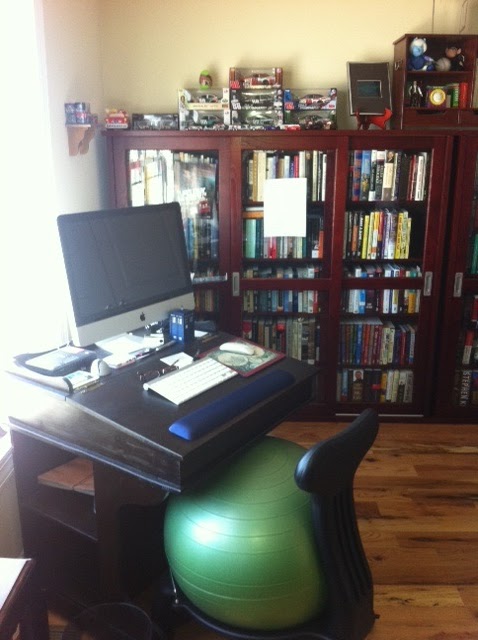
The primary area is my home office, which you can see here (above):

It has a lot of advantages–actually, it has the most advantages. You see my bookcase of reference books (U.S. history, world history, writing), which are at hand. (And, yes, you see the odd juxtapositions in my life: my NASCAR collection next to my Star Trek collectibles.) It has my really powerful iMac and my comfy ergonomic chair. Just to the left, out of the picture, is my satellite radio, which can bring me a constant stream of inspirational music. That, too, can be an interesting and eclectic mix–from heavy metal (Rob Zombie and Nine Inch Nails) to Celtic (Irish Rovers and Tommy Makem) to opera.

As many advantages as this wonderful room has, it has a major distraction–this amazing view of the Blue Ridge Mountains (below). And, yes, I took the shot through the window for verisimilitude. I can be in the middle of something and glance out the window and get completely lost in the wonderful place where I chose to live.

Curtains, you suggest? Uh, why would I cover that up? The tiny office in the old townhouse looked out onto the parking area in the cul-de-sac, so that was rarely a distraction. The view above can figuratively or literally pull me out of my chair to go outside.

Which can be good for clearing the cobwebs with a nice walk, but it happens too often.

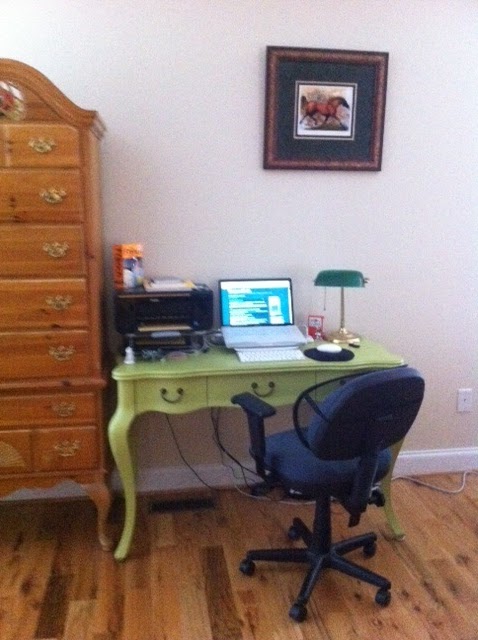
On many occasions, then, I retire to my secondary writing area, well away from any commanding views.

This area (above) is a nook in my bedroom, where I can’t be distracted by the outdoors. The view is the wall, or the nice artwork above, but that’s hardly as alluring as the Blue Ridge Mountains. There is a television in that room, but my back is to it, and it has a decent selection of music channels. I have to have some background noise–always have, much to the consternation of parents who couldn’t understand that homework could be done while singing along with the Beatles.

The disadvantage of this writing area is that if I need something from one of the reference books, that means a trek across the house (oh, horrors) to obtain it. Of course, there’s always The Google. (What toys were popular among pre-teens in 1989? Why, I’ll Google it.)

Wow, what a dilemma, you say, voice torqued by sarcasm. I know. But the secondary writing area, where I am, as I write this, is the least distracting. I often end up here, like a troglodyte in a dim cave, but the productivity is welcome.

Keeping track of versions of the same work on two computers? That’s a whole, other issue.

In the meantime, find your writing place, the one where you’re most productive, where the words come unbidden, and live there.

(Note: I used my two favorite words ever in this post. Can you find them?)

Resolved–to Write

When I retired two-plus years ago, my main goal was to write full time—to produce more short stories, polish the novels I have in various stages of completion, blog more—and to get published. The good news is I can say, with accuracy, that all of that has happened. Just not with the consistency and frequency I expected. And that’s my fault.

I’m most happy when I’m writing, when I go into the world I’ve created in my novels, when I carve out little bits of reality (or fantasy) in a short story. I just don’t do that often enough. I have made a conscious effort to consider and call myself a writer, to get validation from my local writers group and critique group, and to be inspired by the circle of writer friends I’ve cultivated. Again, I can say that, too, has happened.

The problem is, I don’t write enough. I don’t focus myself as well as I should, mainly because I wanted a complete separation from the world of work. Writing is work, and it should be; otherwise, I’d just write cute little stories for my friends and family to read in the annual holiday letter.

A writer friend of mine, Cliff Garstang, has hit the mark for me with a recent blog post. Cliff periodically posts “Tips for Writers,” and his December 9, 2011, post, “Finding the Time to Write,” made me sit up and take notice of how I approach my writing. It wasn’t a pleasant sight.

About the only advice from that post I can’t take is “Get up earlier.” The “Work later” part is easy—I am often most inspired when the day is done. Why can’t I get up earlier? Too many years of rising at oh-dark-hundred for a variety of reasons, but I can work back into it. Gradually. Cliff makes the time to write, and his writing work ethic is inspiring—he shuts away all external distractions and just creates. Though Cliff often goes to writing retreats (something I need to try), he works to re-create that atmosphere at home, which he describes in his December 7, 2011, post, “Bring the Retreat Home.”

Another writer friend of mine, Jennie Coughlin, is in a writing frenzy right now, working on a series of novels about her fictional New England town, Exeter, and its denizens. (Take a look at her blog Welcome to Exeter and marvel at this ambitious schedule she’s set for herself.) She works a full-time job and a part-time job and gives up what free time she has to writing, including publishing the occasional short story as well as character sketches on her blog. Her word output is amazing, and she’s considering a challenge to write a half a million words next year. I’m sure she’ll make it.

You can see I have a lot to live up to. And the pressure on me is mine. I need to do what I said I was going to do when I retired. As Stephen King once said, writing is my job, and I need to stop being a part-timer.

So, I’ve done the dreaded thing, and set up a [shudder] work schedule for writing starting January 1, 2012. It’s a modest start to organizing my free time around what I’ve said is my profession. Right now, it needs to be flexible so I don’t rebel and to accommodate spending time with family and friends and my exercise regimen. It could be a colossal failure—wouldn’t be my first—but it could get me back on track.

Here we go:

Monday            0800 – 1000: Blog about writing or publish a book review on my blog

1400 – 1700: Edit/revise a novel WIP

Tuesday            0800 – 1100: Edit/revise a short story WIP or identify a publication to submit to

1400 – 1700: Edit/revise a novel WIP

Wednesday       0900 – 1100: Blog about politics

1400 – 1700: Edit/revise a novel WIP

Thursday           0800 – 1100: Edit/revise a short story WIP or identify a publication to submit to

1400 – 1700: Something new—a short story or a novel idea

Friday                 0800 – 1000: Blog about writing, publish a book review on my blog, and/or 100-word

flash fiction

1300 – 1500: Submissions—the actual act of doing so—or developing a query letter

Saturday and Sunday: Two to three hours of reading and/or writing reviews

Your job, dear readers, is to point out that I’m not doing what I said I would do. Just think of the possibilities—getting to tell me to get my ass moving. 😉