Clearing the Cobwebs

When you have more than one computer, you run the chance of “losing” a file. Losing as in not remembering which computer you wrote it on. For me it was an 80,000-word-plus second draft of the 2012 NaNoWriMo rough draft. I was convinced it was on my laptop, and I even found a version of it, except I didn’t know it was a version. I thought it was the file I was looking for.

About four chapters of re-writing later, I knew something was wrong, but I couldn’t put a finger on it, so I plodded on. The nagging sensation I didn’t have the right version kept kept up to the point where I put everything aside because I wasn’t happy with the result.

I recently picked up on the “grown-up” coloring book fad and bought a couple of books and seventy-two art pencils. Hey, I do nothing in a low-key way. One book is called Balance: Angie’s Extreme Stress Menders, Volume 1 by Angie Grace. It’s a book of mandalas, uncolored, so you can, well, color them. I didn’t have extreme stress, only the mild stress of a re-write not going the way I expected and the last-minute details of planning and putting on a one-day writers symposium. Okay, that had begun to border on extreme stress.

I’m not in the least artistic, as in painting and drawing. Writing is my art. I was a big fan of paint-by-number when I was a kid. One such “masterpiece” hung in my apartment until I bought a house and started collecting art from people who knew what they were doing. When I was a flight instructor and had to draw airplanes on a blackboard to illustrate a fine point of aviation, my students invariably laughed at my renditions. I was a Bob Ross drop-out; no happy little trees in my muddy paintings.

Grown-up coloring books aren’t paint by number because you have to choose the colors and where you’re going to use them, so I figured this was going to be a disaster, but I’d taken art in college (wherein the professor suggested that perhaps I should become an art historian rather than an artist), so I knew the color wheel and color families. And I had seventy-two art pencils to choose from.

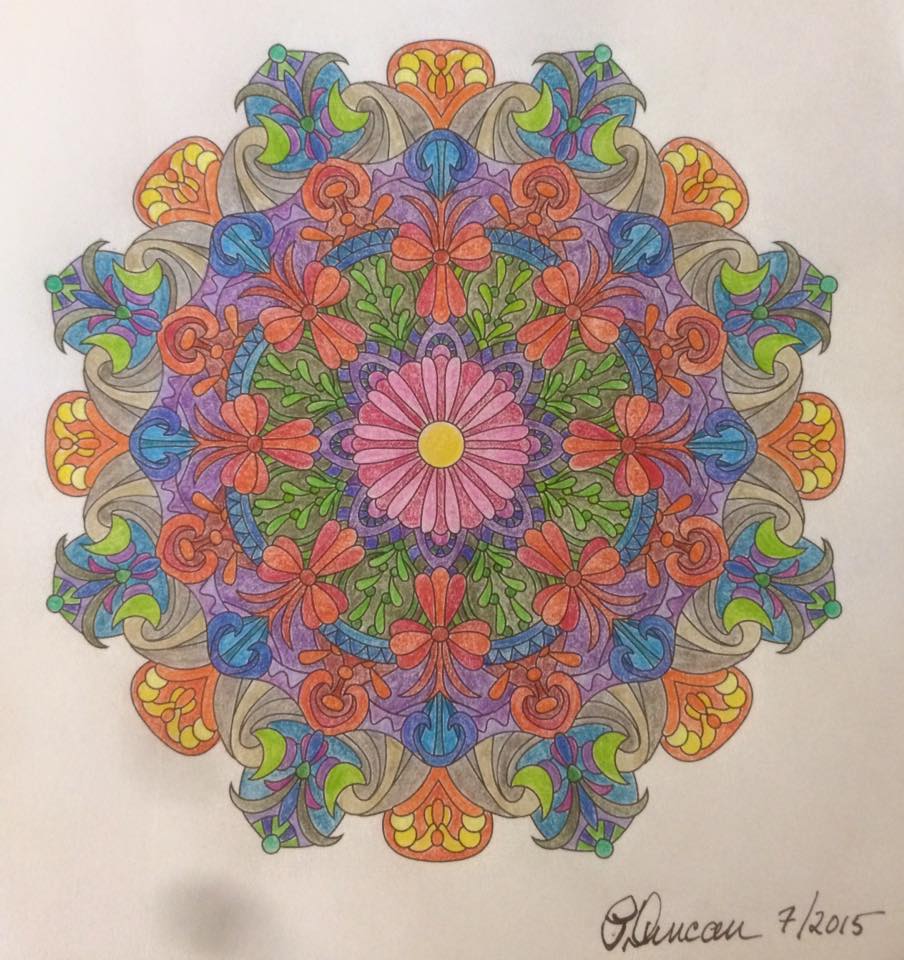
I found when working on what I called “Mandala 1” I didn’t think about much of anything except, “Is this the right color to use next to this one?” But here’s the result:

Mandala 1

Not bad, eh? Actually, I think it’s a bit chaotic and probably should call it “Chaos.” I certainly don’t think it has the calming effect Ms. Grace anticipated in her book.

A mandala in Oriental art is “a schematized representation of the cosmos.” In Jungian philosophy, a mandala symbolizes trying to reunify the self.

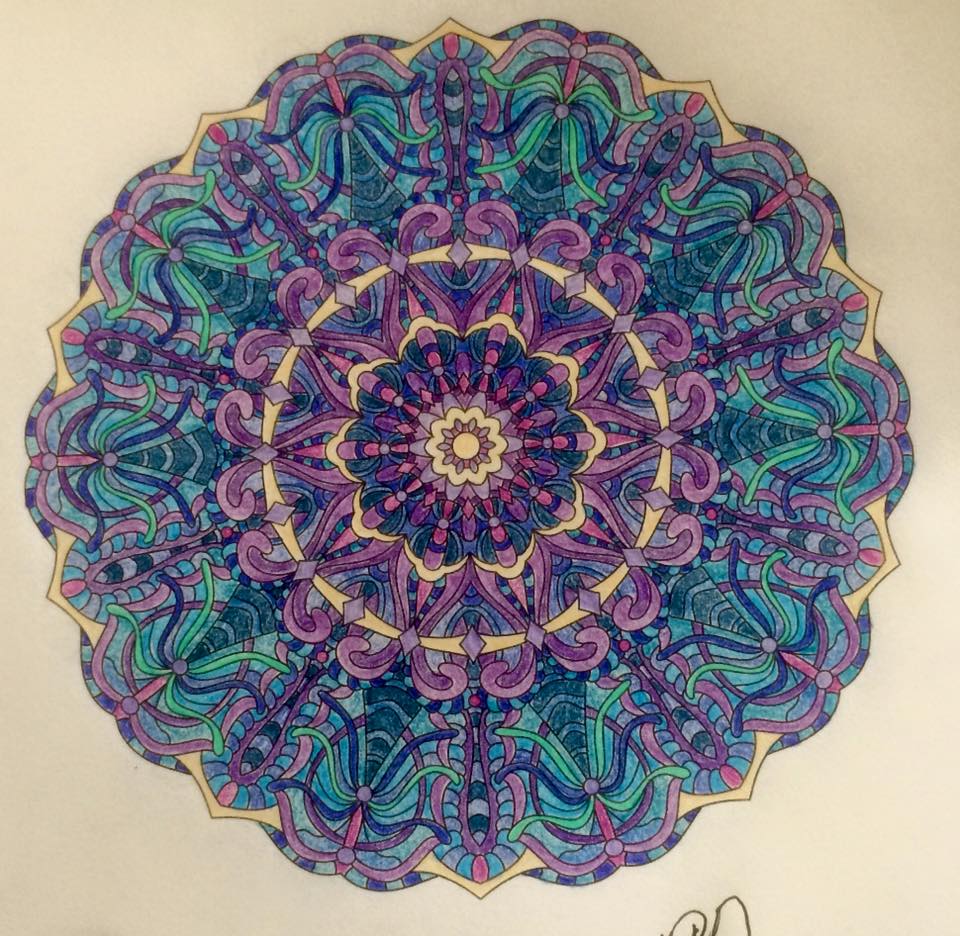
I was trying to do the latter, to reunify the proper draft of a novel with my self so I get on with the needed re-write. Mandala 1 didn’t quite do it. So, there was Mandala 2:

Mandala 2

Ah, much better, and toward the end of this one, I thought, “Look for the draft on the other computer.” Lo and behold, there it was, the file I wanted to re-write from. Self reunited.

Of course, indulging my “artistic” wants takes time from my work, which is writing. However, Mandala 2 cleared a great many cobwebs away and helped me focus the re-write approach. Trust me, before that I was like a Roomba blundering into a piece of furniture and backing up, only to blunder into a different piece. Now, I can do the re-write justice.

I’m sure there’ll eventually be a need for Mandala 3.

Book Launch!

MNE FCFlight Controller: 10, 9, 8, 7, 6, 5, 4, 3, 2, 1. We have lift-off! Lift off of Phyllis “Maggie” Duncan’s very first novella, MY NOBLE ENEMY! Ask yourself, what would you do if your best friend came to you and told you he was dying? You’d pretty much drop everything to care for him, even if it brings up old slights and opens old wounds. Most of all, you’d want the end to be peaceful.

MY NOBLE ENEMY is not my typical historical thriller. Rather, it’s a love story on many levels–what friends will do for each other, supporting a spouse even if you don’t agree with his or her actions, and a bit of young love in, of all places, the red-light district of Amsterdam. Yeah, you know I had to be a little salacious. If you pre-ordered a Kindle version of MY NOBLE ENEMY, it will arrive TODAY! And if you’d like your Kindle version “signed,” go to authorgraph.com, look the book up, and submit a request for a virtual autograph. If you’re looking for a paperback copy, you can order one from Amazon.com–oh, if you buy a paperback, you can bundle the Kindle version at a bargain price. I hope you enjoy MY NOBLE ENEMY.

Tinker Mountain 2015 – My Writing Tribe

The countdown calendar to the right of this post indicates that, as of today, I have seven days to go before the 2015 Tinker Mountain Writers Workshop. I find it amazing this is my fourth one! Three years ago about this time, I was having big second thoughts. For one, I’d never had my work critiqued by strangers, much less a well-respected, actual writer who was my workshop instructor. To say I was a nervous Nellie would freshen that cliché.

But 2012 was all positive with the incredible Pinckney Benedict; 2013 was amazing with the insightful Fred Leebron; and 2014 was an eye-opening experience with a master of genre writing, Laura Benedict. So much so, I’m re-taking her workshop this year, and I hope what I’ve submitted embodies everything I learned from her last year.

As critical as the workshop is now to my writing, the making of writer friends is, in some ways, more important. I have a circle of extremely talented writers who’ll beta-read what I’ve done and point out exactly what I need to do to make it better. More importantly, because we have that shared workshop experience, I respect their opinions. There is no sense of competition; just genuine, meaningful critique. What more could you ask for in a writing workshop?

So, today, I’m positively giddy. I can’t wait for Sunday to get here to head the loaded car south to Roanoke, set foot on the absolutely gorgeous campus of Hollins University (an inspiration in and of itself), and see my writing tribe.

Oh, and, I might get a writing themed tattoo while I’m there. Gasp!

MY NOBLE ENEMY – Ready for Pre-Order!!

MNE FCMy Noble Enemy: A Spy Flash Novella is now available for pre-order for your Kindle or Kindle App. At just $3.99–what a deal! Plus, if you order the paperback (which is also a steal at $5.99), you can add the ebook for just $1.99!

Feel like you’re in an infomercial yet? So much for the marketing skills.

You can pre-order My Noble Enemy by clicking here, and on June 5, 2015, it will magically appear on your Kindle and be accessible on your Kindle App.

But if you’re a gotta-hold-the-book-in-my-hands reader, you can order the paperback now. Did I mention it’s a steal at $5.99? Order the paperback by clicking here.

Thanks for putting up with my attempt at positive marketing. It’s okay to laugh.

Unpublished – WTF? (Part Two)

To read part one click here.

You send a story out into the world, and it gets published. Most of the time you hear nothing more about it, except perhaps for friends who go read it. On February 1, in email I got my copy of the on-line magazine my story, “Dreamtime,” appeared in, and the link to see it on-line. Normally, I’d update my author website with the link to the story, but I was still on the recovery side of a bout of flu. A few days won’t matter, I thought; I’ll get around to it. Turns out I was prescient.

A day later, I received an email from the editor of the on-line magazine indicating there had been some negative comments about the story. Literary critique, I asked? No, some readers found it offensive. How so, I asked? I got a vague reply about offensiveness and an indication the magazine’s editorial staff were considering what to do about it. The editor provided me a link if I wanted to see the comments.

I considered it, but I also didn’t want to get into a social media rant over my writing. No, I responded, I really didn’t want to see the comments. If they were literary critiques about style or story structure, summarize them, and send them to me. No reply.

Trolls and Fake Reviewers

I follow the author Anne Rice on Facebook. She is the rare famous author who will engage with people who follow her. She is adamant about commenters on her posts remaining civil and that she will block anyone who is vindictive or rude. She has also taken on people on Amazon and Goodreads who call themselves reviewers but whose sole purpose seem to be to cut down writers they decide they don’t like.

I’d had one negative review of my collection of short stories, Spy Flash. The reviewer indicated that he or she thought it was a novel but was disappointed to discover it was “just a collection of short stories.” All the information on the book clearly indicates it’s a collection of short stories, so when it became obvious this person hadn’t bothered to read the book, I let it go and didn’t reply. That was mild compared to some things I’ve seen on Amazon and Goodreads–questioning the author’s intelligence, whether the author’s parents were married when the author was born, and worse. Anne Rice is determined to shut these trolls down by pressuring both Amazon and Goodreads to police reviews better.

I had given her issue only passing attention. It didn’t affect me, so why get riled up over people being rude on social media. Happens all the time. I’ve personally pushed the boundaries of rudeness, but I’ve never posted false accusations or personal attacks. (Well, some right-wingers might disagree, but if so, my work is done.) Now, I felt as if I understood what Anne Rice was talking about.

My Offense?

I would never have known I’d been unpublished unless a friend had gone to the on-line magazine’s website to read my story and couldn’t find it. So, I looked. Sure enough, it was gone–no indication in the table of contents, no explanation on the web site. It was as if my story had never existed.

I emailed the editor, who did respond promptly to say it was a “difficult decision” to unpublish the story, but that the number of people who were offended had grown, and the editorial staff felt it had no choice. I again asked for clarification about what was offensive in the story and received a reply indicating that when art deliberately offends it is sending a message; but when art inadvertently offends it shouldn’t be displayed. Again, I requested specifics and got something, but not enough.

Because my story involved a didgeridoo, which is a musical instrument native to aboriginal people of Australia, the assumption was that my narrator was an aboriginal. The Australian Arts Council, so I was informed, has protocols that only aboriginal people or non-aboriginals who have obtained permission from aboriginal people can write about aboriginal people. A caucasian Australian objected to the story on that basis.

Two other writer friends went to the on-line magazine’s Facebook page and looked at the comments there. Most were positive, and indeed people I didn’t know came to my defense in light of what turned out to be a single person’s criticism. I haven’t looked at the comments. I can’t. Though my author’s skin has thickened to constructive criticism, it would do me no good to read the kind of negative comments my friends indicated were there.

The Australia Arts Council Protocols

This organization, which only has effect in Australia, does indeed have a nearly 50-page booklet entitled, “Protocols for Working with Indigenous Artists.” It has a section on writing and does indicate that if you, as a non-aboriginal, are going to tell the story of the aboriginal people of Australia, you should work with aboriginal people to assure accuracy. You should also use aboriginal language to describe cultural aspects. So, by titling my story, “Dreamtime,” which is a western term for a complex aboriginal religious ritual, I was in violation of those protocols.

Except, of course, they don’t apply to me because the Australian Art Council, which is not a regulatory body, has no jurisdiction over my little plot of central Virginia.

I did, however, download and read cover-to-cover those protocols. I believe those protocols have a place in Australia, where the indigenous people’s’ history, culture, and art were in danger of eradication by non-indigenous people who disparaged them because of racial prejudice.

Precisely what my story was about.

So, I’m glad that Australia now seeks to protect the art and culture of its aboriginal people, but, again, those protocols have no license over anyone outside Australia. Now, I’m not saying non-Australians are free to disrespect the Australian indigenous people. If a non-Australian writer did that (or an Australian writer for that matter), I’d be the first to denounce them.

My story revealed the narrator’s feeling of being an outsider at work, of his (or her) face being the only dark one there, how his (or her) co-workers wouldn’t understand why he went walkabout, how he’d overheard them calling him (or her) a derogatory term used by non-indigenous Australians. My story intended to honor the indigenous people’s struggle to be accepted, but it wasn’t perceived that way by at least one person and a few followers of that person’s blog.

The Aftermath

For the most part of two days, I questioned my entire existence as a writer. I’ve fought injustice, discrimination, sexism, et.al., with my words and my actions. To be accused of “inadvertently” offending a whole race of people is shattering.

I did fight back. Though it was obvious the editorial staff of the magazine wouldn’t change its collective mind, I had to make a point. A novel I’ve written, which is at the rough draft stage, features a transgender character. I’m a straight female who identifies as such; however, I’m straight but not narrow, as the meme goes. I pointed out to the editor that based on her (or his) logic about my story, I shouldn’t be allowed to write about a transgender character. That and my point about “unpublishing’s” effect on creativity went unacknowledged.

However, I insisted the publication rights for the story be returned to me, and they were. I instructed the editor to keep the check (Yes, I was going to be paid for the story.) and to cancel my complimentary subscription to the magazine. Small protests, yes, but sometimes it’s the principle of the thing.

So, why not publish the story right here, so you can decide for yourselves? Since I have the publishing rights back, it’s my intent to submit it somewhere else, to a magazine whose editorial staff has a spine and stands up for its authors.
 

Unpublished–WTF? (Part One)

I haven’t blogged in a while. My apologies. There was the run-up to the holidays, the holidays, a six-week-plus bout of the flu, then a set-back in my writing career which had my finger hovering over the “delete all” option in my Writing folder on my hard drive. Then, I realized the only way to cope with that set-back was to write about it.

Once Upon a Time

Anyone who writes knows how hard it is to send stories out into the world of contests and literary magazine publication. Most of the time, those stories get rejected, some with a modicum of hope (“send us something more”); some with not so much as an acknowledgement of receipt. The rare time something gets accepted is such an ego boost, we can live off it alone for months. This is the validation every writer craves.

I recently had a two-fer: I wrote a story for a contest, and it not only won but earned an offer of publication. Double validation.

BTW, I’m not mentioning the name of the contest (to protect the innocent) nor the name of the magazine (so I don’t give the guilty any inadvertent publicity).

I said yes to the offer of publication, of course, because I’m not at the point in my writing career where I can casually turn such things down. If I’d known then what I know now… Except, well, I did my research. Not only did I discover this particular online magazine had a low acceptance rate, i.e., difficult to break into, according to Duotrope, but publication in it was a qualifier for membership in the Science Fiction Writers of America. The positives were adding up, and I was looking forward to my story being published early this year.

The Story

Sometimes when you’re writing a story, you get a feeling about it, that this is one which has a future, one which is special. I had that feeling as I wrote “Dreamtime,” a 500-word story for a flash fiction contest and based on a photo prompt. The photo itself was of the interior of a didgeridoo, a unique perspective, to say the least. I researched the history and manufacture of the didgeridoo, and at some point the unnamed narrator of my story began to speak to me. This is the first thing he said:

“In dreams on walkabout, my ancestors in the rock paintings come alive and descend to my camp.”

Yeah, I know. Pretty amazing. He continued, telling a story of playing a didgeridoo passed down over the generations, then getting the idea to look at the stars through the didgeridoo. He imagines another dreamwalker on another planet doing the same thing. When he returns to his day job at a radio telescope installation, he “listens” for that other’s song, and he also realizes he is the perpetual outsider there, being the only one of aboriginal descent. He understands as well, that one day, he’ll die and return to the earth. When our sun expires millions of years from now, his atoms will be scattered to the far ends of the universe to create another dreamwalker ancestor, who will be painted on rock. He finished his story this way:

“Then, in dreams on walkabout, I will descend and dance around a fire.”

I set it aside for a while, mindful of the contest’s deadline; then, I dusted it off and did some editing. This was a story which resonated strongly for me, but I researched to assure I got the history and the culture correct. (I have a degree in history; research is my be-all and end-all.) If something was slightly off, I realized that in writing fiction, I had a certain amount of dramatic license, especially for a piece which had both a fantasy and a sci-fi tone.

I was happy with it, happier than I’ve been with a lot of my short stories. As I said, I thought this story had a definite future. I submitted the story. I knew it was strong enough to be a finalist, and it was. What I didn’t expect was to win, but I did. The offer of publication was icing on the literary cake.

What could possibly go wrong?

Apparently, everything.

To be continued in part two.

Get Ready for Some Poetry!

Last week I started an eight-week poetry class at WriterHouse in Charlottesville, VA. I’ve always wanted to write poetry, but perfectionist that I am I rarely set pen to paper to give it a try. When I saw the poetry course offered, I figured it would be a good impetus. The instructor, Aime Whittemore, didn’t cut us any slack; we got homework the first class: Using the first line of another poem, write your own poem. And not only did we have to write a poem, but it got work-shopped today. Oy! We had a list of first lines to choose from, and I selected “Bent double, like old beggars under sacks” from “Dulce et Decorum Est” by Wilfred Owen. His poem, written about World War I, is pretty stark, but I’d never read it until after I selected that line. However, the first line brought something else to mind.

Oh, and just be prepared. I’ll probably post my poems, good and bad, and your comments would be appreciated.

Family History
(Prompt: First Line of “Dulce et Decorum Est” by Wilfred Owen)

by Phyllis “Maggie” Duncan

Bent double, like old beggars under sacks,
Their burdens hunger and homelessness,
They fall dead by roadsides and in ditches,
Teeth and tongues the color of chewed grass:
Why I don’t smile at the wearing of the green.

My grandmother hoarded food and money;
A century later the memories were too fresh
With recollections of lost uncles and cousins,
Who left and no word ever came again,
Their empty place settings sacred at table.

Always spoken of in the present tense,
As if they would one day reappear,
Pockets full of coin and victuals to share,
To tell their stories of streets paved in gold
But never mention “No Irish Need Apply.”

To America, that was a choice.
To Australia, the price of passage
Was a loaf of bread taken in desperation
From a windowsill where it cooled
And reeked of survival.

Those memories ride in my blood,
Renew in my marrow.
My grandmother made no waves,
Asked no questions,
So she wouldn’t have to go back;

Fear of deportation stretched
Across decades to my mother,
Who dreaded applying for a passport.
In our house no talk of Auld Erin,
No parsnip or turnip eaten.

Bone and sinew bespeak my history,
And it’s undeniable in my skin
(Never tanned but freckled),
The shape of my cranium (round);
The color of my hair (red).

Barely a note sounds before my feet
Move to the music of bodhran and pipes.
I don’t set out bread and milk for the wee folk
Like the other Maggie, my grandmother,
But maybe I should.

Obsession Much?

July just ended, and now it’s August. Did I get caught in a time warp and miss July altogether? I must have because it seems I opened my eyes the other day, and it was August. How did that happen? And how have I managed not to blog for a month or more?

Three words: Work in Progress, aka WIP.

This particular WIP is a four-book series entitled A Perfect Hatred. I’d left it alone for a year, then resolved to do a complete rewrite of all four books this year. All told, I’ve cut about 90,000 words from three books, and I’m working on the fourth now; it’s down 10,000 words.

A writer friend said why bother to cut; length doesn’t matter in an ebook. It may not, but unnecessary words weigh anything down. Most of what I’ve cut has been back-story, info dumps, and clever little paragraphs to show the reader just how much research I’ve done. I’ve cut swaths through what a character is thinking and let those thoughts emerge through dialogue and action. I hope.

In short, I’m trying to apply everything I’ve learned from three years of workshops and conferences, and it takes a lot of time. I’m back in my characters’ heads, and I don’t want to leave them. I dream about them. When I’m not writing them, I miss them. I find myself getting annoyed when other responsibilities intervene. I’m having chats with my characters when I’m in the car, the shower, at the grocery store. Trust me, if the chat happens in a public place, it needs to be entirely within your head; otherwise, people avoid you.

Why am I suddenly obsessed with this particular WIP? It’s somewhat time sensitive. It deals, fictionally, with an historical event whose twentieth anniversary occurs in April 2015. It would be timely to release an ebook a month starting in January, with the fourth book coming out on the anniversary itself. Of course, that pre-supposes I’m going to self-publish it, another thing I’ve obsessed over, written endless pro/con comparison lists about, and changed my mind countless times.

It’s my opus magnum. I started a first rough draft of it in 1997, researched and wrote in my spare time, discussed the topic to the point where my now-ex said, “Please stop,” and ended up with three books worth of “stuff” by 2000. I put it aside because it had no ending–at least the right ending. I’d tried several; none worked. Then, in June 2001, the ending happened.

In the meantime, I’d drafted other novels and many, many short stories. I got a new job, which involved a lot of my time, and this particular WIP got tucked away again. When I retired in 2009, it wasn’t the first thing I picked up to concentrate on, but when I did focus on it, I realized it should be four books, not three, an unusual number for a series. So, last year I edited the first book, put it aside because something wasn’t clicking, and I got caught up with other projects. It dawned on me late last year, the whole kit and caboodle needed a rewrite, as in start book one from page one in a blank Scrivener file.

I’m likely going to be diagnosed with carpal tunnel syndrome (again), my back is pretty much wrecked from sitting too much, and my house really needs cleaning. Oh, it’s not in hoarder territory at all, nothing a good vacuuming wouldn’t cure, but I don’t want to take time away from rewriting to do that. Lately, I don’t want to use my time for much of anything except writing. I went to a writers conference on Saturday–a good one where I got to be a gushing fan girl to Bruce Holsinger about his incredible novel, A Burnable Book–and resented the hell out of every minute there.

Obviously, this is something I need to get a handle on or I’m never going to leave the writing room in my house.

But, why is that so bad?

Friday Fictioneers and an Elegy

Friday Fictioneers LogoAs I’ve mentioned before, I’m no poet but wish I were. I occasionally dabble and embarrass myself and anyone unfortunate enough to read my attempts. I often read a poet’s work (Seamus Heaney, for example) and realize, there, that’s my voice; there’s nothing I can add.

Of course, there are the times where you read a poet for the first time and understand you could never come close so why bother. I had that feeling when I first read Maya Angelou. When I heard her read “Phenomenal Woman,” I knew those were the words forever locked in my head, which she freed and expressed for the benefit of all us phenomenal women. There were times when that poem was a mantra for me, and I would read it over and over and I, too, would rise. Do me a favor and read “Phenomenal Woman” by clicking here.

So, in addition to a facelift for the blog, (The theme is called “Hemingway Rewritten,” by the way.) I’m changing just for today the format of my Friday Fictioneers offering. Instead of a post here and the story under the Friday Fictioneers tab, I’m combining them. In lieu of a 100-word story, I’ve written a 131-word elegy (def. elegy – a mournful, melancholy, or plaintive poem) in honor of Maya Angelou. I know, totally presumptuous of me, and, frankly, if I were a poet, I’d have managed to write a 100-word poem, but I’m not, so 131 words. Mea culpa. To read other Friday Fictioneers offerings on the photo prompt, click on the icon at the end of my, gulp, poem.

The poem consists of seven stanzas, and I’ve taken the title of nine of her poems which most resonated with me and used them as the first line of five of those stanzas. In the six stanza, the title of three of her poems begin each line, and the final, one-line stanza is the title of the ninth poem. The poems are:

  • “Caged Bird”
  • “On the Pulse of Morning”
  • “Still I Rise”
  • “Phenomenal Woman”
  • “Alone”
  • “To a Man”
  • “When I Think About Myself”
  • “Human Family”
  • “Refusal”

Here is today’s Friday Fictioneers photo prompt, which evoked for me not just Ms. Angelou’s connection with academia but the concept of passing through a doorway to wherever she is now:

(c)Jennifer Pendergast

(c)Jennifer Pendergast


And here is “Elegy for Maya,” with my humble apology:

When I think about myself
I am amazed at the breadth and depth and scope
Of my life. Every place in the

Human family I have occupied:
Dancer, singer, actress, composer, director, author, and more.
I have honors, awards, but I am

Alone in this latest endeavor
As we all will be when life’s final steps are taken.
No longer will I be the

Caged bird whose words caused
A man to die for his hideous violation of a child.
I became who I am in my

Refusal to allow this rape
To define me. Instead, I grew, I flew, I rose, I rose.
And those who heard my words

To a man declared
Phenomenal woman to take us to places unknown; so
On the pulse of morning

Still I rise.


(c)2014 by Phyllis A. Duncan; reprint with permission only.

Inspiration All Around Us

The other day on my Facebook Author’s Page I shared a graphic from a great on-line group called Writers Write. Based in South Africa, this group offers writing courses, some of which sound so great it might be worth the expense of a trip to Johannesburg to attend. They also post inspiring quotes from writers, renowned and otherwise, for writers. Almost every day, one of those quotes makes me stop and think about my writing and my writing goals. Those quotes are affirming on so many levels.

Here’s one I shared recently on my Author’s page:

(c)Writers Write

(c)Writers Write

That struck a chord with me because I want to write more short stories, but I’m always lamenting that the things I draw inspiration from (current affairs, history, politics) lead to longer works. (Not complaining by the way; I love writing novels.) I keep a notebook with me at all times, but it’s distressingly empty lately. I live in a very interesting area of central Virginia, full of intriguing, odd, and refreshing characters and, so you’d think that notebook would be full of dialogue snippets, bon mots, and killer ideas for a raft of short stories.

Maybe I need to overcome the MYOB attitude imbued in me by my grandmother. “It’s not polite to listen in on others’ conversations,” she used to tell me. I paid attention to that because I probably didn’t know then I was going to be a writer. It just seems rude to write down what other people say; a southern thing, I suppose.

I do manage to overcome the reticence of jotting down what other people say on occasion. My one-act play, Yo’ Momma, started from a single phrase I overheard at a bar: “This here’s my new phone–I gots it for free.”

Recently, in my town two young men died within two days of each other, both at the age of twenty-six. One had mental and intellectual challenges; the other was an award-winning and brilliant cellist. One was murdered; the other died in his sleep of a heart defect. They both warmed the hearts of everyone they encountered. All that is rife with inspiration, but it will have to wait. It’s too fresh and raw.

I’ve long wanted to write a novel based on the lives of my father and my ex’s father–I even have a great title: Two Fathers. The ex (when he wasn’t my ex) and I discussed it, and I took a lot of notes on his father’s history. The ex and I haven’t been together for nine years, and even though I haven’t forgotten the idea, it is also too fresh, too fraught with emotions I’ve tried to put behind me. Someday, I’ll be in a place to write it.

Day in and day out, I encounter the oddest collection of characters in the most routine places: the barista at Starbucks whose laughter could damage eardrums; the couple who own a local business and have arguments in front of the customers; a bail bondsman who dresses as if he’s the east coast version of Dog the Bounty Hunter; a senior citizen who is always front and center of every Tea Party event with a sign which reads, “Keep the Government out of my Medicare!” (I fixed the spelling.) And so on.

There is the challenge, of course, of making someone too recognizable. I don’t have a problem doing that with public figures. In my series based on the Oklahoma City bombing, people will have no trouble figuring out on whom I’ve based President Randolph. However, I also have a family member who is pissed about how I characterized  my step-grandfather (that family member’s grandfather) in a story which is based on a family event. Just goes to show, every story has two sides.

Even with the pitfalls, look around you. There is inspiration in everything and everyone. Use it wisely, but use it.