Critique Group Sagas

Note: This is an opinion piece generalized in nature and does not refer to any specific author or writer. If you see yourself in this piece, though, my work here is done.

I’m currently in two writing critique groups. I consider them essential as a writer; otherwise, I end up in a continuous loop of thinking how wonderful my writing is. All that seems obvious and clear to me in my work may not to a reader, and that’s one aspect of a critique group: looking at someone’s work through the eyes of a reader.

Because we’re also writers, we bring that to the critique table, too. In one of my groups, which has been meeting for some time, we have discussions about foreshadowing, conflict resolution, and denouement. Fascinating stuff, all that writing knowledge/trivia.

However, I also bring an editor’s skills to the table. I was a reporter for and editor of a magazine for more than fifteen years, and I edited hundreds of government documents from correspondence to blue ribbon reports. When I read something for a critique group, the MS gets a reader, writer, and editor’s eye. Some are not so appreciative of the latter. My standard reaction is, “Get accustomed to it. It’s better to catch the typos, style errors, and punctuation and grammatical flubs now rather than have an agent or publisher reject your MS for them later.”

For someone who is about to undergo his or her first experience with a critique group, that triple-threat may be intimidating. I don’t intend for it to be. In my warped little mind, I’m being helpful. When I look back on some of my earlier writing, published without the benefit of a critique group, I wish I’d had someone like me to find those embarrassing slip-ups and to point out the things which would make an agent toss an MS into a slush pile.

Critique groups aren’t mutual admiration societies, even though I can’t wait until I receive the next installment of every member’s work. Yes, I come to admire and look forward to their writing, but there is also mutual trust and honesty. We trust each other to be honest. You can’t simply say, “It doesn’t work for me.” You have to explain yourself, and the excuse can’t be you just don’t like something. For example, I’m not a fan of most YA, fantasy, or romance writing (or the various iterations thereof), but if it’s a good story and the writing shines, I’ll read it and probably enjoy it.

Some people seem to approach a critique group with an attitude of not wanting the details, just the big picture. Yes, the details are annoying and nitpick-ish, but they’re there for a reason. A comment about correct placement of commas or use of a semi-colon, etc., are not mortal blows to your writing. Rather, when I read an MS where the grammar’s good, the punctuation spot-on, and the style elements appropriate, I think to myself, “Here is someone who took the time to learn all the aspects of being a writer.”

Having an idea for a story is excellent. Putting it down on paper (or in the computer) is also excellent; you can now call yourself a writer. Staying a writer depends on your willingness to learn–whether through the feedback from a critique group, a writer’s workshop, or writing conferences. (I’m amazed by people who call themselves writers who don’t go to writers conferences or workshops.) You don’t just write and say, “That’s it. Let someone else worry about the silly punctuation details.” Breaking news: Publishers don’t employ copy editors anymore, and the only writers who get to dump a mistake-riddled MS on a publisher is someone like F. Scott Fitzgerald; and he’s dead.

Pointing out punctuation, style, and grammar errors isn’t a reflection on your ability to be a story-teller. You might say it is a comment on your writing ability. Well, yes, because that’s part of the package of being a writer. Can you call yourself a writer if you don’t constantly refresh your writing knowledge and skills? You could, but I’ll still point out the problems, and, believe me, I don’t pull these things out of my arse.

The devil is in the details; learn from them. I know I do. If you don’t want to hear the details from me, at least invest in some time-honored resources: The Chicago Manual of Style, The Elements of Style, or Garner’s Modern American Usage are just some of them, but those three on your writing resources shelf will take you a long way.

A Sheepish Friday Fictioneers

All day yesterday I waited for The Email to arrive, the one from Sewanne Writers Conference telling me whether I got in or not. Family and writer friends kept messaging me all day long asking if I’d heard. I saw others posting on Facebook about their acceptance or rejection, and I wondered what the heck was going on. I hadn’t slept well the night before, so about mid-afternoon, I lay down for a nap.

During my nap someone in a dream said, “Did you check the spam folder?” I woke up and did just that. Sure enough, in the spam folder sat a message from SWC. I opened it and found out why it went to spam. The email itself didn’t provide my status; I had to click on a link to go to my SWC account–why the spambot thought it was spam.

Of course, once I clicked on the link, I realized I couldn’t remember the password I’d used to set up the account when I filled out the application. All right, now I had to undergo the “reset password” process. Finally, after about ten minutes, I could get the answer I’d been waiting for all day.

When the message starts with “I’m sorry…” you know there isn’t much reason to read on, but I did. No place for me, blah, blah. Many talented writers yadda yadda. Wish we had more space, etc. Try again another year.

I rarely take personal motivation from television shows, but the TV happened to be on a re-run of a Castle episode, the one where writer Richard Castle’s daughter doesn’t get accepted into the college she had her heart set on. As I logged out of the SWC website, I heard Castle say, “Rejection isn’t failure. Failure is giving up.”

So, Sewanee, you’re on notice: I’m applying again next year and will until I’m accepted because failure is giving up.

Then, true to its definition, serendipity made an appearance. I woke up this morning and while reaching for the milk for my cereal, I discovered my refrigerator wasn’t refrigerating. The freezer was fine, but everything in the refrigerator portion was warmer than room temperature. The money set aside for Sewanee tuition might have to go for a refrigerator instead. All things happen for a reason.

Friday Fictioneers LogoWhen I saw today’s Friday Fictioneers photo prompt, I thought, “I’ve already written that story.” Of course, it was a couple thousand words long, but the photo prompt reflects a key scene in that story. I excised a couple of paragraphs and cut them down to 100 words, and you get the flash piece, “Escape.” You know the drill: If you don’t see the link on the title in the line above, scroll to the top of this page, select the Friday Fictioneers tab, and pick the title from the drop-down list.

A Merry Month of Friday Fictioneers

Writers don’t get to dance around the Maypole because we’re stuck inside our writing worlds, honing our craft. Maybe that’s a deficit we should address. I know for me when the weather gets warmer and there’s sun (Hoorah!), I gravitate to more outdoor things, which means writing goes by the wayside.

For example, up until right now as I’m writing this post, I’ve written not a single word of fiction since last Saturday when I wrote my contest story for the Short Story Challenge. (Yes, I’ve done two other blog posts this week for Unexpected Paths and Politics Wednesday, but neither of those is fiction.) Some of the distractions have been fun, outdoorsy things; others have been chores and errands, ranging from doctor appointments to having to have work done on both cars, and other things in between.

For somewhat of a compromise, I often move the laptop onto my screened-in porch. That way I can somewhat bask in the sunshine, listen to the birds, and take in my great view. As soon as I deal with household obligations (Kitchens do need to be cleaned on occasion, especially when both sinks get full of dirty dishes.), I’ll make that move.

Friday Fictioneers LogoSo, I put this post aside to look at the Friday Fictioneers photo prompt for this week, and, lo and behold, some fiction escaped my brain. The picture is idyllic and peaceful, so, of course, I went for the dark and deadly. It may take the entire summer to bake a winter’s worth of darkness from my brain. The title of my story, “Rising Tides Are What They Are,” comes from a Rachel Carson quote, and, as usual, if you don’t see the link on the story title above, scroll to the top of the page, click on the Friday Fictioneers link, and select the story from the drop-down list.

Second-Guessing

The set of prompts for the final round of NYCMidnight’s 2014 Short Story Challenge arrived right on time, one minute before midnight last Friday. I, however, was asleep. I barely had one eye open Saturday morning when I fumbled for my iPhone to see what the prompts were: Open genre, a fisherman, jealousy.

The good news is I thought of something right away. The bad news was I had to get up and get ready to drive forty minutes away for a five-hour meeting, after which I’d drive forty minutes back, pending a brief trip to Trader Joe’s. I went to Starbucks for a road breakfast but saw I had some time, so I sat down inside the store, had a somewhat leisurely breakfast, and outlined the story, which had popped into my head. Throughout the day, I’d grab some time during the meeting and jot down snippets of dialogue or ideas which came to me.

Did I forget to mention the story for the final round had to be submitted within twenty-four hours?

By the time I got home and settled to write, it was nearly four, but the outlining had been a good thing. In less than forty-five minutes, I had a first, very rough draft for the 1,500-word story, which came in at 1,510 words. I felt good about that; usually I have to cut hundreds of words. My first edit brought it back to 1,496. I sent it off to an English major to proofread it, and after a quick turnaround, I did another edit and ended up with 1,497 words–not that I added just one word. I cut and added, cut and added, and ended up with a net gain of one word. After formatting it for the contest, I hit the submit button at around six-thirty.

Two and one-half hours to write, edit, and submit a story. Of course, as soon as I hit submit, I wanted to take it back, but I’d crossed the Rubicon, tossed the dice, swung the bat–you get the picture. No do-overs. Again, of course, the next day, I decided to look the story over and saw I wanted to do a complete rewrite. Sigh. Why hadn’t I just waited and submitted in the minutes before midnight and given myself time for improvement?

All of which makes me wonder about writers who dash out a 200,000-word epic and immediately upload it to Amazon–with no editing, no proofreading, no rewriting. Why on earth would you do that? What’s the point? Here’s this measly 1,500-word story I’m losing sleep over because I now see all the ways it could be improved, but other writers blithely put their work out for the world to see without so much as a go-over.

Is it me, or does that just sound nuts?

I’m sure that will anger some people who believe a fresh set of eyes looking at your work will somehow harm your story. Just consider it might improve it. It’s worth taking the chance.

In the meantime, I’ll know by May 29 whether I hit the submit button too soon or not.

National Short Story Month + Friday Fictioneers = Great Reading

In case you didn’t know it, May is National Short Story Month, a celebration of that quintessential literary form, the short story. By the way, I have three collections of short stories published. What better way to acknowledge Short Story Month than to buy them? Should you feel so inclined, click here to go to my author website where you can link to their Amazon.com pages.

Okay, enough shameless promotion. Let’s talk about short stories. I love to read them, and I love to read them from a wide variety of authors. They are, however, some of the most frustrating to write, especially within a specific word limit, but doing so is a great exercise in making sure every word counts.

Short stories are an art form. Some writers, like Alice Munro, write them almost exclusively. Other writers are adept at both short stories and longer works. I can enjoy Ernest Hemingway’s short stories but rarely his novels. Stephen King, best known for his expansive novels, is also quite the short story writer, with several collections of his work and inclusion in many anthologies. A few years ago when he edited the Best American Short Stories 2007, he lamented in the New York Times that short stories were endangered. Walk into a book store and what do you see? Novels right up front and on the top shelves; collections of short stories get relegated to the lower shelves, the ones harder to peruse. Rather than sound the death knell for short stories, King said we need to remember “…how vital short stories can be when they are done with heart, mind and soul by people who care about them and think they still matter.”

Yes, they do, and I, for one, won’t stop trying to write good ones, ones that matter.

Friday Fictioneers LogoToday’s Friday Fictioneers prompt brought a current international incident to mind–I won’t say which; you can let it apply to whatever one you want. The title, “Hope in the Darkest of Days,” comes from a Dalai Lama quote: “I find hope in the darkest of days, and focus in the brightest.” If you don’t see the link on the title above, scroll to the top of the page, click on the Friday Fictioneers tab, and select the story from the drop-down list.


Round Three

I made it to the third and final round of the 2014 Short Story Challenge. My story, “Blood and Guts,” was second among the top five for the prompts: historical fiction, a farmer, saving a life. The story is based on how my father earned his bronze star in WWII. So, yay, me!

The annual Short Story Challenge started with hundreds of writers from all over the world. Round one winnowed that down to 200; round two leaves forty of us vying for ten prize packages, which include some writing software, a writer’s concierge service (still trying to figure that out), and an e-book publishing package. Oh, and money. The first place winner gets $1,500, second place $500, third place $250, and fourth place $100. Places five through ten get no money but a varying degree of other prizes.

The top five from my group of prompts consists of three women and two men, from Florida, Virginia, Nevada, Great Britain, and Denmark. The only thing I wish we could do is read the top five stories from each group after the announcement of the results. The synopses sound interesting. If you want to see all the results for round two, click here.

Round three is the corker: twenty-four hours to write a 1,500-word story based on a set of prompts I’ll get one minute before midnight on May 2. Doable, unless the prompt isn’t in my wheelhouse. If that’s the case, I may pull my first all-nighter since, well, a long time ago.


Not So Lost in Translation

On Sunday, I attended a wonderful literary gathering entitled, “The Translated World: Reading and Discussion on Art and Translation.” It featured eight local writers, each assigned to discuss how they use translation in their writing. Those writers were Angela Carter, Stan Galloway, Shannon Curtis, Cliff Garstang, Indigo Eriksen, Chad Gusler, Susan Facknitz, and Paul Somers. The session was moderated by Michael Trocchia and held in a wonderful used book and record store in Staunton, Virginia, named Black Swan.

If you’re thinking the obvious meaning of translation–translating from one language to another–that’s only part of it. In the arts, translation also means bringing something from one context to another or bringing something non-linguistic to the linguistic in symbolic form.

The basic definition of translate is to move from one place to another, and that did bring to mind an archaic use of the word translate I read in some old English mystery or the other. However, as several of the writers pointed out translation has no fixed meaning and is relational to the person doing the translating.

Before the session started a few of us were talking about translating but in that basic sense of rendering one language into another. Imagine my chagrin when I discovered translation as a multi-layered concept. Then, I realized that in my writing, I take historical events and “translate” them into fictional stories, keeping the history intact but  changing the context in which the events get perceived.

Hey, I’m not a rube after all.

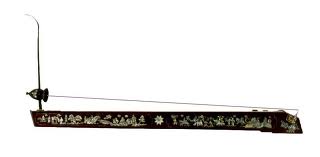
Perhaps the most vivid depiction of translation was Indigo Eriksen’s presentation, wherein she read a poem she had written and a local student of Vietnamese decent played the music the poem evoked in her. Duyen Phan played a one-stringed Vietnamese instrument called a dan bau. Google it and watch a video of someone playing it because I can’t being to “translate” how it’s played except to say it’s extraordinary. Then, Eriksen and Phan changed the translation by having Phan play the music and Eriksen read a poem the music evoked.

Dan Bau

A dan bau


Phan concluded by playing well-known western music on the dan bau, and, again, words are paltry in attempting to describe the ethereal sounds this instrument made in such young hands. This was a perfect physical representation of what translation means in art.

And did I mention I love where I live where such great opportunities for expanding my literary knowledge exist?

Hooligans and Friday Fictioneers

I usually watch my grandkids, whom I fondly call The Hooligans, one day a week, but schedules change. This week I had them Wednesday and Friday. Wednesday was nice and sunny. Today was rainy, which meant all day inside with a five-year-old and a three-year-old (aka The Threenager, which is a three-year-old with the piss-poor attitude of a thirteen-year-old). The five-year-old knows that “Mamo writes books,” but today we had an interesting discussion about telling the truth (meaning I caught him in a small fib), which went something like this:

Me: I’m a writer. I can make things up.
Him: But, Mamo, when you make up things, that’s lying.
Me: Not when you’re a writer. You get to make things up.
Him: And it’s not lying?
Me: No, it’s telling stories, like the books we read.
Him: (very thoughtful) So, it’s like lying, but it’s okay to lie when you’re a writer.

Out of the mouths of babes.

Of course, he’s asked me to read him one of my stories, but that has to wait until he’s a little old. No, a lot older.

Friday Fictioneers LogoToday’s Friday Fictioneers photo prompt is a little dark, as in underexposed, but my story, “Lift Every Voice,” is dark on purpose. As usual, if you don’t see the link in the title above, scroll to the top of the page, click on the Friday Fictioneers tab, and select the story from the drop-down list. And if I’ve offended anyone religious, no apology offered: I’m an atheist who just got through all the Easter to-do without being unduly offended.

The Prodigal Returns

It’s been over a month since my last substantive post here–on the first day of AWP. It’s not that I haven’t been writing; I have. Mostly re-writing. I haven’t been writing my political blog; I haven’t done Friday Fictioneers; I haven’t done Flash! Friday. I’ve not put my finger on quite why, other than the obvious: winter doldrums, lingering nasty weather, and overall write-on-a-self-imposed-deadline burnout.

So, here’s a summary: AWP was great; I had story selected as a finalist in a national contest; the agent loved my writing but decided my novel wasn’t for him; the Virginia Festival of the book was wonderful (though I’ll confess I wish I’d been a panelist instead of in the audience); I had a story rejected for an anthology about a week after an anthology appeared with one of my stories in it; I had an editor solicit a story from me “for consideration;” and we’re about ten days away from the staging of my ten-minute play, “Yo’ Momma,” which was a winner in the Ampersand Arts “Bar Hopping” Contest.

Then, on Sunday, I got tagged in a Facebook post: “Name 15 authors who’ve influenced you and who will always stick with you.” Once I started thinking about that, I began to jot down names and decided this would be a much better blog post than a comment on a Facebook post.

I’m back!

Here are the fifteen authors who’ve influenced me with a brief explanation of how and why, divided into women and men but listed in alphabetical order so as not to give away who is/was the most influential.

Louisa May Alcott – She embodied for me the woman writer’s struggle to be accepted for what you are by society and family.

Margaret Atwood – She shows the world that dystopian fiction can be intelligent and well-wrought, and that makes her worthy of emulation.

Jane Austen – For her time, she wielded a sharp pen of sarcasm, feminism, and egalitarianism, and, damn, but she could turn a phrase.

Charlotte Bronte – She showed me that romance and happy endings aren’t elusive after all.

Ursula K. LeGuin – She is a pioneer in one of my favorite genres, science fiction, and I first heard “write what you want to write” from her.

Barbara Michaels/Elizabeth Peters – She taught me that romantic pairs as protagonists can carry a series (or several series in her case) and that the romance doesn’t detract from a good mystery story.

Sara Paretsky – She showed me your female protagonist can take care of herself and not be dependent upon a man and still be popular (and don’t let editors tell you otherwise) and that plots suffused with liberal politics can be, too.

Kate Wilhelm – She showed that female writers could write “hard” science sci-fi stories and be respected by her male colleagues, even the stodgy ones.

Honorable Mentions: Marion Zimmer Bradley, Octavia Butler, Shirley Jackson, Doris Lessing, Flannery O’Connor,

Isaac Asimov – As well as being one of the most prolific authors of the twentieth century, he showed me you could tell a story and educate people at the same time.

Harlan Ellison – As well as being an ardent admirer of LeGuin, he showed me that you could and should go into the dark areas of the mind and write about them. He also spent fifteen minutes with me once and told me to never, ever give up writing.

William Faulker – He showed me what every writer from the south needs to accept–our history is both full of joy and worthy of embarrassment.

Thomas Hardy – I love this man’s prose. He can take pages to relate a nanosecond of plot, but you don’t mind.

Stephen King – He showed me that when you write about the horrific, at least do it in a way which elevates it.

Boris Pasternak – He showed me how an artist should stand up for the integrity of his or her work and that an epic should truly be an epic.

Kurt Vonnegut – He showed me that a good story is worth spending weeks, months, even years to perfect.

Honorable Mentions: Mikhail Bulgakov, Fredreich Engels, Seamus Heaney, James Joyce, V. I. Lenin, Karl Marx, Vladimir Nabokov, William Shakespeare, George Bernard Shaw, Leo Tolstoy

Now, fifteen of the writers who read this need to do the same. 😉