Friday Fictioneers Fluff

Not that I think Friday Fictioneers is fluff. No, no. I’m talking about the sixteen or so inches of snow which fell in my area on Thursday. Digging out doesn’t have the appeal for me it used to, when in my old neighborhood, we got together and shoveled everyone out. We started out with hot chocolate in the morning and progressed to mulled wine in the afternoons. Great times. Here, it’s every house for itself, and, frankly, I’m well-stocked with food and drink. If my driveway doesn’t get shoveled for a couple of days, I’ll just stay in and write.

And it’s Valentine’s Day, which is my bah-humbug holiday, and that’s not just because I’ve been single for almost nine years. I wasn’t too thrilled with it before. Too much pressure. My ex (before he was my ex) and I agreed that birthdays and Christmas were sufficient opportunities for significant gifts. A nice dinner out was fine for anniversaries, so I never got caught up in the Valentine’s Day hype.

Friday Fictioneers LogoSo, when today’s Friday Fictioneers photo prompt showed up, I was in a quandary. Do I go for the schmaltz or give into my personal bitterness? I posed that question to my online writers group, Shenandoah Valley Writers, and got the advice, “Schmaltzy, with a twist.” Now, we all know my twists can go toward the bizarre, and I hope “Sweets to the Sweet, Farewell!” doesn’t disappoint. As usual, if you don’t see the link on the title above, scroll to the top of the page, click on the Friday Fictioneers tab, then select the story from the drop-down list.

And if you’re snowed in somewhere, take it easy and enjoy the scenery.

Exciting News!

In November I entered a play in the Ampersand Arts Bar Hopping contest. It had to be a 10-minute play set in a bar. I had written a play after a play-writing workshop sponsored by my local writers group, SWAG Writers. I didn’t hear anything after several weeks and put it out of mind until I got this email today:

Thanks so much for your script submission! We have selected “Yo Momma” to appear in Ampersand’s upcoming production of Bar Hoppers!

The shows will be held April 15th and 16th at Red Beard Brewing Company and April 22nd and 23rd at The Pompei Lounge. Shows start at 7:30pm. We would like to offer you two complimentary tickets. Please let me know which nights you would like to attend!

We really appreciate your participation with Bar Hoppers! Your script is brilliant and we look forward to the many laughs it will produce!

So, if you’re in Staunton, VA, on any of those dates, stop in and see my play performed. I’m very excited!

Oh, The Horror!

The NYC Midnight Short Story Challenge is on!

If you recall, this is a two-month challenge involving three rounds (if you’re lucky) where  contestants write short stories from prompts provided by the contest. The top three from each heat of the first round go on to the second, and the same for the third and final round. I signed up back in January to participate, and as the deadline for the first set of prompts (midnight February 7) neared, I went from anticipation to panic. What prompts would I get? Would I actually be able to come up with something? What if I flop?

I didn’t wait up until midnight to get my prompts. I got a good night’s sleep then planned on checking email first thing on Saturday morning. However, a writer friend of mine, who is also participating, messaged me first thing in the morning, terrified about her prompts. Gulp. I looked.

Genre: Horror. Okay, not so bad. I’d been terrified of getting YA or Romance, neither of which I have much experience in nor enjoy.

Subject: Genetically Modified Organism (GMO). Again, not bad. There’s been a debate locally about such products and whether they should be labelled as such, so I knew there was fodder here for a decent horror story.

Character: A prisoner. Hmmm. More possibilities.

However, I didn’t sit down to write right away. I had to travel to Charlottesville, VA, for a meeting of the Board of Governors of the Virginia Writers Club; however, the prompts kept tickling at me the whole drive over. I was a little early in arriving, so I pulled out the notebook I go nowhere without and jotted down this opening paragraph:

“I always figured it went down like this: one of those impersonal government buildings–you know the kind, all concrete, no glass–a conference room, a table occupied by faceless bureaucrats, a couple of guys in lab coats, maybe with names like Krishnamurtichatterjee or Schwartzenschikelgruber. They sat around the table reading a thick report, maybe watched a PowerPoint or a Prezi. The guys were from USDA, FDA, maybe Justice or U.S. Marshals, Bureau of Prisons, or some such.”

Yeah, promising, but where to go from there?

All throughout the meeting, as I knew it would, the prompts kept “talking” to me, and I jotted more notes at breaks and at lunch. By the time I left for home, I had a fully formed idea.

A really grotesque, fully formed idea. Even then I let it stew most of the day on Sunday; then, I sat down and started to write. It was all going smoothly until I got a text telling me I was late for my three-year-old granddaughter’s cake and ice cream birthday party. Oops! I hit save, dashed to the car, and took care of family business. I had to remind myself not to scarf down cake and ice cream and dash home, that Mamo had to be there for the Emster.

I got home, sat right down again, and resumed the story. When I next looked at the clock, it was almost 2300, and I had written 2,498 words. (The story can’t exceed 2,500 words.) I read it over, noted the spots needing work, and got to the end. I liked it. It needed work, but I liked it.

For the first round we have eight days to upload the story, and I’m grateful for the time. I’m letting the draft sit for Monday and Tuesday; then, I’ll pick it up again on Wednesday, with a goal of having it ready to upload on Friday. Yes, I’m grateful because if I make it to Round 2 I only have five days. Should I make it to Round 3, I only have twenty-four hours to upload a story. And you can’t pre-write because you don’t know what the prompts will be.

It’s certainly a challenge–so, aptly named, NYC Midnight–but each story gets feedback, and that’s what most interests me. Two of my writer friends from Tinker Mountain are also participating, so we’re supporting each other by listening to each other vent on Facebook Messenger. It would be the coolest of cool if all three of us made it to Round 3.


Friday Fictioneers for February

Balancing the need for back story and the need for clarity in a work of fiction can be more than delicate–it can be frustrating. I’m currently running a novella 5,000 words at a time through my new critique group. Though the novella uses the characters I’ve introduced in Blood Vengeance and Spy Flash, I wanted the novella to stand alone, i.e., someone who hasn’t read the other books could read the novella and know exactly what was going on.

That means sprinkling in some expository detail and back story so the reader has context. Turns out I overdid it a bit. I wrote about a page and a half, mostly dialogue, about an event which had happened in a previous short story. The critiquers liked it, found it intriguing, and assumed it would have some significance later in the novella. Oops.

My initial inclination was that the reader needed this amount of detail to move on. What I didn’t want to do is leave open questions which would hinder someone from reading further, but it turns out the readers got tripped up on the details. Not just tripped up–that amount of back story started them down a path which has nothing to do with the story I’m telling in the novella.

After some chat about how to address this, one person suggested that I simply remove the detail, allude to the event, then move on. I wasn’t sure that would work, and I thought about it for a couple of days. Then, last night I sat down and edited that scene. A page and a half of exposition and back story I edited down to three lines, and, lo and behold, it worked. Less sometimes is more.

One of the challenges in using a photo prompt to inspire a story is when the photo is of an inanimate object, or objects, in a mundane setting. When I first saw the Friday Fictioneers prompt on Wednesday, I thought, well, what do I make of this? On Thursday, I took another look, and a unique point of view came to me. So, let me know what you think of “Innocent Bystander.” As usual, if you don’t see the link on the title, scroll to the top of the page, click on the Friday Fictioneers tab, and select the story from the drop-down list.

The Waiting Game

In a culture of instant gratification, being a writer can stretch your patience pretty thin. I don’t know which is worse: getting a rejection within days (or hours) of submitting something or waiting and wondering for weeks (or months).

I’ve submitted to several contests and literary journals in the past year, most of which had deadlines far in the future and notification times even further out. I never got a formal rejection notification for any of the journals, and the only way I knew I hadn’t been accepted was when the list of winners or the issue of the journal itself came out. For example, there’s one anthology I submitted a story to in late summer last year; the deadline was December 31, and the notification deadline is in March. I know for a fact it got more than 600 submissions, and they all have to be read and evaluated. Intellectually, as a former magazine editor, I understand that; emotionally, it’s gut-wrenching.

Then, there’s the manuscript which an agent has been considering (as in, whether to represent it or not) for about six weeks. I came to this agent in a roundabout way–through a workshop instructor, and the agent is looking at the MS as a favor to him. I know he probably has lots on his plate. Again, there’s the dichotomy in the whole head/heart thing, but I’m getting twitchy.

Having several things out at the same time puts me in a turmoil: there are all those chances to wonder if I’m good enough, if my writing is worthy. Every day, I get these inspiring writer quotes on Facebook, and I lap them up, every one. But, I still worry that I’m fooling myself.

I mean, I’m not in it for the money, because, as we all know, the publishing business is in an even worse turmoil than I am. Advances are almost nonexistent, royalties are at best minimal (no wonder people self-publish), and even if you’re lucky enough to get a publishing contract, you still end up having to hawk your work like a bad used-car salesperson. There’s a reason why I never lasted long in retail.

I write because it’s in my nature to do so. It has been since I was in third or fourth grade. I made everything into a story, and, trust me, as brilliant as my story-telling might have been, it doesn’t work when you explain to your mother that strange men came into the house and broke her favorite vase, did nothing else, and left. Yes, a fine line between fiction and lying to cover the fact you picked the stupid vase up when you knew you weren’t supposed to, but, hey, what could go wrong?

As human beings, we live for validation, especially when you lived a childhood where that was not forthcoming because your mother wanted nothing to do with you and your father doled out praise so you’d work harder, get better grades, etc. When I post my Friday Fictioneers or Flash! Friday stories and the comments come in, each one makes me feel good, makes me glad to call myself a writer, gives me validation. However, it’s pretty instant feedback–same day or within a few days, built-in writing community; no waiting.

In the last four years I’ve had three stories published, one about to be published, and one which came in third in a contest. There’s a weekly contest I enter, which I’ve won three times. Some days I marvel at that; others, I think it pretty scant. I’m one of the lucky people who doesn’t let that stop her from writing. Hell, I’m going to write even if my writers group and my family are the only ones who will read what I’ve written.

In the meantime, I’ll wait.


A Final January Friday Fictioneers

January is a month which has always dragged for me. I suppose the lead-up to the holidays is always so frantic that the “January let-down” seems prolonged. Add in some of the coldest weather we’ve seen in a while, and this January has felt unending. Yet, here we are, at the last day with the year’s shortest month ready to arrive. I’m telling you, if February ends up being as cold and depressing as January, I’m going someplace warm.

However, the end of February is AWP, that small gathering of 12,000 or so writers, this year in Seattle, WA. I just hope Seattle won’t be having sub-zero temperatures.

The beginning of February is the start of a writing contest I signed up for back in December. It’s the 8th Annual Short Story Challenge, a creative writing competition which could run for weeks, if my story is selected in the first round. There are three rounds, and in the first writers are put in random heats and assigned a genre, subject, and a character. I will have eight days to produce a 2,500-word short story to submit. Judges select the top five stories from each heat to advance to the second round, which is March 27 – 30. Again, you get an assignment but only have three days to produce and submit a 2,000-word story. Judges choose the finalists for the third and final round on May 2-3 where you have twenty-four hours to write and submit a 1,500-word story. Judges select the overall winners from that round.

The interesting aspect of this is every story submitted gets feedback, quite the accomplishment since I’m sure hundreds, if not thousands, of stories get submitted. A writer friend of mine did this last year and made it to the third round but unfortunately didn’t win. So, I’m giving it a try, and it will get me back on track in writing stories longer than 100- or 150-words. Wish me luck.

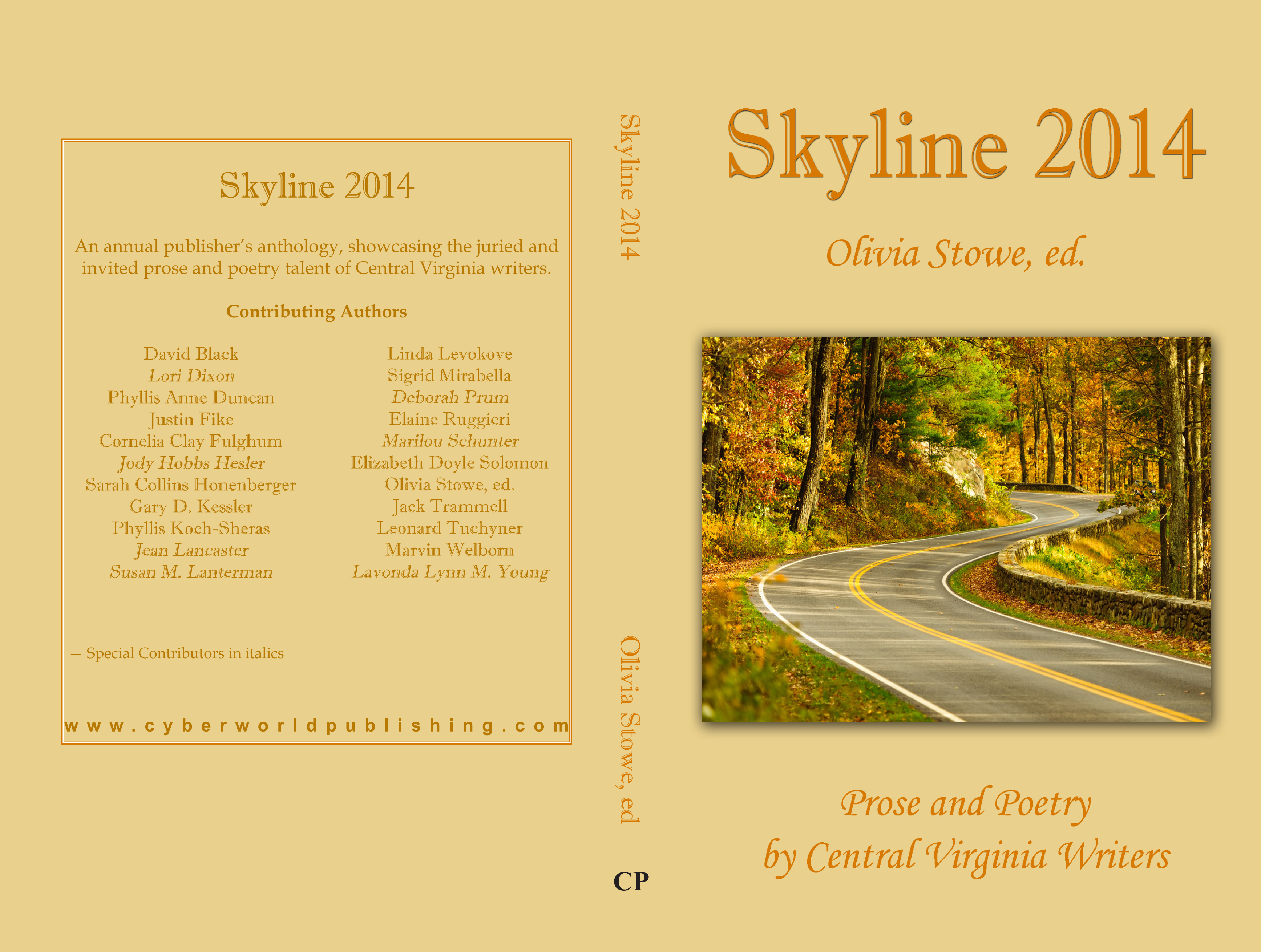
Skyline2014OSCPrintcoverM.inddAnd in other news, a short story (which is actually a chapter from a novel in progress) of mine, “Meeting the Enemy,” will appear in an anthology entitled Skyline 2014: Prose and Poetry by Central Virginia Writers. This story features one of my pair of globe-trotting spies put in an untenable situation and what she does to address it. I’ll post purchase information as soon as I receive it. The cover is to the left.

The seemingly faded aspect of today’s Friday Fictioneers photo prompt reminded me of a Friday Fictioneers Logobox of family photos I have in my keeping. There aren’t many of us left on my father’s side, and I’ve often wondered what some distant cousin will make of these photos if he or she gets them some day. And that led to the story, “Family Ties.” As usual if you don’t see the link on the title in the line above, scroll to the top of the page, click on the Friday Fictioneers tab, then select the story from the drop-down list.
And keep your fingers crossed that Sunday is cloudy so that bloody groundhog won’t see his shadow, and spring will come early.

First Writers Conference of 2014 – Part One

I was really looking forward to the short trip down I-81 to the Roanoke Regional Writers Conference last Friday–mostly because it was six degrees warmer than at my house. Why, it reached a balmy 32 degrees compared to the “low 20’s; feels like teens” at home.

I’m coming to know the Hollins University campus better than my alma mater’s, since this was my fourth trip there in two years, and once again RRWC didn’t disappoint. After a Friday evening networking session, we started the conference with short speeches from several of the instructors.

First was Rod Belcher, whose genre mash-up Sci-fi/Western is intriguing. Entitled “Perseverence,” it was truly inspiring. His description of getting the notification his book had been accepted for publication by Tor (a huge sci-fi publishing house) gave us all some hope. Early on, like me, he received a rejection for a sci-fi story which amounted to “why do you bother writing that crap.” Like me, it put him off writing for some time. His mother broke the impasse by buying him a typewriter. In that way he happened upon his writing process: “put your butt in a chair until you pull it out of thin air.”

Carrie Brown, visiting professor of creative writing at Hollins, spoke on problem-solving. All of writing, she said, “is problem-solving.” The writer as problem-solver comes from the fact “a writer is someone who undertakes a task without knowing what to do.” I found that a very interesting take on the writing life.

The keynote speaker was Sheri Reynolds, and the title of her talk was “Giggling Past the Funeral Home: A Look at What Makes us Laugh.” I’d heard Reynolds speak on a panel about “road trip novels” at last year’s Virginia Festival of the Book. She read from her latest book, The Homespun Wisdom of Myrtle T. Cribb, which had us all falling from our chairs. The book tells the story of Myrtle, a teacher fed up with her husband’s teasing about an asymmetrical aspect of her female anatomy. As she’s headed to an appointment to have surgery to fix it, she panics and keeps driving. Somewhere along the way, she finds a black man in the back of her vehicle, which prompts her to drive further, knowing her husband and family would disapprove. Although her other works are described as serious literature, Reynolds indicated she infuses all of her work with some aspect of humor. She also mentioned that this particular book underwent several rewrites and changes of POV, until she finally settled on first person–and that worked.

Saturday was the main day for the conference, and my first session was “Telling Stories: The Greyhound Bus, the Swedish Gal, and the Flophouse in Seattle.” If that title wouldn’t attract you to Dan Casey’s workshop, I don’t know what will. Casey is a local journalist in the Roanoke area who also does a regular column wherein he tells a story of local life. I’d gone to his workshop the year before at RRWC and knew this would be great. It was, though it also was a different kind of workshop: In between telling the story encompassed in the title, he dropped little bon mots about being a storyteller. After the workshop, a woman started chatting with me and said, “Well, that was a waste.”

“How?” I asked.

“All he did was tell his own story. I wanted to learn about how to tell my stories.”

I said, “Well, I took a page and a half of notes.”

“On what?”

“Well, let’s see. Find inspiration in everyday things. Take ordinary events and turn them into hair-raising adventures. Tell a story over and over until you fix the details in mind, and lots more.”

“Oh.” She moved on.

Next, I went to Sheri Reynolds’ workshop, “Dreamwork for Writers: Using your Dreams to Deepen Your Stories.” Reynolds pointed out how some part of her own dreams ended up in every one of her novels. “Just think of your dreams,” she said, “as a new story every night.” She encouraged the use of dream journals and explained that you don’t necessarily use a dream literally. “Take a disturbing or haunting image and explore it in your fiction,” she said. “Use your dreams as dreams for characters to show the characters’ conflict or the things they–and you–can’t face in real life. Use dreams as scenes–or reflect on a dream you’ve never had but wanted to and use that!”

The first writing exercise was to jot down a recurring dream of our own. Then, after a few minutes of that, Reynolds had us identify what in our dream hit the five senses. To conclude the writing exercise, she had us pick a person from the dream, not us, i.e., “I am the other,” and rewrite the dream from the other’s POV. This was probably one of the more useful exercises I’ve experienced.

Reynolds closed by talking about how to write down your dreams–don’t edit as you do so, don’t let your analytical mind step in, and focus on the images which resonate and recur.

To be continued in Part Two.

The Year of Writers Conferences Redux

A new year brings a new round of writers conferences and workshops. The first for me is the Roanoke Regional Writers Conference at Hollins University in Roanoke, VA. I tried this one-day conference last year and was amazed by the depth of the too-short workshops, but I’m back for more this year.

Hollins University is also the site of the week-long writing workshop I attend, Tinker Mountain, but this one-day event is rather like an appetizer for that.

The keynote speaker is Virginia novelist Sheri Reynolds, and among the workshops are ones for non-fiction and fiction, YA, self-publishing, marketing, and getting an agent. Yes, some of these are topics you see at any writers conference, large or small, but sometimes it’s the different perspective on the issue which is most helpful.

I’m looking at attending Dan Casey’s “Telling Stories: The Greyhound Bus, the Swedish Gal, and the Flophouse in Seattle” first thing on Saturday morning. Casey’s workshop last year was hilarious and educational, so I’m looking forward to this presentation.

Next I think I’ll attend Sheri Reynolds’ workshop, “Dreamwork for Writers: Using Your Dreams to Deepen Your Story.” I love incorporating my odd dreams into my writing, so this workshop should be fascinating.

I’ll close out the morning with some non-fiction work in Bill Kovarik’s “Who Killed the American Newspaper and Where do we Go from Here?” Since I’ve done freelancing for my local paper, and I’m still enough of an old fogey that I start the day by reading two actual newspapers I can hold in my hands, I think this will be an interesting and topical discussion.

After lunch, and because I’ve never thought of doing a YA novel, I’m going to attend Tiffany Trent’s “Science Fiction and Fantasy in YA.”  This is a growing genre, and, who knows? Maybe I’ll get inspired, even though I think with The Hunger Games and Divergent series, we may be reaching the apex of this trend.

I’ll end the day with “The Rebellious Essay,” a workshop hosted by Cara Ellen Modisett. I do some political blogging I consider a bit rebellious, so maybe this will move it to the next level.

A full day of workshops, networking, and connecting with writer friends–I’m looking forward to getting back into the writer conference groove.


Friday Fictioneers Comes ‘Round Again

This is the time of year for me where the time seems to fly by, and I look back on a week and wonder how it got to be Friday. Of course, this never happened when I worked in an office. I’d get to Wednesday, and Friday seemed a million miles away; and there were never enough hours in the day to get done what had to be done.

By the way, there was a significant anniversary this week for those of us who work or worked in aviation, namely the fifth anniversary of the “miracle” on the Hudson. I wrote about it in my other blog, but some might find it interesting. Click here to read “Serendipity on the Hudson.”

Friday Fictioneers LogoWe had a very lovely photo prompt for today’s Friday Fictioneers, but a couple of days ago I watched a documentary on the history of the Celts and had human sacrifice on the mind. So, there you go. Once again, a pretty picture evokes a dark story. Oh, yes, my various therapists over the years have had a field day. Today’s story, “Grasping for Straws,” is both topical and historical, with a dash of speculation. As usual, if you don’t see the link on the title in the line above, scroll to the top of the page, click on the Friday Fictioneers tab, then select the story from the drop-down list.

Writers–Gluttons for Punishment?

Let’s face it, writers are masochists on some level. We create and submit our work, knowing the likelihood of its being accepted is minimal, but we keep doing it. The actual writing is the pleasure; the inevitable line of rejections before an acceptance comes along is the humiliation we endure for those fleeting moments of vindication.

And then we do it all over again.

Rejection is never easy, whether it’s by a potential lover or friend or an agent or editor. I’ve heard so many writer friends–not to mention myself–say, “I just sent a story to [insert name of literary magazine here]. I know I have a snowball’s chance in hell, but at least I’m submitting.”

Why, oh, why do we do that?

Because when you get the acceptance email or you check Submittable and see the “accepted” note, it’s the greatest feeling in the world–for a millisecond it’s better than seeing your children the first time, better than orgasm, better even than a paycheck. It’s affirmation, you see, that you really are a writer; you aren’t just a hack throwing words on the screen, and all your suffering is worth it.

A writer friend of mine recently posted on Facebook that writing her novel required more concentration, more focus, more work than anything she’d ever done. I responded that was what made it so painfully fun. Yes, at times writing is like constantly putting your tongue on a sore tooth, but when the pain goes away–ah, bliss. It’s why when I encounter a non-writer who says, “Oh, well, it’s not real work. You just make things up,” I usually respond with a smile and suggest he or she should give it a try. “Oh, I have better things to do with my time.” Well, good, I’m glad, because you don’t have what it takes to be a writer.

Writing has brought me some of my biggest disappointments, but it has also brought me some of my biggest joys. For years, I’d seen my non-fiction in print, so when my first fiction story was accepted by eFiction Magazine a couple of years ago, I didn’t think I’d have much of a personal response. When the issue with my story showed up on my Kindle, I had the most visceral reaction I’d ever experienced–and I used to be a flight instructor, so I’ve had gut-wrenching moments. There’s nothing quite like seeing your words on a page with your by-line, knowing it’s a story which is the progeny of your imagination, that you “just made it up.” Not only did you make it up, but someone else liked it. Others will read it, and because there is an internet, your story will out there forever. How’s that for immortality?

Now, excuse me. I have to go humiliate myself for some perverse pleasure.