Post-Freeze Friday Fictioneers

The recent deep-freeze from the errant polar vortex this week froze more than water pipes and noses. It induced a brain freeze–in me, at least. I couldn’t seem to coax a single word from that cold-addled brain onto the computer screen. All I really wanted to do was sleep and eat soup.

I’ve already written about seasonal affective disorder (SAD) and how the shortened periods of daylight get me down, and, well, never mind that the intervals of daylight are actually increasing right now, when it’s mind numbingly cold and gray, my brain decides to hibernate. None of my usual writing pick-me-ups seemed to work. I looked at today’s Friday Fictioneers prompt (which comes out on Wednesday) and went “meh.” I scanned the news outlets for a topic for my mid-week political blog and went “ho-hum.” (Thank goodness Gov. Chris Christie is a perfect foil for a knee-jerk, bleeding-heart liberal; otherwise, I’d have skipped the political blog this week. So, thanks to the Jersey guy, my column was only a day late.)

Friday Fictioneers LogoToday dawned (I’m sure it did because it’s moderately light out there.) rainy and foggy but also with an idea for the Friday Fictioneers prompt, one that was at least satisfying. However, I managed to roll over and go back to sleep. My luck is improving, though, because when I woke again, the idea was still there–and ended up being 121 words, way too long for a 100-word story. Snip, snip, cut, slice, and lo and behold “Siren’s Song” met the word count with idea still intact.

As usual, if you can’t see the link on the story title in the paragraph above, scroll to the top of the page, click on the Friday Fictioneers tab, then select the story from the drop-down list.

Now, I’m going to catch a nap or eat a bowl of soup. Whatever.

Non-Fiction in a Fiction Critique Group?

Sounds like a contradiction in terms, doesn’t it? A couple of years ago, I started an off-shoot of my main writers group, SWAG Writers, for critiquing fiction. We began with six people, and after the first meeting we ended up with three regulars. One person was accepted into a graduate program and moved. One indicated she really had nothing prepared to critique, and the third didn’t take well having her grammar and punctuation corrected. But they were all writers of fiction.

The three of us stumbled on for a while, but it wasn’t working well, so we disbanded. Two of us continued to exchange our work online, but we became so accustomed to each others’ work, we realized we couldn’t give it that “other eyes” assessment.

Fast-forward a year, count in some new additions to SWAG, and, huzzah, we have six people again. I learned a bit from the earlier experience. Before we met for the first time, I asked everyone to submit to each other a couple of pages of their work, so we could all decide whether the experience would be beneficial to us; then, we met to critique those two pages. That’s when we discovered, gasp, one of the members is writing a biography.

SWAG is open to all writers in the area–poets, lyricists, fiction writers, non-fiction writers, even crossword puzzle designers. But, clearly, the poets and fiction writers outnumber the non-fiction writers. A few of the poets get together informally, and here we had the re-constituted fiction critique group. There is, however, nowhere else for the non-fiction writer to go. So, we thought, what the heck, let’s give it a go.

A couple of us have experience with non-fiction. In fact, since I got a job as a publications assistant with an aviation insurance consortium in 1976, most of my editing and writing experience has been in non-fiction, specifically in the technical aviation safety area. I was a reporter on and editor of an aviation safety magazine, and for a little more than a year, I wrote non-fiction feature articles for my local newspaper. I have a lot of experience editing non-fiction, not the least of which is my degree in history. Another member of the critique group is a newspaper editor. (She is in the group to have her fiction critiqued, however.)

No problem, you say. Not a problem exactly–editing fiction and non-fiction have similar approaches (grammar, punctuation, etc.), they both tell a story though one is strictly fact-based and has to have the references to substantiate those facts. Now, yes, if you write historical fiction, you have references out the wazoo. The difference is you don’t have to cite them. Yes, you can put a list at the end of your book, but, trust me, the readers hardly ever look there. In a non-fiction piece, particularly a biography, just about everything you say has to have a citation.

When I review or critique a fiction piece, I involve myself completely in the story and characters. In a biography, you can do that too, especially with the current fashion in non-fiction writing, which is to make it “read” like a work of fiction–good characters, action, conflict, etc. Non-fiction writing is still scholarly, but now it just doesn’t sound like it.

Still, and I can’t quite put my finger on it, critiquing fiction and non-fiction is different. When I read the fiction pieces for the upcoming meeting, I was caught up in the characters and the conflict in the stories. When I read the non-fiction piece–which is a rough draft with references listed but not cited–I found myself making notes like, “how do you know this,” “how can you prove that,” etc. I needed the citations, even though I recall from writing my own monographs and senior theses that you usually put those in on the final draft.

I’ve been focusing on my fiction the last four years, the writing there of, that is. It’s a bit of a head-shake for me to break that habit and get back into reviewing and evaluating non-fiction, and unrelated to aviation at that. I just hope I can be of use to that biographer, that my fiction brain can make the abrupt adjustment.

Still, it’s a diverse group of writers, and I’m all heady with anticipation.

Happy Friday Fictioneers New Year!

Friday Fictioneers LogoAt some point this year Friday Fictioneers will be three years old. Pretty amazing to stay around this long. We’ve had vets leave and come back and a lot of newbies come and go as well, but the stories have always intriguing and thought-provoking. I guess that’s what makes us stay and write every week.

With my other online writing group, I set my writing goals for the year, to include participating in Friday Fictioneers, so I’ll be around as long as Friday Fictioneers is around. However, writing a story for Friday Fictioneers isn’t merely to check a box. Paring a story down to 100 words improves not only your writing skills but your editing/revising abilities as well.

Here’s an example. When I first started writing these 100-word stories, my first draft was typically 300-400 words, which took a lot of editing to get to 100 words as a coherent story. As I became more practiced, first draft began to drop in word count–200 words, 150 words, until now when a draft comes in at 105 or so words. Makes the editing easier and quicker, too. Plus doing these flash fiction stories has inspired me to participate in other flash fiction exercises with different word counts. Yep, I’m very versatile.

Another way I’ve used Friday Fictioneers story prompts is to hone my dialogue skills. I’ve written several stories, which consist solely of dialogue. Today is one of those exercises. The story is “Did I Tell You the One About My Talking Dog?” As usual, if you don’t see the link on the title in the line above, scroll to the top of the page, click on the Friday Fictioneers tab, then select the story from the drop-down list. It’ll be easy. After a purge of 2013 stories, it’ll be the only possibility there.

Pre-Solstice Friday Fictioneers

We’re one day away from Winter Solstice and the least amount of daylight for the year. However, I walked outside to get the mail this afternoon and thought I’d been transported several months into the future to April. It could be close to 70 on Winter Solstice this year–but climate change is a myth, so some say.

There’s been very little writing going on this week because of holiday baking and cooking and gift-buying, but I’ve managed to add a few scenes to a new project I’ve started. It wasn’t easy to get them out of my head, where they were enjoying a fine old time bouncing around in my imagination, and onto the computer screen, but I managed to do it. I’m not entirely happy with what I’ve written (who is, the first time around), but it’ll get fixed.

Friday Fictioneers LogoOne of my favorite stories as a child was The Little Mermaid–not the Disney movie but the story by Hans Christian Andersen. Mer-people absolutely fascinated me, and like most kids, I was sorely disappointed when I discovered they weren’t real. Today’s Friday Fictioneers photo prompt brought back all the mer-people stories I’ve read over the years and inspired this week’s story, “Fish Out of Water.” As usual if you don’t see the link on the title, scroll to the top of the page, click on the Friday Fictioneers tab, then select the story from the drop down list.

Happy holidays to all, however you celebrate, or not.

Gifting Writers

If you have a writer on your holiday gift list and haven’t a clue what to give him or her, let me help you out.

We love books, even ones besides our own. The path to being a good writer begins with being a good reader. Writers read books within their own genre, but if you’re like me, your tastes are eclectic–I’ll read almost anything, even if all I take away from a book is, “I don’t want to write like that.”

We love journals because when we’re without a computer, we need something besides a cocktail napkin to capture an inspiration. Smart phones with their built-in recorders go a long way, but there’s nothing better than a sweet little notebook you can carry in a pocket or your purse.

We love pens, too, and not just to write in those journals (or cocktail napkins). We’re always looking for just the right pen to use for book signings so we can make a statement. I’m partial to fountain pens myself (with cartridges, not ink bottles; I’m far too much of a klutz for them).

We love reviews of our work. Good ones, of course, and even bad ones–IF they’re constructive. The new trend in giving books you’ve never read a bad review hits a writer where it hurts. We’re all pretty sensitive creatures anyway, and we know better than anyone words do hurt. So, if you can’t give the gift of constructive criticism, cross me off your list.

We love it when our friends and family give us space to write, when they put aside their demands on our time and don’t make us feel guilty about taking the time we need to write. I recently told someone the sexiest thing my ex ever said to me was, “I know your writing is important to you, so I’ll just go row around the lake for a couple of hours.” That was a gift whose significance missed me at the time. Now, when I have different interests conflicting for my time, I wish others were as understanding that sometimes I need to retreat to my room, wherever that is, and write.

We love it as well when family and friends, even perfect strangers, give us fodder for our fiction. Some people don’t understand why writers live for the family get-togethers others dread. Easy. We know we’ll come away with a half-dozen new ideas for stories and/or snippets of killer dialogue. So, thanks. Really.

There you have it. Some great suggestions for the writer in your life. Oh, wait. I missed one. A great gift for a writer is to just say to them, “I’m proud of what you do.”

Friday Fictioneers – After a High Note, a Low Note, and Another High

The life of a writer has its inevitable ups and downs. Compressing them into a week is hard on the nerves, though.

This week started off with an email from a writing instructor of mine who said he would shop my novel (Sudden Madness of the Carnival Season) to some agents he knew. I also found out my story, “The Dragon Who Breathed No Fire,” had made the top twenty-five in a contest I had entered. Man, I was feeling good, no, spectacular, about being a writer, about having what I thought were good stories confirmed.

Then came Tuesday.

The contest story didn’t make the top ten in the contest. I couldn’t believe it. I read the top ten list twice, three, four times, just to make certain. Now, it wasn’t arrogance which stunned me that my story wasn’t there. That story was good. Beyond good, it was one of the best things I’ve ever written. It came to me in a dream, from the voices of Vietnam vets I’ve known, and I worked it and reworked it for the better part of twenty-four hours before I submitted it. It was real, it was gritty, it was disturbing, and it was good.

A friend of mine, who is a Vietnam vet, emailed me and said it was the best depiction of PTSD he’d ever read in fiction or non-fiction. That was exactly what I wanted. And that beautiful, disturbing story lost out to fluffy dragon stories and happy endings.

(BTW, I love the people involved with the contest, but I’m not apologizing for my characterization. I’m entitled to a bit of a whine. Sour grapes? Maybe, probably, but if you’re a writer, you’ve been there; don’t deny it.)

I was astonished, “bummed” as I told a writer friend, whose great story had also not made the top ten from the top twenty-five, and we commiserated together. Truly, it made me want to close the laptop forever.

The other good thing about being a writer is that you have a cadre of writer friends who won’t let you get down on yourself. “You stop that right now, young lady,” said one such friend (also the mother of a teenager; hence, the tone of the language). “You send that story somewhere else.” And she was absolutely right. I spent Wednesday on Duotrope, selecting some publications where this story might fit. That mitigated the disappointment but didn’t completely eradicate it.

Then came Thursday.

I came awake to my phone indicating I had an email arriving. I fumbled for the phone and my reading glasses to see who had woken me up so early. An email from my writing instructor: “So-and-so from such-and-such agency is reading your manuscript and is considering representing it.” I read it twice, three times, four times. I cried like a little girl and was as giddy as a kid (of any age) at Disney. Now, it’s not a done deal–and when and if it is, you’ll hear me shrieking “Ermagerd!” from just about anywhere in the country. It’s the farthest a manuscript of mine has ever gone; that, in and of itself, is a reason to celebrate.

A typical week in the life of a writer.

Friday Fictioneers LogoToday’s Friday Fictioneers photo prompt creeped me out. For as long as I can remember seeing empty shoes in an odd location has terrified me. I can see them in closets with no problem, but let me see a single tennis shoe on the side of the road and I’m gibbering. I went to an exhibit of photographs taken after 9/11 and never blinked an eye at the shot of a human spine atop some debris. However, the photo of a lone high heel in the middle of a street made me leave the gallery. I have no clue why this is the case–some deep-seated childhood trauma no doubt, but at least it gave me some great inspiration for “Big Shoes to Fill.” Yeah, I don’t write happy endings about fluffy dragons. I write real-life crap. So deal.

As usual, if you don’t see the link on the title of the story in the paragraph above, scroll to the top of the page, click on the Friday Fictioneers tab, then click on the story from the drop-down list.

Of Synopses and Query Letters

Today’s post is somewhat late because I’ve worked most of the day on a two-sentence synopsis for a query letter for my “baby-in-the-wall” novel. Who knew summarizing 83,000 words into two sentences would be so hard. I mean, I’ve been to several query letter workshops and panels at various writing conferences, so how hard could doing a summary be? A lot harder than I thought.

I will add, I’m having some help from an instructor from a workshop I took this year. He’s doing the shopping to agents, but he needed a summary from me, as well as a writing bio. So here was my first iteration:

Supreme Madness of the Carnival Season is a literary novel of approximately 83,000 words, which follows a romance novelist’s investigation into the origin of an infant’s skeleton she and her older, literary-minded husband find while renovating a room in a house they’ve just bought in the Shenandoah Valley town of Ewington, VA. The two-track narrative brings a secret from the past into the present and forces the novelist to confront what she has denied about her  life.”

I thought I should have some other eyes on it, so I posted it on the Facebook page of my online writer’s group, Shenandoah Valley Writers, and after some back-and-forth and some really good suggestions, I ended up with this:

Supreme Madness of the Carnival Season is a literary novel of approximately 83,000 words, which follows a romance novelist’s investigation into the origin of an infant’s skeleton she and her older, literary-minded husband find while renovating a room in a house they’ve just bought in the Shenandoah Valley town of Ewington, VA. The two-track narrative uncovers an old secret, and what she finds forces the novelist to confront what she has long denied about her own life.”

That took the most part of the morning, but I was pretty satisfied with it. Even then, I let it sit for a while, decided it was pretty much perfect, then sent it off to my workshop instructor. A few minutes ago, I got an email from him, indicating he had “tweaked” the summary a bit, and here is what he did:

Supreme Madness of the Carnival Season follows a romance novelist’s investigation into the origin of an infant’s skeleton she and her older, literary-minded husband find while renovating a room in a house they’ve just bought in the Shenandoah Valley town of Ewington, VA. The two-track narrative uncovers an old secret, and what she finds forces the novelist to confront what she has long denied about her own life.”

Subtle edits in both latter versions but effective. Now, in just about every workshop I’ve taken about query letters, the agents have indicated they want to know genre and word count, the two items my instructor edited from the first sentence. However, he is someone who has dealt with a wide range of agents, so I trust his instincts.

I’m giddy that one of my manuscripts is getting sent to agents, but I’m also trying to temper my excitement. Nothing at all could come of this, but I’m beyond honored that this instructor felt strongly enough about my manuscript to give it his personal attention. I frankly have no clue how to repay that–not that he’s expecting remuneration–but as I said to someone today, the list of people to include in the acknowledgements section of the novel is growing long.

We writers are very often a solitary lot. We lock ourselves into our writing spaces and occupy worlds of our own making, our company only the characters we’ve created. And yet, it turns out the writing is the only solitary part of the process. Being published in the traditional manner means you leave your cozy, self-made world and venture into reality, a reality replete with editors and agents and proofreaders and copy editors, all of whom are working with you to make your novel a success. That’s exciting, well, happy-dance-inducing, but it’s also daunting and, not to mention, a little scary.

Still, I’m all for the process.

Rainy Days and Fridays–Fictioneers, That Is

Friday Fictioneers LogoA gloomy, rainy day in the valley means spending most of the day nursing a sinus headache–for me, at least. For a while it looked as if there’d be no Friday Fictioneers for me today, but somehow the story, “BFFs–Not!” managed to claw its way through my congested head and out into the muted light of day. Well, at least onto the page. Maybe not my best effort, but considering my sinuses have made every single tooth in my head hurt, it’s pretty remarkable. As usual, if you don’t see the link on the title a few lines above, scroll to the top of the page, select the Friday Fictioneers tab, then click on the story from the drop-down list.

And if you have time, consider reading my enter for the Flash! Friday Flashversary contest, “The Dragon Who Breathed No Fire.” It’s a story I’m very proud of, so cross your fingers the contest judges agree.

The Company of Writers

You love your family and enjoy your time with them, especially grown children and, if you’re lucky, grandchildren. You look forward to time with friends, old and new; after all, who knows you better than a life-long friend? You approach each of these reunions with anticipation, and the time spent together is some of the best. With grandchildren you get the added joy of giving them back, but I digress.

When you’re a writer, there’s nothing quite like spending time in the company of fellow writers. They talk your language; they understand your ups and downs; they have quirky senses of humor. Socializing with other writers makes you a better writer because you’re part of a community stretching back to the first Cro Magnons who drew the story of a hunt on a cave wall.

Yesterday, several of us from an online writing group planned to get together to celebrate our NaNoWriMo success. The group is the Shenandoah Valley Writers, and it’s a great, supportive, eccentric, and talented collection of writers of many genres. The only issue is, because the Valley is such a big place and we come from the head and tail and all throughout it, we rarely get together face-to-face. For the post-NaNoWriMo celebration, we selected a spot close to the mid-point, the long-lived Johnny Appleseed Restaurant in New Market, VA. Trust me, this restaurant, which I’ve been going to for more than forty years, is a legend in the Valley and beyond. It’s worth a drive-by to see the Johnny Appleseed statue.

For me, it’s around forty-five miles away. Not a big trip, except when you’re traveling on I-81 on the Sunday after Thanksgiving. But I’d looked forward to this for more than the month of NaNoWriMo–I’d looked forward to it since our similar get-together from last year! Nothing was going to keep me away, so I navigated the kind of traffic which had compelled me to leave Northern Virginia just so I could spend time with writer friends.

Writers are always going to talk about craft, but when the dinner conversation turns to how to kill someone, or someone missing a family event because they’re in jail, or dragons, you get some interesting looks from the other patrons–to the point where we had to announce, loudly, we were writers. Of course, that’s the fun part about it, and, hey, I’m sure at least one of us will write about that occurrence.

The point, however, is, when you have a great writers community, you’ll do anything, including braving holiday traffic, to have face time with the members. So, when a round-trip drive which normally takes about eighty minutes takes nearly two hours, you know you’ve done it for something important to you. I’m lucky to have two great writing groups–a virtual one and one where we meet face-to-face once a month. The wonderful aspect of a virtual writers group is you can meet and interact with writers from around the world or from right up the road. Consider finding and joining one, virtual or real.

An off-shoot of Shenandoah Valley Writers for the past year is a weekly flash fiction contest called Flash! Friday. This week is the one-year anniversary, or, since we’re writers who make up words sometimes, the Flashversary. To celebrate our community of writers, there is a special contest, with real prizes, including the possibility of being published in an online magazine. I’ve judged this contest several times over the past year, and there are some wicked excellent writers who participate. I even gave up judging so I could submit a story for the Flashversary Contest. For submission guidelines and other information click here, and consider giving us a try.


1 Photo, 50 Authors, 100 Words

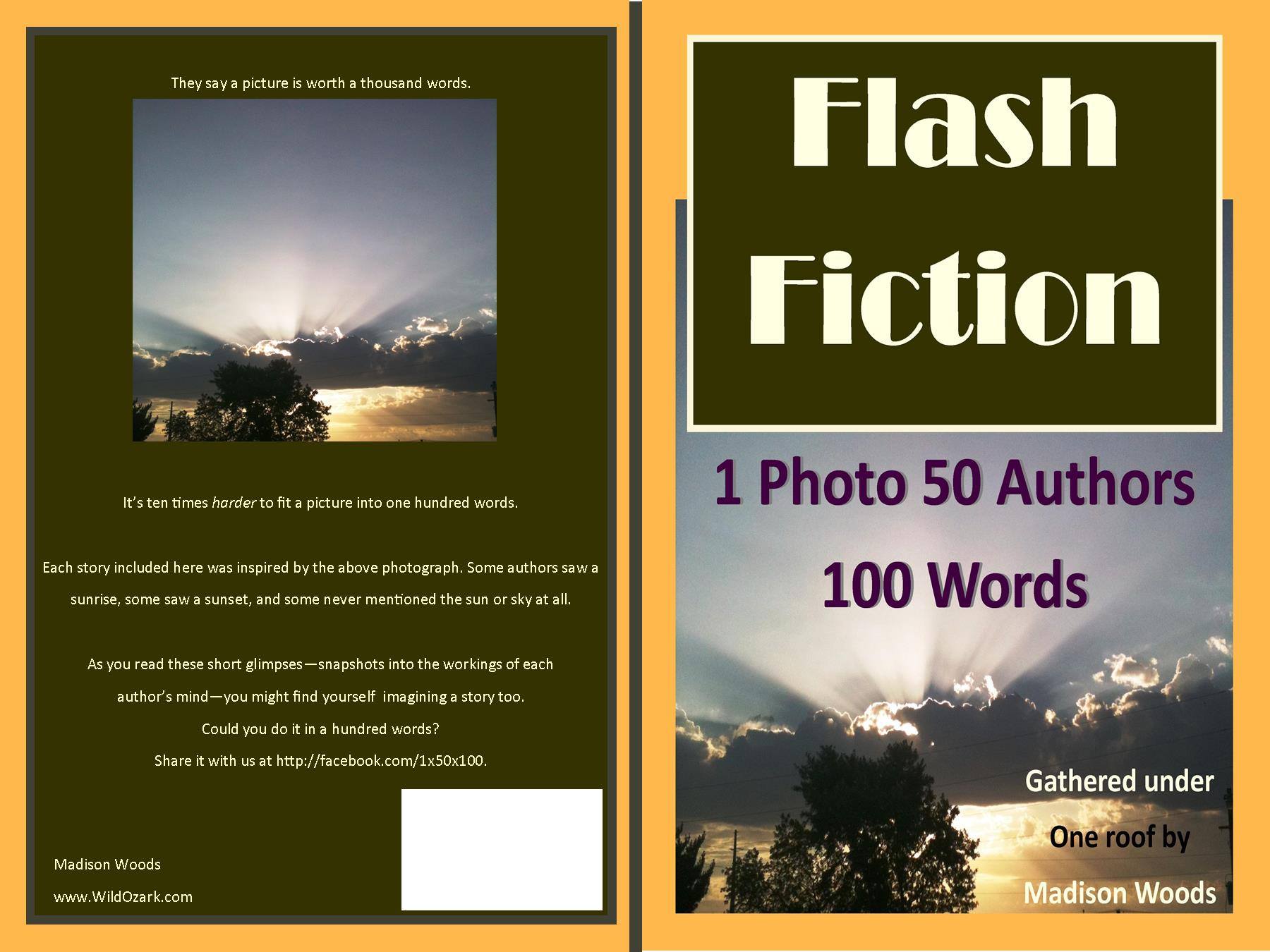
Flash Fiction Anthology CoverThis anthology, which contains my 100-word story, “The Elusive Pursuit of Perfection,” is now available in eBook form for Kindle, and it’s only 99 cents.

All the stories in this collection of flash fiction are short, sweet, and oh, so good. This is a little book with big writing. You’ll enjoy it.

To purchase your copy, click here; then you can go to Authorgraphs and get a digital autograph from me (as Phyllis Anne Duncan) for your copy.