Friday Fictioneers From Tinker Mountain

For those of you who’ve wondered, Tinker Mountain is a mountain next door to Hollins University in Roanoke, VA, and is the location of the writers workshop I’ve been attending all this week. Today’s the day my story gets critiqued, but more on that later today.

Being involved in this workshop is certainly inspiring, and one thing I’ve learned is the economy of words. Another way Friday Fictioneers connect with a writer–and I’ve said this before–you learn how to cut and pare until you’re down to the essentials.

Obviously, this week I’m done with the sweet, cutesy stuff and am back to the dark side of things. About time. And I hope you find the title, “The Atheist’s Wish,” just a tad intriguing.

For other offerings (Read my story, and you’ll see that’s a pun.), go to Madison Woods’ blog and have a read or several.

Tinker Mountain – Day Three

Yet another cool thing about Tinker Mountain is the fact that while a bunch of us are here learning to be better writers, a whole bunch more are here learning to be better ceramicists. It’s an interesting juxtaposition of artists, as we found out last night at my dorm (Sandusky–yes, a little creepy) where the writers number only two. There might have been wine involved–I say might, in case, well, having wine on campus is a no-no.

But it was a great discussion of creative process–the ceramicists thought they were the only ones who worked alone and inside their heads. We were more alike than any of us thought.

Today’s craft seminar was “Looking at You–Notes on the Second Person, its Pleasures, Risks, and Surprises,” conducted by poet Thorpe Moeckel. A more laid-back presenter, Moeckel was just as engaging as Benedict and McKean, and his love of poetry was obvious in the selections we read to illustrate the premise of the lecture. Some I knew well, like “When You Are Old,” by W. B. Yeats, and “Letter to Simic from Boulder,” by Richard Hugo. Others were new gems for me to behold: “Visit” by A. R. Ammons, “Merengue,” by Mary Ruefle, and “Directions,” by Michael McFee.

I left the craft lecture wanting to delve more into poetry–and how to write it–and ready to experiment some more with second person.

Even though I know I’ve heard this before, somehow when Pinckey Benedict uses David Mamet to teach about what a scene should do, it sticks harder and longer. According to Mamet, a scene–whether for a television program, movie, novel, or story–should establish who wants what, what happens if the person doesn’t get what he/she wants, and why now. Once you’ve established that and written the scene, you have to ask yourself: Is it dramatic? Is it essential? Does it advance the plot? Then, you have to answer truthfully. If the scene isn’t dramatic or essential and it doesn’t advance the plot, out it goes.

Easy, right? Apparently not, because we were all slapping our foreheads and saying, “Duh!” (To see in detail what David Mamet has to say, Google “David Mamet Memo,” and you should get the memo he wrote to his staff of writers on the TV show, “The Unit.” Great stuff.) To get us in the habit of this, Benedict instructed us to try an experiment: stop writing anything expository for a while, make sure every sentence shows someone doing something, start with action, and once something has been accomplished, end it.

We had great fun in the workshop reading aloud a homework assignment. We had to write down a real dream then a fake dream. After we read both to the class, the others had to guess which was which–and justify why we voted that way. We’ve all come to know each other pretty well, but it was still difficult to decide which was the dream and which is real. Pinckney joked that this workshop might be the dream we all wake up from–if that’s so, let me sleep.

Homework for tomorrow: write an event that happened to you and one that didn’t; write a short bio where one thing is not true; and write the worst opening to a novel or story there ever was.

I haven’t looked forward to homework in a very long time.

Tinker Mountain – Day Two

Yesterday, on day one, I contemplated buying an umbrella since I’d left mine at home. None of the ones offered in Hollins’ book store were small enough to fit in my backpack, so I opted not to buy one.

Later in the afternoon the skies opened and dropped buckets of water. For a couple of hours. I hung around after a lecture in the hopes of scoring a ride back to my dorm, knowing if I hiked through the rain, I’d be sick in a day or so. It turns out I got a ride from another former FAA-er who is attending the Advanced Novel Workshop. He was a speechwriter for a former administrator, and after chatting we figured out our paths had crossed before. I arrived back at the dorm relatively dry, and he was quite the gentleman–walking me to the door and holding the umbrella over me.

Because, as I well know, knights in shining armor are rare, this morning, I went to the book store and purchased a magic, green, rain-warding-off umbrella, and it’s been sunny all day long.

Today’s craft lecture was “Things Writers Can Write Besides Just Stories, Novels, and

Pinckney Benedict at the craft lecture “Things Writers Can Write Besides Just Stories, Novels, and Poems.”

Poems,” conducted by my workshop instructor, Pinckney Benedict. And being Pinckney Benedict, we weren’t treated to a mere lecture. There were TV show trailers, movie excerpts, graphic novels about the king of the hillbillies, interactive computer games, and a musical adaptation of The Scarlet Letter, all creations of Pinckney’s. And they served to show us there is a world beyond the novel, story, or poem, and that it’s perfectly all right as writers to play.

Play is a big part of Benedict’s workshop, Stretching Your Fiction. Paracosm is a new word I learned, and it means “a prolonged fantasy world invented by children.” Benedict explained that writers, as children, were big into “Let’s pretend…” All our friends grew out of that stage, but we didn’t. Keeping play in our writing is embracing paracosm, and, as writers, that’s a good thing.

Today Pinckney reminded us what all our stories have to contain: The Agon, aka the central struggle in a drama or work of fiction, i.e., the conflict. A key component we often overlook. We may think it’s there, but when we examine the story closer, it’s weak or missing.

We did a practice reading, learned about eucatastrophe, and critiqued two participants’ stories, but the best part of the workshop are Pinckney’s riffs on craft. As far as I’m concerned we could sit for eight hours every day and just listen to him. The man is an MFA on two legs.

What is eucatastrophe? It’s when a story builds up that something horrific is going to happen, but a wonderful, beautiful thing happens instead. That’s eucatastrophe, much like my blog post early yesterday and the one today. I’d completely built myself up for something bad to happen, but, instead, it’s becoming something wonderful and beautiful.


Tinker Mountain – Day One

EVENING UPDATE:

The day opened with a great craft seminar by Jim McKean: Creative Research and the Art of Facts. The seminar was about research for non-fiction work, particularly memoir, but definitely was applicable to fiction. After describing the types of “archives” important to use–visual, living (interviews), electronic, audio, etc.–McKean provided specific examples from his own work to show how to use any or all of these archives to improve your non-fiction or fiction.

Then came the dreaded workshop. Truthfully, it didn’t go as badly as it had been built up to be, so that eased my concerns a lot. But, my work doesn’t get critiqued until Friday afternoon, so I’ve got the rest of the week to put myself in a state about it. But that’s me.

——————-

It’s been a long time since I let anyone mess with my head, especially a man. I mean, I’ve faced down FAA-hating airline captains without a blink, so why did I let my workshop instructor scare the hell out of me?

Probably because my writing defines me. It’s the only thing that is truly me–my voice, my characters, my worlds. And probably because even though people tell me I’m a good writer, I never think I’m quite good enough.

When someone of “authority,” i.e., the instructor, who is a writer of some renown, tells you the critique is going to hurt, then I have to wonder what the point of the critique is. I thought it was to give honest, constructive feedback, which I expected and don’t mind. Getting hurt is something I didn’t expect and do mind. Getting hurt will mean nothing that’s said will make an imprint because the abused child I was will be cowering inside my head begging Mommy not to hit me again.

Yes, he said his job is to shake us out of where we are now as writers and push us to the next level–that’s what I paid the goodly amount of money for–but telling us that we won’t sleep and our fingers will bleed by the end of the week makes me wonder if my trusty Jeep took a wayward trip to Gitmo.

He was right about one thing. I didn’t sleep last night.

I’ll update later after the first critique today (not mine)–provided my fingers aren’t bleeding.

Friday Fictioneers Take Flight

In more ways than one, this week’s Friday Fictioneers inspiration photo was right down my alley, or should I say, runway. Not only was it aviation related, but it was also a picture of an aircraft I had the privilege to fly (under close supervision, of course, since I’m not airship-rated) for several, incredible hours over the Virginia countryside some years ago.

Goodyear doesn’t usually allow passengers on its airships–it’s pretty impractical anyway–but they do allow press and VIP’s on board. (I was aviation press not a VIP.) When I mentioned I was a pilot, the Captain put me in the right seat and talked me through take-off and maneuvering the huge gas bag around. The blimp is so long that unexpected downdrafts aft can take you by surprise, as do unexpected updrafts forward. This means you’re constantly manipulating the controls–no automatic pilot here! It was great fun, and I learned a lot in a couple of hours.

My story this week, “Surly Bonds,” is based on an actual event. Its last line and the title come from probably the world’s most famous aviation poem, “High Flight,” a copy of which has hung in my home since I became a pilot. I choke up every time I read it; it’s an aviator thing.

John Gillespie Magee, Jr. was an American aviator/poet who joined the Royal Canadian Air Force to fight in World War II before America entered the war. In August 1941, after flying to 33,000 feet in a Spitfire, Magee was inspired by what he saw there and afterwards wrote the sonnet, “High Flight.” Four months later, he died in a midair collision, but the words of his sonnet live on. Many aviators  since have memorized it, and rather than send you to a link, you can read it here.

High Flight
by John Gillespie Magee, Jr.

Oh, I have slipped the surly bonds of earth
And danced the skies on laughter-silvered wings;
Sunward I’ve climbed, and joined the tumbling mirth
Of sun-split clouds–and done a hundred things
You have not dreamed of–wheeled and soared and swung
High in the sunlit silence. Hov’ring there,
I’ve chased the shouting wind along, and flung
My eager craft through footless halls of air.
Up, up the long, delirious, burning blue
I’ve topped the windswept heights with easy grace
Where never lark, or even eagle flew.
And, while with silent, lifting mind I’ve trod
The high untrespassed sanctity of space,
Put out my hand, and touched the face of God.

To read more Friday Fictioneers’ offerings, go to Madison Woods’ blog and enjoy.

Story Cubes Challenge – Week 8

When I was writing my novels back in the 1990’s and 2000’s I never had a community of writers, either in person or on-line. I had the deluded notion that associating with other writers just meant someone would steal your work–that happened to me in the 1980’s. And, yes, it was deluded because writers are incredibly supportive of each other’s work. I mean, where else are you going to find someone who understands when you talk of your characters as real people or about the world you’ve created as reality?

Writers can also inspire you, and not just in the way you’re inspired when you read something by your favorite author. Writer friends encourage you, support you, critique you, and challenge you. From Madison Woods’ Friday Fictioneers, I’m accumulating my 100-word stories into a manuscript (titled Extinction Level Event) I want to submit for a chapbook contest. From Jennie Coughlin’s Story Cubes Challenge, I’m collecting my espionage vignettes into a manuscript I’ve tentatively titled Spy Flash (because the pieces are short enough to be flash fiction).

This is writing I wouldn’t have done if not for these two writers, and if not for these two writers, I wouldn’t have met other writers on-line and in person to inspire and encourage me.

One particular item in today’s Story Cubes Challenge picture led me right to the character I wanted to highlight in a short piece. It’s Nelson, the one-named head of the fictional intelligence organization called The Directorate. He was Alexei Bukharin’s partner until a near-fatal injury put him behind a desk, from where he eventually became director. Because of his injury he uses a cane, and since one of the cubes showed a cane, you get a little glimpse into the history of this man so involved with his secret organization he never leaves its premises.

This is what I saw, from left to right:  headphones/listening; evil side; fire/burning; cane; tree; earth/globe/ world; key; arrow; eating.

And here’s “The One Who Got Away.” (If you don’t see the link highlighted, hover your cursor over the Story Cubes Challenge tab above and select the title from the drop-down list.)

If you want to participate in the Story Cubes Challenge, use the picture to the left and write a story of any length using those items and actions. Then, post a link to your story on Jenny Coughlin’s blog for the rest of us to read.

Prepping for Tinker Mountain

I haven’t been this excited to sleep in a dorm room since the summer of 1970 when I left to attend Madison College in Harrisonburg, VA (aka James Madison University). And it’s funny how the prep list is similar: bring your own bed linens, towels, soap, shampoo, etc., and something to carry them to and from the bathroom; bring a desk lamp; and bring money for the laundry. It’s nice to see some things have immutability.

A few things are different: There’s free wi-fi in the dorms, and the course of study lasts just one week.

What I’m talking about is Tinker Mountain Writers Workshop at Hollins University in Roanoke, VA. From Monday through Friday next week, I’ll be in craft workshops and one, intense five-day workshop on stretching my fiction, taught by Pinckney Benedict, author of an amazing book entitled Miracle Boy and Other StoriesThere are eight other writers in the class as students, and we’ll each critique the others’ work.

We had to submit 5,000 to 7,000 words of a current work, which both the instructor and the other students will review. The instructor’s comments are one-on-one, so the humiliation factor is low. There is an evening where the students sign-up to do a reading. I’m not so certain about that. It was a lot to push my comfort level by reading at SWAG Writers, but I managed to do that and look forward to it. However, I know most of the people in SWAG, and this will be baring your soul in front of strangers.

Yes, I can be a drama queen.

Still, I’m so looking forward to this adventure that my writer friends are likely sick and tired of hearing about it. I have attended small, one-day or half-day workshops and attended several writing conferences in the past two years, but this is my first intensive workshop where my writing is up on the sacrificial altar. Daunting, yes, but I know I’m coming out of it a better writer.

So, my notebook is ready; the bed linens and towels are ready; the desk lamp is ready; I’m ready. But I have to wait until Sunday. 😦

I’ll try to blog from there periodically, but I think my schedule will be full. And my readers will probably tire of hearing about it, too. Hey, I’m as excited as a college freshman. Indulge me!

Story Cubes Challenge – Week 7

Several people have asked me why I write espionage fiction, and the truthful answer is, it just happened. When I was in high school I was a big fan of the old television show, “The Man From U.N.C.L.E.,” which got me intrigued about the world of espionage (and good-looking Russian men). But I was a bigger fan of John le Carre who wrote spy stories that were authentic. No car chases, no missile-equipped Astin Martins, no unlikely gadgets. Oh, there are women, but they aren’t Bond girls.

My favorite le Carre novel is The Spy Who Came in From the Cold, and it has thriller aspects, but it’s a deep psychological study of espionage tradecraft and the people who employ it. I find this type of espionage writing very engaging, and when I figured out I wasn’t going to write cute little mysteries involving a smart, young, female FAA inspector, I decided I wanted my stories to be an homage of sorts to le Carre.

In the 1990’s I discovered the spy novels of Alan Furst. Furst writes the “historical spy novel,” meaning he immerses himself in the time and place where he sets his novels, and his spies are the unlikeliest of people, which is most always the case. Being an historian myself, I love his series of novels set before and during World War II. They’re a “behind the scenes” look at the tangled web espionage can be. Again, his novels, like le Carre’s, are the antithesis of the cinematic James Bond. (Ian Fleming’s first several Bond novels were straightforward, gritty stories of just how dirty and amoral espionage can be, but crass commercialism, alas, is crass commercialism.)

Now, don’t get me wrong. I’m not comparing myself to either le Carre or Furst. I have a healthy ego, yes, but I also know I could only be imitative of two masters of true to life spy novels. I try, but how well I’ve done remains to be seen.

That little bit of background in place, here is the picture for this week’s Story Cube Challenge:

This is what I saw, left to right: break/broken; pushing/up against a wall; hand in hand/holding hands; hanging/hanging on; flower; reaching/out of reach; reading; book; lab accident (It looks like a lab flask to me!).

Again, I have to say that when Jennie Coughlin rolls these dice, the result is chance but also challenging. This week was probably the most challenging yet. Once again, there were repeats, so coming up with something that didn’t echo a previous story took me some time.

This week’s story, “A Beautiful Day,” involves some of that old-fashioned tradecraft, but I threw in an explosion for you action lovers. It also shows that espionage and spies are necessarily deceptive, sometimes even to the people they trust.

If you’re interested in giving Story Cubes Challenge a try, use the picture above, write a story, then go to Jennie Coughlin’s blog and post a link to your story. Did you see the same things I did?

Friday Fictioneers Goes to Mars?

I hope the title is enough of a teaser. You’ll have to read my Friday Fictioneers’ story to see what it’s teasing.

Yeah, that’s a tease, too.

Recently, the creator and driving force behind Friday Fictioneers, Madison Woods, wanted to know what, if anything, we’ve learned from participating all these many weeks and months. I’ve blogged a little about that before, but one thing I’ve learned is I can write flash fiction. Before Friday Fictioneers, I thought 2,500 words was short for me. How could you possibly tell an entire story in a mere 100 words? Well, you can, if the right person challenges and encourages you.

So, Friday Fictioneers makes you focus, intently, on what you’ve written. You see you’ve written 118 words, and you think, “I can’t find 18 words to cut.” But you don’t give up. You find those 18 cuts and sometimes more, which then allows you to develop the story a little better. And, I can translate that type of editing to longer works. I’ve begun to realize which words are fluff and which ones the story needs to tell itself.

I’ve also “allowed” myself to write in genres or about things I never thought I would. I mean, did I ever think I’d be writing ditties about two leprechauns named Seamus and Declan? No, but I have, and those two wee folk are growing on me. Did I ever think I’d write a conversation between two moths? No, but I did, and not only was it fun, it was instructive–I got to research moth reproduction.

And I’ve learned to ignore the naysayers who proclaim it’s death to your writing career to publish on-line. I’m having fun, I’m honing my craft, and I’ve found an incredible community of writers whose work I look forward to every week.

All that is a lot to get from a little, 100-word story challenge.

This week’s photo, which you’ll see in my story, is by Friday Fictioneer Doug McIlroy, whose stories are some of my favorites. And how cool is this? He is associated with the Keck Observatory in Hawaii, which has discovered exoplanets. That was partly the inspiration for my story this week, Expendable. (If you don’t see the link on the story title, hover your cursor over the Friday Fictioneers tab above, and select “Expendable” from the drop-down menu.)

To read more Friday Fictioneers, go to Madison Woods’ blog. Consider joining us. Who knows what you’ll learn?

Rarely Well Behaved, Adieu

Little did I know when I casually entered a writing contest in early 2000 that by the end of the year, I’d have a book published. The winner of the contest got the trip to New York to meet an agent, and the rest of us slobs who were runners-up got the opportunity to claim a $99 printing contract with a relatively new print-on-demand publisher named iUniverse. The “claim it” window had a fairly short fuse, and if you claimed it, you had to get a manuscript submitted also in a fairly short amount of time. To “qualify” the manuscript had to be longer than 110 pages.

The $99 contract (which is now unheard of at iUniverse, with the minimum contract now close to $1,000) was bare bones–no editorial review and you had to correct the proof, but if your corrections numbered more than 200, you got charged for author’s alterations.

I decided I would give it a try. Yes, it was self-publishing, but I could justify doing this by the fact my story was good enough to be a runner up and get the consolation prize. The problem was, I didn’t have enough short stories lying around to constitute 110 printed pages. I started writing and/or finished a few pieces that I’d started and never concluded. I spent most of a night proofreading the manuscript and made the deadline for submission. I figured I could fix any typos or obvious editorial gaffes when I got the proofs.

The proofs arrived, and it didn’t take long for my corrections, i.e., edits, to approach the magic number of 200, and I had to go back and decide which were the most important–typos, obviously, and as many edits as I could get in under the magic number. The proofs went back, and a few days later came the cover for my approval. It was one of those seminal moments when you wish every loved one who had passed on was there to see such a beautiful thing. I had given a very vague suggestion for the cover–a house, a woman in old fashioned clothing, and a fence, which was based on one of the stories. The cover was perfect. I’ll let you judge for yourself:
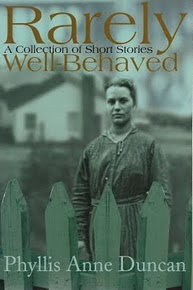
I approved the cover, and about a week later came the proof copy of the book. That was another seminal moment, and I couldn’t help but be sad that my father, who was always amazed by what he called my “way with words,” wasn’t there to see it.

After the proof approval, here came my box of complimentary books, ten of them, and I had the pleasure of going on Amazon.com and seeing my book for sale. iUniverse at that time had an agreement of sorts with Barnes and Nobles book stores, and I used a couple of the free copies to hand off to events managers at the stores near me. That resulted in my books being on the shelves of a book store, several book signings and readings over the next year, and a guest speaking engagement on the benefits and pitfalls of self-publishing.

The biggest pitfall for me was the fact I had to do my own marketing while working a full-time job. I managed to score a couple of radio interviews, but this was in the days before the current social media. If I wanted press releases to go out, I had to create them, stuff the envelopes, and mail them. iUniverse gave you free marketing materials, i.e., graphic files of bookmarks, postcards, and small posters, but I can to print them and distribute them.

But that’s no different from what many authors published by small presses experience. I was lucky that I had media and professional contacts I could use. In fact, the organizer of a large aviation conference gave me time at the conference book table even though the stories (except for one, peripherally) had nothing to do with aviation. I sold thirty-six books in two hours.

In the twelve years since its publication Rarely Well Behaved enjoyed very modest success, but to me any sale was a success. A couple of years the royalties were less than $10, but the sales were consistent.

Yes, it was a self-published book, but I was damned proud of it. Still am. I’m a much better writer now than I was twelve years ago, but the stories still resonated. When I moved to my new hometown, I ended up being able to put copies in a local bookstore and a museum shop. At a book event in 2010 I sold eleven copies of it, more than any of the other authors there. I got e-mails and Facebook posts from people who told me what the stories meant to them.

My book may not have met the criterion for a New York Times bestseller, but it was my own bestseller.

When the time came to consider making Rarely Well Behaved an e-book, I gave it considerable thought and decided now was the time to improve those stories. I gave each of them an overhaul, but I vowed the central plot and characters of each wouldn’t change. I did combine two into a single, long story, almost the length of a novella, but each story is crisper, better honed, and contains fewer -ly adverbs.

Since I was doing that, I decided to break the one print book into two e-books, so that the  espionage stories could be in a volume to themselves. Fences and Blood Vengeance were published in April, a few days before my birthday, and that was the best present. (You can see the e-books in the sidebar to the right. Just one click, and you can own them. No, the marketing never stops.) Then, I made the decision to take Rarely Well Behaved out of print. Mostly, I didn’t want people to buy all three books–and some did–only to discover the, well, similarities.

On May 26, Rarely Well Behaved went out of print, and I was a little sad; but I was also very grateful for the opportunity to hold in my hands a real book with my name on the spine.