I came late to the tattoo scene. I’d wanted one for a long time, but I heeded my then-not-my-ex’s advice about how a visible one would be perceived by the stodgy management where we both worked. My personal inclination was not to give a f**k, but he made sense. However, it wasn’t until he was my ex that I got the first of two tattoos I have. Pick your battles.
Tattoo #1
I wanted something to denote my Celtic heritage, but I didn’t want what every other person who thought they were Irish got: a shamrock, a Celtic knot, or a Celtic cross. I wanted something unique but recognizably Celtic.

My triskele is similar to this but is enclosed in a circle.
I looked through books on Celtic history and finally came across an article about archeology at the neolithic tomb in Newgrange, Ireland. Prominent among the carvings there was a three-lobed spiral called a triskele or a triskelion. The triskele is sometimes called the spiral of life, and ancient Celts found things in the combination of three to be sacred, likely why they took to the Catholic trinity.
Once I had a sample of what I wanted in hand, I went to a tattoo shop near my house. It was small and clean, but let me tell you it was not like the shops in the reality TV shows popular then–L.A. Ink and Miami Ink. The guy behind the desk had tattoos with a death motif on every inch of exposed skin, and it didn’t take much imagination to figure out what was on the unexposed skin. He didn’t seem terribly interested in what I showed him, but once I mentioned it was a carving from a Bronze Age tomb, he was all in.
The best place I decided was on my left ankle, on the inside. He made the stencil and applied it, and I wanted to watch him do the tattoo. Outlining the tattoo wasn’t an issue. It hurt but it wasn’t excruciating. The artist kept asking me if I wanted to lie down. Nope, I’m good, I told him.
When he started filling in what he’d outlined, which involved a head on the tattoo gun with multiple needles and a scraping motion, I decided it was time to lie down. In all, it took less than an hour and fewer than a hundred dollars to get inked.
I’m a bad girl now, I thought, and relished in my badness.
However, when I went back to work on Monday, I wore slacks for a couple of weeks before I wore skirts, and with them I wore dark hose or tights. Finally, after a month of keeping my tat “under cover” I wore a skirt with nude panty hose and…
No one noticed. Oh well, so much for bada$$ery.
Tattoo #2
The second tattoo is for a far more somber reason than denoting my heritage and wanting to be a bada$$, in my own mind at least.
When one of my grandsons was four years old, he was diagnosed with Type 1 Diabetes–an autoimmune disease which essentially means his immune system attacked his own pancreas and put it out of service. At four, he faced a lifetime of insulin shots several times a day.
My own brother had T1D, but he wasn’t diagnosed until he was in his twenties. He eventually became insulin-resistant, and every system in his body started to fail. He died when he was forty-four. I take heart for my grandson because the medicine and the treatment for T1D is far superior than what it was close to forty years ago when my brother was diagnosed.
My grandson’s father, who has a couple of tattoos also, and I decided we needed to show solidarity with him. If he was going to face a lifetime of shots, we could endure needles for as long as it took to get a tattoo.
On my right ankle, mirroring the first tattoo, is a T1D ribbon.
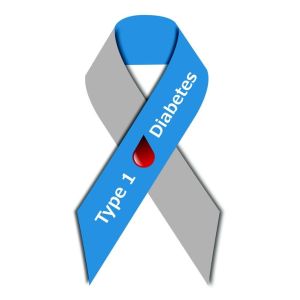
My tattoo omits the words “Type 1 Diabetes” and has my grandson’s name above it and the date of his diagnosis below it.
This kid is the bravest little guy I know. An insulin pump has replaced the syringes, and he’s a normal kid in every way, including getting on Mamo’s nerves. Now eight, he’s decided he has T1D so he can educate people about it. I adore him; I absolutely adore him.
So, do me a favor. Read this and go contribute to the Juvenile Diabetes Research Foundation.
Tattoo No. 3?
I’ve been wanting a tattoo acknowledging the fact I’m a writer for some time, as well. I’m thinking on the inside of my wrist so I can look at it when there are those days where the words won’t come.
I’m leaning toward the words, “I write” or “Write well,” in my own handwriting, with a small quill pen in case no one gets it.
How about you? Are you inked? What do they symbolize? Tell me or show me in the comments.
 How Many Writers Does it Take…
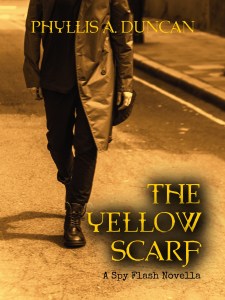 But, lo and behold, without prompting, he bought a copy of my novella, The Yellow Scarf. Unknown to me, he was intending to write a blog post on the place of the novella in literature today and sought examples to use in his post. To my surprise and delight, he used The Yellow Scarf as an example of a good novella. (To read his blog post, “Is the Novella the New Netflix?” click
