A Gathering of Writers

Sorry to take so long to blog about this, but last week was full of events (none writing-related for me; I gave a book party for a friend’s latest book); and I was fighting off a cold. The one-day writers workshop sponsored by Press 53 and Prime Number Magazine in Winston-Salem was a jam-packed day with great instructors and the opportunity to mix and mingle with other writers–one of my favorite things to do.

Press 53 is a small press based in Winston-Salem, NC, and specializes in publishing collections of short stories and poetry. It is also the publisher of Prime Number Magazine, edited by my writer friend, Cliff Garstang. In just seven years of existence, Press 53 is set to release its 100th title some time in October. For the past few years, it has sponsored “A Gathering of Poets.” Prose writers demanded equal time and got it.

As with A Gathering of Poets, the first-ever Gathering of Writers aimed for 53 attendees. The actual count was in the forties, which was promising for a debut. The workshops offered each featured an author published by Press 53 as the instructor, and the topics covered fiction, nonfiction, and publishing. Each instructor gave his or her workshop twice, in the morning and in the afternoon, so you didn’t have to miss one you wanted. As it was, there was time for only four workshops, and six were offered. There’s always next year.

These were the offered workshops:

Creating Immediacy in Fiction, John McNally
Crafting Dialogue that Moves, Valerie Nieman
Going Vertical in Memoir: How to Move your Creative Nonfiction from Slush Pile to Publication Success, Tracy Crow
Creating the World in a Short Story, Clifford Garstang
Scene Construction: Building a Scene Layer by Layer, Susan Woodring
Your Path to Publication, Kim Wright

I signed up for McNally, Nieman, Garstang, and Wright’s workshops.

McNally provided a handout, “20 Things that Lessen Immediacy,” and went over each. Rather sobering to read through the list and see just how many of the 20 “offenses” I’m guilty of, but no more. Very eye-opening and enlightening but practical as well.

Nieman used screenplay excerpts to demonstrate how dialogue in a non-screenplay should read, but the fun part was these were movies we were all familiar with; and workshop participants got to “act out” the dialogue by reading it aloud. Then, we had a short dialogue exercise to write based on a prompt. The prompt was a snippet of a real conversation Nieman had overheard. A lot of fun and very helpful.

Wright, who has been published by a Big Six press, a small press, and self-published gave us the pro’s and con’s of each type of publishing. It was refreshing to hear someone be honest about each type, rather than being all rah-rah Big Six and boo self-publishing. Wright was careful to balance the presentation without showing any favoritism for one form or the other, but she was able to provide good information to help you choose which version might be appropriate for your work. We ended with an exercise where we paired up and described our current works to each other; then, the other person had to give an elevator pitch of your work. Also great fun and showed us just what is important for an effective pitch.

Garstang’s workshop I had seen bits and pieces of before, but as a whole it was a workshop that offered just the practical information with very little fluff. Key to the presentation: Write what you don’t know from the basis of what you do know, and show AND tell. Of course, it was more in-depth that than, and Garstang provided specific references from other writers’ works to illustrate his points. And we left not only with a reading list but suggested exercises as well.

Between the workshops and at lunch, we all had the opportunity to meet each other and discuss writing. I could do that all day, every day. I came away with new Facebook friends, and after listening to those new friends talk about which literary magazines had recently published them, I realized I hadn’t been living up to my resolution to submit more work. Though that wasn’t really a workshop, it was an example to inspire me.

Sometimes the first of anything can be disappointing, but not this–well organized, well produced, and worth every dime spent. I can’t wait until next year’s Gathering of Writers.


A Special (For Me) Friday Fictioneers

The photo prompt for this week’s Friday Fictioneers is one I took this past Spring when I woke to the epitome of “The fog comes on little cat’s feet.” (For photo buffs, I took the photo on a Nikon Coolpix L110 set on “Landscape.”) I could hear the cattle but couldn’t see them, and since I was up early and the fog was a sound suppressor, the quiet really did make me feel as if I’d woken in another time.

Where I live now, even though I’m a born Virginian, I’m on the wrong side of the Civil War. It’s a place where, when I say “Civil War,” strangers feel obligated to speak up and correct me: “The War of Northern Aggression.” Well, bull… pucky. When a group of citizens from a country fight their own countrymen, it’s a civil war.

So, when I re-looked at this photo again to write something for Friday Fictioneers, I looked over the ridges and valleys and imaged the barriers that presented to an escaping slave. (Granted, slavery wasn’t as widespread in the Shenandoah Valley as it was among the planters of the Piedmont in Virginia, but it existed here.) To get to the famous Underground Railroad, a slave from the Valley would have to go north, probably staying in the mountains, go through a gap in the Blue Ridge Mountains, to a Quaker-settled area in what is now Loudoun County. From there, they’d be smuggled farther north into Maryland and Pennsylvania.

I know only in my intuition some Valley slaves probably tried the trek, and I’m sure it’s unknown how many made it and how many didn’t. I, however, wrote a story where someone did succeed, “Pillar of Salt in the Promised Land.”

The Underground Railroad had a specific “code” known to fleeing slaves to hide what brave men and women, on both sides, accomplished. “The Promised Land” was Canada, where many escaped slaves ended up. Some returned after Emancipation; some didn’t.

To read stories by other Friday Fictioneers, click on the frog-like image at the bottom of the story. I’m eager to see the stories written for my photo. If you don’t see the link on the title, “Pillar of Salt in the Promised Land” above, click on the Friday Fictioneers tab at the top of the page and select it from the drop-down menu.

Spy Flash – Week 18

Week 18 was last week, so I’m a little late. I spent the weekend at a writer’s conference (more about that tomorrow) in Winston-Salem, NC, so I’ll use that for an excuse. That and the teepee. (See below.)

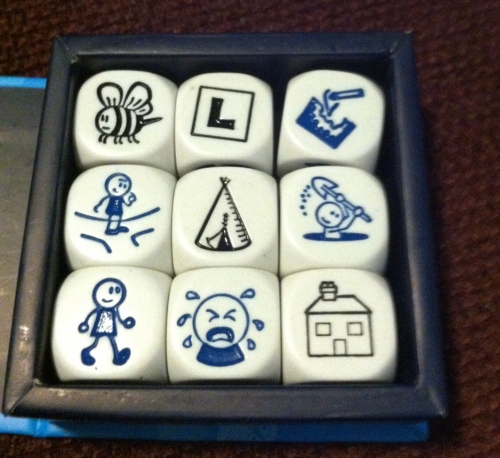
Here’s the roll of the cubes for week 18:

Here’s what I saw: l. to r. – bee; the letter L; striking a match; fork in the road; teepee; digging; walking; crying/weeping; house/home.

There, dead center, is what threw me for days. Yes, a teepee.

I’m using these prompts to write espionage flash fiction, so how on earth was I going to connect that to spies?

Since one of the characters I write about was originally born in the Ukrainian Soviet Socialist Republic, I even researched whether the Scythians, a tribe from the east that conquered most of what became Ukraine, had used yurts (large, well-furnished, collapsible tents moved from campsite to campsite), but I couldn’t confirm it to my satisfaction. (Turns out the Scythians may have been the origin of the Finnish sauna, but that’s another story.)

Then, after an unsuccessful attempt on Monday, I decided that wasn’t a teepee, but a tent. Hey, it’s all about how each person interprets the cubes after all.

The lesson here is sometimes we writers get hung up on a scene, a sentence, a word, which blocks everything else. Once we let go of the hang-up, creativity has room to grow.

This story, “Patience,” is a prequel of sorts to an earlier story, “Here, There be Dragons.”

If you don’t see the link on either title, click on the Spy Flash tab above and select them from the drop-down list. If you want to take the Rory’s Story Cube Challenge, use the photo above and write a story of any length, then post a link to it on Jennie Coughlin’s blog.


Interview, Part 2

To read the second part of Jan Bowman’s interview with me, click here. If you don’t see the link, click on the About Me tab above, and you’ll see the link there.

I always enjoy being interviewed by other writers, and Jan’s insightful questions were great.

Enjoy!

Out of the Mouths of Babes – Sort of, Part 2

This is the conclusion of last week’s post on Pixar’s 22 Rules of Phenomenal Storytelling. If you want to refresh yourself on the first 11, click here. Otherwise, read on.

Pixar’s 22 Rules of Phenomenal Storytelling

12. Discount the first thing that comes to mind. And the second, third, fourth, and fifth. Get the obvious out of your way. Surprise yourself.

I’m not certain I completely agree with this, unless it refers to the revision process. I don’t know that the first thing that comes to mind is the obvious or that the obvious is unacceptable. I do agree with “Surprise yourself.” If you let yourself be surprised by your writing, you could get something magical.

13. Give your characters opinions. Passive and malleable might seem likable to you as you write, but it’s poisonous to the audience.

Think back to the seemingly most passive character you’ve ever read. Jane Eyre, for example. A mousy, repressed, prim young woman who molded herself into compliance at the horrid school where her aunt sent her, we find she has definite opinions about Rochester and her life at Thornfield. Or Miss Marple. She always seems to sit placidly by while murder happens all around her, but when she lays out the evidence and fingers the murderer, she is almost vicious in her opinions about the suspects. Giving your characters opinions gives them depth, makes them real, because we’re all human. We have opinions. Just ask my friends.

14. Why must you tell this story? What’s the belief burning within you that your story feeds off of? That’s the heart of it.

I know the feeling of having something eat at you until you write it down. Sometimes the why isn’t clear until you write the story; then, it all becomes apparent. That’s a great feeling. At a recent panel on creativity, I mentioned how these two characters who are spies tapped me on the shoulder and told me to write about them. My stories about them feed off my sense of social justice, and that’s why I write them.

15. If you were your character in this situation, how would you feel? Honesty lends credibility to unbelievable situations.

This isn’t the same as being in your character’s head. This is you, dropped in the middle of your story, but chances are the way you react is the way your character will react. The reader will believe that.

16. What are the stakes? Give us reason to root for the character. What happens if they don’t succeed? Stack the odds against.

Let’s face it, a story would be pretty dull unless the character had obstacles to overcome. We don’t ease through life, so why should our characters? Besides, stacking the odds against them is rather fun. And who says a character always has to succeed? That’s the one issue I had with Miss Marple–didn’t she ever make a mistake?

17. No work is wasted. If it’s not working, let go and move on. It’ll come back around to be useful later.

It seems I let go and move on a lot, but it does usually come back around to be useful. It’s more than just saving every version of your story or novel. It’s being able to know when something’s not working. For me, it’s staring at the computer screen, unable to compose or revise. If I belabor it, it only becomes worse. Time to move on, but I know it’s waiting for me when I know the time is right.

18. You have to know yourself. The difference between doing your best and fussing over the story is testing, not refining.

“Fussing over the story” is an interesting concept, and it is a fine line between useful refinement and second-guessing every word. I’m definitely guilty of the latter, but as I’ve come to know myself as a writer, I’ve learned to recognize which side of the line I’m on.

19. Coincidences to get characters into trouble are great; coincidences to get them out of it are cheating.

I’m sure you’ve been in the middle of a suspenseful story, the proverbial runaway wagon full of women and children headed for the cliff, and the writer doesn’t resolve it in a challenging way. Think of that season of the original TV show Dallas where Bobby Ewing was dead the entire season, but we find at the beginning of the next season it was all a dream. I know I felt cheated.

20. Exercise: Take the building blocks of a movie you dislike. How’d you rearrange them into what you do like?

That would certainly be a tremendous exercise in creativity. Consider how many movies you’ve left thinking that you’d wasted your money. Now, think about how you’d rewrite them. I know I wish–and I suspect Disney does too–someone would have rearranged the building blocks of John Carter.

21. You gotta identify with your situation characters, can’t just write “cool.” What would make you act that way?

This is a corollary, I think, to number 15 above. If you have a character do something, you have to think about what would have to happen to make you do the same thing. Otherwise, the character has no depth, and the reader won’t be interested. When I had a character cross a moral line in a story, I did wonder what I would do if faced with the same situation. The result was no coincidence.

22. What’s the essence of your story, the most economical telling of it? If you know that, you can build out from there.

At a recent workshop I attended on creating a world in a short story, the instructor described how a writer he knew one time just wrote the dialogue for a story, no exposition, no character descriptions, just dialogue. That was the economical telling of it, and he went back and added exposition and description–only where it was needed. Maybe the essence of your story is a list of character traits, maybe a location. Whatever it is, recognize it as the infrastructure of a really great story.

So, there you have them. Twenty-two rules to make your writing phenomenal–and without going to work for Pixar. How will you incorporate them in your writing?

– – – – – – – – – – – – – – – –

Later this week, look for a post about the very first Press53 “Gathering of Writers,” a one-day intensive workshop in Winston-Salem, NC.

A More Challenging than Usual Friday Fictioneers?

This week’s photo was quite the challenge–as you’ll see when you read the story.

I grew up on a farm which had a lot of forest throughout it, and a walk through the woods revealed some very interesting, natural works of art: two different types of trees whose trunks had fused, trees that grew around or through abandoned farm equipment, a forgotten scythe, rusted almost away, which had been imbedded in a tree branch but which had been “carried” up as the tree grew. Many a bovine skeleton fired my imagination–and followed me in my dreams–back then.

So, this week’s picture made me smile before it stumped me, and then an idea came to me. Some might consider the story, “Thus Endeth the Lesson” blasphemy. Just relax. It’s fiction. Or is it the future?

If you don’t see the link in the story title in the paragraph above, hover your cursor over the Friday Fictioneers tab at the top of the page and select it from the drop-down menu.

To read other offerings (that’s foreshadowing my story, by the way) from Friday Fictioneers, click on the frog-like icon at the bottom of my story and enjoy the fruits of our fecund imaginations.

And I’m Interviewed…Again!

I’ve been pretty popular lately–three interviews in six weeks. Really, all that means is that I like to talk. My friends know that’s true.

This one, though, is special because it was conducted by a new writer friend, Jan Bowman, whom I met at Tinker Mountain Writers Workshop. Not only were we in the Stretching Your Fiction class taught by Pinckney Benedict, but we were dorm-mates as well. And I tell you, this veteran of Tinker Mountain knows how to prepare for the week-long workshop: many varieties of wine and snacks so the evenings were, ahem, lively.

To read part one of the interview, click here or hover your cursor over the About Me tab above and click on the link there.

Out of the Mouths of Babes – Sort of, Part 1

If you’ve seen Cars 1 and 2, Toy Story 1, 2, or 3, Wall-E, or any of a number of animated films produced by Pixar, you’ve seen engaging stories that appeal to all ages. Though produced for children, Pixar’s films are equally enjoyed by adults. In some cases, the kids are just the excuse for the adults to go to a Pixar movie. (Wall-E and both Cars movies are among my DVD collection.)

In addition to its movies and its revolutionary advances in computer-generated imagery, Pixar is also famous as a Steve Jobs project–the one he joined when Apple originally kicked him out. Eventually and post-Jobs, Disney bought Pixar, and it’s been a good merger.

The computer-generated characters in Pixar movies would be nothing without a good story to showcase them, and to ensure that, we have “Pixar’s 22 Rules for Phenomenal Storytelling.” They’ve shown up on Pinterest and on other blogs, but I thought I give them a little different spin and describe the impressions these rules made on me and how I related them to my writing. I’ll do the first eleven this week, and the remainder for the August 20 writing post.

Pixar’s 22 Rules of Phenomenal Storytelling

1. You admire a character for trying more than for success.

When you think back on any Pixar movie, this is really its central theme. Perhaps it’s better phrased as “It’s not the destination, but the journey, that matters.” Of course, we all want to get to the “destination,” a completed book or story, but getting there is sometimes more important. Don’t “try” to write; just write. Don’t self-edit when you’re in the writing zone. Just write.

2. You gotta keep in mind what’s interesting to you as an audience, not what’s fun to do as a writer. They can be very different.

We like to do lots of fun things as writers–twist and turn a plot, dump in a surprise ending, and so on–but we have to remember we’re readers, too. Yes, write what appeals to you, but remember you’re not the only one who’s going to read it. I hope.

3. Trying for theme is important, but you won’t see what the story is actually about ’til you’re at the end of it. Now re-write.

I can’t count how many times this has been true for me, especially when writing a short story. I sit down with something in mind, but it goes in a completely different direction. Sometimes I think I have a whole other person inside me who just takes over, and she’s obviously a better writer.

4. Once upon a time there was _____. Every day, _____. One day _____. Because of that _____. Because of that _____, until finally, __________.

I don’t usually outline, but this is perfect to remind me of just what the writing process is–short, sweet, to the point.

5. Simply. Focus. Combine characters. Hop over detours. You’ll feel like you’re losing valuable stuff, but it sets you free.

I have a work in progress whose opening scene involves a person who isn’t sure if she’s alive or dead. I really liked it when I first wrote it and after I tweaked it. Now, I realize it has nothing whatsoever to do with the work in progress, so it’s time to “hop over that detour.” I never completely delete anything. Cut and paste to a new file. You never know when it might come in handy. Recycled writing.

6. What is your character good at, comfortable with? Throw the polar opposite at them. Challenge them. How do they deal?

How real life is this? Doing this to your characters would certainly make them real, not just shadows on a page. Just reading this rule got me thinking “What if I…?” 

7. Come up with your ending before you figure out your middle. Seriously. Endings are hard. Get yours working up front.

I agree, endings are hard, but sometimes they’re not that easy to come up with. Of course, if the ending is so divorced from the middle, there’s always that great R-word: re-write. (See Rule Number 3.)

8. Finish your story, then let go even if it’s not perfect. In an ideal world, you have both, but move on. Do better next time.

It’s never good for the ego to go back and read stuff you’ve written 10, 20 years before. Moving on is exactly the thing to do. I’m a better writer than I was 10, 20 years ago. I’ll be a better writer 10, 20 years from now.

9. When you’re stuck, make a list of what wouldn’t happen next. Lots of times the material to get you unstuck will show up.

This is another rule which made me do a forehead smack–what a great idea. I think we see now why I’m not a writer at Pixar.

10. Pull apart the stories you like. What you like in them is a part of you. You’ve got to recognize it before you can use it.

We all know what appeals to us in a story or novel. That’s why we read an entire series by the same author or books of a similar ilk. For me, it’s strong, believable characters who struggle with their frailties. So, what kind of characters do I write? Yep, you got it. 

11. Putting it on paper lets you start fixing it. If it stays in your head, a perfect idea, you’ll never share it with anyone.

How many of us have kept our ideas for the world’s greatest short story or novel in our heads? We probably do that because our insecurity says, “Nah, it can’t be that good.” Our inner critic isn’t the best judge, after all. It won’t be the world’s greatest story unless we put it on paper.

What do you think of Pixar’s 22 Rules so far? Inspiring? Nonsense? (Just remember the writers of those multi-million-dollar grossing films followed these rules of story-telling.) I’d like to know what you think.

Tune in next week for Rules 12 – 22!

Spy Flash – Week 17

The roll of the cubes this week inspired a topic I’ve been wanting to write a story about for a long time. As the result of my research into a still-unpublished novel about political murders in Milosevic’s Yugoslavia, I came across the Russian and Serbian Mafiya’s ties to human trafficking, usually of Russian women tricked into thinking they were going to Belgrade or other European cities as nannies or models.

Several years later I learned, as if the human trafficking of adult women (and men) weren’t horrific enough, of a “sub-culture” in human trafficking, that of very young girls. Even more shocking to me was that certain contractors the U.S. Government hired to do work soldiers don’t do anymore, once they were in Kosovo bought women and girls as sex slaves–using government money. Lest you think this is another of my liberal rants, Google it. Or read a detailed new book by Rachel Maddow, Drift: The Unmooring of American Military PowerThe chapter where she described this, and worse, behavior angered me and must have stayed with me, because I wrote this story to show the human trafficking of children, of anyone, has to stop.

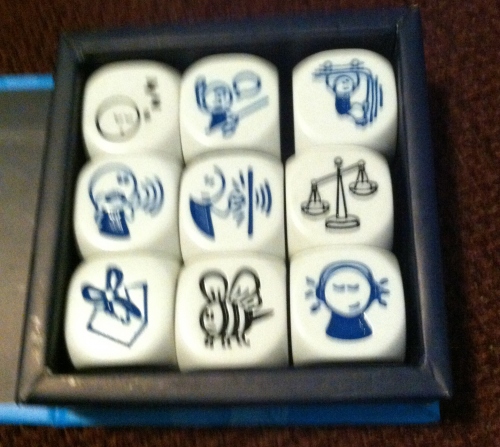
Here’s this week’s roll of the cubes:

This is what I saw: l. to r.–flashlight; reaching/out of reach; keyhole; falling; right turn; counting money; beetle; castle/rook; scales/balance/justice.

And the story I wrote is entitled “Angel of Death.” Be warned, it contains a section of dialogue toward the end that may offend some, but it’s not prurient or gratuitous. This one is definitely not for children, and it may not be for some adults.

This story is dedicated to the men and women who fight human trafficking around the world, and, of course, to the victims. There are too many of them.

If you want to participate in the Rory’s Story Cube Challenge, use the picture above and write a story of any length, using each object or action shown. Then, post a link to your story on Jenny Coughlin’s blog.

If you don’t see the link on the story title above, hover your cursor over the Spy Flash tab at the top of the page and select the story from the drop-down list.

It Can’t be Friday Without the Fictioneers!

Though it’s been a rare Friday Fictioneers I’ve missed (two, I think), there’s always mixed emotions when Friday rolls around. One is joy–it’s Friday, and I’ll get to read Fictioneers’ stories. The other is sometimes terror–it’s Friday, and I haven’t written a word! Fortunately, this is a joyful week because I got inspired as soon as I saw today’s picture.

This week’s photo brought back fond memories of the various beaches I’ve walked–in the U.S. (both coasts and Hawaii, five of the islands), in Mexico, and in Europe. I’ve collected shells and beach glass from all those places and have them in a large candle holder in my bathroom. Each one has a good memory attached to it, despite the fact that I’m no longer with the person who walked those beaches with me. It’s bittersweet to look at them, and it makes me nostalgic for the man he was, but I won’t shut them away.

So, I went for the bittersweet this week, the ultimate story of unrequited love, entitled “Down by the Sea Shore.”

Yeah, I’m getting sentimental in my old age.

To read other Friday Fictioneers stories–or to add your own–click on the little frog-like icon at the bottom of the story. If you don’t see the link on the story title above, hover your cursor over the Friday Fictioneers’ tab at the top of the page and select it from the drop-down list.