Tinker Mountain Days Four and Five

The craft lecture on Thursday was by my workshop instructor, Fred Leebron, and was entitled, “Achieving Complexity in Narrative.” Fred had said his workshop didn’t need to attend because we’d already heard it, but most of us did show up. And a good thing, too. The second time around you realize all the things you missed the first time.

Though Fred had some interesting things to say about plot (“Plotting can be a literary straightjacket–it makes you think as if all stories have already been written.”), he emphasized his standard points about how to make your fiction transport the reader into your world and to resonate with the reader, i.e., go on beyond the end and stick with the reader. Fred then described the various ways to create the complexity needed to both transport the reader and have your work resonate with him or her, and it can be anything from judicious line editing, to multiple POVs and narrative arcs, and many more until, he says, “you get to the end of your narrative after exhausting all the possibilities.” Exhausting all the possibilities is the point where you can finally begin to revise.

The craft lecture concluded with an exercise we could take home with us to help with characterization, an exercise designed to develop the “shades” of a character: Describe what the character is most ashamed of, what haunts him/her the most, when he or she came close to doing someone harm, when he or she was the most humane, what he or she wants the most, and what he or she doesn’t want at all. You may never use the answers in a story, but you’ll understand the character better and make him or her layered and complex.

Day Four’s workshop session focused on dialogue and the various ways you can layer time in a story with dialogue, enlarge the cast of characters, and reveal things a character doesn’t know. Tension, important to story structure, can be both created and enhanced by dialogue that contradicts, is passive aggressive, ignores, or even agrees with.

Day Five’s craft lecture was on screen-writing, and I’ll write something on that later. The final day’s workshop session began with a discussion of drafts of our work. “The first draft,” said Fred, “is what the character wants. The final draft is what the reader wants.” I’d never quite thought of it that way, but essentially that is the case.

The rest of the time before the final critique of the week was a free-wheeling Q&A about writing–using substory, flashbacks and flashforwards, when to use dreaming (“economically,” says Fred), and how to give your endings “bite.”

After the last person’s critique, it was time for goodbyes. The week flew by and, for me, is immeasurable in terms of what I learned. Fred Leebron gives you a lot to think about and not just for the five days of the workshop; for the rest of your writing life. I’m already looking forward to next year!


A Tinker Mountain Friday Fictioneers

I’ll post reflections on Tinker Mountain Days Three and Four once I get back from a meeting I’m attending in Northern Virginia this weekend. Yes, after workshop is over this afternoon, I’m hitting the road and driving almost 300 miles to attend the American Ethical Union assembly in Fairfax. Oh, joy.

Friday Fictioneers LogoBut here’s today’s Friday Fictioneers story, “Simon Sez.” As usual, if you don’t see the link on the title, scroll to the top of the page, click on the Friday Fictioneers tag, then select the story from the drop-down list.

Tinker Mountain Day Three

Wait. Day three? Hello, didn’t we just arrive? How can it be Day Three? Rather proves the cliche about time aviating when you’re entertained.

The craft lecture today by Jim McKean was about including suspense in your fiction, creative non-fiction, and poetry. Perfect for me since 1) I write suspense, and 2) I’m giving a one-evening workshop next week on incorporating suspense into your work. So the “Nine Tricks for Incorporating Suspense” and the “41 Ways to Create and Heighten Suspense” were perfect for me–and not just for the workshop. I’m certain I’ll keep both at hand when I’m writing/revising stories about Mai and Alexei.

Before the critiques started today, Fred Leebron talked about the relationship of the title to the remainder of the work then about Risk = Ambition in novel writing. They are essentially equal, he said, but one also leads to the other in a loop.

Some of the ways you take risks in novel writing are altering the form or structure, using an unusual voice, the content itself, how you use time, and how you treat what’s absent from the novel.

For using an unusual voice, for example, he cited Bright Lights, Big City by Jay McInerney. It’s written entirely in second person. Then he had us do an exercise where we took something from our novel excerpt and put it in a voice opposite to what we’d already written. Amazing how that changes perspective and meaning.

When taking a risk, you need to ask yourself if that risk is necessary or gratuitous; a reader rebels against gratuitous risk. In other words, like the inclusion of sex and/or violence, it has to work within the story. Then, our exercise was to identify what risks we had and hadn’t taken with our novels.

Finally, we discussed how to keep our novels from becoming obsolete. For example, how do novels like Moby Dick, The Great Gatsby, or Heart of Darkness still resonate today, decades, even a century or more after publication? The writer “got the details right”–in other words, verisimilitude.

Tomorrow’s craft seminar is by my instructor, Fred Leebron, and his subject is “Achieving Complexity in Narrative.” He indicated his students didn’t have to attend, since it will be a summary of what he’s told us the whole week, but I have a feeling we’ll all be there. After workshop, we have our class photo out by the famous campus rock, then open mic night for those who didn’t read on Tuesday night.

And then, it will be almost over.

Tinker Mountain Day Two

Thorpe Moeckel makes me wish I were a poet. His craft lecture, “Food and Drink in Poetry: The Techniques, Trappings, and Themes,” was, pun intended, a feast of delicious poems he used to illustrate his point; namely, that the necessity of food and drink to life makes them elementals. The act of eating and drinking is sensory, a particularly good ingredient for writing of any kind.

Moeckel imagines the first poets were proto-humans who sat around a campfire chanting about their basic needs–sustenance, warmth, and mates. When we see our work on a page, he says, think of it as food on a plate. That distances you from the work and lets you  begin to revise.

Many of my fellow prose writers skipped this craft lecture, and I say, “Shame on you!” It well worth the time and the reading of the poems he used as examples. My favorite was this one, by Charles Simic:

Watermelons

Green Buddhas
on the fruit stand.
We eat the smile
and spit out the teeth.

The afternoon, of course, was day two of the Advanced Novel workshop, and my novel excerpt was up for critique at the end of the day. Fred Leebron started it off with a brief overview of finding an agent and preparing the right sort of query letter. Then, he went over some hints about how to submit a successful manuscript–formatting, for example–then things to do to make an editor “love your book for two years,” the approximate length of the publishing cycle. Keep at it, he advised. “If you give up, nothing will happen, so you can’t give up.”

Then came the critiques. Again, this was a civilized process, which provided positive feedback. I’m still at the level of confidence where someone who likes or praises my writing leaves me in a state of wonder. When a well-known teacher of writing compares your excerpt to Sinclair Lewis’ Main Street or Theodore Dreiser’s An American Tragedy, holy crap, you must be doing something right.

The one-on-one conference afterwards gave me good direction and a plan to pursue, and it wasn’t exactly what I had already planned; but it’s where I need to go.

Tonight was student open-mic night, and I read “Marakata,” my short story which won third place in WriterHouse’s contest back in May. It was very well-received, and I got some suggestions on where to submit it for possible publication.

Jim McKean will give tomorrow’s craft lecture, entitled, “Suspense?”–a timely topic since I’m teaching a one-night, online workshop next week about including suspense in your fiction. Then, two more critiques of other classmates’ excerpts. It’s hard to believe as of tomorrow we’ll be on the downward slide.

Tinker Mountain Day One

“The only way to bring your novel to the final level is to address what worries you the most about it.”

So said workshop instructor Fred Leebron after having us answer, to ourselves, three questions he posed:

What excites you most about your novel?

What worries you most about your novel?

What do you want to accomplish in your novel?

The answers to those questions should all be the same, and that’s where you have to focus during the revision process. For me, the answer to all three was “It’s a radical departure from what I usually write.”

And this is just one example of a constant three hours of mental exercises about the novel excerpts we submitted for the workshop. It was a grueling yet very enlightening afternoon, preceded by Pinckney Benedict’s morning craft lecture “From Page to Screen.”

Benedict explained that when you attempt to bring a work to the screen, you can be successful only through “the power of collaboration.” He described the collaboration not only between him and the filmmaker but between them and the small town where they shot the very (very) low-budget movie version of one of Benedict’s most anthologized short stories, “Miracle Boy.”

Much of the collaboration Benedict acknowledges is accidental but because he and the filmmaker had a strong professional and personal relationship before the project, there was automatic trust. Benedict knew his friend would do his story justice.

We got to view the seventeen-minute film, which richly brought to life the short story I was very familiar with. “Thinking cinematically,” Benedict said, “helps you write how things look.”

Probably his best advice of the craft lecture was, “While you write, indulge the fantasy that your writing will win a Pulitzer or will become a movie. Why not? You can always dream.”

Leebron’s craft discussion on the first day of the workshop was intense and packed with information–he accompanied his presentation with a thirty-two page handout. It was complex yet simple in content. It’s all stuff I’ve heard before in various writing classes and workshops; yet, it was far more coherent and better explained than I’ve ever experienced. Conflict, for example, is far more complicated than we think and yet expressed in such simple terminology.

Leebron moved on to narrative arcs (using the example of The Great Gatsby), how to write movement in your work, how to make your work resonate, and more. It was a ten-pages-of-notes day. Great stuff.

Tomorrow is the first of the critiques, and I’m up second, purely by coincidence of having a last name that begins with D and close to the top of the alphabet. The craft lecture for tomorrow is by poet Thorpe Moeckel, and his topic is “Food and Drink in Poetry: The Techniques, Trappings, and Themes.”

In the evening is the time set aside for student readings, and I signed up and will read my short story, “Marakata,” which recently took third place in a contest.

Another busy day to look forward to.

What’s on Tap – Tinker Mountain Day One

On Sunday evening we had our orientation and meeting with our instructors, after a tasty dinner, dessert, and wine. Yeah, this is my kind of workshop.

One thing is clear: Fred Leebron is going to challenge us in the Advanced Novel workshop, and that’s what we’re here for. Our “homework” is to spend thirty minutes tomorrow morning thinking about the novel project we submitted an excerpt of and to ask ourselves two questions about it: How much is it taking on, and what are we leaving unasked?

All fine and good. I do this sort of thing all the time and make notes. Fred’s twist? We’re to think about it for thirty minutes without writing or making notes. After thirty minutes we can write away. The “thinking” should be about the whole book, not just the excerpt. An interesting concept, and I know it will be hard for me not to pick up a pen for thirty minutes. Oh, and during that thirty minutes–no music, no radio, no internet, no video streaming, just thinking. Oy!

He’s also leaving us wondering about the order in which we’ll be critiqued. Last year I wondered why I was last. This year it’s a different fretting, then–when will I be critiqued. Trust me, there’s always something to fret about.

Tomorrow’s craft seminar features Pinckney Benedict (my instructor from last year), and his topic will be “From Page to Screen,” or taking a story and adapting it for film. In the past year, one of his stories, “Miracle Boy,” was made into a film, so it will be interesting to see how he adapted it.

The actual workshop starts in the afternoon, except again Fred is turning it upside down. No one will be critiqued Monday afternoon. We’ll introduce ourselves, discuss craft, and ask questions. There are seven in this workshop, including yours truly, and an auditor/observer. So, I think the discussions will be lively. It also means I need to get reading everyone else’s manuscript.

This year I couldn’t wait to get here, and I’m excited to get this party, I mean, workshop started.

June Friday Fictioneers is Busting Out All Over!

Friday Fictioneers LogoThis week’s photo was quite the poser. I looked, walked away from the computer, then looked again. Yep, it was the same both times. It spawned the whine, “How will I ever come up with something for this?”

Then for some reason I thought about a time in my life when my parents were separated and my time with my father, who was in the Army, became less and less. Whenever I did see him, it was as if he tried to outdo the previous present he brought me. All I wanted was the time with him, but how does a five year old communicate that?

So, today’s photo made me think about what part-time dads would do to keep their daughters their little girls, and “Young at Heart” came to me. I seem to be on a sentimental kick lately, but I’m certain the dark will return. It better.

As usual, if you can’t see the link on the story title, scroll to the top of the page, click on the Friday Fictioneers tab, then select the story from the drop-down list.

Gearing Up for Tinker Mountain Redux

By this time next week, I’ll be at my first craft lecture at the Tinker Mountain Writers Workshop. Last year’s experience was the highlight of my fledgling fiction-writing career–twenty pages of a WIP thrown out to eight strangers and an author whose work I admired and which received very positive feedback. But, before that happened, I shook in my Tevas, I was ready to go home the first night, and I had convinced myself I’d made a bad decision. Then, it all turned out completely differently and gave me a confidence boost I’m still surfing.

Of course, being the nervous Nellie I am, I’m already tying my stomach in knots over attending Fred Leebron’s Advanced Novel workshop. I had put in for Beginning Novel, which seemed logical. I have all these unpublished novels in various stages of completion–unpublished being the operative word. Not enough people signed up for Beginning Novel, so I was faced with the choice of re-taking the same workshop from last year (which would be good but there’s nothing like fresh eyes on your work) or not attending Tinker Mountain at all.

After I lamented this on Facebook, a writer friend suggested Leebron’s workshop would be the best option. One glance at Leebron’s bio at Gettysburg College, where he teaches writing, is intimidating, and he’s also a founder and director of TMWW. That’s like taking a constitutional law class from the President, but every writer friend I know who has had Leebron for a workshop has praised him for providing just the right critique.

Okay, gulp. Twenty pages of a different WIP polished and sent off to more strangers and an author whose work I’m not as familiar with–though that will change.

Really, I’m ready to go right now. My head is in the right space for it, and I know in the next week I’ll start that hideous second-guessing I always do and work myself into a tizzy of self-doubt.

I’m a writer; it’s my job to doubt myself.

The Last Friday Fictioneers of May

Okay, it’s the end of May. How could we be five months into 2013? Wasn’t it just New Years last week? Time flies when you’re writing.

I’ve had some good carry-over from last week’s retreat–Monday’s post on the retreat itself, a pretty killer political blog post on Wednesday (Click here if you’re interested; if you’re not politically to the left of Stalin, you won’t enjoy it, so you might want to skip it unless you are.), a draft of a new Spy Flash story, today’s Friday Fictioneers (of course), and several more scenes for a novel draft, which had a lot of plot holes. Plus some great writer talk with a writer friend. I love it when the giddiness carries on.

But…a week from Sunday it’s Tinker Mountain Writer’s Workshop, and I’m already doubting the twenty-pages I sent in for the Advanced Novel workshop. Is it advanced enough? Am I advanced enough? Will everybody else hate it? You know, the exact same feelings I had last year about this time.

Friday Fictioneers LogoWeek after week, Rochelle Wisoff-Field manages to find a truly inspiring photo, and today’s is perhaps one of the most intriguing. Yeah, I say that about each of them, but this one is so interesting, I’m sure the collection of stories will be eclectic and amazing.

Today’s story, “Put on Your Red Dress,” features my two characters from the Spy Flash short story collection, Alexei and Mai, on a little adventure to find… Well, you’ll have to read it to find out. If you don’t see the link on the title above, scroll to the top of this page, click on the Friday Fictioneers tab, then select the story from the drop-down list.

The Porches

I’ve never been on a writing retreat. I mean, when I retired three and a half years ago, I figured the rest of my life would be one, long writing retreat, but life intervenes. Yes, I’ve been extremely productive in that time, but one thing or another threw up speed bumps along my writing journey.

So, I watched vicariously on Facebook as author friend after author friend went to writing or artist retreats. I studied the possibilities in Poets&Writers Magazine, but I still wondered if that was for me. I need contact with human beings. Shut me up in a writer’s garret somewhere and leave me to my own devices, and I’ll give stir crazy a bad name.

Still, on this journey to publication, I want to give everything writerly a try, so I signed up to go to a week-long retreat at a place recommended by Mel Walsh Jones–The Porches. PorchesSummer500pxThe Porches is the kind of house I grew up in–antebellum, quirky, and with character. I loved it the minute I saw it–minus the shrieking cicadas and the ubiquitous stink bugs. The whole house and the writers rooms are charmingly eclectic with wonderful artwork, intriguing knickknacks, and an amazing collection of books. It is, literally, in the middle of nowhere in Nelson County, Virginia, surrounded by hills and trees. The web page says “on the James River,” but “near” it might be more accurate. However, the foliage is thick enough the James could be out the back door but you couldn’t see it. It is incredibly quiet (even the trains seem subdued) and incredibly inspiring.

Take a look at the web site (link above), and see how Trudy Hale started this place, and you’ll be tempted. Give in to the temptation because it’s also incredibly affordable. Though you do bring and cook your own food–which I like–the nightly cost is well less than a stay at a decent hotel, and the more writers in the house, the price goes down. And it’s not necessarily for locals. In addition to me and a writer friend from the Richmond area, there was a poet from Iowa and a novelist from Alaska!

“Quiet time” for writing reigns from early morning until about 1730, when writers gather in the kitchen to make dinner or in the parlor to watch DVDs–and to talk writing in both places. Most often after those evening get-togethers, we go back to our rooms and write some more.

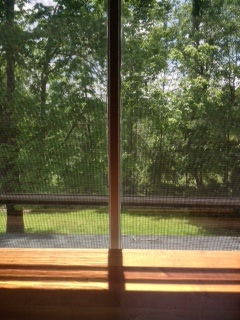
The view from the window of my room at The Porches.

The view from the window of my room at The Porches.

And that quiet time goes fast. In five days and four nights here, I did a read-through of a novel rough draft to identify the plot holes. Got that done on the first day. I worked on the draft of a short story for a contest–editing it from 1,600 words down to the required 1,200 words–and submitted it. I drafted three completely new short stories, between 2,000 and 3,500 words each, as well as several new scenes for the novel, not to mention editing the first twenty pages of it so that was in good enough shape to submit to the workshop I’m going to attend at Tinker Mountain.

The down side? Well, as I said, you are in the middle of nowhere–a half hour to the nearest grocery store–and I was concerned about how long it would take an ambulance to get here if needed (not to mention navigating the narrow road and driveway). Yes, when you get to be my age, you focus on such things. By Thursday when someone needed a ride to Charlottesville to catch transportation to DC, I jumped to volunteer for the drive. I needed to be around people. The quiet time rules are pretty inviolate, and I missed being able to go knock on someone’s door just to chat or bounce ideas off. I had also thought we’d do some readings of our work, but that didn’t come together, because, as I said, after dinner we often went back to writing.

Also, though The Porches has Internet, it is satellite Internet with a minutes limit. Twice we exceeded it and lost Internet access just when I wanted to research, say, condoms in World War II. I think that’s something that needs to be addressed to make a stay here close to perfect. Yes, social media can be distracting, but when you write fiction, which draws a great deal from history, as I do, you need Internet access to research. And, yes, I know such things can wait until I’m back home with my high-speed Wi-Fi, but sometimes when you get the need to know something and can’t get to it, that is just as much a distraction.

Would I do it again? Yes, probably in the fall, because the foliage would be incredible and the humidity way less. It was an incredibly productive week for me, and I accomplished much more than I expected. Going to The Porches was an excellent investment in advancing the publishing journey.