On the Road Again…

Unless something in the Providence, RI, Airport inspires me to blog about “writing, the writing life, and the journey to publication,” today’s post could be delayed on account of exhaustion (3.5 hours sleep; Note to self: stop going to visit the ex-inlaws.) or being on the road.

Tomorrow. Maybe. Stay tuned.

Friday Fictioneers Time!

Today’s photo is called “Outside Pecos” and was taken by Amanda Gray. It was a spooky picture, and, yeah, I went there and maybe a little beyond.

To read today’s story, “Price of Passage,” click on the title. If you don’t see the link, hover your cursor over the Friday Fictioneers tab above and select “Price of Passage” from the drop-down menu.

To enjoy other Friday Fictioneers’ stories, click on “Links in Collection” below and have a good read. I suspect Ms. Gray’s photo inspired a lot of creepiness.


The Dark and Stormy Nights of First Lines

This past Friday evening, when something called a “derecho” blew through the mid-Atlantic, “It was a dark and stormy night” would have been an apt title.

How’s that for a first line? Would you read on after reading that? Well, obviously, you are, so….

As writers we’re taught everything has to be a hook–from that twenty-five-word “elevator pitch” to a first line that grabs the reader and forces him or her to read the rest. The first line, especially when you’re submitting your work, has to be something that catches the reader’s or agent’s eye, something that will stop him or her from tossing your manuscript on the slush pile.

A first line can be versatile. It can be dialogue or straight prose. If you’re James Joyce, it can be inarticulate. If you’re Charles Dickens, it can almost tell a story on its own. If you’re Toni Morrison, it can take your breath away.

In some ways, as we edit and revise, we neglect our first lines, until we get feedback that says, “You know, the first line just didn’t grab me.” Grab. That’s the key word. That first line has to both be a “stopper”–something that makes the reader stop and ponder–and inspiring–something that compels the reader to read the next line, and the next, and the next. It’s not so easy as it seems.

The first line that tops many a list of “best’s” is “Call me Ishmael,” from Herman Melville’s Moby Dick. Short, to the point, imperative tense–you call me Ishmael. Now, had this not been required reading, I’m not sure if that line alone would have made me read further, but I’m glad I did.

This post was inspired, in part, by coming across the American Book Review’s “100 Best First Lines from Novels.” These first lines have done their work well because as I scanned the list of best first lines and recognized books I’ve read (I was surprised how many), the rest of the book came quickly to mind.

I saw “It was a pleasure to burn.” and remembered just how Ray Bradbury’s Fahrenheit 451 impacted me when I read it as a teen. I loved books, so a world where books were burned because they were obsolete was one I had to explore.

I saw “riverrun, past Eve and Adam’s, from swerve of shore to bend of bay, brings us by a commodius vicus of recirculation back to Howth Castle and Environs.” and remembered exactly how difficult it was to work my way through Finnegan’s Wake by James Joyce. This was another required read, but I had hoped to explore my Irish side with it. Oh, well.

I saw “He was an old man who fished alone in a skiff in the Gulf Stream and he had gone eighty-four days now without taking a fish.” and remembered the only Hemingway work I could stomach, The Old Man and The Sea. I remembered I felt as if I were in the boat with the Old Man and felt his frustration as he futilely beat away the sharks from his magnificent catch.

My personal favorite first line is “It is a truth universally acknowledged, that a single man in possession of a good fortune, must be in want of a wife.” (Bet you didn’t see that coming, did ya?) I have read and re-read Jane Austen’s Pride and Prejudice many times, and each time that first line makes me smile in anticipation of what is to come.

Close behind Austen is another Brit, George Orwell, with “It was a bright cold day in April, and the clocks were striking thirteen.” 1984, more than anything, shaped my political views. The first independent clause in this first line bears a striking resemblance to the “dark and stormy night” opening you’re supposed to avoid. Likely, if Orwell had put the period after April, few would have read on. It’s the second clause that’s the hook, the grabber: “…and the clocks were striking thirteen.” Six simple words that tell you dystopia is about to follow. Pretty masterful.

Taking a look at that 100 Best First Lines list is instructive because the examples run the gamut from modern literature to a few centuries past. You can see the evolution of the first line, and, believe me, what was a grabber in the eighteenth century is very different from something modern. And yet, the same. All in all, it will renew your love of language, but, more importantly, it will make you focus on your first lines to make certain they “hook.”

What’s your favorite first line from a novel or short story? Have you tried to imitate it? What makes you want to read more?

(By the way, American Book Review also has a list of best last lines of novels. Another post, perhaps?)
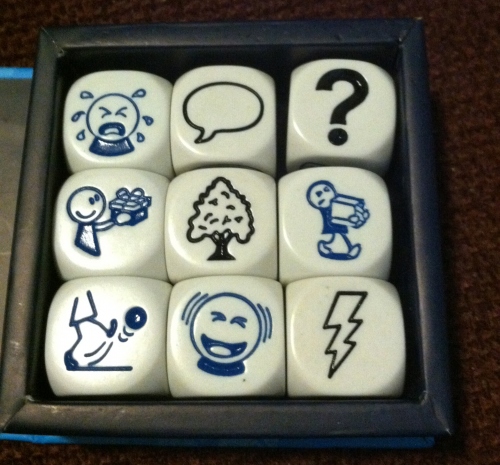
 

Story Cubes Challenge – Week 11

In just one more week, the Rory’s Story Cube Challenge will be three months old. Time flies when you’re having fun.

In a past story, I delved into how Alexei Bukharin came to The Directorate (“Desert Nights and Weeping Flowers“), so I thought it was time to get a glimpse into why Mai Fisher chose her life’s work. This story also gave me an opportunity to explain why espionage intrigues me–the casting aside of morals and norms to assure a country’s integrity may seem a contradiction in terms, but it’s beyond interesting to learn whether a newly minted spy can handle these “shades of gray.”

So, initially, I was going to name the story “Shades of Gray,” for reasons that are obvious when you read it, but I don’t want to imply any connection with a current “book” that’s all the rage for some reason I don’t quite grasp, Fifty Shades of Gray. The story does end up being the longest (at about 4,300 words) of all the offerings in “Spy Flash” and probably doesn’t count as flash fiction at all. Oh well.

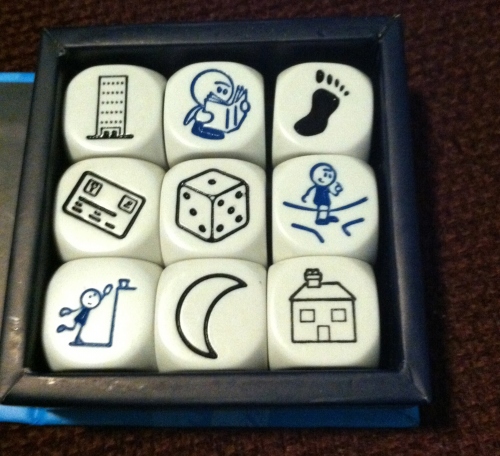
Here’s the Week 11 roll of the cubes:

And here’s what I saw: (l. to r.) building/hotel; reading; footprint; credit card; die/roll of the die; fork in the road/at a crossroads; reaching/out of reach; moon; and house.

Here’s the link to “Family Matters.” If you don’t see the link, then hover your cursor over the “Spy Flash” tab above and select the story from the drop-down list.

Why don’t you give the story cubes challenge a try? Take a look at the picture above, write a story of any length, then post a link to it on Jennie Coughlin’s blog.

Author Interview – Gulp

In my years as an aviation magazine reporter and editor, as a manager, and now as a sometimes newspaper feature writer, I’ve interviewed a few hundred people. The aviation  folks were easy; we spoke a common language. Interviewing prospective employees meant a prescribed set of questions for each applicant, and my recent work writing features means researching some things (like blacksmithing) before I conduct an interview.

Being on the other side of the interview–the one being asked the questions–is even more daunting. Did I say the right thing? Did I really say that? Am I always that inarticulate?

I had some trepidation when an interview with me was to be published at James River Writers’ web site. It just goes to show, even with interviews, having a good editor is important, so many thanks to Melissa P. Gay, author of the blog This Common Reader, for making me sound as if I know what I’m talking about.

To read the interview, click here.

If It’s Friday, It Must be Friday Fictioneers!

Today’s Friday Fictioneers photo brought back many fond memories of weekends at the family farm in Reva, VA. Wild berry bushes were abundant, and my cousins and I, usually under the supervision of one of my uncles, would take buckets and be gone for hours. We’d return to my grandmother’s house with our fingers and tongues and clothes stained and our bellies full. My cousins always went for the blackberries, but the tart, little, red raspberries were my favorite.

This photo was serendipitous too because last Thursday at a special reading event sponsored by my writing group, SWAG Writers, Jim Minick spoke and read from his book, The Blueberry Years. The book is the real story of Minick and his wife’s adventure as blueberry farmers in southwest Virginia. I left the reading with a copy of the book and a desire to plant my back yard in blueberry bushes, because wouldn’t it just be full circle to take the grandkids berry picking?

But, of course, my Friday Fictioneers offering isn’t quite so bucolic. I hope you enjoy “May the Punishment Fit,” then go to Madison Woods’ web site and read some other great 100-word stories. Then, give it a try yourself.

(If you don’t see the link in the story title, hover your cursor over the Friday Fictioneers tab above and select “May the Punishment Fit” from the drop-down menu.)

A Shameless Plug

If you’re enjoying the flash fiction adventures of U.N. spies Mai Fisher and Alexei Bukharin written for Jennie Coughlin’s Rory’s Story Cubes Challenge (Click on the Spy Flash tab above.), you’ll probably love this first collection of short stories about them:

Blood Vengeance is a collection of linked short stories for sale as an eBook at Amazon, and it’s only $3.99! I can even sign your e-copy through Kindlegraph.com.

Here’s what a recent reviewer of Blood Vengeance had to say:

“This is as real and intense as it gets. The stories mix real events with fictional characters in a way that makes everything extremely believable. The fact that those events can be researched on the web, where explicit pictures show the extent of the horror, is hair-raising.

“The characters’ expertise takes them to world hotspots. They get the job done while trying to lead normal lives, which is a lost battle. But they try very hard, and live very intensely. I enjoyed their struggles immensely and hope to read more about their undercover work. A great find.”

Give Blood Vengeance a try. You may like it, and then I won’t have to resort to these shameless, buy-my-book-please plugs. 😉

Story Cube Challenge Week 10

This was the hardest one yet, mostly because that damned pyramid showed up again, and I was at a loss how to account for it. Somehow, I managed it.

I’ve studied and written a lot about the Balkan Wars of the 1990’s and especially about the horrors of “ethnic cleansing.” It took me some time to get inspired by this week’s roll of the cubes, but once I thought about the digging image, the story came to me.

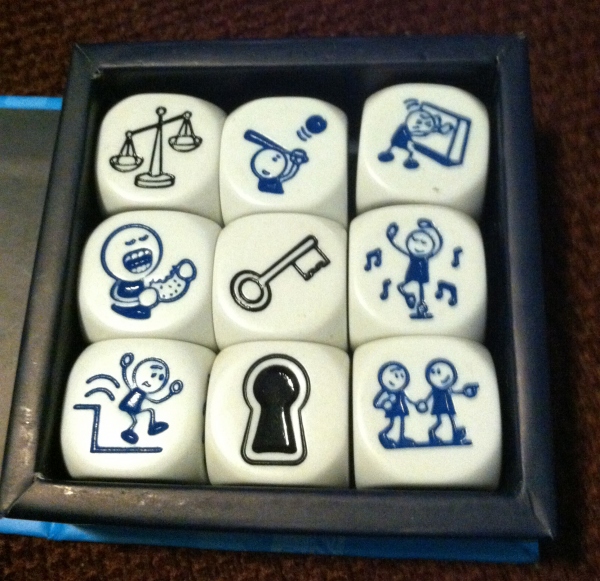
Here’s this week’s challenge:

From left to right, here’s what I saw: key; peeking/spying/binoculars; digging/foxhole; alien; giving a present; pyramid; thinking; knocking on a door; eating.

Here’s the story, “Yea, Though I Walk,” and just a note about a little alteration on the web site. I changed the Story Cube Challenge tab above to Spy Flash, which is the title of the manuscript I’m compiling with these stories. So, if you don’t see the link on the title, then hover your cursor over “Spy Flash” and select “Yea, Though I Walk” from the drop-down menu.