For some reason, I couldn’t get the pictures for the picture blog to work right, so to see this post, go to http://mymusings-maggie.blogspot.com/
National Short Story Month – William Faulkner’s “Barn Burning”
A few months ago I took one of those Facebook quizzes–which Southern writer are you? I came up as William Faulkner. Faulkner was typical of the Southern men I grew up with–hard-drinking, hard-working, philandering, and overwhelmingly brilliant. In each of his works I’ve read, I’ve found a piece of my Southern heritage, sometimes a snippet I don’t particularly want to acknowledge. Faulkner, at least, forces me to examine it.
“Barn Burning” was a story I read both in a high school American Lit class and a college one as well. During the discussion period in the college course, a student who had no rural roots posed the question, “What’s the big deal about a barn burning anyway? It’s just a building. It wasn’t the person’s house.” The professor opened it up to the class, and there were several of us who grew up on farms who were happy to explain that the barn is the heart of a farm. You store animals, equipment, feed there. My Dad’s main “barn” was a complex of buildings, all interconnected, which was the farm’s nerve center. The loss of a barn brings physical damage in the loss of tangible assets, but it is also a symbolic loss as well. If you’re a subsistence farmer, and you lose your barn, you’re out of business.
This was why armies burned barns when they went through a country, this is why the Soviets scorched the earth and a lot of barns in Ukraine in World War II to leave nothing for the Germans to use, and this is why Abner Snopes burns barns to address insults he feels he’s been dealt in Faulkner’s short story.
The story opens in a store where the justice of the peace is hearing an accusation from a Mr. Harris, whose barn has been burned. Mr. Harris describes a dispute with Snopes over a pig getting loose and coming onto Mr. Harris’ land and rooting in his corn. The first time, Harris sends it back. The second time, Harris sends fencing so Snopes can build a better enclosure for the pig. The third time Mr. Harris sends Snopes a message that it will cost a dollar for him to get the pig back. Snopes sends a black man who works for him with the dollar and a message for Harris:
“He say to tell you wood and hay kin burn.”
“What?”
“That whut he say to tell you. Wood and hay kin burn.”
Harris sends the black man away with the pig, and that night, his barn burns to the ground. Harris then brings Snopes before the JP to have him charged. The Justice of the Peace, however, sees that Mr. Harris has no real proof that it was Snopes who burned his barn. Harris tries to compel Snopes’ younger son–the story is really from his point of view–to speak up the boy stays quiet. The Justice has no choice but to dismiss any complaint against Snopes.
As Snopes and his son leave the store and walk down the street someone calls Snopes a barn burner, and his son, named Colonel Sartoris after Snopes’ Civil War commanding officer, launches himself at the man and gets roughed up in the process. Snopes pulls the boy away and takes him home. When they arrive, Snopes’ wife has their wagon packed. This is when you realize this is not the first time Snopes has been accused of barn burning. In fact, Sartoris’ entire life has been a constant journey from town to town, farm to farm, where they live and work briefly then pack up and move on. Yet, you can see this is a boy who adores and worships his father despite his father’s obvious flaws. Sartoris is conflicted far beyond a young boy’s ability to rationalize. He hopes no one will upset his father and release the nasty, vengeful man Snopes really is. You can also see Sartoris is getting tired of the life he’s living. Cracks are beginning to appear in the armor of fatherhood Snopes surrounds himself with.
Snopes reminds me of an uncle of mine, my father’s brother John Marshall, who got the Scots-Irish temper. He never burned a barn, but he found other ways to get back at people who he felt had offended him–turning another farmer’s cows out so they wandered off and took weeks to round up, putting sugar in the gas tank of yet another farmer’s tractor. There are lots of examples, none of which are as serious as barn burning, but costly in their way. All this got my Uncle John the same reputation that Snopes in Faulkner’s story had–be careful what you do or say to this man.
Snopes and his family go their next sharecropping gig. The owner of this farm sends a black man to tell Snopes to come see him and to make sure he comes to the back door. Snopes dresses in his best clothes and brings Sartoris along as he goes to meet his new boss. However, Snopes not only goes to the front door, he deliberately walks through a pile of horse droppings and tracks horseshit through the house and on an expensive French rug. Snopes has also deliberately come at a time when “The Major,” the farm owner, isn’t at home. With The Major’s wife near to faint from the ruination of her rug, Snopes and Sartoris leave, Snopes’ boots still tracking horseshit.
A few hours later, The Major sends the rug to the house the Snopes family have moved into on the farm, with the instructions that the rug be cleaned and sent back up to the main house. Snopes’ wife offers to do it, but Snopes tells her he’ll take care of it. Snopes spreads the rug in the dust, cooks up a pot of lye, and has Sartoris’ sisters “clean” the rug. Now, pure lye will burn, so the rug is now clean of horseshit, but a ghost of itself.
Needless to say, The Major is not happy with the result and informs Snopes that the cost of the rug will come out of his share of the corn crop. In a twist, Snopes brings The Major before this town’s Justice, claiming the redress is too much. Snopes–you can see him, hat in hand, deferring to the Justice, playing innocent–asserts that he’d never cleaned such a rug before, so he shouldn’t be held accountable for cleaning it the wrong way. He did, he claims, exactly what The Major told him to do.
“He brought the rug to me and said he wanted the tracks washed out of it. I washed the tracks out and took it back to him.”
When the Justice reminds him he didn’t take the rug back in the same condition it was before he dirtied it, Snopes has nothing to say. The Justice finds against Snopes but reduces the amount of corn Snopes has to forfeit to pay for the rug. When the corn is harvested, Snopes will have to give 10 barrels, or $5, from his share to The Major.
Sartoris hopes that’s the end of it, but by the time they reach the wagon, Snopes is muttering that The Major won’t get the 10 barrels, or even five barrels. They get home and Sartoris stays outside, listening to the birds and other sounds of nature as night falls. Then, he hears his mother begging and pleading with his father. Sartoris dashes into the house to see his father emptying all the lamp oil into a kerosene can. Snopes orders Sartoris to get “that can of oil we were oiling the wagon with.” Sartoris protests, but Snopes orders him again.
“Then he was moving, running, outside the house, toward the stable: this the old habit, the old blood which he had not been permitted to choose for himself, which had been bequeathed him willy nilly and which had run for so long (and who knew where, battening on what of outrage and savagery and lust) before it came to him. I could keep on, he thought. I could run on and on and never look back, never need to see his face again. Only I can’t. I can’t…”
Sartoris does what he was told but begs his father to send the black man to warn The Major, as he had done all the previous times, so ardently Snopes makes his wife hold the boy while he goes off to make The Major pay. However, Sartoris breaks away, but he doesn’t run after his father. He runs to The Major’s house and without knocking bursts in and breathlessly shouts, “Barn! Barn!” Even though Sartoris is put out of the house, The Major has figured out what he means.
The ending of this story is frenetic. Sartoris’ screaming, The Major shouting for his horse. Sartoris then runs toward his father when he sees The Major gallop off with a gun. As he warned The Major, he tries to warn his father, but smoke is already rising and whatever action The Major now takes, he is well within his rights. Sartoris runs to his father, screaming for him even as he sees the glare of the fire, stumbling in the forest, and stops only when he hears the shots. For hours he sits in the dark sobbing, knowing what has happened and his part in it. “My father,” he says, “he was brave.” Then you realize he spoke of the father as a soldier who fought bravely and well before his descent to barn burner.
Sartoris ran to The Major with the intent of stopping his father, so his father could be in reality the way Sartoris thought of him, but what Sartoris really did was cleanse that “old blood.” There are many Southerners, myself among them, who would give almost anything for the same.
Rapture
Did you think I was going to be writing about the event that’s supposed to occur May 21, 2011, at 6 p.m. local time? No, I’m going to write about the 1981 song, “Rapture,” by Blondie. This song was one of the earliest number one hits to feature rap–and with a white chick doing the rapping. “Rapture” was a mix of rap, jazz, pop, and several other genres and is probably Blondie’s best known hit.
Gotcha.
Of course, I’m going to write about the event predicted by self-styled preacher, Harold Camping, of Family Radio. The first point I’m going to make is that he always makes a big pitch for money, and his net worth is now estimated to be close to $80 million. I’m sure since he’s predicted he’ll be in heaven come one nanosecond after 6 p.m. tomorrow, that he’s distributed those millions to organizations that will be tending to all the victims of the end times to come. What? He hasn’t? Oh.
I’m an atheist. I was one in my heart for a long time but acquiesced to societal pressure and declared I was really an agnostic, i.e., that there was probably a god, but I hadn’t yet been convinced. Regardless of how I “came out” as an atheist, The Rapture is something I scoff at. I’ve heard about it since my grandmother pulled me into revival tents when I was a child. Truthfully, I found the whole concept of The Rapture terrifying on a couple of levels. First, the thought of being “snatched up” or disappearing is totally freaky to a child, and I didn’t really want to leave my dog behind. Being the inquisitive little snot that I was, I asked if my dog, Missy, could get Raptured with me and was told that dogs don’t have souls. Yeah, right, but that’s a topic for a different post.
My second, and probably most significant, fear about The Rapture was not being good enough to be Raptured. And that’s one of my problems with religion–that a seven or eight year old child would be terrified that she wasn’t good enough to be taken to heaven in The Rapture. When I finally figured out there was no god, that fear evaporated, and I slept much better at night. Still do.
I try to be reasonable about other people’s beliefs. Most of my Christian friends and I have come to a place of mutual respect–you don’t try to convert me, and I won’t try to convert you; we can have civilized debates, but we respect each other’s beliefs, or lack thereof in my case. It is difficult for me, however, to find that respect for people who blindly follow charlatans like Camping, who are clearly only in this for the money. (By the way, he predicted in the 1990’s that The Rapture was coming and had only a lame excuse of poor biblical scholarship as his reason why it didn’t. But send more money so he can do a better job of studying the Bible.)
I can’t respect parents who quit their jobs, stop paying their bills, and spend all their assets before May 21, so they won’t leave any worldly things behind. I especially can’t respect the mother in that family, who has a small child and another on the way, who is putting her belief in superstition above the care of her family.
I can’t respect another set of parents, these of three teenagers, who have also put their faith before their children. This mother told her 16-year old daughter, who disagreed with her mother’s contention about the impending Rapture, that she won’t be in heaven. The mother went on to say, essentially, “My children will be left behind, but, oh well, that’s god’s will.” If I were in child protective services in that state, I’d be on their doorstep come Monday. And Monday will come.
I can only disrespect a mother of two who was so certain she’d be Raptured but was sure her two young daughters wouldn’t be. In her “motherly” concern, however, she decided even though they’d be left behind, she didn’t want them to suffer, so she cut their throats. (Abraham and Isaac, much.) Thankfully, someone found them before they bled out and got them to hospital. And I guess the mother, and I use the term loosely, decided she didn’t want to wait for May 21; she cut her throat, too. In her mug shot, you can see a two-inch cut that appeared not to need stitches.
There are countless other examples, but, frankly, it’s just too depressing to recount just how ignorant modern-day humans can be. I could understand Homo Habilis believing in The Rapture, but not people with evolved forebrains. Then again, Homo Habilis’ brain couldn’t conceive the concept of religion, so who’s to say which of us is evolved?
The other, disturbing thing about believing you’re one of god’s chosen is the arrogance. You, as a person, have decided you’ve been so good, so perfect–even though the son of the god you believe in admittedly wasn’t–you’re going to heaven, and you don’t give one whit about those of us you’ve decided aren’t. If you were truly Christians, you’d understand that The Rapture is not mentioned in the Bible, Jesus didn’t talk about it, and he’ll be really pissed when he sees how you’ve treated the rest of us.
If a single person commits suicide before this event to hasten the trip to heaven or in the aftermath because it didn’t happen, I lay the blame at the doorstep of Harold Camping. In some way, I wish I believed in a Judgement Day, because I’d like to be a fly on a cloud when he stands before St. Peter. (It’s a metaphor, people.)
See you next week. I promise.
Dead or Alive Redux
Dead or Alive Redux
Just a little mini-post today while I’m working on the next post for National Short Story Month.
I’m still reflecting on the death of Osama bin Laden. Really, I have no choice. Almost two weeks into the aftermath, it is still often the lead topic on a news cast.
After an initial, albeit reluctant, show of support for the President’s authorization of the mission and its parameters, the extreme right and extreme left have twisted themselves around on this until they somewhat agree. The right is in high dudgeon because they feel W didn’t get enough credit. Excuse me, but how can a person who has been out of office for more than two years get any credit for instructing the CIA to recommence its search for bin Laden and then authorizing a mission that requires the go-ahead from a sitting President? Oh, it was the enhanced interrogation techniques which W, who’d never fought in a war and who perhaps had the barest minimum of SERE training in his air guard days, insisted we use? Wrong again. As interrogation professionals (if there is such a term, and if there is, god help us) iterated then and now, putting someone in extreme pain or in fear of his or her life only gains you “white noise,” bogus intelligence given only to make the threat go away. Khalid Sheik Mohammed, whom the right asserted, incorrectly, was the source of the tip that let us to the compound in Abbotabad, was waterboarded 183 times and never gave up the courier’s name. It was another detainee in a CIA rendition center who gave it up after his interrogator “made friends” with him. My eroded respect for Sen. John McCain (R.-AZ) is somewhat rebuilt after his recent Post op-ed and his Senate speech setting the record straight about the use of torture and also for the fact he calls it what it is–torture, not the harmless-sounding euphemism “enhanced interrogation techniques.”
And, excuse me, we near-drowned someone 183 times in a three-month period, just about twice a day. Let’s not forget that. Khalid Sheik Mohammed is a despicable person, yes. He videotaped himself beheading reporter Daniel Pearl, but we should not have lowered ourselves to his level.
On the left, we have Michael Moore, whom I adore, and Rosie O’Donnell, whom I can’t abide because she doesn’t bother to get her facts straight, questioning the legally of hunting and killing bin Laden. “Double-tapped an old man in his pajamas” is about how Moore referred to it. First of all, bin Laden was a few years younger than I, and I’m not old. He was in his mid-50’s, not old and apparently not as infirm as we were led to believe. He was of an age where he still could have mounted resistance with any of the weaponry found nearby. Yes, he was in his nightgown-like sleeping attire, but when a Seal says, “Don’t move,” and you do, you accept the consequences. As I said in an earlier post, bin Laden would have shown that Seal no mercy had the roles been reversed, and the Seal’s death would not have been quick as bin Laden’s was. Again, as I said before, it would have been preferable to take bin Laden into custody and provide him the unique kind of American justice which has no equal in the world, and I’m not talking about a midnight raid with high-tech stealth and silenced guns. Though a trial would have offered its own problems, it was a desirable outcome, but we train our Special Forces quite well to make on-the-spot decisions and changes in tactics. Because I’ve never been trained that way and my research only gives me a theoretical perspective, I’m going to give the Special Forces the benefit of the doubt and accept they made the right call under the circumstances. And the President did, too.
I wish this incident would pass into history, already. It’s over and done with. We can’t, nor should we, change anything; however, as altruistic human beings we need to accept that bin Laden’s family can mourn the loss of their brother, uncle, father, husband, a death he brought to his own door, unlike the thousands of deaths he ordered then sat back and relished.
National Short Story Month – Shirley Jackson’s “The Lottery”
 This is the second of several posts for May celebrating National Short Story Month.
“The morning of June 27th was clear and sunny, with the fresh warmth of a full-summer day; the flowers were blossoming profusely and the grass was richly green.”
A story that starts so sweetly just has to be warm and cozy and delightful, doesn’t it? There are scenes of children playing and adults chatting about spouses, the weather, and taxes. The older folks complain that young people don’t follow traditions any more. Young boys scamper about, stuffing their pockets with rocks and building a pile of stones–typical boy stuff in a typical small town. Those of us who grew up in one of them (and in my case came back to one) will recognize this. How very bucolic and dreamy.
However, this is a story by Shirley Jackson, so there’s nothing bucolic and dreamy about it. “The Lottery” is the stuff of nightmares, and that’s what makes it another of my favorite short stories. (I’m not sure what that says about me, but I’m harmless. Mostly.) Most of Jackson’s work is dark because she sees things in the everyday that others don’t. Stephen King, Neil Gaiman, and Richard Matheson, masters of the macabre all, have acknowledged her influence on their work. When The New Yorker published “The Lottery” in June 1948, it received more mail about it than any previous story, most of it questioning why the magazine had published a horror story?
“The Lottery” describes one day for the 300 citizens of a small, rural town, unnamed and where it is we don’t know, nor does it matter. Jackson acknowledged she based it on Bennington, VT, her home town, something I’m sure didn’t exactly thrill her neighbors. In the story, every year at 10 o’clock on a particular day in June, the town–as does every town and city–holds a lottery. The responsibility for preparing for the lottery falls to one man, who is replaced by a volunteer when he decides he doesn’t want to do it anymore. Tradition is very important to the lottery, though necessary changes have occurred. The black box used to hold the lottery slips formerly held wood chips; however, when the population grew, the box was too small to hold all the chips. The man in charge of the lottery changed to paper. Over the many years of the lottery, much of the paraphernalia for the black box and the original black box itself have disappeared or disintegrated. Now a three-legged stool gets placed in the town square, and the black box sits atop it. Otherwise, everything is the same as it’s been for countless years and innumerable lotteries. One old man boasts that this is his 77th lottery, his “seventy-seventh time.”
The purpose for the lottery, other than it’s tradition, is never explained, which adds to the darkness of the story. Those would have been wasted words. It’s enough to know the lottery is and always will be.
As people arrive for the appointed time, they chat as friendly neighbors about harmless things. When I first read this story in high school and reached this point in the story, I remember thinking, how boring. They’re all standing around talking about commonplace things, much like my father at the cattle market or my mother at the hair dresser. What was so good about this story was eluding me.
Then, you feel the tension mount as everyone walks up to the black box when his or her name is called and removes a folded piece of paper. Everyone must keep the paper folded until all have chosen. There is a brief dispute about whether a young woman draws along with her family or her husband’s. Once that’s settled, the reveal can begin.
At a signal, people unfold their papers and hold them up for all to see. Jackson’s prose lets you “hear” the sighs of relief as paper after paper is blank–except for one, which has a black spot on it that “Mr. Summers had made the night before with the heavy pencil in the coal company office. Yes, there are lots of allusions to dark and black things throughout the story. I always envisioned a colorless town with people in drab clothing, though there’s no such description.
Soon, it’s obvious someone isn’t owning up to having the black spot, one Tessie Hutchinson. She knows she has the dreaded piece of paper and even though she knows it’s futile to try to hide it, she clenches it in her fist. Her husband is the one who pries her hand open and shows everyone the paper with its black spot.
The villagers back way, leaving Mrs. Hutchinson alone, but they are only moving to pick up their stones from the pile the boys made earlier. Other stones are scattered about, and you get the impression they have been used and reused time and time again. Someone actually puts stones in the hands of Mrs. Hutchinson’s small son because everyone must participate. She begs and pleads, but no one–not her husband, not her children–will help her or stop the inevitable. This is tradition and must be upheld.
Shirley Jackson was renown for not giving interviews or explaining her stories, though the reaction to “The Lottery” compelled her to offer this:
“Explaining just what I had hoped the story to say is very difficult. I suppose, I hoped, by setting a particularly brutal ancient rite in the present and in my own village to shock the story’s readers with a graphic dramatization of the pointless violence and general inhumanity in their own lives.” (July 22, 1948, San Francisco Chronicle)
Today, we read of stonings in Afghanistan, Iraq, Pakistan, and are repulsed. We attribute such actions to backwardness, and we are so smugly certain civilized people don’t do such things, that we have evolved beyond being slaves to tradition. Really?
Jackson was married to literary critic Stanley E. Hyman, who wrote the preface for a posthumous anthology of Jackson’s stories. He noted her purpose in “The Lottery” wasn’t to simply horrify but to incite subversion, and she was pleased when she learned the aparteid government of South Africa had
banned the story there because they considered it subversive. Many critics then and since have speculated Jackson wrote on the dark side because of a traumatic childhood or was neurotic–the usual reasons given when women write something other than children’s stories or romances. Hyman felt her writing gave voice to our inner, post-Holocaust, Cold War fears of mutually assured destruction and getting the enemy first.
One of Jackson’s two novels, The Haunting of Hill House, I read soon after I finished “The Lottery.” Don’t bother to see any of the movie adaptations. Just read the novel instead. It will scare the absolute bejesus out of you, not with gory, explicit scenes of mayhem or murder, but with the careful, thoughtful juxtaposition of words. Nothing else will ever scare you as much.
Except, perhaps, the last line of “The Lottery”:
“‘It isn’t fair, it isn’t right,'” Mrs. Hutchinson screamed, and then they were upon her.”
National Short Story Month – Harlan Ellison’s “A Boy and His Dog”
We’ve probably had short stories in oral form since humans began to speak and told fanciful tales, but the “official” origins of the modern written short story are in the 19th Century when magazines could be printed rather cheaply. The short story in these publications became very popular and fueled the magazine industry from then until now. The magazines printing those early short stories weren’t technically literary magazines because they contained other, non-literary material. The 20th Century saw the rise of the literary magazine as we know it today, chock full of short stories, essays, poetry, and author interviews. But this isn’t National Essay Month (though I’m sure there is one), so throughout this month, I’ll blog about the short stories of particular interest to me.
There’ll be no specific order to the stories I’ll write about–no Top 10 lists–just ones that mean something to me. So, for me, the only logical starting place is Harlan Ellison’s “A Boy and His Dog.” This story is from Ellison’s story collection, The Beast Who Shouted Love at the Heart of the World
Ellison is primarily a short story writer, mostly in the Science Fiction and speculative arena, where he’s won just about every award in that field and a few literary awards as well. In the 1970’s and 1980’s he would regularly go to a book store in Los Angeles, pick a first line from a collection submitted by patrons of the store, sit down, and begin to type. Each page, typos and all and with no editing, would be taped to the front window of the store. People would stop and read or go inside and watch the process. Ellison is known for being an egoist and an all around difficult person, volatile and vocal about fools he doesn’t suffer lightly, but I met him at the World Science Fiction Convention in the early 1970’s, and he was perfectly cordial to me. After spotting me, gawking as he “debated” with his good friend Isaac Asimov, he took me aside and spent a good half hour alone with me, talking about writing and encouraging me to “keep at it.” It’s something I’ll never forget.
I could pick any of his hundreds of short stories, but “A Boy and His Dog” was the one that gave me the biggest “kick in the gut” when I read it. It takes place in a post-nuclear war world where men and their dogs roam a desolate landscape scavenging for shelter, food, and women. Vic, the Boy in the title, travels with Blood, a dog who is telepathic, the result of a pre-war experiment. Blood’s talent is “sniffing” out females for Vic to rape. Vic is able to “score” more women because of Blood’s talent and their ability to communicate silently.
A pretty dark and horrific premise, but as with most of Ellison’s stories, there is a comeuppance. Blood leads Vic to Quilla June, whom Vic rescues from mutants called Screamers. When she shows Vic she’s willing to have sex with him, Vic is confused, and Quilla June tells him of a paradise where he can have all the willing women he wants. Quilla June has been send to the surface by her father to seduce men and bring them to the “downunder” for breeding purposes. Vic is eager to go with her, but a suspicious Blood tries to dissuade him from following Quilla June. However, Vic is, well, thinking with his lower head. Vic descends into Quilla June’s underground Utopia and leaves Blood alone topside.
Quilla June’s world is quirky and rather like the Amish on acid. Everyone wears mime makeup, dresses like a 1950’s farm town, and people who don’t conform get sent to the “farm,” a euphemism for execution. One of the reasons downunder women go topside to bring men back is that so many get sent to the farm for the merest of reasons. When Vic arrives, Quilla June and 34 other women are set to “marry” Vic, but to Vic’s surprise there is no sex. He’s, um, tied down and attached to a machine that extracts his sperm, and his “wives” will be artificially inseminated. The town’s odd moral code, however, doesn’t allow unwed mothers, so the women have to marry before being inseminated. Quilla June knows that once Vic’s sperm has produced 35 pregnancies, he’ll be sent to the farm. Because she hasn’t enjoyed her deception–and she’s basically rebelling against the tyrannical rule of her father–and because she now loves Vic, she breaks him out, and they head back to the surface.
Ever loyal, Blood has not strayed from the point where Vic went underground. When Vic and Quilla June find him, Blood is badly injured and starving, near death. Quilla June gently encourages Vic to leave Blood, but Vic realizes he has only survived in his post-apocalyptic world because of Blood’s wisdom. He’s faced with a choice–the love Quilla June has for him alone or the loyalty of his faithful dog, who first and foremost needs food.
At the end of the story Blood is feeling much, much better and is no longer hungry, and he and Vic resume their travels.
A grim ending and not for the light-hearted, but it is gripping. Ellison moves easily from the violent, gruff, raucous, rapacious world of the surface to the artificial, gentile, cultured, and deadly world of the downunder. The changes in language and writing style reflect each world. The reader is left to wonder which is the worse of the two worlds, and the decision isn’t easy. What looks inviting about the downunder is in some ways more of a nightmare than the devastated civilization above. We don’t even cringe at Vic’s choice, because he’s a child of that nuclear holocaust, which occurred when he was small. Survival is all he’s ever known, and he did whatever he needed to until he met the restraining guidance of Blood. It is Blood who is the hero in a story that shouldn’t have any.
If you read “A Boy and His Dog,” you’ll not only look twice at the wolf inside your house; you’ll also want to read more Ellison. He’s a curmudgeon, but he writes like a son of a bitch.
Dead or Alive
A friend of mine wrote a short story a few weeks after September 11, 2001. In the story, Osama bin Laden is about to go on trial–a civilian trial, by the way, since the whole military tribunal mess hadn’t yet occurred–but his attorney argues successfully that bin Laden can’t get a fair trial in America. The fictional judge reluctantly agrees and releases bin Laden into the streets of New York City then sits in his chambers and listens to the people exact their revenge.
An insightful and thoughtful story, but one that was fiction. The reality we know now is that had we captured bin Laden alive, we would have remitted him somewhere and eventually tried him before a secret military tribunal. There is no doubt what the outcome of that trial would have been. In the meantime, however, no American would have been safe anywhere in the world. An exaggeration? Remember when the United States admitted the exiled Shah of Iran for cancer treatment? Employees of our embassy in Tehran became pawns in that clash of wills for more than a year. Remember, too, the failed hostage rescue attempt that left U.S. aircraft in a hostile country to provide intelligence to the Iranians on who inside their country had helped the U.S. More than anything else, the failed Operation Eagle Claw assured Jimmy Carter wouldn’t get re-elected.
The reality is, as much as I believe in justice and rule of law, neither of those mattered to Osama bin Laden. We were the “other,” the non-believers, unworthy in his eyes. He gave no quarter, and, I suspect, he would have wanted none. Though I would have preferred we had afforded him that, he died as he lived, and he can no longer be the monster under the bed, the boogeyman in the closet, that Republicans have held up as an excuse for suborning our Constitution in the near decade since September 11, 2001. In some aspects, this was the only way to take the burden of his actions off America’s back. They have weighed us down far too long.
We will find the closure temporary and fleeting, but some closure is better than living with the mythos of bin Laden indefinitely. It is disturbing, though, that while they had the White House, the Republicans invoked bin Laden’s name to justify all sorts of sordid acts; yet, they were the ones who stopped the operation in Tora Bora that would have captured him in 2001. There were tastier fish to fry in Iraq. The President who initially explained his feelings about bin Laden by alluding to Old West Wanted: Dead or Alive posters, soon moved on and didn’t think too much about the man who approved a “martyr operation” that cost the lives of 3,000+ Americans on a bright, beautiful September day.
In the year of the 10th anniversary of September 11, 2001, we have a President thought by some to be unseasoned, too soft on terrorism, too equivocating. Despite that, he asked for options, received three, and picked the most risky. It’s failure would have been his own Operation Eagle Claw, and he could have kissed any hope of re-election goodbye. But the execution was nearly flawless, and I think that for a nanosecond as bin Laden looked on the Navy Seal who put two bullets in him, he knew an American had put him to death, as he had put Americans to death. There is satisfaction in that coming full circle. There is closure in that.
As the daughter of a re-conn soldier from World War II and the cousin of one of the first Green Berets, I acknowledge our Special Forces as some of the best military in the world. I doubt any other special forces could have accomplished what Seal Team 6 did. Behind them they had good intelligence, obtained in an “old-fashioned” manner by time-honored tradecraft, not the torture so gleefully discussed in the previous Administration. And though we didn’t know about it until after the fact, they carried the hopes of the American people with them. Now, we can finally say, to some extent, and not be laughed at, Mission Accomplished.
And yet, I do not rejoice in Osama bin Laden’s death. Am I glad he’s gone? Yes. By not rejoicing, I’m one-up on him because he undoubtedly rejoiced in any American’s death at the hands of an Afghan or Iraqi or any other member of the religion he subverted for his own ends. I’m not so naive to think his death is the end of al Qaeda. Al Qaeda is a concept, not something tangible we can destroy irrevocably. We have, however, diminished its importance and standing. Coupled with the Arab Spring, we are moving toward reducing al Qaeda, and Osama bin Laden, to a footnote in history.
Let’s not forget, however, who created Osama bin Laden. In the 1980’s, so deep in our Cold War paranoia, we moved heaven and earth to deal a defeat to the Soviet Union. We armed an insurgency, used their religion to unite and motivate them, to make them zealots, encouraged young Arab men from other countries to go to Afghanistan to fight the godless Soviets. We promoted jihad. We created our own mercenary army of religious fanatics, and Osama bin Laden was among the ranks. So, why were we surprised when our creation turned against us?
What Really Motivates the Birthers?
Just coincidentally a week or so ago, I was looking for something in my desk and came across an envelope with my mother’s handwriting on it. Just one word–“Important.” I had a vague memory of seeing it when I was going through papers after her death, so I decided to open it. Guess what I discovered? A Certificate of Live Birth.
For some reason I needed a copy of my certificate of live birth in 1990 and sent for it. The certificate itself is a Xerox on elaborately bordered, special paper (manufactured by the American Bank Note Company, no less), which bears the words, “Certification of Vital Record.” It was produced by the Commonwealth of Virginia, Department of Health, Division of Vital Records. At the bottom right is the seal of the Virginia Department of Health. At the bottom left is a raised version of that same seal. In tiny print at the bottom, it reads, “This is to certify that this is a true and correct reproduction or abstract of the official record filed with the Virginia Department of Health, Richmond, Virginia.” That’s followed by the photocopied signature of the then State Registrar.
It has a birth number and all sorts of interesting statistical information. Of particular note is box 15 “Birthplace (State or foreign country)”. Typed in is the word, “Virginia.” Not, Virginia, USA; just Virginia. As certified by the doctor attending, a Dr. Jones–hmm, that sounds like a made-up name, doesn’t it–it even includes the time of birth: 2:20 a.m.
All of this bureaucratic information, the birth number, the raised seal, even the facsimile of the original record, etc., is reminiscent of the Certificate of Live Birth for Barack Hussein Obama, which I’ve viewed at Politifact.com, a 2009 Pulitzer Prize winner, by the way. However, according to Donald Trump and other birthers, there is a question as to whether I was really born in Virginia, because for them, a certificate of live birth doesn’t cut it.
I guess my mother and father conspired before my birth to make me a bureaucrat in a Federal agency, so they submitted false information to the Commonwealth of Virginia so it would appear I was born there. How devious is that?
Then, deeper in the envelope, I found a 1976 version of my certificate of live birth. Though the middle portion of this version is the exact same record as the 1990 version, the whole certificate is a Xerox. Uh, oh. I now have two versions of my certificate of live birth. Highly questionable. The information on both versions match to every letter and comma, but two versions? I better not run for office–I have my own conspiracy in the making.
Then, there’s the whole matter of one citizen verbally abusing another citizen over the production of a “long form” birth certificate. I went to Virginia’s state government Web site and searched for “long form birth certificate.” No hits. Apparently, either of my two versions of my certificate of live birth is a long form birth certificate because it’s the only birth certificate Virginia issues.
I am still amazed that we’re discussing this in America. I’ve written before about how my mother and her family came to America when she was very young and how a town in Virginia “adopted” them, got them SSN’s, and any other government form a citizen would need. So, yes, I’m an anchor baby, apparently. The fact that my mother wasn’t a citizen didn’t come to light until the late 1970’s when she and my father were supposed to go to the Soviet Union at the request of the U.S. Department of Agriculture for an agricultural expo. She simply refused to apply for a passport, and my father finally figured it out and decided it would be way too complicated to get her “established” as a citizen. They didn’t go. Several flags got raised, but my mother was never investigated. She even served several times on juries. The difference, of course, was my mother looked like the majority of people in the country at the time she immigrated. She was European and white, not of African descent and dark, like our President.
And that, my dear Watson, is the crux of the matter and the answer to the question I posed in the title of this post. Would anyone be questioning the validity of President Obama’s certificate of live birth if he were as white as Sen. John McCain? Of course not. McCain was born in the Panama Canal Zone when his father, on active duty in the military, was stationed there. That should hold the same concern for the ignorant Tea Baggers who raise the issue of the President’s birth, but it doesn’t. (By the way, children born overseas to American citizens, whether on active duty in the military or not, are U.S. citizens, but you have to dig into the law to know that, and we all know the Tea Baggers only go for the superficial.)
Most people and the media, as usual, have tried to overlook the overt racism in Trump’s and the other birthers’ claims, saying it’s just politics as usual. No, it’s not. Every time Trump or Bachmann or the half-governor of Alaska or any of the other self-aggrandizing publicity hogs mentions that the President may not have been born here or questions why he doesn’t produce that elusive long form birth certificate, call them on their racism. Point out exactly what they are–so insecure we have a President who doesn’t look like them that they have to resort to childish finger-pointing and bullying. They are racists, plain and simple. That, not patriotism, is their sole motivation.
SWAG Writers Poetry Fest!
Here’s a pictorial blog today on last night’s great Poetry Fest sponsored by SWAG Writers.



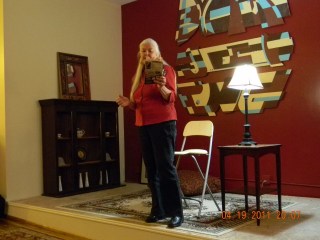




The featured poet was Sarah Kennedy, an Associate Professor of English at Staunton’s Mary Baldwin College. She read from Home Remedies, one of her six books of poetry. Home Remedies contains poems based on real persons from 17th and 18th Century Ireland and Wales. Very evocative to my Irish half.

Local poet Lauvonda Lynn Meade Young read from her first book of poetry, Just a Woman. We women in the audience who are her contemporaries–we could certainly relate to her poems! Wonderful glimpses into the life of a woman who isn’t “just a woman.”
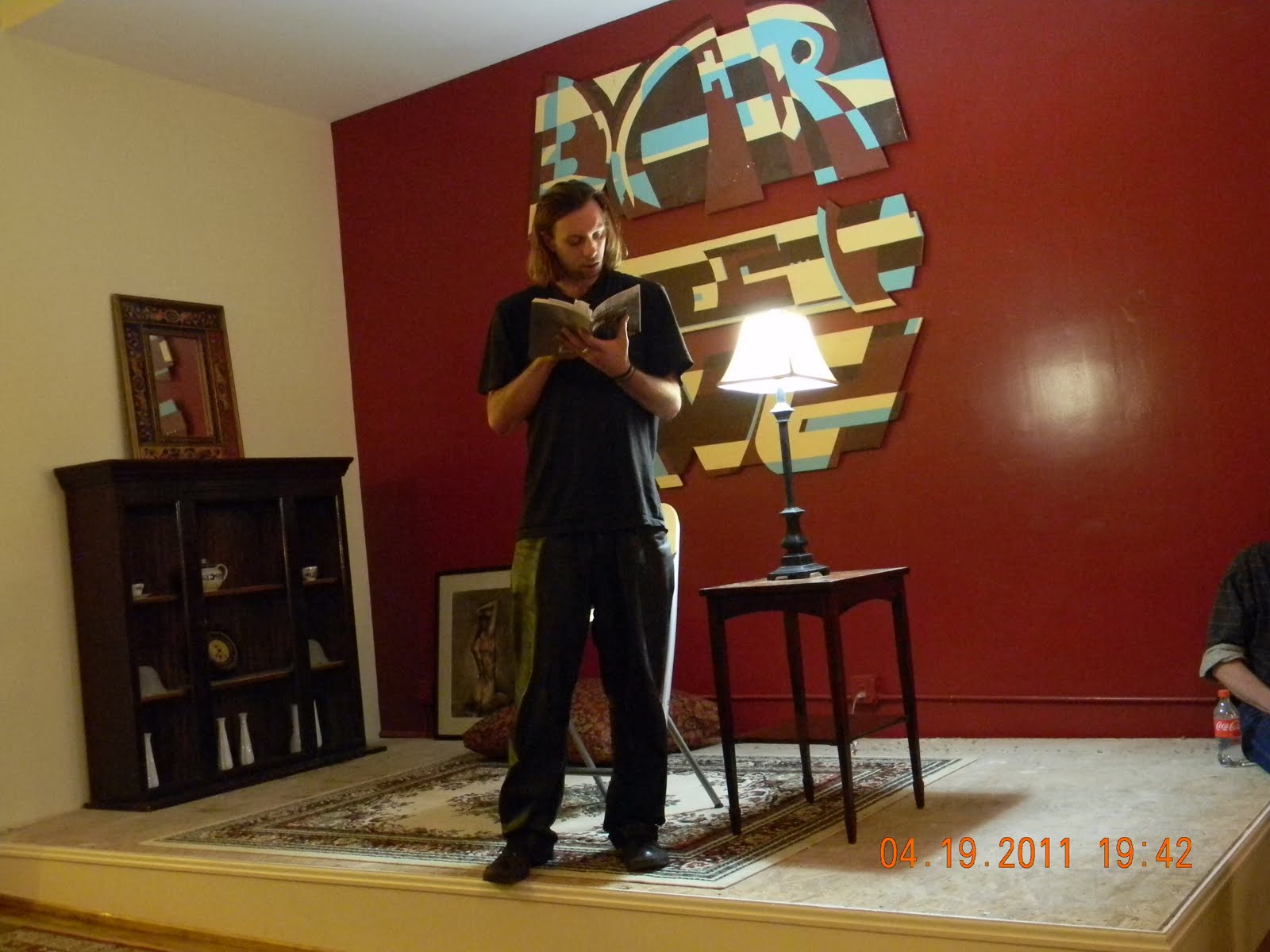
Shea Anthony is a local poet from Fishersville who read from The Forgotten Theatre, one of his two books of poetry. Reminiscent of musicians Jim Morrison, Kurt Cobain, and Trent Reznor, Shea got us all participating in his reading. A great contemporary voice. And, let’s face it, anyone who does a poetry reading in the Valley in black leather pants deserves our attention!
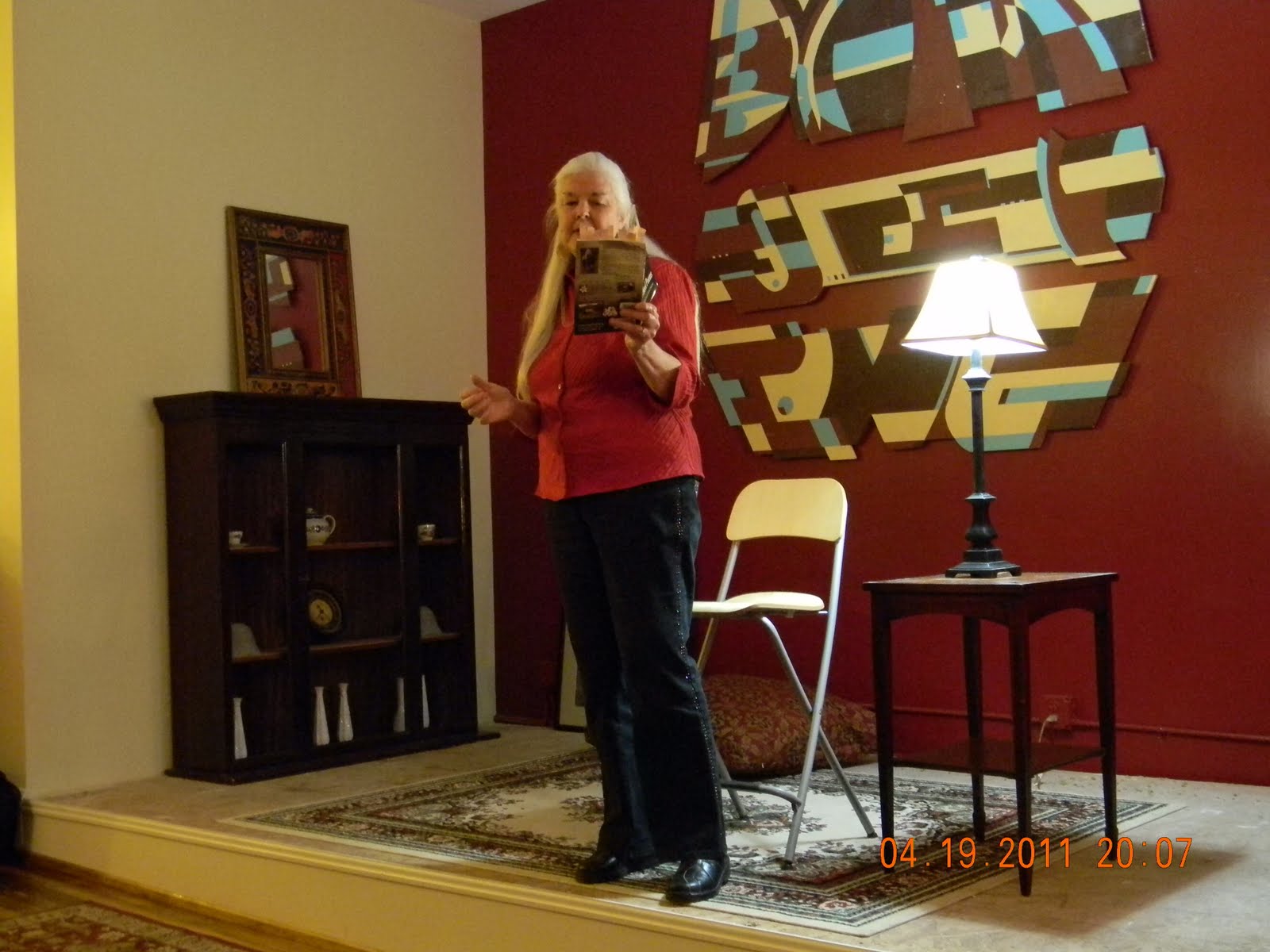
Elizabeth Doyle Solomon often gets inspired while driving the roads of the mountains and the Valley. When that happens, she jots the first few lines on the steering wheel, then finds a place to park to write the rest. Hence, she read from her second book of poetry, entitled, appropriately, The Steering Wheel Poems. Her poems celebrated the wildness of nature around us and lamented how easily we pave over those places of beauty.

Lorraine Rees from Charlottesville read from her second book of poetry, Goodbye Zoo. Her poem about a college ethics professor who hits on all his female students was amusing but full of pathos–and very authentic. She describes herself as the one who “got away.” Great insight.
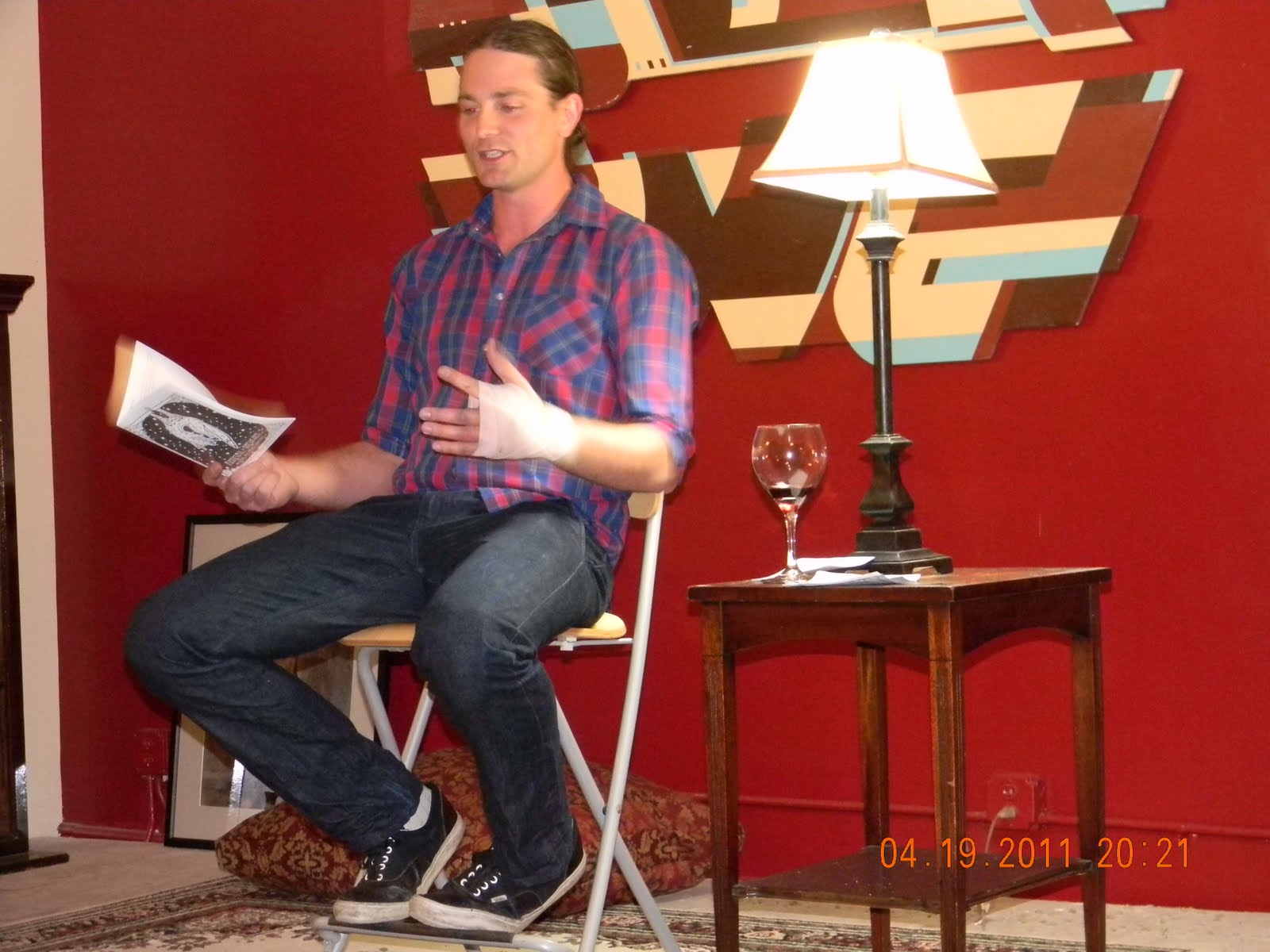
Paul Somers rocked and rolled us with energetic readings from his first book of poetry, Animal Insight, and from several as yet unpublished poems. Later we talked about how he uses humor in his poems to illustrate serious aspects of his life in rural North Carolina. Deeply profane and poignant.

The last, but not least, poet of the evening was Linda Levokove, who read from her first book of poetry, Walk on the Heart Side. Her poems are glimpses, earthy and explicit, into romantic relationships. I related to these most of all because her poems seemed as if they were written expressly for the most important relationship of my life and captured my sense of loss. Overall, though, they so vividly portrayed the wonders of a deep relationship, I could remember all that was good, and I thank her for that.
And let us not forget our hosts for the evening, The Darjeeling Cafe in Staunton, VA, and our master of ceremonies, SWAG Writers founder Cliff Garstang, author of the award winning linked short story collection, In an Uncharted Country.

