New Book Trailer

Secrets, a three-novel, eBook Box Set coming out in June 2024, is working its way through the publication process. Two of the three novels have been to my editor, and I’m incorporating her suggestions and changes now. The third and final book is almost through my beta readers. Once I analyze the beta readers’ comments and incorporate them, that will be on to my editor.

After that is formatting and proofreading, so, we’re on schedule for the June 1 release.

In the meantime, have a look at the book trailer I made using the AI on Lumen5. Where I’ll NEVER use AI to write a novel, I’ll gladly use it to write promotional copy–a different kind of writing I suck at.

Have a look:

SECRETS Book Trailer (c) 2024, Unexpected Paths Media

Also, I’m close to finalizing the Box Set cover, which will be different from the covers for the separate print editions of each novel. With the help of one of my online writer groups, I’ve narrowed it down to four possibles, and you can help select the final cover. Take a look at the covers below, read the description that follows, and send the number of the cover you like in a comment to this post or email your choice to me at paduncan@unexpectedpaths.com.


Book Description

How far would you go to keep a secret?
Three women caught in a web of secrets.
Katherine Maitland-Fisher became a spy to make the world a better place for her only child, Mattie, and the need to come home to that child has kept her alive all these years.
Olga Yevgeniya Lubova only wanted to please her father by being the best possible KGB officer, but things like love, family, friends encumber her. She rid herself of them all until she found her true self.
Grace Sandra Lydell was always a genius—graduated high school at 16, college at 19. She wants her name in lights on Broadway, but she didn’t know she’d find her calling in an organization that officially doesn’t exist.

SECRETS – an eBook box set with three, full length novels.

Coming June 1.


Thank you!

NaNoWriMo Update, A Change in Book Distribution, and Holidays

It’s been a busy November, as it always is with NaNoWriMo. This year, however, I was co-municipal liaison for the Shenandoah Valley Region, with some added responsibilities, like write-ins (online and in-person) and cheerleading. On top of that, I made some changes to how my ebooks are sold, and there’s the whole holiday thing.

NaNoWriMo Update

I passed 50,000 words on November 17 and officially validated my win on November 24. This year’s NaNoWriMo was my first as a co-municipal liaison for my region, Shenandoah Valley. I had a lot of fun, met some great writers online and in person, and  hope to do it again.

My project this year was a bit different from my usual work. It takes place present day, instead of in the past. And a couple of interesting and unplanned things happened–NaNoWriMo just does that.

First, I reached the logical conclusion the existence of my super-secret, fictional intelligence organization, The Directorate, needed to be acknowledged. Without spoilers, I’ll simply quote one of my characters, Alexei Bukharin, “The time for that secret is over.” That freshens things up a bit and adds a new protocol to any further stories about it.

Second, I created a character initially for perhaps two or three scenes. I had no intention of making her a permanent character at all. Remember, your NaNoWriMo project is a rough draft. I’ve removed whole threads of plots and characters in subsequent edits. However, as I was writing what I thought was the character’s final appearance, my other character, Mai Fisher, and I recognized something interesting: This character deserved to have a future.

Enter into my canon, Cybill Fleming. For now, all I know about her is she’s a Directorate operative-in-training and that Mai Fisher spotted something of herself in Cybill. This coming year while I work on publishing two books (Books One and Two of A Perfect Hatred), I’ll be fleshing Cybill Fleming out a lot more. Stay tuned.

As of today, this year’s NaNoWriMo project stands at 70,776. Four days to go and four more planned scenes. I like it when a plan comes together!

Going Wide

No, not talking about a football play or race cars passing each other. Last month I decided to take all ten of my published ebooks out of exclusive Amazon distribution. After seeing the success others had had using a service called Draft2Digital, I decided to give it a try. Coincidentally, two of my ebooks were nearing their automatic KDP Select renewal, so I “unchecked the box” and a few days later uploaded Spy Flash and Who Watches the Watchmen? to D2D. An easy process over all, though formatting was an issue in places. That is, you can’t simply take the Kindle version file and upload it; you have to make certain the formatting imbedded in the file doesn’t glitch. I’m pleased with D2D and its ease of use and may use it for the release of my second novel next April.

Not long after, three more ebooks were due to automatically renew in KDP Select. I unchecked those boxes too. Now, the ebooks of my novellas My Noble Enemy and The Yellow Scarf, as well as my first novel, A War of Deception, have wider distribution.

Some of the places where the ebooks will appear are Kobo, iBooks, Barnes&Noble, SCRIBD, among others. You can also purchase ePub versions of these five books via PayPal right here on my web site. From the home page, look for the tab, “Shop for Books.”

Let me say, I have nothing at all against Amazon’s distribution of my paperbacks and ebooks. KDP Select is optional; however, it is one of those “opt in” processes with an automatic renewal unless you take a physical action to change it.

As with the new directions my NaNoWriMo projects took me with my characters, my other books will be going off in new directions as well.

Change is scary but good.

Happy Holidays

No flames please. December happens to be the month where a lot of religions celebrate winter holidays. Unlike KDP Select, I don’t want to be exclusive, rather inclusive.

I’m not a fan of the winter holidays. Lots of bad childhood memories abound, and the crass commercialism turns me off. The holidays also take a lot of time away from writing, but family is family. I’ll do the shopping, I’ll wrap the gifts, and I’ll take delight in watching my grandchildren unwrap their presents. As six-year-old Emory says, “It’s about giving not getting.” Love her.

What holiday traditions do you fondly remember? What are those you’d just as soon forget?

Author Fest!

A bit more than two weeks from now, and I’ll join other authors local to my area (the Shenandoah Valley) at the Waynesboro Public Library’s author fest. Imagine–a room full of writers–of all genres. You’ve got your cozy mysteries. You’ve got your thrillers. You’ve got your literary fiction, not to mention romance, horror, and sci-fi.

Have a look at who’ll be there:

Waynboro Author Fest

I think it’ll be as much fun for us writers as it will be for you.

Waynesboro Public Library is located at 600 S. Wayne Ave., Waynesboro, Virginia. The Author fest goes from 10 a.m. to 2 p.m. on May 6, 2016, and is free to the public.


52-7 A Book You Love and A Book You Hate

The “love” part of this topic for the 52-Week Writing Challenge I thought would be the easy part. As I considered it though, I have so many books I love and read and re-read constantly. The easy part became the hard part.

The actual easy part was the book I hate. I had to read for novel research, and I loathed it, every scene and character.

The Book I Love

While studying English Literature I became enamored of most 19th Century authors: Shelley, Hardy, Austen, Dickens, the Brontës. One book, however, stands out, and that’s Jane Eyre by Charlotte Brontë.

The story of an orphan much put upon by her extended family, who ultimately send her to a boarding school from this side of hell, and how she rose above her abuse to be a learned and dedicated governess touches me on so many levels. I have a weird family. I was the first female in that family to obtain higher education. I was a teacher who loved the kids but not the office politics. I found my very own bad-boy, Mr. Rochester. In my family’s history there were quite a few crazy women–who weren’t shut up in an attic.

Jane appealed to me because she stood up for herself. She remained skeptical of Mr. Rochester’s affection (and don’t get me started on the sh**ty way he expressed it), and she removed herself from the relationship rather than compromise her morals. She went off and became her own woman before she rediscovered Mr. Rochester.

And, most of all, it had a dark but happy ending. I didn’t get that in my love relationships, but I like reading about them because, hello, hope.

Jane Eyre is a book I’ve probably read a dozen times over the years, those intervals long enough that when I do re-read it, I find something new in it. Not bad for a 170-year-old novel.

Of course, now that I’ve talked about it a little, I have the itch to read it again.

The Book I Hate

I’m not a believer in censorship at all, particularly of hate speech. It’s nasty, it’s uncomfortable, but I prefer having it in the full light of day where everyone can see it for what it is: bigotry of the worst ilk. I’d rather it not be expressed in closed-door rooms or dark basements because if you don’t know about it, you can’t fight it.

A white supremacist named Dr. William Pierce so hated the U.S. government and the Civil Rights Act that he wrote, under the pseudonym Andrew Macdonald, a novel about how a rightwing “heroes” overthrow the U.S. government and set up a new one where Jews, African-Americans, and other “mud peoples” are executed by mobs and hung from lampposts–The Turner Diaries.

The “second revolution” begins with the bombing of FBI headquarters–by a “martyr” in a rental truck who drove up to the front of the building and set off his bomb. (Sound familiar?) The rebels end up having to fight the U.S. armed forces and succeed only in small, commando-like raids. Until the novel’s protagonist, Earl Turner, flies a small plane with a stolen nuke into the Pentagon, leaving behind his diaries to “inspire” his fellow rebels.

Inspire this novel did, unfortunately. In the 1980s, an anti-government, white supremacist group from the northwest who called themselves The Order copied the novel’s exploits in almost every way. No bombs, but bombings were in the planning before one of their group turned informant. The FBI arrested many of them, and they’re in jail to this day for their involvement in the murder of a left-wing Jewish radio DJ named Alan Berg.

The reason I read this ugly tome was in my research for my series based on an act of domestic terrorism, I’d heard that The Turner Diaries was Oklahoma City Bomber Timothy McVeigh’s favorite book and that he may have used it to learn how to make his bomb. Neither was true, though he had read the book, but it added to the monster image of him.

I’m a fast reader. A book the size of The Turner Diaries should have taken me a day or two to finish. It took me weeks. It was too dark, too hateful for me to take except in brief snippets. There is one scene that haunted my dreams for weeks.

I also don’t believe in book burning, but I’d make an exception for this hateful book. It doesn’t reside on any bookshelf in my house. It’s packed away at the bottom of a plastic bin containing all the materials I used for researching my series–buried in the dark where it belongs.

The sad part is, there is likely someone out there, now, in this current political climate for whom The Turner Diaries will be a book to love.

What about you? What books do you love? Which ones do you regret reading?

10 Influential Books – For Me, That Is

Every now and then a challenge pops up on Facebook, and, even though I normally don’t fall for them, some of them do intrigue me. Recently among my book-loving friends, it was the “10 Works of Literature that Inspired Me” challenge. I made it several days before anyone tagged me, and, then, I got tagged by two different people. I didn’t mind this challenge because it made me reflect on the literary works which have inspired me.

Now, I’ll add, just about every book I’ve ever read inspires me either as an everyday, mostly normal person or as a writer (sometimes both), and if I’d kept a running list of the ten most influential, it would have been a fluid one. So the list here is what came into my head today. Challenge me again in a few months, and some of the books might change.

And I noticed people who accepted the challenge listed the ten books but never explained why any of them made their list. That would have been interesting to me–especially in cases where there was duplication with my list or a book, which when I read it made me gag. So, for my list, I’ve included a brief statement about why/how the book influenced me.

Some of you will likely turn up your noses at some of my selections and declare, “This is not literature!” There is, gasp, science fiction on my list and, horrors, popular fiction, too. 

Oh, and since I was always the one who perversely broke every chain letter/e-mail/Facebook post I’ve ever received, I won’t be tagging anyone to post his or her “10 Most Influential…” list, other than to say: Anyone who reads this should do the same, but you have to explain how or why each book influenced you. Ready, set, dare ya!

10 Works of Literature That Inspired Me (in no particular order)

  • Black Beauty by Anna Sewell. This was the first book, other than a comic book or storybooks, ever given me as a child, when I was around six, I believe. I still have it, though my PITA little brother managed to tear the front cover off this hardback. How did it influence me? It sparked my life-long love of books and reading, and writing too, since I did nothing but write stories about horses for years afterward.
  • The Handmaid’s Tale by Margaret Atwood. When I read this book in the 1980’s it validated my feminism, which I only acknowledged privately to people I could trust not to “out” me. It made me less afraid of the “f-word” (feminism; I’ve never been afraid of the other) and made me proud to be a feminist. The fact that it’s even more relevant now is a testament to Atwood’s genius. I want to be her when I grow up to be a writer.
  • Jane Eyre by Charlotte Bronte. This book made me a sucker for happy endings, in fiction and in life. Even in my own writing, which is sometimes dark and bleak, I consciously, or unconsciously, find a way to work a happy resolution in because this book showed me it can happen. On a personal level, I’m still waiting.
  • Little Women by Louisa May Alcott. This book showed me what a happy family living with adversity looked like and that there were, indeed, happy families. That was quite the eye-opener to me given my combative and tumultuous immediate and extended families. Plus, there was the whole woman-writer thing going on there; I felt Jo and I were really the sisters.
  • A Visit From the Goon Squad by Jennifer Egan. This book blew away all my preconceived notions of what a novel/novel-in-stories should be. It enthralled me and pissed me off and made me both question and challenge myself as a writer. To absorb this novel you have to shed your skin of mediocrity and just let it pummel you.
  • Stranger in a Strange Land by Robert Heinlein. Though I thought his later works were just plain creepy and some of his earlier works bordered on fascism, this book was incredible–well-written and timely. This book made me–finally!–question the origins of my own religion and put me on the non-theist path, for which I am forever grateful. Do you grok me?
  • The Still, Small Voice of Trumpets by Lloyd Biggle, Jr. Another sci-fi icon on the list, this was the first, novel-length science fiction book I read. Before it, I picked up sci-fi from comic books, tv shows, and B-movies. I bought the battered paperback at a library sale for a nickel, and when I brought it home my mother swore the depiction of aliens on the cover would give me nightmares. She was wrong; it made me think.
  • The Left Hand of Darkness by Ursula K. LeGuin. Because it blew my freakin’ mind!
  • On Writing by Stephen King. I’m one of those writers who like Stephen King’s writing because I see past the grimness and gore and revel in how he turns a phrase. This was the best instructional book on writing (pun intended) I’ve ever read, and it made me give up -ly adverbs, with reluctance.
  • Divine Secrets of the Ya Ya Sisterhood by Rebecca Wells. Don’t bother to see the movie (though it was decent); read the book. Wells never met my parents, I’m reasonably certain, but she coincidentally explained their complex and enervating relationship in a way I could ultimately forgive them.

Of course, I’ve been thinking as I’ve written this, and I offer this addendum: anything by Octavia Butler, Toni Morrison, Maya Angelou… Oh, hell, just ask me again in a few months, like I said, and the list will be different.

Tag–you’re it.

Defying a Ban

Today’s writing blog post crosses ever so slightly over into political commentary, so if you have qualms about my protesting the fact people want to ban books, you might want to skip this post.

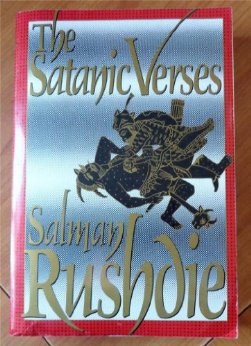
Satanic Verses

Written work has probably been banned since the beginning of written communication. I’m sure some Cro-Magnon shaman who disagreed with the way a hunt was depicted on a cave wall forbad his or her tribe to view it. And, as it’s always been, forbidding someone from seeing something usually results in an overwhelming desire to see the forbidden thing.

Religion and political power always seem to raise their heads in these disputes. You can’t read this book because it goes against the Bible. Only if you’ve read the Old Testament do you appreciate that irony. People who look to the Bible as their moral guide in deciding which books you should and shouldn’t read conveniently overlook the fact that particular book is rife with rape, murder, infanticide, lust, political corruption, and incest among other distasteful things, which go largely unpunished. Governments have banned works–Stalin’s successors didn’t like the way Boris Pasternak portrayed the Soviet system and banned Doctor Zhivago; the Nazis held massive book-burnings designed to expunge the Reich of anything with a Jewish or Communist taint; Salman Rushdie had a fatwa issued against him by Islamic fundamentalists for The Satanic Verses.

Of course, Pasternak received a Nobel (for his poetry) two months after Doctor Zhivago was published outside the Soviet Union. The Nazis met their inevitable end in the spring of 1945. Rushdie, after being guarded in undisclosed locations for years, has a long (a very long) list of awards, including the Booker. All, as well as countless other examples, are testaments to the power of the written word and the fact people don’t like being told what they can and can’t read.

And lest you think this is a thing of the past or only occurs in regressive dictatorships, think again. A county in North Carolina recently banned 1952’s The Invisible Man by Ralph Ellison. Considered one of the best books about racial identity and prejudice, The Invisible Man won the National Book Award in 1953 and has been a mainstay on high school reading lists since. Just not in a particular county in North Carolina, where a school board member said, “I didn’t find any literary value.” (Translation: Our precious white boys and girls do not need to read about the problems with racial identity; it might make them tolerant.) After that county’s decision, sales of The Invisible Man shot up, for which, I’m sure, the Ellison estate is truly grateful.

When we write–at least when I do–we don’t think about whether or not our work will be banned by some religious prig or overbearing politician. Self-censoring is just as bad as government or church censorship. It inhibits our craft. Do my fingers hesitate over the f-word when I’m writing? No, because if I drop the f-bomb, it’s because it’s central to the character using it. We have to write the story that’s in us. Anything we do to alter that means it’s not the right story and that we’re not truly writers.

This last week of September is the American Library Association’s Banned Books Week. Libraries around the country highlight books, which have been banned for various reasons, putting them on display and encouraging people to check them out. Librarians are quite often at the forefront of complaints about books, and it’s the courageous ones who stand up to the book-burners, whether literal or figurative. (Click here for a list of ALA’s most challenged books from 2000 – 2009. Some won’t surprise you; others will shock you.)

If you don’t want your child to read the Harry Potter series or R. L. Stine or Toni Morrison or Ralph Ellison, then don’t buy those books. Tell your child they’re not to be read. (Understand, though, that forbidding something makes it ever so much more desirable.) You’ll end up with an intellectually stunted child who won’t be able to handle the real world, but that’s your choice.

However, don’t tell me I can’t read them or that my child can’t read them. Is that limiting your First Amendment rights? No, because you’re free to opine all you want about what you find objectionable about a particular book, but you can’t force your narrow-minded opinion on others whose minds are open to knowledge.

There is no irony in the fact that the books people seek to ban are the ones which expand our knowledge, which challenge facts we shouldn’t accept on face value. Trust me, I never would have learned about the real facts of life (and not the confused mess my mother told me because she found sex disgusting) had one classmate not circulated a much-thumbed copy of Everything You Ever Wanted to Know About Sex but Were Afraid to Ask. I never would have learned to question authority without Animal Farm or 1984. I never would have understood the horrors of war if not for The Red Badge of Courage or All’s Quiet on the Western Front. I never would have learned about the negative aspects of letting money rule your life if not for The Great Gatsby or Bonfire of the Vanities. I would have followed my family into intolerance had I not read To Kill a Mockingbird or, yes, The Invisible Man. And, I never would have learned about the dangers of banning books if I hadn’t read Fahrenheit 451. Somewhere in America, at some point, all those books I mentioned have been banned, and, thank goodness, those bans didn’t work.

Even now, when I hear some puritanical school board has banned a book, I want to read it. I want to know what they’re afraid of so I can emulate the author. Yes, that’s how I’ll know I’ve “made it” as a writer–when some troglodyte bans a book I’ve written.

Celebrate Banned Books Week–read a banned book in public and piss off a book-burner. You’ll feel better for it.