A Post-Thanksgiving Friday Fictioneers

Is it me, or does Thanksgiving seem early this year? Even so, I’m grateful for many things–family, friends, writing groups (yay, SWAG!), writing, and Friday Fictioneers. Aww, you guys are the best writer buddies a fellow writer can have. Looking forward to another year of Friday Fictioneering!

I’m particularly grateful for having some ability to put words together to tell a story. If I weren’t able to do that, I can’t imagine the toxicity that would fester in my brain. So, when I saw today’s photo prompt, I rubbed my hands together in glee as I immediately come up with today’s story, “Bête Noire.”

If you don’t see the link on the story title above, then scroll to the top of this post and click on the Friday Fictioneers tab then select the story from the drop-down list.

NaNoWriMo Update

The final update for this year’s NaNoWriMo! I finished my draft, of 65,000 words, yesterday evening. Now, it’ll take a nap for a few months, before the hard work begins–revising and editing and editing and revising. I like the concept of the novel, and I like the characters I created, and I look forward to improving both. Thanks, everyone, for all the words of support. See ya next year!

Dueling Manuscripts

Even though I crossed the 50,000-word goal for my NaNoWriMo project for this year, the first draft of the manuscript itself isn’t finished. There are two to three big scenes left to wrap the story up, and I have them mapped out in my head. I figured for the next few days I’d devote the time to fleshing them out completely.

Good plan, right? Just after I started NaNoWriMo this year, a different manuscript–from NaNoWriMo two years ago–finished its journey through my critique group. I got excellent feedback from that experience: no major plot holes but several very good suggestions on how to tie up a couple of threads. I took copious notes because I knew my focus would be on this year’s NaNoWriMo first draft. The plan was to pick the other manuscript up after November 30.

As a countryman of mine once wrote, “The best-laid schemes of mice and men go often awry.”

I woke early this morning with the critique group manuscript in mind. In fact it superseded everything on the calendar today, including a doctor’s appointment where the physician’s assistant kept asking me if I were listening to her. The rewrites I needed to do based on the suggestions were crystal clear, so clear, in fact, that during the time I normally reserve for morning coffee and the newspapers, I immediately wrote them down so I wouldn’t forget. All right, I thought, that should have put the nagging need to fix the 2010 manuscript to rest, because the “best-laid scheme” was still to pick this manuscript up after finishing the 2012 NaNoWriMo first draft.

But no, that wasn’t how it worked. I’ve spent the better part of the day going into the 2010 manuscript and fixing that thread. That meant adding/changing dialogue in eight or nine chapters then doing a quick review to make certain I hadn’t created other loose threads by weaving together the previous one.

Despite not adding to the 2012 word count–that will come later today–I’ve got that goose-bumpy feeling a writer gets when you know you’ve made a breakthrough on a manuscript. Now, this particular manuscript is the closest of any of the ones I have in various stages of completion to being ready to shop around. For that reason, I’m glad it was so insistent that I should drop everything (including the regular Monday morning writing blog and lunch, apparently) to get that fix made.

The truth is the remaining scenes for the 2012 NaNoWriMo wouldn’t turn out the way they needed to because of the distraction. Sometimes, though, distractions are good. If I’d ignored the need to fix that older manuscript, it would have colored my work on the current one. So, I gave into it. Bad writer planning? Bad craft? Maybe to some, but it’s obvious to me it was exactly what both manuscripts needed.

Now, let’s hope that all the other MSS stay quiet for the remaining eleven days in November!

Getting a Friday Fictioneers Charge!

The title of the post will become clear when you see Sean Fallon’s great photo prompt. And the similarity of Sean’s name to a particular name from a rather famous Fenian anthem meant that it was time for those wee folk, Seamus and Declan, to return.

You’ll recall, we last left them at an abandoned croft, where they decided to immigrate to America along with millions of other Irish. Of course, being as Seamus and Declan are magical creatures, time mean nothing to them, and we find them in present day in a story entitled, “The Rising of the Moon.”

If you don’t see the link on the title above, scroll to the top of this post and click on the Friday Fictioneers tab, then select the story from the drop-down menu. To read more Friday Fictioneers stories, click on the icon at the end of “The Rising of the Moon.”

NaNoWriMo Update

Yesterday, I barely made it over the 40,000-word mark, and the story itself is about two-thirds done. I’m glad to have this breathing room, so I can concentrate on wrapping it up just the way I want. Thanks for all the comments and words of encouragement.

Quashing the Inner Editor – For a While

This past Saturday I went to a National Novel Writing Month (NaNoWriMo) write-in in Harrisonburg, VA. Seven of us made it and commandeered a corner of Panera to have some writing fun–word sprints, where you write as many words as possible in a set amount of time, and the “no backspace” game.

The “no-backspace” exercise really suppresses your inner editor, and the exercise consists of writing and not backspacing or deleting anything, not even a typo. The person who can go the longest without backspacing is the winner. In the first go-round, I lasted six words; I made it to about 200 words the second time around, but, oy, what a mess!

The concept of NaNoWriMo is to write without editing yourself in the moment. That comes later. By not editing as you write, NaNoWriMo-ers believe you tap into creativity that pausing to edit disrupts. Writing purists may cringe at such seat of the pants writing, which does sacrifice structure to a certain extent, but I find it particularly liberating.

A few weeks ago at the James River Writers Conference I heard Tim Robbins explain his writing process. The reason years pass between his works is because he literally perfects one sentence at a time and doesn’t go back to revise when the book is done. When he finishes a book, he considers it edited and revised because of this rigid method.

I’m not dissing that sort of structure; in fact, I admire it, and, obviously, it works for him. I’ve always been the type of writer to get what’s in my head down on the page, then I go back and “fix” it–rather a middle ground between a seat-of-the-pantser and the dedicated structuralist.

When I’m not doing NaNoWriMo writing, which, by the way, is eleven months out of twelve, I typically start the next day’s writing with a review and rework of what I wrote the day before. That refines it for me and gives me a basis to begin the next part. It’s true I rarely work from a written outline, but I usually have the structure in my head. I’ve always jotted down notes and ideas for anything I’ve written, but I, personally, find a detailed outline confining. I haven’t adhered to one yet.

The free-wheeling aspect of NaNoWriMo is what appeals to me, to just sit down and write without second guessing a sentence or what a character says or whether this is the direction the story should go. I know I’ll go back and fix that later, and the very act of putting the editing and revising off for a period of time, unleashes my brain.

For example, I had a fairly detailed list of scenes I’d foreseen for this year’s project, but somewhere about a third of the way through getting those scenes fleshed out, a new direction emerged. Frankly, you can’t ignore that. You can’t limit yourself to an outline or a list of scenes and not be flexible. At least I can’t. If the idea pops up that I need to go over here and explore something, I have to go do it. I may end up tossing it out in editing and revising, but I have to write it when it manifests itself.

The NaNoWriMo project from 2009 wound up in an entirely different way than I ever intended. The idea came to me that I should kill off one of the two main characters I’ve written hundreds of thousands of words about, so I did. It was an amazing writing experience to explore the thoughts and feelings of the person left behind (and a great outlet for those same feelings after the break-up of my long-term relationship).

When I got to the revision stage, though, I knew it was wrong. I’ve joked the character tapped me on the shoulder and said, “It’s not my time, yet.” Purists scoff at the idea that characters speak to you or direct a story, but I know what I know. The character was right; I knew I wouldn’t be able to write more stories in the genre I’d chosen if he weren’t around.

That’s not a wasted manuscript though; I’m incorporating large portions of it into another plot. Another NaNoWriMo MS I’ve mined for short stories. Yet another, after editing and revising, just completed a trip through my critique group, and after another set of revisions, will be ready to see if someone is interested in publishing it. I haven’t touched the MS from last year (2011), but that’s on my list for projects in 2013.

This year’s? I’m so pleased about the direction it’s headed and the fact I decided to strengthen my literary fiction skill set, that it will be a 2013 revision project as well, probably toward the end of the year to get time and space between the writing and the revising.

NaNoWriMo is neither futile nor frivolous. It is, however, what you make of it. If you treat it as a creative way to develop a first draft, it can be very fulfilling. And great fun.

NaNoWriMo Update

This weekend, eleven days into the adventure, I hit the 30,000-word threshold. At the NaNoWriMo average of 1,667 words per day, by day eleven 18,337 words would have put me on track to finish with 50,000 on day thirty. Well, I’ve always been an overachiever.

The point is, without that artificial stimulus, that “imposed” deadline, I would never have written an average of 2,700 words a day. That’s worth it to me.
 

Thanks, Mom

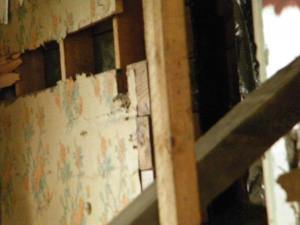
The project I’m working on for this year’s NaNoWriMo is based on a Friday Fictioneers, 100-word story from several months ago. This was the photo prompt:

And here is the story:

Amontillado

“That wallpaper’s stuck to the wood,” the contractor said. “If you want it gone, you’re gonna have to take the wood down then drywall.”

We’d hoped to save the old walls. They lent such a rustic feel to the place, but the ancient wallpaper wouldn’t budge. Drywall wouldn’t be the same, but what can you do?

To save money we did the demolition ourselves. With pry-bars we had fun, imagining we ripped away annoying people.

It was all great fun until the last corner, when the boards came away and we saw the tiny bones wrapped in a baby blanket.

I had a lot of positive comments on the piece (and, yes, someone did mention I used the word “fun” twice within a couple of lines), and several people suggested I expand it into a longer story or even a novel. I appreciated the confidence in me, but I put it out of mind until I was on a train trip to New York. The story kept coming back to me, and I started jotting notes. It wasn’t long before I had four pages of them, some snippets of dialogue, and a concept for what was obviously a novel.

However, I had a couple of writing/editing/revising projects I was deep into and didn’t want to start anything new back in the spring, but I kept the notes close by, added to them over the months, did a little research (part of the story takes place during World War II), and decided this was perfect for NaNoWriMo. So, I’m off and running–just over 12,000 words in four days.

As an historian, I love researching other times, but this project has another significance for me. Many who know me well know my relationship with my mother was problematic at best, traumatic at worst. She was a teenager to young adult during World War II, worked in a uniform factory, and wrote to a lot of soldiers whose convoys passed through her home town. She would talk about the homefront of World War II as if it were her personal playground, and she often referred to it as the best time of her life. (Yep, Mom wasn’t particularly thoughtful of others; it was always about her.) Her stories, though, have given me a lot of background detail that I can include in this project. So, in a big way she can contribute to my writing other than as a model for a nutcase character.

It’s probably good that she’s gone, though, because she’d be pissed as hell to recognize any of her life stories in anything I wrote. You see, no one was allowed to talk about her except her, but thanks anyway, Mom.

And something a little off-topic here: Tomorrow is Election Day, and it is the civic duty of every eligible voter to vote. Find a way to do it. It’s important to our democracy.

Countdown to NaNoWriMo

National Novel Writing Month begins in just under nine hours where I live, but it’s already kicked off in other parts of the world. For those who don’t know, National Novel Writing Month–or NaNoWriMo–is a pure fun project where you write a 50,000-word novel draft in thirty days. You “win” by reaching at least 50,000 words on or before 2359 on November 30. You can download web badges, get pep talks by video, enjoy local write-ins, and generally have a good time writing.

The Office of Letters and Light is the non-profit that sponsors NaNoWriMo to highlight the art and craft of writing and to raise money for school programs to encourage kids to write.

An excuse to write and donating to a great cause, and NaNoWriMo lives up to its tag line: “Thirty Days and Nights of Literary Abandon!”

Many writers have turned their NaNoWriMo novels into published work–after editing and revising, of course. Some, unfortunately, have self-published their work immediately after writing and omitting the key steps of editing and revising, but that shouldn’t detract from the fact it’s very liberating to sit down and just write for writing’s sake for thirty days, knowing revising and editing can wait for a calmer time.

I almost didn’t participate this year because I’m prepping two other manuscripts–one for a contest and one to publish in December–but I managed to get both MSS ready ahead of schedule, despite having a cold.

So, I’ll have leftover Hallowe’en candy for snacks, plenty of coffee, a fully charged laptop, and an idea I came up with back in the spring that I can now flesh out. I’ll crank Sat Radio or my iPod up to full volume and put a “Do Not Disturb” sign on the door.

And I’ll write, and it’ll be fun, until the end of the day and the word counter hasn’t hit 1,667. (To get to 50,000 words in 30 days, you have to write at least 1,667 words per day.) Plus, I’ll be an election officer on November 6, so no writing that day, unless it’s all over quickly and the poll numbers add up.

If you’ve never NaNoWriMo’ed before, give it a try. It’s never too late to subject yourself to such exquisite torture.


Spy Flash – Week 28

I said you might get another Spy Flash story rather quickly, and never let it be said I’m not a writer of her word. (I think that might be a pun.)

Week 28’s story, “Delicate Sensibilities,” is somewhat of a sequel to “Hero Worship,” posted yesterday. “Delicate Sensibilities” takes place about a year after the events in “Hero Worship,” again in the late 1980’s.

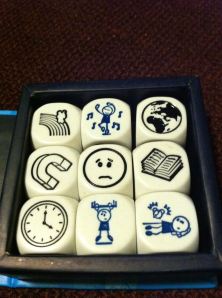
Here’s the roll of the cubes:

l. to r. – a rainbow; dancing; earth/world/globe; a magnet; sadness/dismay; a book; a clock/4 o’clock; hanging on/doing chin-ups; waking to an alarm

As usual, if you don’t see the link on the title, “Delicate Sensibilities,” above, click on the Spy Flash 2 tab at the top of the page and select it from the drop-down menu. If you want to give the Rory’s Story Cube Challenge a try, write a story of any length based on the items and actions pictured above, then put a link to your story in a comment below or at Jennie Coughlin’s blog.

James River Writers Conference 2012

As with anything that’s successful and grows, change can be upsetting to some. James River Writers had held its annual writers conference at the Library of Virginia for several years. As a first-time attendee at last year’s conference, I saw it was obvious the conference had outgrown the Library, wonderful venue that it is. Last minute room switching because some presentations were more popular than others meant clogged hallways and confusion.

The Greater Richmond Convention Center hosted this year’s James River Writers Conference (the tenth!), and I was pleased. Light, roomy, airy, the space almost made the conference seem small, but the meeting rooms were larger, as was the exhibit space. The conference fee this year included lunch for both days of the conference, which was very convenient, and the food wasn’t too bad either. Also, the conference was part of the Virginia Literary Festival this year, and it’s a good fit.

Still, there were plenty of people who lamented not being at the Library of Virginia, but some people just can’t handle change. I, for one, am pleased to see the success of James River Writers’ annual conference. It has the potential to be a showcase event for the Commonwealth–and heaven knows we need to emphasize our contributions to the arts since we’re stuck back in the 19th century in so many other areas.

I attended a total of six workshops over the two days, all good, but one in particular stood out: Writing Diversity. I almost didn’t go to this one, and am I glad I changed at the last minute. I had slated myself to go to “Publishing Industry Issues Demystified,” but when I arrived at the conference on Sunday morning, I realized this would probably be repetition of several articles/blogs I’ve already read on the publishing industry. “Your Day Job and Your Book,” wherein you learn how to apply project management concepts to writing, seemed too much like my old job, and “How to Survive a Plot Collapse” just didn’t sound appealing. So, “Writing Diversity” it was.

The description didn’t do this workshop justice: “Panelists discuss the importance of diversity in fiction and nonfiction, issues of cultural appropriation, and ways they write people of many ages, ethnicities, classes, and more.” It was a powerful discussion of why literature should reflect the make-up of society and a challenge to writers to write outside the boundaries we find so comforting.

The panelists were Jonathan Coleman, Camisha L. Jones, Malinda Lo, and Lila Quintero Weaver. They are, respectively, an older white guy, an African-American poet, an Asian who proudly describes herself as “queer,” and a Latina, who lived the life of a South American immigrant in rural Alabama. That’s probably the most diverse panel I’ve encountered in two years of attending writers conferences.

The panelists told us that by sticking to characters who reflect us (in my case, a middle-aged white woman), we limit our focus as writers, and in that aspect we limit our voice. There was understanding of the reluctance to write a character who’s gay but you’re straight, who’s ethnic but you’re not, but, as Malinda Lo said, you can overcome that by “doing your research.” Lo emphasized that the overall civil rights struggle is ongoing, especially for gay, lesbian, bisexual, or transgender people. “There is a need,” she said, “for stories where it’s okay to be gay, stories that normalize what we now consider the ‘other.'”

Most of the panel directed their remarks to writers of young adult or middle-grade fiction with an emphasis on showing those age groups strong characters who are like them. Jones said by doing this, writers “help people see one another’s humanity” through their stories.

A question from the audience encompassed what many of us were thinking: If you write about a character you’re not, will you be taken seriously? Coleman replied, “If your writing is good, if it’s your best work, you’ll be taken seriously. Just don’t over think it, and take a risk.”

Jones added, “Just because you’re white doesn’t mean you can’t write about diversity. I would like to see stories by white people about the pressure on them to conform to racism. That’s an important story to tell.”

Weaver said, “When you don’t see yourself reflected in literature, it’s not interesting to you. You have to have characters who look like all your potential readers.”

The final question engendered a passionate response from Lo. A writer indicated that she deliberately wrote characters for her middle-grade books so their gender and ethnicity were “ambiguous” and asked if that weren’t the better way, so any child could see themselves in the story.

“Say what a character’s race is,” Lo said, “because ambiguity reads as white. A character should not be a blank person.”

I could have gone to a day-long workshop on this subject with these panelists, and this was one panel whose challenge I’ve accepted. This panel and these writers, more than anything, made this conference a complete success for me.

Spy Flash – Week 26

When I accepted Jennie Coughlin’s Rory’s Story Cube Challenge six months ago, I really didn’t think I’d still be at it now, but it took on a life of its own.

As I indicated when I started on this adventure, I looked upon it as an opportunity to flesh out back story on two characters I thought I knew pretty well. Suffice it to say, I learned a few things about them, and, despite what some may think, they talked to me and explained many things about their personalities. I never thought I’d turn these vignettes into a book, but when the thought of that struck me, it made the challenge much more exciting.

For example, who knew I’d need to come up with something other than the obvious to deal with the recurring pyramid cube? But it’s all in how you perceive the meaning of the cubes, and sometimes it isn’t as cut and dried as you think.

So, if you’re still reading along, you need to read the story for Week 26 soon because within the next week to ten days, I’m taking down all the existing Spy Flash stories and, well, you’ll have to buy the book. Please? I’m not stopping taking on the challenge, and, who knows, maybe in six more months, there’ll be a Spy Flash 2 collection?

This week’s story, “Cleopatra’s Barge,” features a character from a trilogy I wrote and am editing (A Perfect Hatred) about an act of domestic terrorism based on the Oklahoma City bombing. The character, John Thomas Carroll, is the bomber, in prison and awaiting his execution. One thing we know about the character Mai Fisher is that she keeps her word, and she’s made a promise to the bomber, whom she tried to turn, which she intends to keep. That doesn’t set well with Alexei Bukharin, who is the other significant character in this week’s story, though he’s never named. In the trilogy Carroll never knows Alexei’s name, so I didn’t change that.

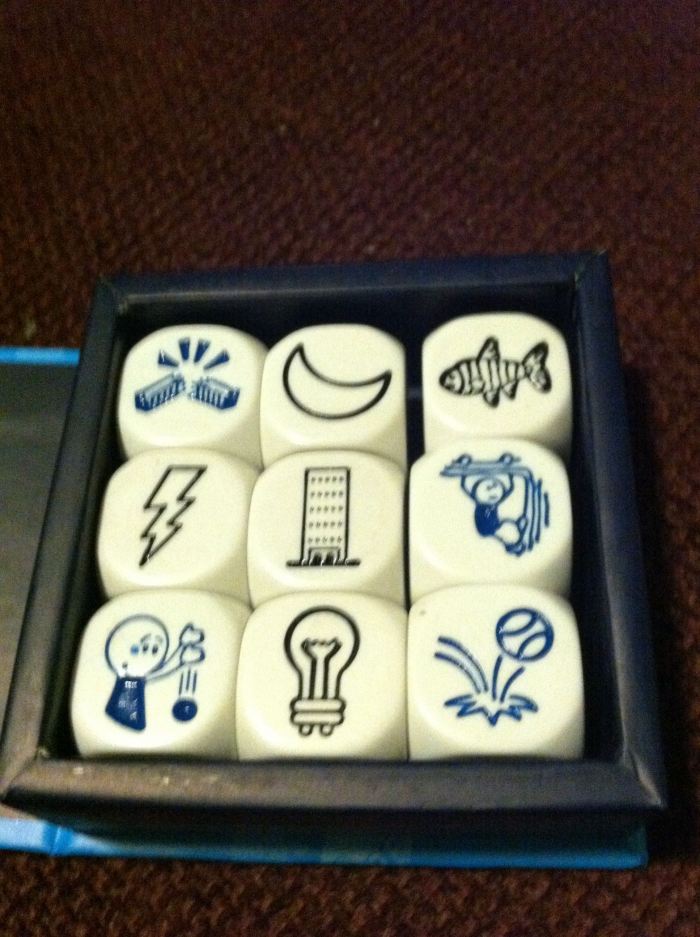
Here’s this week’s roll of the cubes:

And here’s what I saw: l. to r. – breaking; a moon; a fish; a lightning bolt; a building; up in a tree/climbing a tree; dropping the ball; a light bulb; a bouncing ball/playing baseball.

If you don’t see the link on the story title above, then go to the top of this post and click on the Spy Flash tab then select “Cleopatra’s Barge” from the drop-down menu.

Look for Spy Flash in December as a paperback or an eBook on Amazon.com.

Spy Flash – Week 25

Within the next week, I’ll have accumulated half a year of stories in response to Jennie Coughlin’s Rory’s Story Cube Challenge. (I got behind and combed two weeks into one story, which is why there will be twenty-five stories instead of twenty-six.) About three months into the Challenge, I decided I’d amass the stories into a collection and publish the collection via Kindle Direct Publishing. Short story collections are notoriously hard to be picked up by publishers, and add in the fact that these short stories are flash fiction and mostly fall in the “thriller” genre, and Kindle Direct was the only logical answer.

But Kindle Direct has helped in a revival of short stories for both traditionally published writers and self-published ones. Kindle Singles started out as essays, but many publishers, and authors, saw it was an easy to get a short story published. Many traditionally published authors come under pressure from their publishers to keep their name before the reading public between books, and Kindle Singles fit that bill as well.

But I digress. Once I started putting together the manuscript, I saw it had a certain incoherence if I left the stories in the order in which they appeared in this blog. I spent some time deciding when each occurred. For a few that was obvious because the story wouldn’t have context without the date. One story’s title is a date, after all. Once I assembled the stories in more or less chronological order, they had a certain flow. Good decision, that.

The novel in stories is quite popular lately. From Jennifer Egan (A Visit from the Goon Squad) to Molly Ringwald (When It Happens to You), novels in stories have made a mark. Writer friend Cliff Garstang’s new book, What the Zhang Boys Know, is another example of a novel in stories. Basically, each story can stand alone, and, in fact, most of Garstang’s twelve stories in this book were published separately in literary journals before the novel came out. For the work to be considered a novel in stories, each of them has to be a piece of a larger or overarching story arc.

Can you have a novel in flash fiction stories? We’ll see.

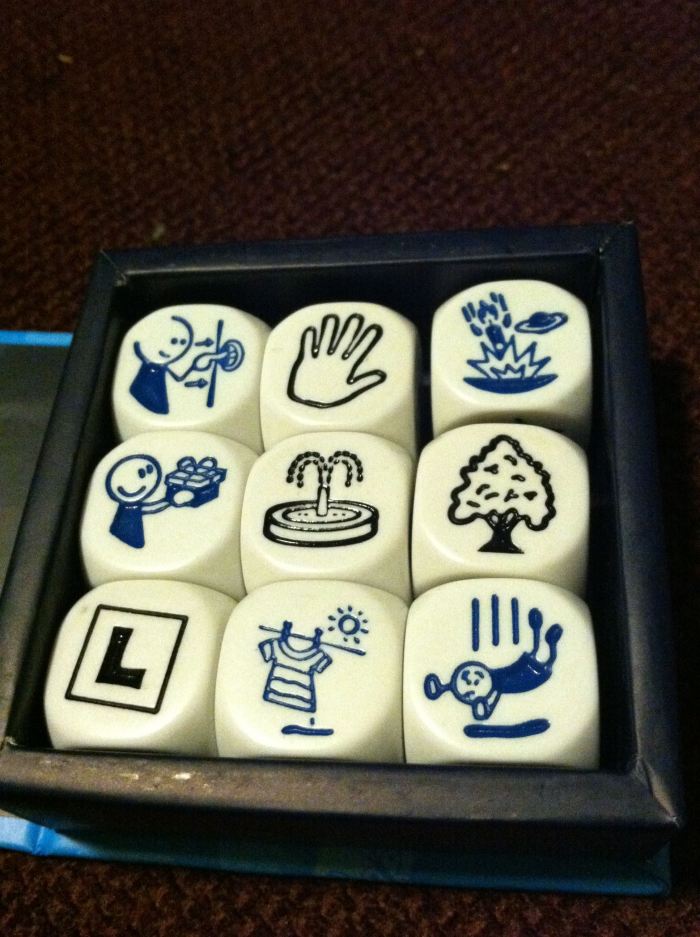
This is last week’s roll of the cubes: 

This is what I saw: l. to r. – ringing a doorbell; a hand; a UFO attacking (this one was tough); gifting/giving a present; a water fountain; a tree; the letter L; clothes drying/clothes hanging on a line; falling.

As a lot of my fiction does, the story, “Closure,” involves a recent historical event, which becomes obvious early if you remember your recent history.

As usual, if you can’t see the link on the title “Closure” above, go to the top of this post and click on the Spy Flash tab then select the story from the drop-down menu.