Set That First Draft Aside

I’ve been doing a lot of reading of indie published books lately (or, if you’re a stickler for terminology, self-published books, but terminology adapts, by the way). I have a list of eight of them I’m going to review, and, unfortunately, it’s been a mixed bag of quality. Oh, the stories have been decent; getting to the story through the morass of bad grammar and punctuation has been the hard part. Part of the problem is I’ve been both an English teacher and a magazine editor. What, to some apparently, may be unimportant details, to me are essentials of language. If those fine details–commas, word usage, grammar–aren’t present, I get distracted–and frustrated–by what I consider elementary school-level errors.

It’s too easy to attribute this to lack of education, but the authors involved–on their blogs or on social media–seem to have had a decent education. Then, it hit me, as I was helping a friend with a manuscript, these works read as if the authors had published their first drafts.

That’s the seduction of indie publishing. It is very empowering, on one level, to eliminate all those filters (agents, editors) who don’t get your fiction, who don’t see you as a money-maker, who have to take a cut of your royalties, etc. I believe publishing is evolving, but for indie publishing to get any sort of professional acknowledgement from traditionally published authors, you can’t publish your first draft.

First drafts, of course, are necessary. First drafts are the place where you finally get on the page that story that’s been rattling around in your head for a long time. It is an accomplishment in and of itself to do that–one of the reasons I like National Novel Writing Month. I can come up with something completely new at least once a year. Have I published any of the manuscripts I wrote the past four Novembers? No. They’re first drafts of what will be good works later. After proofreading and editing. When I finish a NaNoWriMo project, I set that draft aside for a good six months or more before I pick it up again. In the meantime, it’s never far from my thoughts, but I’d never, ever see the holes in the plot or the un-obvious typos if I started the edit immediately after finishing the first draft.

Whether you’re pursuing traditional publishing or indie publishing, the process is to set the first draft aside for the amount of time it takes to make it fresh when you look at it again. When you publish your first draft and start seeing those five stars on Amazon (which your mother and all her friends have put there) and read the comments like, “We need more of [insert character name here]!” resist the temptation to write a sequel in a weekend and publish it raw.

Cultivate a friendship with a local high school English teacher or newspaper editor or even a friend from school you know got good grades in English. Let them proofread your work for the typos, punctuation problems, grammar, etc. You can accomplish some of this yourself by reading your work out loud–at home, preferably, unless you like people at Starbucks staring at you and wondering if they should call the cops. (In reading this post aloud, to this point I’ve found a half dozen typos, now fixed.) But nothing beats a “fresh” set of eyes.

Then–and this has been something hard for a lot of indie authors to accept–hire a developmental editor. Yes, you get a higher percentage of royalties if you self-publish without all that traditional publishing detritus, but you’ll get better reviews and more sales if a reader/reviewer can’t tell the difference between your book and a traditionally published one. That takes work. That takes commitment not just to telling a good story but presenting a good story.

I have an indie writer friend who consistently produces a good first draft–in the sense of proper punctuation, grammar, and usage–and the story is decent as well. Recently, she sent a copy of her first draft of a new novel to her editor, and now she’s in the midst of a total rewrite. You may say, “See, that’s what’s wrong with editors, and that’s why I don’t want one.” However, this writer understands the editor’s purpose–to make it better–and she’s excited about the major revision because she knows she’ll have something beyond a good, first draft. She’ll have an outstanding novel.

So, set that first draft aside for a while. Resist the temptation to publish it until it’s polished. Get a tougher skin when your proofreader/editor suggests changes (being part of a critique group helps with this). Don’t be suckered in by seeing your words in print until what you’re trying to say is in its best shape.

Be a writer, not a hack.

————
I set out my writerly resolutions for the new year in a recent post: http://mymusings-maggie.blogspot.com/2011/12/resolved-to-write.html. So, periodically, I’ll provide an update because I know you’re just dying to know.

Writer Work Schedule Update:

  • Sunday: Started reading one book to review (which inspired this post) and finished another
  • Monday morning: Blogged on writing (see above)
  • To do Monday afternoon: Edit/Revise a review of Linkage: The Narrows of Time Series (Volume 1) by Jay J. Falconer and get it ready for submission to eFiction Magazine

Whither to Write?

In the tiny townhouse in Northern Virginia where I lived before I retired, for years I was tethered to a single place to write–an upstairs “bedroom,” which I declared my office, with a chunky, Dell desktop. I think prisoners in SuperMax have a bigger cell than that 10′ x 10′ space, but, boy, was I productive there. With my stereo blasting whatever music I was into at the time, I wrote a trilogy and the somewhat fleshed-out skeletons of three more novels.

When I purchased a laptop, I became rather bohemian–at least what passed for that in the Yuppie Capital of the Free World–and could write in book-store cafes (loved Olssen’s in Old Town) and coffee shops, not to mention any room in the house, on the road for work, on vacation, etc. Re the latter: It helps to have a supportive partner, and I did. He got that I needed space to write and didn’t begrudge it.

I’m happy to say I can write almost anywhere, whether using a laptop, a Moleskine reporter’s notepad, or a spiral notebook. Sometimes a notebook is good, especially when you’re people-watching to get ideas for characters. You could be writing a grocery list and no one knows you’re jotting down what’s being said or how someone acts.

There comes a time, though, in any writer’s life where you need to focus on a particular writing project to the exclusion of all else. When that time comes for me, it can’t be in a coffee shop or working in the gift shop at the R. R. Smith Center in Staunton. I have to be in seclusion. On the Myers-Briggs scale, I’m a very high (as in off-the-scale) E, meaning I’m energized most and best by external stimulus. When I need to focus on a writing project, the latent I, meaning I prefer to do a Greta Garbo, emerges.

I’m lucky in the house I bought after retirement to have a primary and a secondary writing area, which I use alternately depending on how strong the “I” becomes.

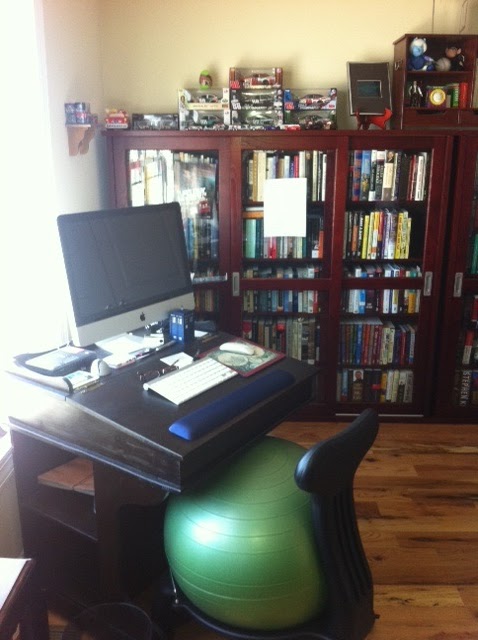
The primary area is my home office, which you can see here (above):

It has a lot of advantages–actually, it has the most advantages. You see my bookcase of reference books (U.S. history, world history, writing), which are at hand. (And, yes, you see the odd juxtapositions in my life: my NASCAR collection next to my Star Trek collectibles.) It has my really powerful iMac and my comfy ergonomic chair. Just to the left, out of the picture, is my satellite radio, which can bring me a constant stream of inspirational music. That, too, can be an interesting and eclectic mix–from heavy metal (Rob Zombie and Nine Inch Nails) to Celtic (Irish Rovers and Tommy Makem) to opera.

As many advantages as this wonderful room has, it has a major distraction–this amazing view of the Blue Ridge Mountains (below). And, yes, I took the shot through the window for verisimilitude. I can be in the middle of something and glance out the window and get completely lost in the wonderful place where I chose to live.

Curtains, you suggest? Uh, why would I cover that up? The tiny office in the old townhouse looked out onto the parking area in the cul-de-sac, so that was rarely a distraction. The view above can figuratively or literally pull me out of my chair to go outside.

Which can be good for clearing the cobwebs with a nice walk, but it happens too often.

On many occasions, then, I retire to my secondary writing area, well away from any commanding views.

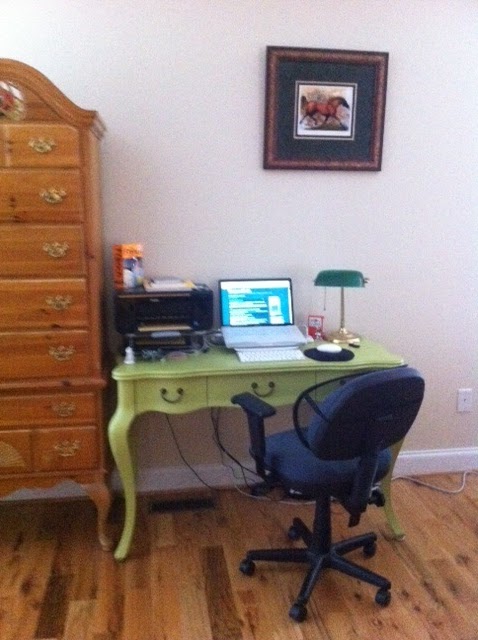
This area (above) is a nook in my bedroom, where I can’t be distracted by the outdoors. The view is the wall, or the nice artwork above, but that’s hardly as alluring as the Blue Ridge Mountains. There is a television in that room, but my back is to it, and it has a decent selection of music channels. I have to have some background noise–always have, much to the consternation of parents who couldn’t understand that homework could be done while singing along with the Beatles.

The disadvantage of this writing area is that if I need something from one of the reference books, that means a trek across the house (oh, horrors) to obtain it. Of course, there’s always The Google. (What toys were popular among pre-teens in 1989? Why, I’ll Google it.)

Wow, what a dilemma, you say, voice torqued by sarcasm. I know. But the secondary writing area, where I am, as I write this, is the least distracting. I often end up here, like a troglodyte in a dim cave, but the productivity is welcome.

Keeping track of versions of the same work on two computers? That’s a whole, other issue.

In the meantime, find your writing place, the one where you’re most productive, where the words come unbidden, and live there.

(Note: I used my two favorite words ever in this post. Can you find them?)

Resolved–to Write

When I retired two-plus years ago, my main goal was to write full time—to produce more short stories, polish the novels I have in various stages of completion, blog more—and to get published. The good news is I can say, with accuracy, that all of that has happened. Just not with the consistency and frequency I expected. And that’s my fault.

I’m most happy when I’m writing, when I go into the world I’ve created in my novels, when I carve out little bits of reality (or fantasy) in a short story. I just don’t do that often enough. I have made a conscious effort to consider and call myself a writer, to get validation from my local writers group and critique group, and to be inspired by the circle of writer friends I’ve cultivated. Again, I can say that, too, has happened.

The problem is, I don’t write enough. I don’t focus myself as well as I should, mainly because I wanted a complete separation from the world of work. Writing is work, and it should be; otherwise, I’d just write cute little stories for my friends and family to read in the annual holiday letter.

A writer friend of mine, Cliff Garstang, has hit the mark for me with a recent blog post. Cliff periodically posts “Tips for Writers,” and his December 9, 2011, post, “Finding the Time to Write,” made me sit up and take notice of how I approach my writing. It wasn’t a pleasant sight.

About the only advice from that post I can’t take is “Get up earlier.” The “Work later” part is easy—I am often most inspired when the day is done. Why can’t I get up earlier? Too many years of rising at oh-dark-hundred for a variety of reasons, but I can work back into it. Gradually. Cliff makes the time to write, and his writing work ethic is inspiring—he shuts away all external distractions and just creates. Though Cliff often goes to writing retreats (something I need to try), he works to re-create that atmosphere at home, which he describes in his December 7, 2011, post, “Bring the Retreat Home.”

Another writer friend of mine, Jennie Coughlin, is in a writing frenzy right now, working on a series of novels about her fictional New England town, Exeter, and its denizens. (Take a look at her blog Welcome to Exeter and marvel at this ambitious schedule she’s set for herself.) She works a full-time job and a part-time job and gives up what free time she has to writing, including publishing the occasional short story as well as character sketches on her blog. Her word output is amazing, and she’s considering a challenge to write a half a million words next year. I’m sure she’ll make it.

You can see I have a lot to live up to. And the pressure on me is mine. I need to do what I said I was going to do when I retired. As Stephen King once said, writing is my job, and I need to stop being a part-timer.

So, I’ve done the dreaded thing, and set up a [shudder] work schedule for writing starting January 1, 2012. It’s a modest start to organizing my free time around what I’ve said is my profession. Right now, it needs to be flexible so I don’t rebel and to accommodate spending time with family and friends and my exercise regimen. It could be a colossal failure—wouldn’t be my first—but it could get me back on track.

Here we go:

Monday            0800 – 1000: Blog about writing or publish a book review on my blog

1400 – 1700: Edit/revise a novel WIP

Tuesday            0800 – 1100: Edit/revise a short story WIP or identify a publication to submit to

1400 – 1700: Edit/revise a novel WIP

Wednesday       0900 – 1100: Blog about politics

1400 – 1700: Edit/revise a novel WIP

Thursday           0800 – 1100: Edit/revise a short story WIP or identify a publication to submit to

1400 – 1700: Something new—a short story or a novel idea

Friday                 0800 – 1000: Blog about writing, publish a book review on my blog, and/or 100-word

flash fiction

1300 – 1500: Submissions—the actual act of doing so—or developing a query letter

Saturday and Sunday: Two to three hours of reading and/or writing reviews

Your job, dear readers, is to point out that I’m not doing what I said I would do. Just think of the possibilities—getting to tell me to get my ass moving. 😉

Interview with an Indie Author – Jennie Coughlin

To coincide with my review of Thrown Out: Stories from Exeter by Indie author Jennie Coughlin, which appears in the December 2011 issue of eFiction Magazine, I interviewed Ms. Coughlin about her works, in print and in progress. To get a better understanding of the interview you might want to read the review. Better yet, buy the book. (Thrown Out is available to download at amazon.com and Smashwords and as a paperback, also from Amazon.)

DuncanIn a way you haven’t used in other interviews, tell me how the concept of Thrown Out came about.
CoughlinThrown Out started as some writing exercises to dig more deeply into the characters and help my editor get a better sense of them. I was posting the exercises on my blog, and, based on the feedback, we decided to go ahead with the collection while I was working on the novels. Once I had “Bones” and “Thrown Out,” the first two stories in the collection, we decided to take another look at the character Joe and his family, which led to “End Run.” Since at this point, the collection had themed itself as an introduction to the characters, Becca and Riordan were the logical choice for the final story. Although at least one of them had appeared in each of the other three stories, neither really was the focus of any of them. Thus, “Intricate Dance” was born.
DuncanThe title story, “Thrown Out,” touches on a timely issue, gay rights, one of which is to be able to live your life without fear. I confess when I saw the title, I was certain the ending wouldn’t be a happy one, but I was glad to be wrong. The fictional town of Exeter seems remarkably progressive in this area. Was that a conscious decision, or did Exeter “reveal” its nature to you in the writing?
CoughlinInteresting take on it, and I think there are a couple of pieces to that answer. First, the title story “Thrown Out” is set in 2001, after Vermont had approved civil unions and shortly after the court case was filed that would lead to gay marriage in Massachusetts. So in that time and that place, it’s certainly a more open climate than in many other states then or now. But really, a theme that came out as I was writing “Thrown Out” was that we accept things in people we know that we might not in people we don’t know.
That cuts both ways — the Exeter residents know Dan as a friend, a neighbor, the star running back on the high school football team, the guy who fixed their front steps, Kevin and Eileen’s son. He happens to be gay. Likewise, Joe is the local insurance agent, the kid who rang up their bread and milk at his dad’s store, somebody active on the Parish Council, a member of the Rotary Club, dad to their kids’ friends. He happens to be homophobic. You can’t exclude either one of them without big ripple effects. And if you already know somebody, already have them in your life, you’re likely to be more accepting of something than if you’ve just met the person. In “Thrown Out,” Dan’s partner Chris has a much different reaction to Joe than Dan, Evan, and Liz, who grew up with him. Likewise, Chris gets a measure of acceptance from the town just because he’s with Dan.
DuncanAs an Irish-American, I can “see” your characters so vividly. I suspect some people without the cultural background might not “get it.” Do you agree or disagree? Why?
Coughlin: Well, I’ve heard the same thing from readers who aren’t Irish-American, so I’m going to generally disagree. I suspect some things might not resonate as much, but that’s also true of the Catholic elements and the New England elements. The character Chris, who’s not from Exeter, serves as the bridge for readers who aren’t familiar with some regional terms, such as jimmies (chocolate sprinkles on ice cream), but there probably are pieces that are less accessible or read differently to people who don’t have some element of those backgrounds.
DuncanYou also touch on a taboo subject among Irish-Americans—the Irish Mob. Why was that important to you? I mean, Irish-Americans will talk easily about the IRA but not the Irish Mob.
Coughlin: I grew up in a town that was heavily settled by Italians, and I’ve heard stories all my life about Mafia ties in the town. The first newspaper where I worked even had a two-inch-thick file on the former police chief, later a Town Council member, who was jailed for perjury when he alibied a mobster back in the 1960s. The Irish mob was further afield, but Whitey Bulger fled when I was in high school, and periodically I’d get stories from home of FBI agents going around questioning people trying to find him. The story that touches on the Irish Mob, “Bones,” I drafted the week after the FBI caught Whitey in Santa Monica earlier this year, so that’s probably why my plot bunnies headed that direction.
DuncanYou went the Indie route for publication, but you used some traditional publishing aspects, e.g., an editor whose input you considered and incorporated. Do you think Indie publishing is at the point where it needs standards? Or would that miss the point of Indie publishing?
Coughlin: I’ve been pretty outspoken about the need for Indie authors to make sure their work is up to traditional publishing standards. I think the opportunities Indie publishing present are amazing, but it’s not a path without pitfalls. If we put out work that’s substandard, it hurts both the overall Indie reputation and the reputation of that author. Once we publish something, we can’t take it back. For those authors who do good work that the publishing industry just deems unsalable, Indie publishing gives a chance to prove that wrong. For those authors who see it as a shortcut to honing their craft, Indie publishing gives us lots of chances to torpedo our career.
That said, I don’t think there’s a way for the Indie community to set and enforce standards. Any mechanism like that becomes a new form of traditional publishing, which some people are doing in new types of small presses.

I do think that for Indie publishing to become a long-term, viable part of the publishing ecosystem, something will have to arise through book bloggers and review sites to provide readers with a place they can go and trust that the books recommended there will, in fact, be quality publications. Not all will be something any given person would want to read, but all meet the standards of good writing and good storytelling.

DuncanYou’ve said writing a short story is the opposite of writing a news story. What’s the journalistic opposite of writing a novel, which you’re now doing?
Coughlin: I don’t know that it’s the form so much as fiction vs. journalism. Whether it’s a short story or a novel, the process I go through is basically the same. That’s what, for me, is reversed from my reporting days. Because I’m not a visual thinker, when I covered events where the scene was integral to the story, I would record lots of details while I was there to help myself re-create it back at the office—this was in the days before mobile reporting was common. All those details painted a picture for me that went beyond what people were saying.
Now, when I sit down to write, I know what the final picture is, and then figure out what it is the readers would need to see to draw that same conclusion. Some scenes flow easily, and it’s an unconscious effort on my part. Others I really have to slow it down to step by step interactions for it to feel real to me.
DuncanThumbnail the Exeter novels for us and give us an idea of how long we need to wait for each installment.
Coughlin: I have at least six in mind, but I’ve been finding that the original first novel keeps getting pushed back—it’s now on track to be novel four of six—because earlier stories bubble up as I dig into the characters. So I’ll give you the first four, but I do plan to do others after those four are done, and others might join the mix as I go.
All That Is Necessary is the novel I’m revising right now, with a plan to release it in late March. While it starts and ends in present time, the bulk of the story starts right before Dan and Evan find the bodies in the marsh as kids [The story “Bones” in Thrown Out.] and goes through the fallout from that, which changes many of the characters in the town. Dan has to stand up to a lot of adults when almost everybody else around him is afraid to rock the boat.
The second novel, as yet untitled, follows from that story. Liz’s nemesis returned in All That Is Necessary, and that causes a lot of problems for her and those around her.
Fate’s Arrow pulls back from Exeter a bit to focus on Ellie, who’s still living in DC. After her annual holiday visit to Becca, she realizes her life has some holes and must figure out how to plug them.
Better The Devil continues some developments from Fate’s Arrow and puts Dan, Liz, and Ellie together for a big project that could alter Exeter’s future forever—if they can figure out who wants to stop them and why.
I have two others beyond that, but last week at the first book club discussion on Thrown Out, several of the members wanted to know what happens with Joe, Annabelle, and their family in more detail, so that’s now higher on my radar than it had been before.
I’d like to release a new novel every six months, but since I have a full-time job as well as a part-time one, some of it depends on those not going too nuts, as well as on my editor’s other commitments. There also will be periodic short stories. Some of the small ones will be posted on my blog, either as Rory’s Story Cubes Challenge entries or just as flash fiction like last week’s “Now What?” Thanksgiving short. Longer ones probably will be released as 99-cent eBooks, and I’m not ruling out future short-story collections.
DuncanDo you see Exeter and its wealth of characters as a story well that is unending? Or do you have plans for non-Exeter stories or novels?
Coughlin: Yes. The beauty of the small town setting is you have a limitless cast of characters and developments with those characters. In present day, I have characters who range from middle school age into their early seventies, so the multiple generations allow me to move forward and backward in time to tell all sorts of stories.
I might branch out from Exeter at some point, but right now I have more stories than I have time to tell in that world.
DuncanWhat’s your advice for people who opt for Indie publishing, i.e., how to go about it as a professional writer, how to deal with flak from fellow writers who don’t see Indie publishing as a viable option?
Coughlin: The biggest advice I can give is to get a good developmental editor who can provide feedback. If you can’t find one, a good critique group also can be invaluable, as well as beta readers. But an editor is the best of the available options if you can find a good one. Also, honestly evaluate your skill set and available time. I’m fortunate that I have a lot of design, graphics, copy editing, web design/HTML, social media, and formatting experience from my journalism background. With all that, plus a group of beta readers, I’m able to produce a quality product.

If you don’t have skills in a particular area, be prepared to hire somebody to handle various elements of each project for you. And if you do have the skills, be prepared to spend the time. In the six months since I started production on Thrown Out (three pre-release, three post-release), probably fifty to sixty percent of my time has been spent on non-writing elements, and that’s including most of the revisions on Thrown Out and all the writing to date on All That Is Necessary.

As for the current debates about the validity of indies, both online and from fellow writers you may know in person, my best advice is to think through why you’re taking this path before you choose it. My two main reasons were the chaos in the publishing industry right now and a concern that my series doesn’t fit neatly enough in a single genre/category to convince a publishing house’s marketing department that it’s salable.
The industry chaos is something I’ve been fairly outspoken on, especially in its parallel to newspapers’ struggles in the past decade. Publishers aren’t learning any lessons from what newspapers went through, and I prefer to stay out of the arena while they’re figuring all of this out the hard way. The salability is something I would disagree with the marketing folks on. By going Indie, I’m betting my career on my being right, not them. And if I’m right, when the industry has finished this eBook-driven shakeout, I’ll be able to pitch to traditional publishers, or whatever the closest approximation to those entities is, with a fan base and solid sales—assuming I want to. It’s possible I could decide that staying Indie is the best bet, and I won’t know that for a few years yet.
As I hope I just demonstrated, I have a reasonable, logical answer for people who hear “Indie” and think “vanity press.” Most people—in the industry and not—who hear my reasons agree with my approach, given my perspective and circumstances. Those who still scoff, I just tune out. As long as each of us taking the Indie path has a reasoned-out approach that can be backed up by facts, I think those who want to denigrate our individual choice can be safely tuned out.
DuncanWho is the one author (non-screenwriter) who inspires you to write? Who is the author (non-screenwriter) you’d like to be compared to, favorably, of course?
Coughlin: Sneaky, to take out my usual answer. 🙂 Once that answer is excluded, the answer to both questions is actually the same—Harper Lee. To Kill A Mockingbird is my favorite book and has been since the first day my freshman English teacher assigned it in high school. I stayed up until midnight that night to finish it, and I’ve read it a couple of dozen times since then. Atticus Finch is one of three lawyers—the other two are real people—who inspire Riordan Boyle’s (from Thrown Out) approach to law.
The other author I would mention is Natalie Goldberg. I’ve never been able to read more than a few pages in herThunder and Lightning: Cracking Open the Writer’s Craft without having to put the book down and starting to write. In terms of inspiration, she’s the non-screenwriter who has the strongest effect.
Lee inspires me to tell great stories, but Goldberg inspires me to put pen to paper and make the words flow.
To visit Exeter while Jennie Coughlin works on her novels, go to her blog: http://jenniecoughlin.wordpress.com/

Friday Fiction Rolls Around Again!

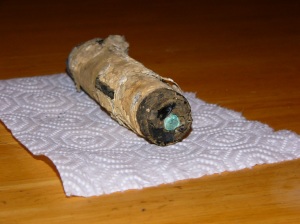
We had an interesting picture for today’s Friday Fictioneers, but it took all day for some inspiration to hit me. Here’s the picture, of a long-buried stick of dynamite one hopes is inert.
I call this 100-word fiction, “Homeland Security”
“9-1-1. State your emergency.”
“My husband brought a stick of dynamite into the house.”
“Dynamite? Are you certain?”
“Well, that’s what he says it is. Can you send the bomb squad here or something? I mean, it’s old and corroded. Harmless, right?”
“Ma’am, what is your husband doing with dynamite?”
“What? It’s not his dynamite. He found it. If you just send the bomb squad to get it…”
“Just a moment, ma’am.”
“Hello? Hello?”
The front door crashed open. A bright flash and loud bang. Men with guns. Shouting and confusion.
“Hands up!”
Her husband was so in trouble.
—–
Questions, comments? To read more 100-word fiction, go to http://madisonwoods.wordpress.com/flash-fiction/dynamite/

TGIFriday Fictioneers!

Friday rolls around every week–imagine that. When I worked 60 or 70 hours a week at a “real” job, Friday always seemed unreachable, there but just beyond my grasp. Now, in retirement, it can’t wait to get here and leave me totally uninspired for Friday Fictioneers.

Here’s today’s inspiration photo from Friday Fictioneers’ maven Madison Woods:

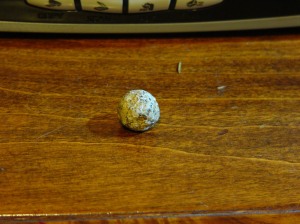
The caption for this picture reads, “This is an artifact marble, once used as a game-piece by early Native Americans who inhabited this area of the Ozarks, known as the Bluff-Dwellers.” Totally fascinating and way beyond my expertise so I’ll just go with the first thing that came into my head when I first woke up this morning–obviously I went to sleep last night with Friday Fictioneers on my mind.

I think I’ll call this one, “Never Judge a Rock.”

“Hey, Honey, come look at this.”

“I’ve got something on the stove.”
“Well, turn it off, ‘cause you gotta see this.”
If a screen door can slam open, she managed it. “What?” The frown on her face made him step back.
“Look at this.” He pointed to a small, round object on the top step of the porch.
She studied it then regarded him with disdain. “It’s a rock.”
“Yeah, but where did it come from?”
“It’s a rock.”
He reached for it.
“No!”
He looked at her and saw terror. He smiled, smug and superior. “It’s just a rock.”
———-
Questions? Comments? Go read some more 100 word flash fiction at http://madisonwoods.wordpress.com/flash-fiction/the-marble-100-words/ 

Learning to Be “Write-Brained”

I posted recently in an on-line writers forum about a class I was taking on how to get published. Someone commented, “Honey, one of these days you need to stop taking classes and just write.”

Well, duh. Except that I can do both at the same time. (And, by the way, a month after finishing that class, one of my short stories got published.)

You can continue to sharpen your writing by writing, but it sometimes helps to get refreshers along the way. I was an editor for eleven years, but I took a grammar or copyediting refresher every couple of years just to sharpen my skills.

So, when I saw The Write-Brained Network’s information on “A One-Stop Workshop for the Serious Writer: A Roadmap from “How-To” through “I Did!” I couldn’t resist. Add in the fact that it was twenty minutes away in my old college town, how could I not go? The deal-sealer was one of my favorite authors, David Robbins, on the bill. His War of the Rats, about the siege of Stalingrad, was so historically accurate and vivid, you felt as if you were there. The End of the War, told from the Russian soldier’s point of view as the Red Army entered Berlin in 1945, was particularly meaningful to me because my Dad was in on that from the American side.

The workshop began with tips on redlining your writing given by Robbins. He’s a very engaging speaker, and the redlining tips he gave are what we’ve heard before but need to remember—watch your POV, “Show, Don’t Tell,” don’t use redundancies, cut the modifiers, etc. He provided his unique perspective, however, and gave specific examples to bring the points home. When he said, “Write what you know is a lie,” he had me. The story and the telling of it, Robbins emphasized, are separate. You can take a great story in your head then ruin it by the poor telling. I think he should have stopped there because he went on to diss several contemporary writers, some in his genre. I think that’s called “biting the hand…” I mean, perhaps at his next conference, David Baldacci or Dan Brown will point out what he dislikes about David Robbins’ writing. Just sayin’.

The next session made me glad I hadn’t sent in a first page to be critiqued. When I saw that offered, I figured you’d send in a page and you’d get it back marked up. Oh, no. The page got read aloud, followed by an instant critique by Robbins and Tiffany Trent, who writes young adult fiction. Granted, the writer’s name wasn’t read aloud, but you could tell by the squirming when someone was on the grill. Critiquing is always a helpful exercise, but I think this could have been improved by separating the first pages by genre, then having someone familiar with the genre provide the critique. A colleague with me at the workshop was braver than I and submitted a first page. This author, who’s sold two books, writes in a genre where the reader expects flowery words and setting a sense of place and time before delving into the story. Of course, the two panelists skewered it, but neither was familiar with the genre. I also think this would have been better one-on-one, rather than in public. Yes, yes, I know others can learn from a colleague’s critique, but the whole exercise left me queasy.

“Getting Noticed, Getting Paid: How to Build a Platform and Freelance Your Way to an Audience,” was a panel consisting of a writer friend of mine, Cliff Garstang, and Bridgid Gallagher, a freelance and young adult writer, who has a web site, Inky Fresh Press, for new writers to learn the business. Both Garstang and Gallagher emphasized the importance of social media in developing your brand and in increasing your sales. Garstang in particular emphasized the importance of separating personal social media and the social media platform for your work. This was a very meaningful panel—showing how Facebook and Twitter friends who aren’t writers can still help in publicizing your work by mentioning it to their followers. Very practical and down to earth.

After lunch we had a “Query Clinic.” Similar to the first page critiques in the morning, you sent in a query letter, which was again read aloud and publically critiqued by two literary agents, Dawn Dowdle of the Blue Ridge Literary Agency and Lauren MacLeod of Strothman Agency. Again, I think this was an exercise better done one-on-one. However, both this and the first page critiques show that getting published and/or getting an agent to represent you is highly subjective. In particular, trying to find the right agent using a reference list is almost impossible. You have to click, as was proved in a later session.

Two authors—Trent and David Kazzie—and two agents—Dowdle and MacLeod—were the panelists for “Traditional Publishing, Self-Publishing, and E-Publishing.” Kazzie self-published an e-book at the same time he got an agent for a traditionally published work. The consensus of this group was a resounding “no” to self-publishing. The exception was Kazzie, who emphasized, quite rightly, that if you are going to self-publish, you need to adapt some of the aspects of traditional publishing—a copy editor, an editor, a good graphics designer. When one of the panelists said, “I don’t really know much about self-publishing,” but then went on to pontificate against it, I wondered why that person was on the panel to begin with. One of the things not covered was the difference between self-publishing and e-publishing, which most of the panel considered the same. Stephen King has e-published—meaning his work is available for reading on a Kindle or a Nook—but that’s different from self-publishing.

The final panel was MacLeod and Jodi Meadows, one of McLeod’s newest clients, talking about the Author/Agent Relationship. This was an excellent panel, demonstrating just how important it is to have the proper representation. MacLeod and Meadows obviously clicked and just as obviously like each other. MacLeod is enthusiastic about Meadows’ work, and they seem to have the perfect agent/author relationship. That alone gives hope and a better understanding of the process of acquiring the right representation.

With the exception of Robbins and Garstang, most of the talent (on the stage or in the audience) at this workshop was from the YA genre. I have nothing against YA, and I know my path is not that way; but a better mixture from other genres would have made an excellent workshop perfect.

I know I may seem critical of some of the elements of this workshop, but I’m, at least, constructive. Overall, it was money and time well-spent. I love being around other writers, people who understand just what it is to be a writer. The Write-Brained Network understands as well and provided a top-notch workshop with a lot to absorb in a day. Kudos to Write-Brained Network Coordinator Ricki Schultz and her team for a worthwhile day.

Just the Facts

I’ll preface this post by saying I don’t have any fiduciary interest in Google.

Several years ago at a Women in Aviation International conference, I purchased a book about a fictional female pilot “from the dawn of aviation!” I read the back cover blurb and thumbed through the book, and it looked like a good read. So, I bought it and started reading it on the flight back. It was a decent book, and the aviation aspects were accurate–something important to me; I’ve walked out of movies when they got the aviation bits wrong.

About midway through the book, the heroine, after losing a lover in an aircraft accident decides to drive to Newport, RI, from New York City to rethink her career choice. The time period was the early 1920’s, and, at least, I thought, the writer didn’t make the easy mistake and say our heroine flew into Newport’s airport, which didn’t exist then. A few pages later, the writer describes the heroine’s reaching the foot of the Newport bridge and slowing down because the height of the bridge had always intimidated her. Wait, what?

I was lucky that my then-spouse was always supportive and understanding of my obsession with writing. When I got off the plane, did I greet him with an embrace and a kiss appropriate to having been apart for five days? Uh, no. He was born and raised in Newport, RI, and I had heard plenty of stories from his mother about how as a teenager in the late 1950’s, he’d always managed to miss the last ferry from Jamestown Island in Narragansett Bay to Newport. (The Newport Bridge now spans the Bay from Jamestown Island to Newport.) The first words from my lips were, “When was the Newport Bridge built?”

“In the 1960’s,” he replied. “Why?” (It opened on June 28, 1969, by the way. I Googled it.)

I spent the walk to the car and drive home ranting about how that author could make such a stupid mistake. I didn’t bother to finish the book.

Yeah, I’m a hardass about some things, and, yeah, it’s fiction; but when a writer drops you into a real place for a fictional story, shouldn’t he or she try to get it right, dramatic license notwithstanding? In some ways, science fiction or fantasy writers who create their own worlds have it somewhat easier. If your world is completely fiction, nitpickers like me won’t nitpick. No one is going to question the accuracy of the worlds created by J.K. Rowling or George R.R. Martin. Well, except maybe fanboys and fangirls who think they know Hogwarts or the world of A Game of Thrones better than Rowling or Martin, respectively.

Google was only a couple of years old when the Newport Bridge boo-boo happened, but the public library system has always been a great source for fact-checking. Or, whatever happened to picking up the phone, calling the Newport city offices, and asking, “When was your bridge built?” It was obvious that, at some point, the author had been to Newport, parts of which still look like it did in the 1920’s, and decided that her heroine should have a reaction to that impressive bridge–forty years too soon.

Because I’m an historian, I’ve always approached my fiction–especially when I write about actual events–as a research project. You know, three sources and the whole bit. If it were allowed, I’d probably footnote. A lot of what I write about happened ten, fifteen, twenty years ago. Before Google, I spent a lot of time in the history sections of various libraries where I lived. The bibliography in one book usually gave me a list of others I wanted to read. When I couldn’t find a book I needed in the library, I purchased it. Before Amazon.com, even that was sometimes difficult to do.

Then, along came Google. If I wanted to find out what a rebellious British teenager was likely to wear in the 1970’s, I Googled it. Who was the Secretary General of the UN in 1962? I Googled it. You get the picture. (And I won’t even get started on how Google Earth can put you in a place where you’ve never been.) Just recently, I was editing a manuscript that involves a real event from early 2001. One character has a disability, and, when I initially wrote the MS some six months before, I thought, “Hey, wouldn’t it be cool if he motored around on a Segway?” So, I wrote it that way. During the edit, though I was reasonably certain of my memory, I decided to Google it. The event in the MS takes place in February 2001. The Segway wasn’t introduced until December 2001. I had my Newport Bridge moment, thankfully before publication.

I once bought an expensive map of Belgrade, Yugoslavia (now Serbia), so I could write a three or four page car chase scene using correct street and place names and be accurate about one-way streets. Even then, I found someone who had actually been to Belgrade and was familiar with the city to review it for any obvious errors.

Of course, this isn’t to say my writing has no mistakes of this ilk. I’m sure there are lots, but the point I’m trying to make is, with the Internet, research is quicker and easier (just verify anything you find in Wikipedia), and I can eliminate the obvious gaffes. You’d think those Newport Bridge moments would be a thing of the past. Yet, recently I read something which mentioned an area of the country I am very familiar with. The writer’s physical description of this area didn’t jive with my memory, so I went to Google Earth to check it, and my memory of the area was accurate. The story wasn’t. I was able to check that particular fact in Google Earth in a matter of seconds. Why couldn’t the writer?

I mean, I know that in the heat of words flowing, you don’t want to stop and Google what to you may be a minor aspect of a bigger story. I’ve been there, and, darn it, but that Segway sure seemed like a good idea.

Thank goodness I Googled it.

Review of July 2011 eFiction Magazine

I stumbled across eFiction Magazine a little more than a month ago when I was looking for more periodicals to have on my Kindle. eFiction’s calling itself an “indie fiction” publication made me think back to the 1980’s when indie music was the rage. Punk and grunge musicians who couldn’t score mainstream recording contracts began to start their own labels, something made easier by the fledgling digital age. Similarly, indie (or independent) fiction tends towards new or emerging writers whose voices may not necessarily fit a specific, mainstream genre. (In reality, anyone who has self-published could consider their work indie fiction.)

eFiction takes this a step further, with on-line forums where contributors, aspiring contributors, and the editorial staff interact. I’ve never seen another on-line magazine do this, or print magazine, for that matter. They may be out there, but I’ve never seen it. I find it refreshing.

The July issue was downloaded to my Kindle while I was standing in some line at Walt Disney World, but I didn’t get a chance to “open” it until the Auto Train ride back to Virginia. And it was well worth the wait. I’ve finished the first three stories, which I’ll discuss a bit more below, and as with the June edition, my first, they were stories I know I’d never see in a literary magazine. For one, the stories are a bit unclassifiable, genre-wise. They have elements of horror or speculative fiction or fantasy, but you’re always left questioning if that’s the case or if you’re simply looking into another reality.

Take “Ozark Pixies” by Madison Woods. A woman is convinced she’s seeing pixies around her rural home, and her husband is about ready to call the “white coats” on her. One day she sees a pixie at the side of a road and wants so badly to prove to her husband that she’s not crazy that she hits it with her car. She only intends to stun it, but it’s mangled so badly she thinks she’s killed it. It’s when she shows her husband the mess she’s brought home that he really thinks she’s gone off the deep end. The woman takes the pixie to her barn, where the pixie recovers enough to latch onto the woman’s ear. The woman and the pixie come to an understanding, and the pixie convinces the woman to eat a carrot-like root the pixie digs up. The root turns out to be hemlock, and the woman is slowly being paralyzed. She begs the pixie’s forgiveness and for an antidote, and the pixie gives what could be forgiveness then places some seeds in the woman’s mouth and disappears. The story ends with the woman thinking, “I knew there was no remedy for hemlock. But she knew things I didn’t.” So, fantasy (pixies), horror (being slowly poisoned to death by a pixie), or suspense (was the woman really just hallucinating)? I’ve read it twice and can’t classify it, but that’s what made me like it.

The zombies in “A Bad Zombie Flick” by Nathanial Chambers are quite familiar to me–commuters moving in lockstep toward work. I lived that for too many years. I even related to the nonconformity of Chambers’ protagonist, who, though a new stock broker, still drives an old tank of a car and scoffs at the other commuters marching forward as one. Yet, we get a hint that things are not quite right when the man picks up his morning newspaper off the lawn. The lines for the columns are there but no words. He shrugs it off as a printing problem and heads to work. The next hint we get is when he’s in line at his favorite coffee shop and looks around at the blank faces of the people waiting in line for their turn with the barista. He notices, like the cars on the road, everyone moves forward precisely the same distance at precisely the same time. Now, the folks in line at my local Starbucks gave pretty vacant stares until that first hit of Caramel Macchiatto, but something about these folks leads our protagonist to declare when he’s before the barista that he no longer wants coffee. But he gets coffee, and in a nightmarish way that has to be read to be appreciated. Here’s a taste:  “The line moves, not forward but toward me. I can hear chairs scraping behind me and the shuffling of feet coming in my direction. I see two men at the doors; they appear to be standing guard. Panic seizes me. They are on me in seconds.” Afterwards, he gets back into his car and notices he has now fallen in step with everyone else–he moves his car the same distance the same time as everyone else and sips coffee from his travel cup exactly when everyone else does. Is this horror–the coffee scene in the shop could lead you to think it is–or fantasy because of the element of conformity taken to the unreal? Or did he merely fall asleep in the coffee shop and dream it all?

“Little Sisters” by Myra King tells the story of three sisters with a focus on the one their parents decided to name Myron. Myron is looking back on her life in her 90th year. She has broken her hip and contracted pneumonia and is in hospital recovering but thankful she has “no one left to mourn me.” I get the impression she is in a ward if not for indigent patients then certainly for people who have limited funds for health care. With her is a 15 year old pregnant girl on bed rest, and the knowledge that another older woman died overnight. The young girl is feeling guilty for not having spoken to the woman who has died. When the young girl begins to cry, Myron remembers how one of her sisters would cry every night. Then, she remembers she was her father’s last hope for a boy, hence “Myron,” and how her father tried to turn her into a boy by giving her boys’ toys. At first she delighted in the attention, but when her father had her collect caterpillars, which he then killed one by one despite her protests, she wants no more of him. Her father no longer paid her attention, and we suspect we know who was responsible for the drowning of her kitten, one he’d given her for her birthday. He turned his attention instead to another of her sisters, and the type of attention is more than obvious in this chilling account: “Father’s attention turned to my sister Roslyn, but he didn’t try and make her a boy. Later, with the sickening wisdom of hindsight, I knew it was more of a woman he was trying to shape.” Watching the young girl’s boyfriend come to visit her and discuss the problem pregnancy makes Myron remember how her mother died giving birth to her, then how a fire kills the father, leaving Myron and her sisters to the mercy of the foster care system. None of the sisters ever married. Myron became a nurse to “relieve the suffering of others while Margaret gave her life to care for Roslyn.” A coughing fit overcomes her and she hears “voices of comfort. Familiar voices. I sink back into the pillows, close my eyes, listen to those words, our three little sisters song once more played to the tune of my memories and the faltering of my breath.” Of the three stories, this is the one I could classify definitely as literary fiction, but it’s written in a way that engages you and makes you hope there will be people left to mourn you.

There are more stories in the July issue, but I’m savoring them. Slowly.

A Writer’s 10 Commandments

Several months ago I found “The 10 Commandments of Fiction Writing” inWriter’s Digest magazine. The list so resonated with me that I printed it out and taped it to a bookcase right next to my writing area. In the months it’s been there, I’ve glanced at the list from time to time, not necessarily for inspiration, but for affirmation. Writers always question why we do what we do, especially when the acceptances are few and the rejections many—or like me, when you find the whole rejection process so ego-bending, you get anxiety attacks when you contemplate submitting work. Glancing at these brief “commandments” helps focus me at times, mocks me at times, but reminds me a lot of the time that I can’t be anything except a writer.
Here they are with a few thoughts of my own.
I
Take yourself seriously
Sometimes hard to do when you don’t see the success you think you should have. I think part of taking yourself seriously is to do things that successful writers do—read, hone your craft, learn from your failures, continuously study writing. You have to write to be serious about writing.
II
Act like a professional.
That means not sending snarky e-mails back to a magazine or agent or publisher who rejected you. You can’t burn any bridge, narrow as it may be, you’ve built. It also means not stalking agents at writing conferences, insisting your manuscript will make you both rich. By the way, I’ve never done either of those things, but I’ve seen them happen, and I’ve been on the receiving end when I was an editor. For me, acting like a professional means be a professional writer. Check that spelling, use proper grammar (dialogue involving an uneducated person being an exception), master punctuation. When I was an editor, nothing said “unprofessional” to me more than a misspelled, ungrammatical, mis-punctuated mess. “You’re the editor; you’ll fix it,” wasn’t an excuse I’d accept.
III
Write your passion.
Note this didn’t say, “Write what you know.” It means write what stirs you, what inspires you, what makes you sit down at the keyboard and write. Your passion is all your own. No other writer will feel about that passion the same way you do. You may share the object of that passion, but yours is unique. No one can write about it as you do, so do it.
IV
Love the process.
For me, there’s nothing like the times I write when the words pour out as if they’ve taken control of my fingers on the keyboard and insist I make them take form. Then, I’m head over heels in love with the process. When the words hide in my head and refuse to stand in the light of day, loving the process is harder. That, however, is part of the process, so perhaps this one should be, “Love/Hate the process?”
V
Read—a lot.
It never ceases to amaze that people who call themselves writers don’t read a variety of other writers. They stay within a shared genre or limit themselves by reading only fiction or only nonfiction. As I look at the books in my bookcases or on my Kindle, the only word to describe my reading interests is “eclectic.” Some might say eccentric, but I’m going with eclectic. My life is a perpetual struggle to balance the two loves of reading and writing—when I’m doing one, I feel guilty not doing the other. A literary triangle, perhaps? One thing that has disciplined me is joining a couple of book clubs, one in person for nonfiction, one on-line for fiction. Peer pressure does have an influence.
VI
Stick to a schedule.
This is my biggest struggle. I genuinely try to write a little or edit something every day. “Try” being the operative word. When I retired, it was to devote more time to writing, and I have, but it hasn’t been the daily exercise I wanted it to be. I’ve tried setting specific days or times, but other things (i.e., life) pop up. I won’t be content until I’m “working” regularly at writing.
VII
Be critical of your work.
Let’s face it, not everything we write is gold. Trust me, it isn’t. I look back on my collection of short stories published more than a decade ago and realize, though the guts of the stories are good, I wasn’t ready to be published. I won the publishing contract in a contest, it had a deadline attached, and I took that bait and swam with it. I didn’t have the time to be critical about it, and that’s why I need to have something else, something I have been more critical of, published. As much as I’m glad I had the opportunity to be published, I don’t want that one book to be my only writing legacy. I’m about to start a writing critique group, an offshoot of the local writers group I belong to, and I hope that will help not only in being more critical of my work and in receiving constructive criticism but helping others, too.
VIII
Develop thick skin.
So, maybe a person who already has insecurities shouldn’t become a writer? I’m still amazed when someone tells me he or she likes what I’ve written. I know I like what and how I write, but I know I’m not for everyone. Frankly, the rejections are why I rarely submit work. I haven’t yet learned to separate the writing from the person. A rejection of a story I’ve written is a rejection of me. Intellectually, I know that’s not the case, but emotionally I can’t help it. The only way to overcome that, I know, is to keep submitting because one day the rejections will stop.
IX
Trust your editors.
When I was a reporter for an aviation magazine, my editor was a frustrated author. He’d published a novel in the 1950’s that won some awards and recognition but had nothing published since. This meant when he was my editor in the 1970’s, he rewrote everything. The first time it happened I thought my article sucked so much that I’d be fired, so I went to him for a critique. Oh, no, my article was fine, good even; he just wanted all the articles in the magazine to sound as if he’d written them. The light bulb came on—I wasn’t a reporter; I was a glorified researcher. That experience makes it hard for me to trust editors, and yet I know the time for me to continue to be my own editor is past. Trust has to start sometime. When I became the editor of that same aviation magazine, I had a “happy to glad” rule—if happy was the right word, I wouldn’t change it to glad without a damned good reason. The reporters who worked for me responded better to that than total rewriting, so I did learn something after all.
X
There are no certainties.
Ain’t that the truth? Not every manuscript is destined to be published, much less a best-seller, but we still play the odds. That’s because there’s no certainty it won’t be published either. It’s the uncertainty that keeps us writing.