National Short Story Month – The Best Laid Plans of Mice and Writers

I was pretty excited about National Short Story Month (May 1 – 31). Though I don’t consider short stories my first choice in writing (despite the fact my only published book is a collection of them), I read a lot of them. My intention for this past month was to pick 10 short stories meaningful to me and write about each. Because of a cold that knocked me for a serious loop, I only managed three—Harlan Ellison’s “A Boy and His Dog,” Shirley Jackson’s “The Lottery,” and William Faulkner’s “Barn Burning.”

I’ve left you with the impression that I don’t read any modern short stories. Not true. I was working my way up to that before I got sick. Since I can’t cram seven more stories into a single post, I’ll do a quick list of stories and collections I recommend.

First, I’d be remiss if I didn’t mention the Master of Horror, Stephen King, but the story I recommend is considered one of his “mainstream” works: “Rita Hayworth and the Shawshank Redemption.” (They shortened the title for the movie.) A marvelous character story and tribute to, well, redemption.

Agatha Christie, in addition to her many (many) novels, also wrote several collections of short stories involving her best-known characters. The ones I recommend revolve around Miss Marple. Though I always found Miss Marple a little grating on the nerves with her false modesty, any of Christie’s short stories with Miss Marple is a gem—the mystery presented, discussed, resolved so succinctly.

Kurt Vonnegut—I miss him every day—has had several collections of short stories as well. Pick any one of them up, and he will transport you—into the past, the future, someone else’s head, his head. You won’t be disappointed by any of them.

Not because he’s a writer friend of mine but because his collection is so evocative, I’ll include Cliff Garstang’s In an Uncharted Country. (I mention him after Vonnegut because he might not like being so close to King. ;-D ) This is a collection of linked short stories about people and life in a fictional town in the Shenandoah Valley. Cliff links the stories in interesting and provocative ways, and there’s not a disappointment in the bunch.

If you think Vladimir V. Nabokov and your next thought is only, Lolita, think again. He has a large collection of short stories (The Stories of Vladimir Nabokov) that will horrify, intrigue, sicken, delight, and amaze you. You begin to understand how seeing your father murdered in front of you creates an incredible writer.

Ray Bradbury’s “Beggar on the Dublin Bridge” has a hint of the fantasy Bradbury is famous for, but, mainly, it reminds you that opportunities lost can’t be recovered.

Be patient. I’m getting to the women in just a moment.

A literary e-magazine I subscribe to on my Kindle is One Story. Aptly named, it publishes a single story every three weeks. All the ones I’ve read have been excellent and by up and coming writers (which gives me hope I’ll be one some day), but “Filament” by K. L. Cook is a stand-out. If you don’t have or want a Kindle, you can purchase the stories individually as they’re published on the web site (click on the link).

So I don’t let my feminist sisters and brothers down, here are some stories by women writers I’d like to highlight. A lot of these are classics as well, and it’s not that I don’t like modern short stories. A lot of them just don’t give me the “kick in the gut” the “oldies but goodies” do. Oh, they are perfectly structured and punctuated, grammatically flawless, but many are so faultless, they move me only intellectually, not emotionally.

Sarah Orne Jewett – “A White Heron”

Willa Cather – “Paul’s Case”

Edith Wharton – “The Mission of Jane”

Edna Ferber – “The Afternoon of a Faun”

Dorothy Parker – “Big Blonde”

Eudora Welty – “Death of a Traveling Salesman”

Flannery O’Conner – “A Good Man is Hard to Find”

Joyce Carol Oates – “Where are You Going, Where Have You Been?”

Like Bradbury’s “Beggar on the Dublin Bridge,” there are a lot of missed opportunities here—darn that “three-week” cold—but there’s always next year.

National Short Story Month – William Faulkner’s “Barn Burning”

A few months ago I took one of those Facebook quizzes–which Southern writer are you? I came up as William Faulkner. Faulkner was typical of the Southern men I grew up with–hard-drinking, hard-working, philandering, and overwhelmingly brilliant. In each of his works I’ve read, I’ve found a piece of my Southern heritage, sometimes a snippet I don’t particularly want to acknowledge. Faulkner, at least, forces me to examine it.

“Barn Burning” was a story I read both in a high school American Lit class and a college one as well. During the discussion period in the college course, a student who had no rural roots posed the question, “What’s the big deal about a barn burning anyway? It’s just a building. It wasn’t the person’s house.” The professor opened it up to the class, and there were several of us who grew up on farms who were happy to explain that the barn is the heart of a farm. You store animals, equipment, feed there. My Dad’s main “barn” was a complex of buildings, all interconnected, which was the farm’s nerve center. The loss of a barn brings physical damage in the loss of tangible assets, but it is also a symbolic loss as well. If you’re a subsistence farmer, and you lose your barn, you’re out of business.

This was why armies burned barns when they went through a country, this is why the Soviets scorched the earth and a lot of barns in Ukraine in World War II to leave nothing for the Germans to use, and this is why Abner Snopes burns barns to address insults he feels he’s been dealt in Faulkner’s short story.

The story opens in a store where the justice of the peace is hearing an accusation from a Mr. Harris, whose barn has been burned. Mr. Harris describes a dispute with Snopes over a pig getting loose and coming onto Mr. Harris’ land and rooting in his corn. The first time, Harris sends it back. The second time, Harris sends fencing so Snopes can build a better enclosure for the pig. The third time Mr. Harris sends Snopes a message that it will cost a dollar for him to get the pig back. Snopes sends a black man who works for him with the dollar and a message for Harris:

“He say to tell you wood and hay kin burn.”

“What?”

“That whut he say to tell you. Wood and hay kin burn.”

Harris sends the black man away with the pig, and that night, his barn burns to the ground. Harris then brings Snopes before the JP to have him charged. The Justice of the Peace, however, sees that Mr. Harris has no real proof that it was Snopes who burned his barn. Harris tries to compel Snopes’ younger son–the story is really from his point of view–to speak up the boy stays quiet. The Justice has no choice but to dismiss any complaint against Snopes.

As Snopes and his son leave the store and walk down the street someone calls Snopes a barn burner, and his son, named Colonel Sartoris after Snopes’ Civil War commanding officer, launches himself at the man and gets roughed up in the process. Snopes pulls the boy away and takes him home. When they arrive, Snopes’ wife has their wagon packed. This is when you realize this is not the first time Snopes has been accused of barn burning. In fact, Sartoris’ entire life has been a constant journey from town to town, farm to farm, where they live and work briefly then pack up and move on. Yet, you can see this is a boy who adores and worships his father despite his father’s obvious flaws. Sartoris is conflicted far beyond a young boy’s ability to rationalize. He hopes no one will upset his father and release the nasty, vengeful man Snopes really is. You can also see Sartoris is getting tired of the life he’s living. Cracks are beginning to appear in the armor of fatherhood Snopes surrounds himself with.

Snopes reminds me of an uncle of mine, my father’s brother John Marshall, who got the Scots-Irish temper. He never burned a barn, but he found other ways to get back at people who he felt had offended him–turning another farmer’s cows out so they wandered off and took weeks to round up, putting sugar in the gas tank of yet another farmer’s tractor. There are lots of examples, none of which are as serious as barn burning, but costly in their way. All this got my Uncle John the same reputation that Snopes in Faulkner’s story had–be careful what you do or say to this man.

Snopes and his family go their next sharecropping gig. The owner of this farm sends a black man to tell Snopes to come see him and to make sure he comes to the back door. Snopes dresses in his best clothes and brings Sartoris along as he goes to meet his new boss. However, Snopes not only goes to the front door, he deliberately walks through a pile of horse droppings and tracks horseshit through the house and on an expensive French rug. Snopes has also deliberately come at a time when “The Major,” the farm owner, isn’t at home. With The Major’s wife near to faint from the ruination of her rug, Snopes and Sartoris leave, Snopes’ boots still tracking horseshit.

A few hours later, The Major sends the rug to the house the Snopes family have moved into on the farm, with the instructions that the rug be cleaned and sent back up to the main house. Snopes’ wife offers to do it, but Snopes tells her he’ll take care of it. Snopes spreads the rug in the dust, cooks up a pot of lye, and has Sartoris’ sisters “clean” the rug. Now, pure lye will burn, so the rug is now clean of horseshit, but a ghost of itself.

Needless to say, The Major is not happy with the result and informs Snopes that the cost of the rug will come out of his share of the corn crop. In a twist, Snopes brings The Major before this town’s Justice, claiming the redress is too much. Snopes–you can see him, hat in hand, deferring to the Justice, playing innocent–asserts that he’d never cleaned such a rug before, so he shouldn’t be held accountable for cleaning it the wrong way. He did, he claims, exactly what The Major told him to do.

“He brought the rug to me and said he wanted the tracks washed out of it. I washed the tracks out and took it back to him.”

When the Justice reminds him he didn’t take the rug back in the same condition it was before he dirtied it, Snopes has nothing to say. The Justice finds against Snopes but reduces the amount of corn Snopes has to forfeit to pay for the rug. When the corn is harvested, Snopes will have to give 10 barrels, or $5, from his share to The Major.

Sartoris hopes that’s the end of it, but by the time they reach the wagon, Snopes is muttering that The Major won’t get the 10 barrels, or even five barrels. They get home and Sartoris stays outside, listening to the birds and other sounds of nature as night falls. Then, he hears his mother begging and pleading with his father. Sartoris dashes into the house to see his father emptying all the lamp oil into a kerosene can. Snopes orders Sartoris to get “that can of oil we were oiling the wagon with.” Sartoris protests, but Snopes orders him again.

“Then he was moving, running, outside the house, toward the stable: this the old habit, the old blood which he had not been permitted to choose for himself, which had been bequeathed him willy nilly and which had run for so long (and who knew where, battening on what of outrage and savagery and lust) before it came to him. I could keep on, he thought. I could run on and on and never look back, never need to see his face again. Only I can’t. I can’t…”

Sartoris does what he was told but begs his father to send the black man to warn The Major, as he had done all the previous times, so ardently Snopes makes his wife hold the boy while he goes off to make The Major pay. However, Sartoris breaks away, but he doesn’t run after his father. He runs to The Major’s house and without knocking bursts in and breathlessly shouts, “Barn! Barn!” Even though Sartoris is put out of the house, The Major has figured out what he means.

The ending of this story is frenetic. Sartoris’ screaming, The Major shouting for his horse. Sartoris then runs toward his father when he sees The Major gallop off with a gun. As he warned The Major, he tries to warn his father, but smoke is already rising and whatever action The Major now takes, he is well within his rights. Sartoris runs to his father, screaming for him even as he sees the glare of the fire, stumbling in the forest, and stops only when he hears the shots. For hours he sits in the dark sobbing, knowing what has happened and his part in it. “My father,” he says, “he was brave.” Then you realize he spoke of the father as a soldier who fought bravely and well before his descent to barn burner.

Sartoris ran to The Major with the intent of stopping his father, so his father could be in reality the way Sartoris thought of him, but what Sartoris really did was cleanse that “old blood.” There are many Southerners, myself among them, who would give almost anything for the same.

National Short Story Month – Shirley Jackson’s “The Lottery”

This is the second of several posts for May celebrating National Short Story Month.

“The morning of June 27th was clear and sunny, with the fresh warmth of a full-summer day; the flowers were blossoming profusely and the grass was richly green.”

A story that starts so sweetly just has to be warm and cozy and delightful, doesn’t it? There are scenes of children playing and adults chatting about spouses, the weather, and taxes. The older folks complain that young people don’t follow traditions any more. Young boys scamper about, stuffing their pockets with rocks and building a pile of stones–typical boy stuff in a typical small town. Those of us who grew up in one of them (and in my case came back to one) will recognize this. How very bucolic and dreamy.

However, this is a story by Shirley Jackson, so there’s nothing bucolic and dreamy about it. “The Lottery” is the stuff of nightmares, and that’s what makes it another of my favorite short stories. (I’m not sure what that says about me, but I’m harmless. Mostly.) Most of Jackson’s work is dark because she sees things in the everyday that others don’t. Stephen King, Neil Gaiman, and Richard Matheson, masters of the macabre all, have acknowledged her influence on their work. When The New Yorker published “The Lottery” in June 1948, it received more mail about it than any previous story, most of it questioning why the magazine had published a horror story?

“The Lottery” describes one day for the 300 citizens of a small, rural town, unnamed and where it is we don’t know, nor does it matter. Jackson acknowledged she based it on Bennington, VT, her home town, something I’m sure didn’t exactly thrill her neighbors. In the story, every year at 10 o’clock on a particular day in June, the town–as does every town and city–holds a lottery. The responsibility for preparing for the lottery falls to one man, who is replaced by a volunteer when he decides he doesn’t want to do it anymore. Tradition is very important to the lottery, though necessary changes have occurred. The black box used to hold the lottery slips formerly held wood chips; however, when the population grew, the box was too small to hold all the chips. The man in charge of the lottery changed to paper. Over the many years of the lottery, much of the paraphernalia for the black box and the original black box itself have disappeared or disintegrated. Now a three-legged stool gets placed in the town square, and the black box sits atop it. Otherwise, everything is the same as it’s been for countless years and innumerable lotteries. One old man boasts that this is his 77th lottery, his “seventy-seventh time.”

The purpose for the lottery, other than it’s tradition, is never explained, which adds to the darkness of the story. Those would have been wasted words. It’s enough to know the lottery is and always will be.

As people arrive for the appointed time, they chat as friendly neighbors about harmless things. When I first read this story in high school and reached this point in the story, I remember thinking, how boring. They’re all standing around talking about commonplace things, much like my father at the cattle market or my mother at the hair dresser. What was so good about this story was eluding me.

Then, you feel the tension mount as everyone walks up to the black box when his or her name is called and removes a folded piece of paper. Everyone must keep the paper folded until all have chosen. There is a brief dispute about whether a young woman draws along with her family or her husband’s. Once that’s settled, the reveal can begin.

At a signal, people unfold their papers and hold them up for all to see. Jackson’s prose lets you “hear” the sighs of relief as paper after paper is blank–except for one, which has a black spot on it that “Mr. Summers had made the night before with the heavy pencil in the coal company office. Yes, there are lots of allusions to dark and black things throughout the story. I always envisioned a colorless town with people in drab clothing, though there’s no such description.

Soon, it’s obvious someone isn’t owning up to having the black spot, one Tessie Hutchinson. She knows she has the dreaded piece of paper and even though she knows it’s futile to try to hide it, she clenches it in her fist. Her husband is the one who pries her hand open and shows everyone the paper with its black spot.

The villagers back way, leaving Mrs. Hutchinson alone, but they are only moving to pick up their stones from the pile the boys made earlier. Other stones are scattered about, and you get the impression they have been used and reused time and time again. Someone actually puts stones in the hands of Mrs. Hutchinson’s small son because everyone must participate. She begs and pleads, but no one–not her husband, not her children–will help her or stop the inevitable. This is tradition and must be upheld.

Shirley Jackson was renown for not giving interviews or explaining her stories, though the reaction to “The Lottery” compelled her to offer this:

“Explaining just what I had hoped the story to say is very difficult. I suppose, I hoped, by setting a particularly brutal ancient rite in the present and in my own village to shock the story’s readers with a graphic dramatization of the pointless violence and general inhumanity in their own lives.” (July 22, 1948, San Francisco Chronicle)

Today, we read of stonings in Afghanistan, Iraq, Pakistan, and are repulsed. We attribute such actions to backwardness, and we are so smugly certain civilized people don’t do such things, that we have evolved beyond being slaves to tradition. Really?

Jackson was married to literary critic Stanley E. Hyman, who wrote the preface for a posthumous anthology of Jackson’s stories. He noted her purpose in “The Lottery” wasn’t to simply horrify but to incite subversion, and she was pleased when she learned the aparteid government of South Africa had
banned the story there because they considered it subversive. Many critics then and since have speculated Jackson wrote on the dark side because of a traumatic childhood or was neurotic–the usual reasons given when women write something other than children’s stories or romances. Hyman felt her writing gave voice to our inner, post-Holocaust, Cold War fears of mutually assured destruction and getting the enemy first.

One of Jackson’s two novels, The Haunting of Hill House, I read soon after I finished “The Lottery.” Don’t bother to see any of the movie adaptations. Just read the novel instead. It will scare the absolute bejesus out of you, not with gory, explicit scenes of mayhem or murder, but with the careful, thoughtful juxtaposition of words. Nothing else will ever scare you as much.

Except, perhaps, the last line of “The Lottery”:

“‘It isn’t fair, it isn’t right,'” Mrs. Hutchinson screamed, and then they were upon her.”

National Short Story Month – Harlan Ellison’s “A Boy and His Dog”

We’ve probably had short stories in oral form since humans began to speak and told fanciful tales, but the “official” origins of the modern written short story are in the 19th Century when magazines could be printed rather cheaply. The short story in these publications became very popular and fueled the magazine industry from then until now. The magazines printing those early short stories weren’t technically literary magazines because they contained other, non-literary material. The 20th Century saw the rise of the literary magazine as we know it today, chock full of short stories, essays, poetry, and author interviews. But this isn’t National Essay Month (though I’m sure there is one), so throughout this month, I’ll blog about the short stories of particular interest to me.

There’ll be no specific order to the stories I’ll write about–no Top 10 lists–just ones that mean something to me. So, for me, the only logical starting place is Harlan Ellison’s “A Boy and His Dog.” This story is from Ellison’s story collection, The Beast Who Shouted Love at the Heart of the Worldpublished in 1969.

Ellison is primarily a short story writer, mostly in the Science Fiction and speculative arena, where he’s won just about every award in that field and a few literary awards as well. In the 1970’s and 1980’s he would regularly go to a book store in Los Angeles, pick a first line from a collection submitted by patrons of the store, sit down, and begin to type. Each page, typos and all and with no editing, would be taped to the front window of the store. People would stop and read or go inside and watch the process. Ellison is known for being an egoist and an all around difficult person, volatile and vocal about fools he doesn’t suffer lightly, but I met him at the World Science Fiction Convention in the early 1970’s, and he was perfectly cordial to me. After spotting me, gawking as he “debated” with his good friend Isaac Asimov, he took me aside and spent a good half hour alone with me, talking about writing and encouraging me to “keep at it.” It’s something I’ll never forget.

I could pick any of his hundreds of short stories, but “A Boy and His Dog” was the one that gave me the biggest “kick in the gut” when I read it. It takes place in a post-nuclear war world where men and their dogs roam a desolate landscape scavenging for shelter, food, and women. Vic, the Boy in the title, travels with Blood, a dog who is telepathic, the result of a pre-war experiment. Blood’s talent is “sniffing” out females for Vic to rape. Vic is able to “score” more women because of Blood’s talent and their ability to communicate silently.

A pretty dark and horrific premise, but as with most of Ellison’s stories, there is a comeuppance. Blood leads Vic to Quilla June, whom Vic rescues from mutants called Screamers. When she shows Vic she’s willing to have sex with him, Vic is confused, and Quilla June tells him of a paradise where he can have all the willing women he wants. Quilla June has been send to the surface by her father to seduce men and bring them to the “downunder” for breeding purposes. Vic is eager to go with her, but a suspicious Blood tries to dissuade him from following Quilla June. However, Vic is, well, thinking with his lower head. Vic descends into Quilla June’s underground Utopia and leaves Blood alone topside.

Quilla June’s world is quirky and rather like the Amish on acid. Everyone wears mime makeup, dresses like a 1950’s farm town, and people who don’t conform get sent to the “farm,” a euphemism for execution. One of the reasons downunder women go topside to bring men back is that so many get sent to the farm for the merest of reasons. When Vic arrives, Quilla June and 34 other women are set to “marry” Vic, but to Vic’s surprise there is no sex. He’s, um, tied down and attached to a machine that extracts his sperm, and his “wives” will be artificially inseminated. The town’s odd moral code, however, doesn’t allow unwed mothers, so the women have to marry before being inseminated. Quilla June knows that once Vic’s sperm has produced 35 pregnancies, he’ll be sent to the farm. Because she hasn’t enjoyed her deception–and she’s basically rebelling against the tyrannical rule of her father–and because she now loves Vic, she breaks him out, and they head back to the surface.

Ever loyal, Blood has not strayed from the point where Vic went underground. When Vic and Quilla June find him, Blood is badly injured and starving, near death. Quilla June gently encourages Vic to leave Blood, but Vic realizes he has only survived in his post-apocalyptic world because of Blood’s wisdom. He’s faced with a choice–the love Quilla June has for him alone or the loyalty of his faithful dog, who first and foremost needs food.

At the end of the story Blood is feeling much, much better and is no longer hungry, and he and Vic resume their travels.

A grim ending and not for the light-hearted, but it is gripping. Ellison moves easily from the violent, gruff, raucous, rapacious world of the surface to the artificial, gentile, cultured, and deadly world of the downunder. The changes in language and writing style reflect each world. The reader is left to wonder which is the worse of the two worlds, and the decision isn’t easy. What looks inviting about the downunder is in some ways more of a nightmare than the devastated civilization above. We don’t even cringe at Vic’s choice, because he’s a child of that nuclear holocaust, which occurred when he was small. Survival is all he’s ever known, and he did whatever he needed to until he met the restraining guidance of Blood. It is Blood who is the hero in a story that shouldn’t have any.

If you read “A Boy and His Dog,” you’ll not only look twice at the wolf inside your house; you’ll also want to read more Ellison. He’s a curmudgeon, but he writes like a son of a bitch.

SWAG Writers Poetry Fest!

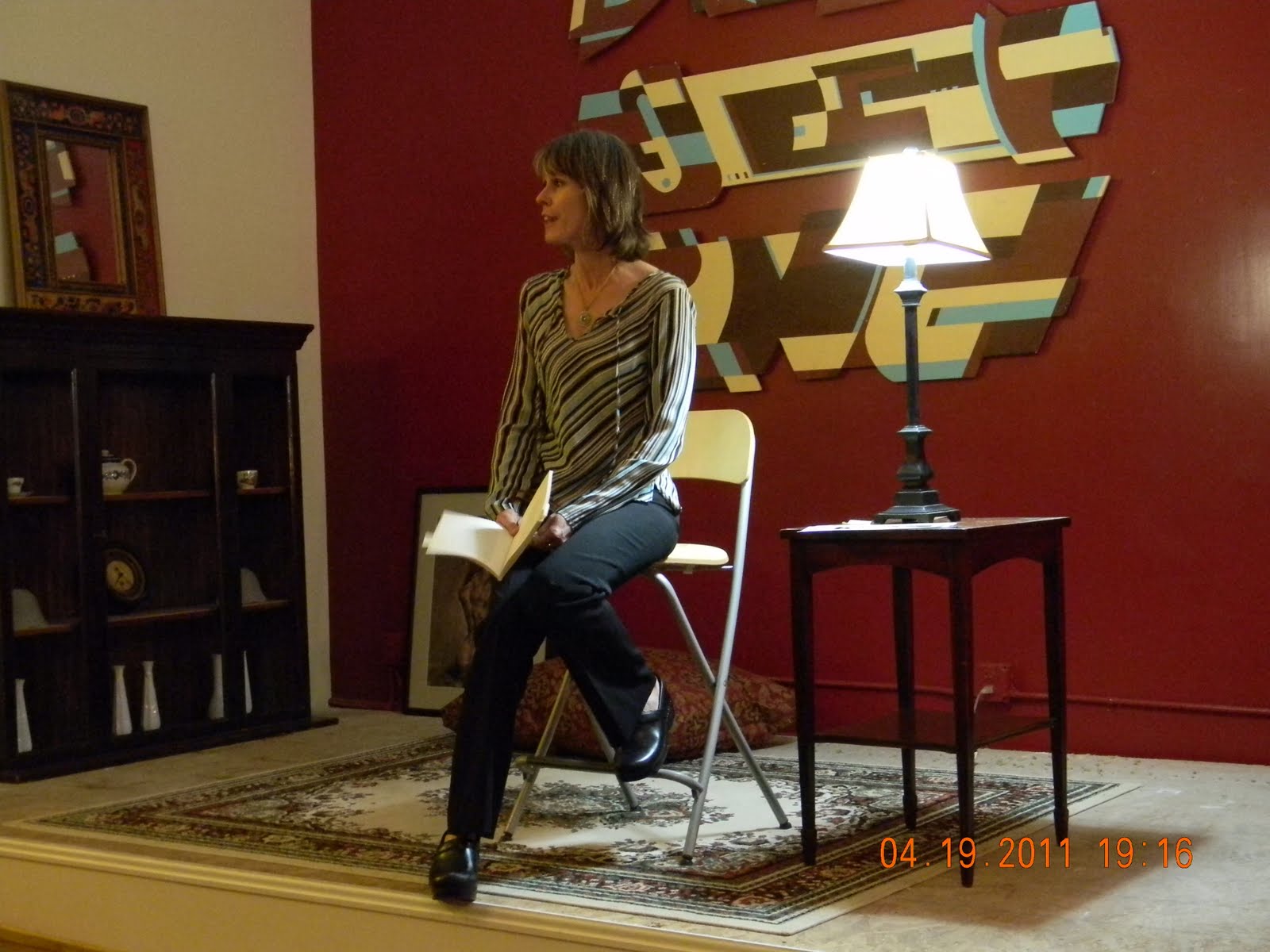
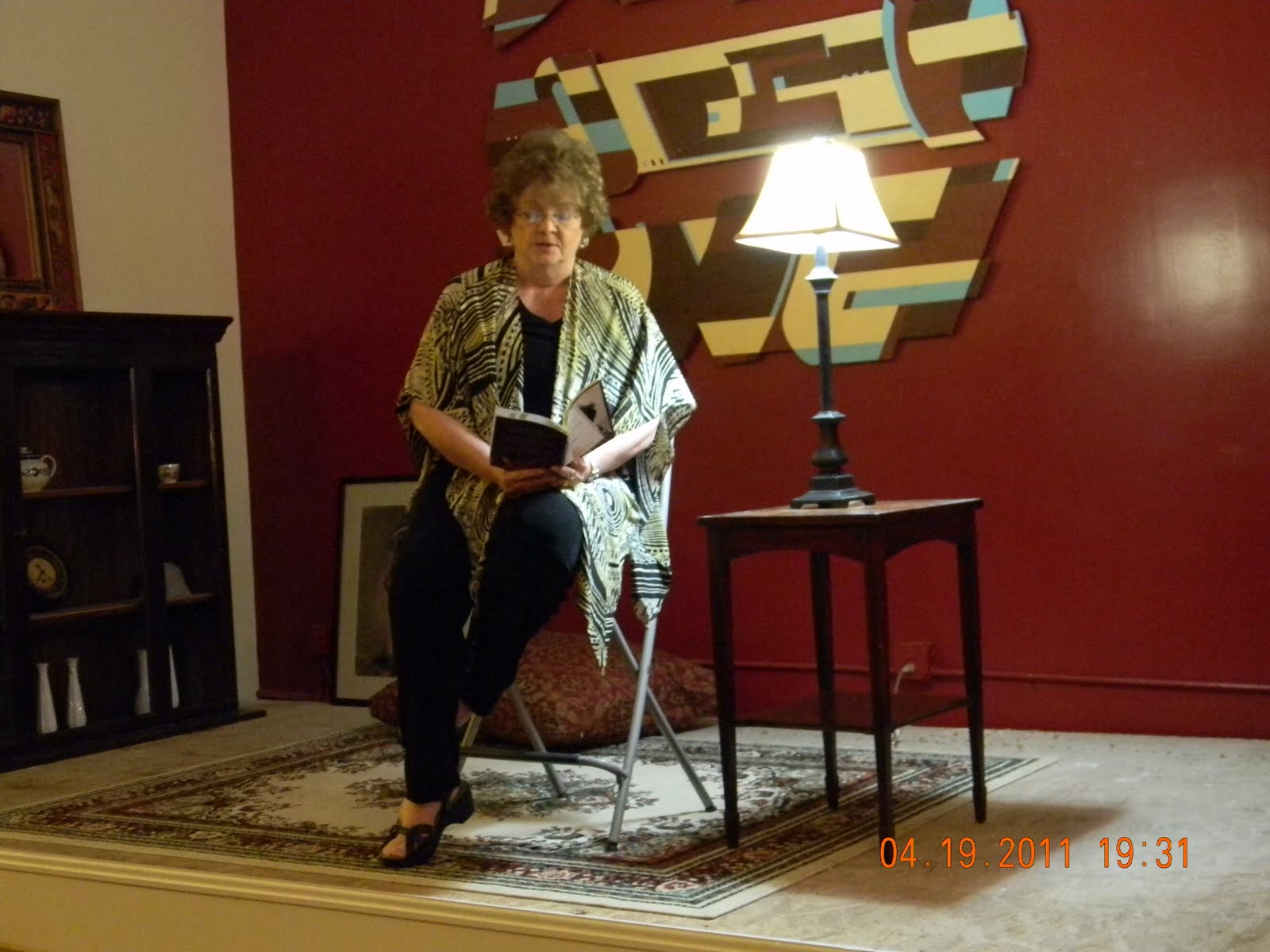
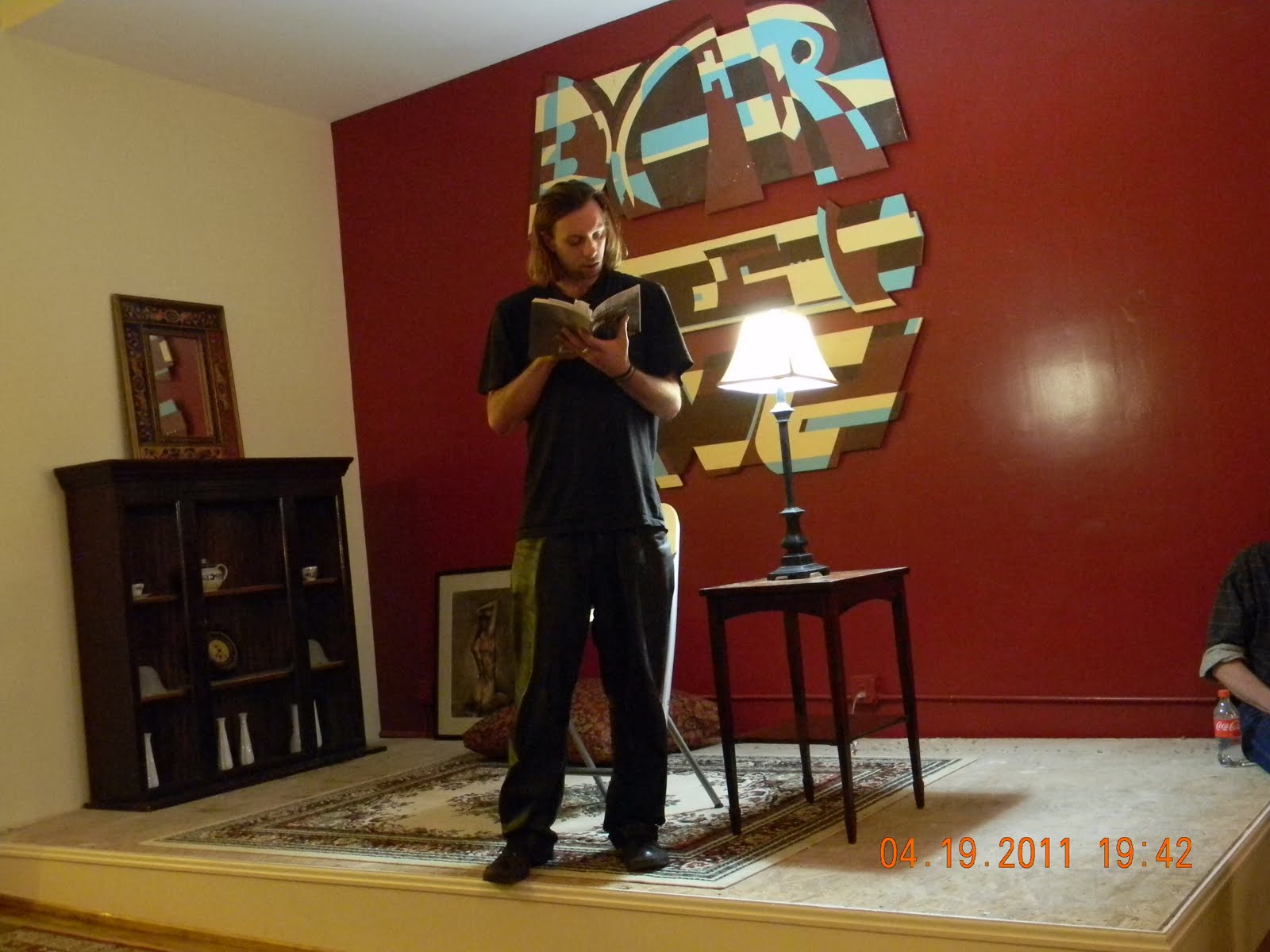
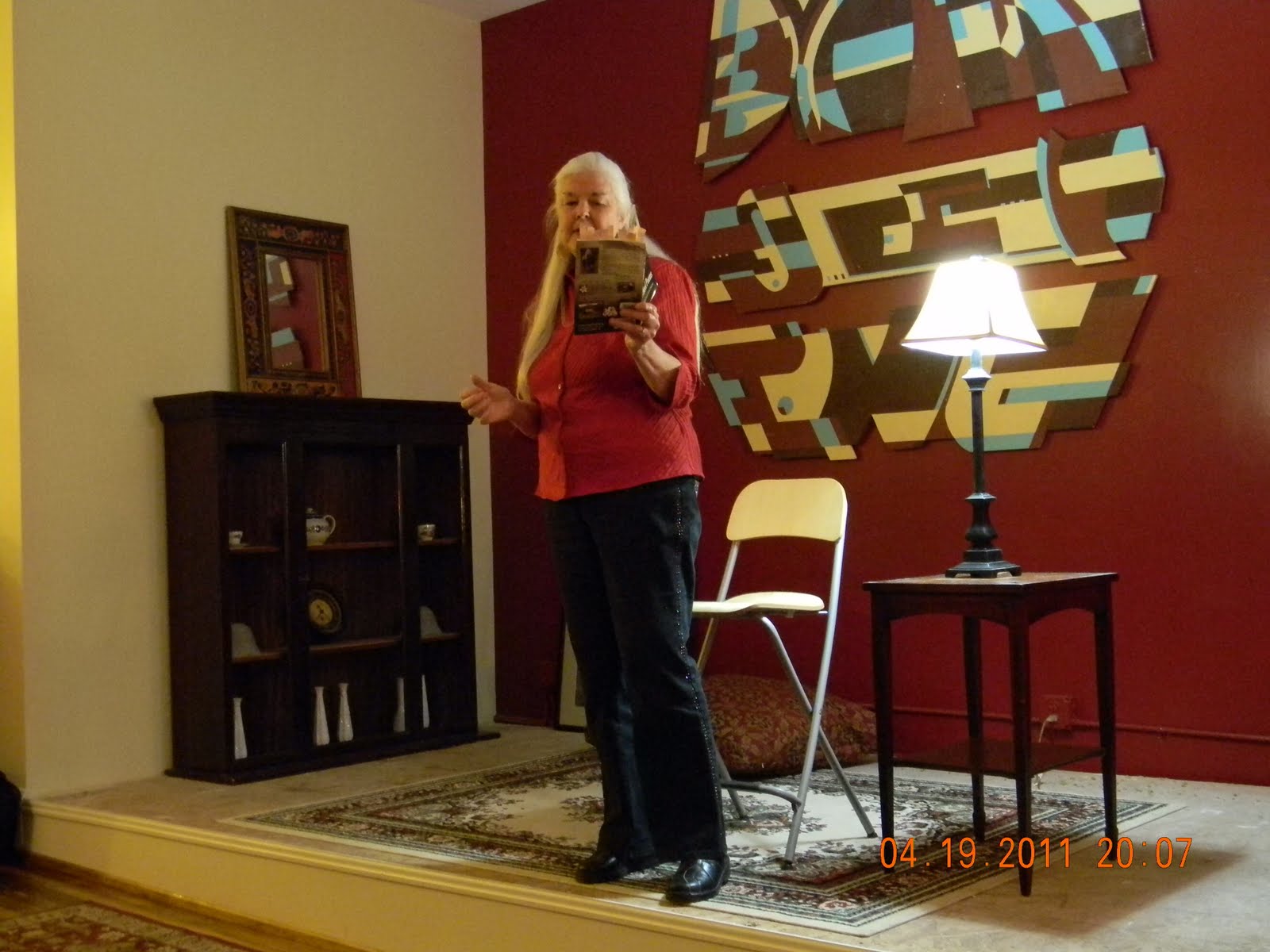
Here’s a pictorial blog today on last night’s great Poetry Fest sponsored by SWAG Writers.

The featured poet was Sarah Kennedy, an Associate Professor of English at Staunton’s Mary Baldwin College. She read from Home Remedies, one of her six books of poetry. Home Remedies contains poems based on real persons from 17th and 18th Century Ireland and Wales. Very evocative to my Irish half.

Local poet Lauvonda Lynn Meade Young read from her first book of poetry, Just a Woman. We women in the audience who are her contemporaries–we could certainly relate to her poems! Wonderful glimpses into the life of a woman who isn’t “just a woman.”

Shea Anthony is a local poet from Fishersville who read from The Forgotten Theatre, one of his two books of poetry. Reminiscent of musicians Jim Morrison, Kurt Cobain, and Trent Reznor, Shea got us all participating in his reading. A great contemporary voice. And, let’s face it, anyone who does a poetry reading in the Valley in black leather pants deserves our attention!

Elizabeth Doyle Solomon often gets inspired while driving the roads of the mountains and the Valley. When that happens, she jots the first few lines on the steering wheel, then finds a place to park to write the rest. Hence, she read from her second book of poetry, entitled, appropriately, The Steering Wheel Poems. Her poems celebrated the wildness of nature around us and lamented how easily we pave over those places of beauty.

Lorraine Rees from Charlottesville read from her second book of poetry, Goodbye Zoo. Her poem about a college ethics professor who hits on all his female students was amusing but full of pathos–and very authentic. She describes herself as the one who “got away.” Great insight.

Paul Somers rocked and rolled us with energetic readings from his first book of poetry, Animal Insight, and from several as yet unpublished poems. Later we talked about how he uses humor in his poems to illustrate serious aspects of his life in rural North Carolina. Deeply profane and poignant.

The last, but not least, poet of the evening was Linda Levokove, who read from her first book of poetry, Walk on the Heart Side. Her poems are glimpses, earthy and explicit, into romantic relationships. I related to these most of all because her poems seemed as if they were written expressly for the most important relationship of my life and captured my sense of loss. Overall, though, they so vividly portrayed the wonders of a deep relationship, I could remember all that was good, and I thank her for that.

And let us not forget our hosts for the evening, The Darjeeling Cafe in Staunton, VA, and our master of ceremonies, SWAG Writers founder Cliff Garstang, author of the award winning linked short story collection, In an Uncharted Country.

Not So Bad After All

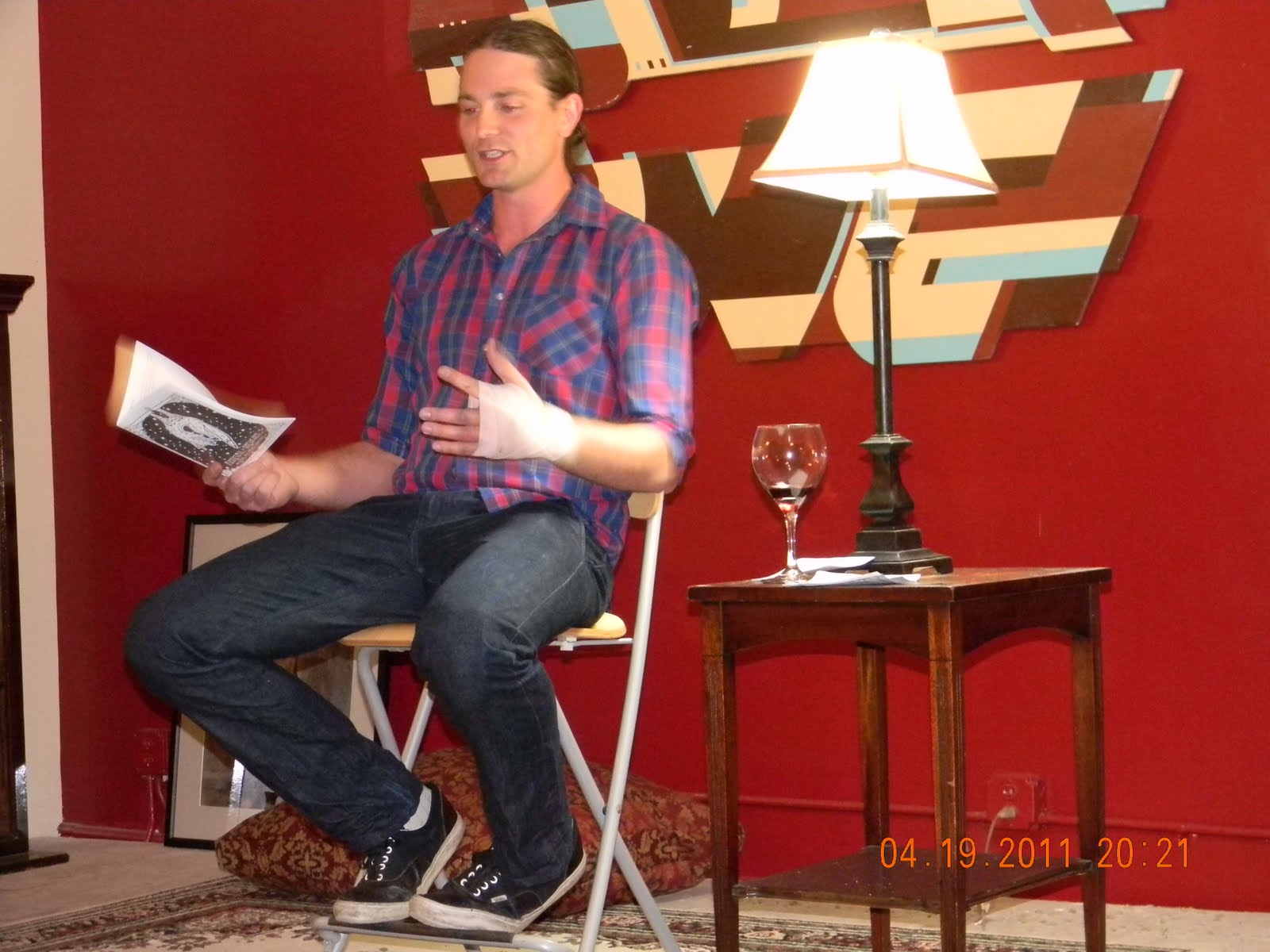
The local writers group I belong to–Staunton/Waynesboro/Augusta Group of Writers, aka SWAG–had its first open mic night on April 13. Six local writers–self included–read prose and poetry before maybe 12 people. The restaurant we were in, The Darjeeling Cafe, is awaiting its last government hurdle before opening to the public, but we could have a private party and “donate” money for a glass of wine. All completely above board.

The small crowd made getting up in front of some perfect strangers and reading my prose easier. The nice glass of Shiraz helped, too.

My first public reading was a decade ago, when a neighbor threw a book party for me to celebrate the publication of Rarely Well Behaved. The neighbor wanted me to read a particular story, her favorite, which included the use of the n-word by specific characters. It was essential to the story, not gratuitous, but it’s easier to write that word in the context of a fictional story than to read it aloud. I solved that by reading very fast, which meant people kept asking me to slow down. Next, I had a book signing and reading at a local Barnes and Noble. Again, the audience was people I knew, and I picked a different story, but I was still nervous.

What if they hated my work?

That’s the “what if” question that dogs my writing still and is probably what holds me back from pushing my work on agents and lit mag editors. For some reason it doesn’t matter that people read my work and compliment me and find positives in what I’ve written. I focus way too much on the fact that one person may hate it. I’ve long since given up changing my writing to please everyone else and write to satisfy my creative needs, but that insecurity drags me back.

For last night’s reading, I picked a story from Rarely Well Behaved, entitled, “When Gramma Came to Call.” The story is based on a dream, and though, on the surface, it appears to be a ghost story, it isn’t. I had a certain amount of comfort with it; it’s one of the less controversial of my stories. The audience laughed at the funny parts, commiserated when it got serious, and gave me a hearty round of applause. One person stayed behind after the evening was over to discuss it. It was a positive experience. I mean, I knew no one would likely boo me off the stage–we’re very polite here in the Valley–but there’s always the possibility you’ll put someone to sleep.

I know these are the things I have to do to be considered a “real” writer–do public readings, shamelessly plug my book, submit my work to places that will possibly print it (or reject it), encourage other writers by supporting their efforts to do the same. I’m just not a person who takes rejection well, and I can hear my therapist’s voice now telling me to separate the personal and professional. That’s hard to do when writing is for every writer a reflection of self, a glimpse into what goes on in our addled little heads.

So, next month at the next open mic night, I’ll be back up in front of strangers, baring my soul, and it’ll be fun.
_______________________

For National Poetry Month, here’s one of my favorite Seamus Heaney poems:

Requiem for the Croppies

The pockets of our greatcoats full of barley…
No kitchens on the run, no striking camp…
We moved quick and sudden in our own country.
The priest lay behind ditches with the tramp.
A people hardly marching… on the hike…
We found new tactics happening each day:
We’d cut through reins and rider with the pike
And stampede cattle into infantry,
Then retreat through hedges where cavalry must be thrown.
Until… on Vinegar Hill… the final conclave.
Terraced thousands died, shaking scythes at cannon.
The hillside blushed, soaked in our broken wave.
They buried us without shroud or coffin
And in August… the barley grew up out of our grave.

Demystifying Literary Magazines

Part of one’s growth as a writer is the whole submission/rejection/ submission/rejection cycle you undergo. If you’ve got thick skin and confidence in your craft and work, those rejections roll off your back. If you’ve got thin skin, a boatload of insecurity baggage, and confidence in your craft and work, every rejection slashes a rip in that skin, from which your ego flows.

I think it’s obvious which category I fall in. I have gone years between submissions because rejections of good stories without explanation is too depressing. Trust me, I understand the role of an editor. I was one. I know a lot of subjectivity is involved in making a decision about what to accept or reject. And I didn’t have the time either to give every aspiring aviation writer a detailed critique about why an article wasn’t appropriate for my mag. It’s just different when you’re on the receiving end of a rejection.

I also understand that a lit mag’s submission guidelines are deliberately vague and excruciatingly specific. They have to be specific about genre, word count, etc., because it’s no good to send a 10,000+ word paranormal romance story to a straight literary magazine whose guidelines specify 4,000 words or fewer. The vague part comes in when the guidelines describe the type of story the mag is looking for. Then, obscure words like “edgy,” “fresh,” or “distinctive” hold sway. I sometimes think that lit mag editors should say what they don’t want because, let’s face it, we all think our work is edgy, fresh, or distinctive. In some ways, I would almost rather hear, “Your story sucks,” than “I enjoyed reading your story, but it’s not for us.” The question that brings to mind is, “Okay, why?”–especially when you’ve hit the word count, you’ve followed the guidelines, and you know it’s a good story; otherwise, you wouldn’t submit it in the first place.

So, when I saw a Sunday afternoon seminar entitled “Demystifying Literary Magazines” offered by WriterHouse in Charlottesville, VA, I decided to exercise my new WriterHouse membership and attend. (Another great thing about being retired–you can join all those writer groups you didn’t have free time for when you slaved away in an office.) Another deciding factor was that Cliff Garstang, a writer friend from Staunton, was one of the panelists. He was representing his on-line literary magazine, Prime Number. Representing Meridian, the literary magazine of the University of Virginia’s MFA program, were Hannah Holtzman (Editor) and Lee Johnson (Fiction Editor). The panel’s moderator was Sarah Collins Honenberger, WriterHouse member and author of Catcher, Caught.

Honenberger asked the panelists to describe their magazines’ mission and vision, how they handled submissions, and the “brass tacks” of running a literary magazine. The Meridian editors explained that its mission/vision shifted with the editorial staff, which changes regularly as MFA students move through the program, but they were in agreement that the overarching vision was to print fiction and poetry that “takes a risk.” Unfortunately, what they meant by “takes a risk” wasn’t articulated. Garstang was more helpful in that he indicated what he wouldn’t take–work with bad grammar, work that’s been “done before.”

The discussion branched off into whether literary magazines were for other writers only or for the general reading populace. Meridian Fiction Editor Lee Johnson parried with, “Being by and for writers isn’t a bad thing.” But both magazine editors indicated the hope is that writers, of course, read their magazines and submit but that non-writers enjoy the content as well.

Did the seminar demystify literary magazines? Yes, in that the panelists described the underlying process for their individual magazines, something not so apparent when you read the submission guidelines on-line. I’d also have to say no to an extent, in that no one would admit that process concludes with a subjective judgement. It was, however, a worthwhile way to spend a Sunday afternoon, and even tidbits of knowledge go a long way on the writing journey.
__________________

For National Poetry Month, here’s a little poem a friend sent me to show that my disliked first name has a place, perhaps dubious, in literary history:

Phyllis by Thomas Randolph

Poor credulous and simple maid!
By what strange wiles art thou betrayed!
A treasure thou hast lost today
For which thou can’st no ransom pay.

Well, I’m no “simple maid,” so I figured out what he was talking about. Did you?

Quietly Arrayed

For years after my father’s death, I carried a copy of this poem, “Richard Cory,” by Edwin Arlington Robinson in my purse:

Whenever Richard Cory went downtown,
We people on the pavement looked at him:
He was a gentleman from sole to crown,
Clean-favored, and imperially slim.

And he was always quietly arrayed,
And he was always human when he talked;
But still he fluttered pulses when he said,
“Good morning,” and he glittered when he walked.

And he was rich–yes richer than a king–
And admirably schooled in every grace:
In fine, we thought that he was everything
To make us wish that we were in his place.

So on we worked, and waited for the light,
And went without the meat, and cursed the bread;
And Richard Cory, one calm summer night,
Went home and put a bullet through his head.

As a writer of prose, I’m hardly qualified to analyze poetry. Oh, in the variety of English and American Lit courses I’ve had, I studied the form and rhythms, memorized and recited poems for teachers who either dozed through 30+ kids reciting the same verses or criticized that the emphasis on particular words wasn’t quite right, presented Shakespeare soliloquies for final exams.

In my earlier post, “Discovering,” I highlighted some other poets and poems that were meaningful to me, and without getting too maudlin about this one, I thought I’d talk a bit about it as another homage to National Poetry Month. (Yes, I’ve been writing about writing a lot lately and not about “politics, society, and religion,” but don’t worry. I’ve got some socio-political religious commentary about burning books and its fallout roiling about in my head. Just be patient.)

I first read “Richard Cory” in high school. The English teacher walked in, put copies of the poem face-down on our desks, then told us to all turn them over and read. As some read faster than others, you began to hear a cascade of reactions. Then came the discussion. I remember one boy asked to leave the room. Apparently, the teacher had forgotten (or didn’t know) his father had shot himself, but in those days you didn’t run crying to your parents at every trauma. You sucked it up and went on.

“Richard Cory” has been analyzed as everything from a socialist take on modern capitalism, to a lament about the Great Depression, to sentimental sop. Some scholars have speculated that Cory must have had a physical issue–back then the only “acceptable” reason for suicide. Others have commented that despite that outward appearance of success and happiness, he led a lonely and empty life, and that’s what drove him to his final act. Since I was in my early stages of Marxism-Leninism, I probably considered Cory some depraved, exploitative capitalist who deserved what he got.

That poem was no more than a high school assignment for many years and forgotten; then, my father committed suicide one calm, summer morning, though not in the way Richard Cory did, not that any way is preferable. I was muddled for weeks after with that perpetual question, why. He left no note, and, of course, my brother and I, separately, decided it was our fault. Then, the poem “Richard Cory” appeared in the Washington Post. I don’t even know why it caught my eye or why I read it, but I did. In those four, short stanzas with the gut-punch ending, a burden left me.

This poem, more than any therapist who helped me, showed me there are some times when there is no answer to the question, “Why?” Theists, I’m sure, are certain there is an answer, but this poem gave me what I needed to go on.

And that is the power of poetry, that expression, so lyrically, of emotions we would otherwise quash or ignore. Let’s face it, some poetry is pap, and what I like someone else might think is pap. But “Richard Cory,” a short, succinct poem, saved my life, and I’ll just leave it there.
___________

If you’re in the Shenandoah Valley on April 20, please join the Staunton-Waynesboro-Augusta Group of Writers (SWAG) for our Poetry Fest at The Darjeeling Cafe in Staunton at 7 p.m. The featured poet reading her work is Sarah Kennedy. Local poets participating in the read include Lorraine Rees, Shea Anthony, Linda Levokove, Lauvonda Lynn Young, Elizabeth Doyle Soloman, and Paul Somers.

And Yet Another New Name

I wrote earlier in the year about wanting my blog to be taken more seriously, so I dispensed with the catchy, alliterative name, “Maggie’s Musings.” I thought about using “Rarely Well Behaved,” after the title of my book but decided that would be too confusing. Besides, I’d discovered by then people had misquoted Laurel Thatcher Ulrich. The correct quote is “Well behaved women seldom make history.” So, the blog became “Seldom Well Behaved.”

Yeah. Positively exciting. Look, it was the best I could come up with at the time, but I’m not a fan of it. In the three months since I changed the blog’s name to Seldom Well Behaved, I haven’t really come up with an alternative.

I like to change things around–I’ve never had the fear of change that can paralyze the accomplishment of anything from a new blog title to repealing Don’t Ask, Don’t Tell. My ex would come home after a trip and often find furniture moved around. One time I swapped the living room and the dining room, and even now in a brand new house, every few weeks I make some sort of little change–rearranging photos, moving lamps among the tables. The women out there understand; it’s not something we can articulate. It’s just something we do.

That being said, why is re-naming a blog so difficult? I’ll admit titles have never come easy to me. Many times I’ve written a story, given it to someone to read, and asked him or her what I should name it. However, titling a work has become easier over the years. I’ve reached the point where the story or the novel “tells” me its name. Now, if the blog would just cooperate, I wouldn’t be wasting a post whining about it.

So, let’s wind this up. A couple of weeks ago I ordered an iPad2, and because I did so on-line (rather than stand in line at a store) I got free engraving. My first iPod, a Nano, is engraved with “Deed not Creed,” a reflection of my commitment to Ethical Culture and trying to live an ethical life. What to engrave on the iPad2 came to me easily and also from an earlier post when this blog was called Maggie’s Musings. When I wrote about the six-word memoirs project I concluded the post with my six-word memoir, “I never took the expected path.” That sums up my life so succinctly that it even surprised me with its brevity and appropriateness–whatever others expected of me, I did just the opposite. If my parents were still here, they would be nodding their heads vigorously in agreement. It’s not a bad thing; it’s just me.

Welcome, then, to Maggie’s Musings, aka Seldom Well Behaved, and finally, Unexpected Paths.

My Day Two–VA Festival of the Book

There are few things that will get me out of bed before 0700 on a Saturday morning, but a book fair will do it. My Day Two at the Virginia Festival of the Book was going to start at the Book Fair at 0900. I hit the road a little before 0800, stopped to get my favorite road breakfast from Starbucks, and then I was on my way to C’ville.

The atrium of the Omni Hotel was a sea of books and authors. Cliche, I know, but it was. What was very heartening to see were the number of African-American authors showcasing their work. Virginia hasn’t quite “gotten there” yet, but we have come a long way. I decided to stop by the James River Writers table. That’s the organization sponsoring the contest one of my novels is in. I just wanted to say thanks for the encouraging e-mail I got from JRW–yes, I’m sure all the finalists got an encouraging e-mail, but it was especially encouraging to me. I introduced myself, and the person there blurted, “Oh, your book is in the contest! Congratulations! We’re so excited you stopped by!” Yes, I’m sure they said that to every finalist who stopped by, but it was nice they remembered me. They were so boisterous, in fact, people stopped and took notice, and the JRW folks pointed to me and said, “She’s one of our novelists!” Nothing like a little ego boost to start the day!

Both panels I picked that day were moderated by a writer friend of mine, also from Staunton, Cliff Garstang. (Cliff’s award-winning book of linked short stories is In an Uncharted Country.) Cliff is a voracious reader and lover of the written word, and he brought his enthusiasm for his art to both panels. The first, Death: Another Time, Another Place, focused on murder mysteries and featured John Connolly (Nocturnes, Bad Men), Alan Orloff (Diamonds for the Dead), Deanna Raybourn (Dark Road to Darjeeling), and Paul Robertson (Dark in the City of Light).

Connolly, being an Irishman with the gift of gab (aren’t we all?), was a great opening “act” for the panel, and he discussed how an Irishman writing about Ireland had been done before. So he came to America to be an Irishman writing about Maine. I had read one of his books some years back, so I picked up Nocturnes, a collection of short stories with a supernatural bent.

Orloff draws on his Jewish background for his featured book and familiar places–to me–in the Washington, DC metro area for his mystery. He has recently started a mystery series featuring a stand-up comedian. He also described his writing process–a substantial outline that he fills in. Quite the engineering approach, but he is an engineer.

Raybourn’s featured book was the latest in her Lady Julia Grey series that take place in Victorian England. A former teacher with degrees in history and English (like me), she picked the Victorian Era she said because she wanted all that proper repression “with the evil peeking out from behind the curtain.” Her humor and characters reminded me of Elizabeth Peters’ Amelia Peabody series, so I decided to try Dark Road to Darjeeling.

Robertson’s book, Dark in the City of Light, is about the Franco-Prussian War, but what I enjoyed about his talk was that he does the same thing I do–take real characters and a true story and weave a mystery about them. Whereas he focuses on the 19th Century, I’m in the 20th, but it’s the same concept. So, I added Dark in the City of Light to my bookshelf.

All the authors were so willing to chat afterwards that I found it rather refreshing. Connolly and I chatted about my Irish grandmother, then Raybourne and I talked about the challenges of teaching when you know you weren’t really cut out for it. The good day just kept on going.

The afternoon panel moderated by Cliff was Historical Fiction. As I’ve said, I guess what I write is historical fiction, just focused more on current events than far in the past. I had a question already framed about the importance of research, but Cliff was way ahead and posed it to the panel. Paul Robertson was a repeat from the morning, joined by Brenda Rickman Vantrease (The Heretic’s Wife), Lenore Hart (The Raven’s Bride), and George Minkoff (The Leaves of Fate.)

Vantrease’s featured book was her third with the concept of freedom of thought and religion. She took a real person associated with Sir Thomas More and made that person’s wife (whose name is lost to history) the protagonist. She also showed More in an accurate light. Many people choose to ignore that he burned  at the stake a lot of people he considered heretics.

Minkoff has spent years working on a trilogy which takes place in England and America around the time of the Jamestown Colony. John Smith, Powhatan, and Pocahontas are key characters, but accurately portrayed. Minkoff has also studied the language of the time and has his characters speak like true Elizabethans. It was obvious the tremendous amount of research he’s conducted to produce this trilogy, but he emphasized the point that you research to put yourself in the time and place, you read book after book for that knowledge, but you don’t just regurgitate what you’ve read. The research gives you the voice.

Hart, named for the Lenore in Poe’s “The Raven,” decided not to ignore that connection she had with Poe, but she didn’t want to write historical fiction with Poe as the main character. “Done to death,” she said. She opted instead to write about Poe from the point of view of his dead wife–the lamented Lenore and Annabel Lee of his poetry. She read from the first chapter of The Raven’s Bride, a scene where Mrs. Poe goes to hospital to see her “Eddie,” and it takes her a few minutes to realize she’s a ghost. I’d already purchased Robertson’s book, so I added Hart’s to my collection.

It was a great two days of books and writers. I love being around writers, especially those who’ve enjoyed initial success. They are so accepting of fans and other aspiring writers, so much so that for next year I can see myself on the other side of the table, maybe signing my book. Yep, I can’t wait ’til the next Virginia Festival of the Book.