Reality is Just a Crutch for People Who Can’t Handle Sci-Fi

The title of this post I took from a small sign I bought many, many years ago at a sci-fi convention called Balticon. I always put it in a prominent place in every cubicle or office I’ve ever had. I’ve loved sci-fi since I first started to read something other than Dick and Jane and endured ridicule for it from friends and family. My mother swore reading sci-fi would give me nightmares because covers of paperbacks books back then were pretty lurid–a lot of big-headed, bug-eyed, multi-limbed aliens menacing a buxom blonde. Many times, the story within had nothing to do with the cover, but covers sell the book.

And, of course, I gave writing sci-fi a try, thinking I was good enough as a teen to submit to the venerable sci-fi genre magazine, Fantasy and Science Fiction. The rejection didn’t discourage me from writing, but it did make me realize that I was a better sci-fi reader. One of my short stories, published last year in eFiction Magazine, has a sci-fi hint–it’s the story of a professor hired for what seems is her dream job, then she finds out it involves time travel. Since it was a character study, I didn’t need to go deeply into the physics of possible time travel.

I know I’m about to offend some, but to me sci-fi is space, spaceships, space travel, traveling to other planets, encountering aliens (“new life and new civilizations”), living or co-existing with same with the concomitant problems, and time travel. To me it’s not telepathic cats, even if they live on another planet, any form of elves, pixies, ogres, orcs, dragons, or quasi-medieval themes. That’s fantasy or its derivative, sword and sorcery. But Sci-Fi as a genre is very forgiving and has fans who are always open to genre smash-ups.

Now, I have enjoyed some fantasy–Marion Zimmer Bradley’s Darkover series, Anne McCafferty’s Pern series, Conan the Barbarian, Red Sonja, Tolkien’s books, among others. I’m currently on book five of George R. R. Martin’s multi-volume A Song of Ice and Fire. But I always go back to what, again to me, is pure sci-fi. Bradley and McCafferty infused some sci-fi into both series, but the sci-fi aspects were always secondary, so far in the past, they were myths and legends, and I could never accept how women were treated in Bradley’s Darkover novels.

One of my favorite books of “pure sci-fi” is a collaboration by Larry Niven and Jerry Pournelle, The Mote in God’s Eye. This book involves a quasi-military, human space fleet sent on a first contact mission to a newly discovered planet with life. It’s a well-written and well-spun tale of the things that go right, and wrong, with a first contact, and Niven and Pournelle meshed so well as writers, you can’t tell two people wrote the novel.

A few weeks ago, another writer from my local group, SWAG Writers, approached me with an offer to collaborate on a sci-fi piece. I demurred because I still don’t think I’m a sci-fi writer, but his concept was interesting. Then, I remembered finding a snippet of something I wrote probably more than thirty years ago (I could tell it was type-written.), and I pulled it from its hiding place and re-read it. There was something about it that could fit with my fellow writer’s premise, and I transcribed it as is as a Word file and sent it off to him. What came back was great–excellent enhancements of what I’d written, including an incredible character name, and an addition of a blaster-battle (somewhat requisite)–and I riffed off that to the tune of about 2,500 words late on a Friday night.

I get it now that I don’t have to be an astrophysicist to write sci-fi, and sci-fi has always issued a wealth of memorable characters. So, I’m having fun with collaboration, and I’m looking forward to seeing where it’s going to go–short story, novella, novel, who knows? But that’s the anticipation, and the lure, of writing.

How about you? Have you ever collaborated in your writing? How did it go? Who are your favorite collaborators? Would you take up an offer to collaborate?

Another Friday Fictioneers!

And Friday rolls around again, and it’s a busy day. Friday Reads, a hair appointment (yeah, I’m hiding my age as long as possible), and–drum roll–Friday Fictioneers! After a lifetime of working, Friday was always my favorite day of the week. Friday Fictioneers is just icing.

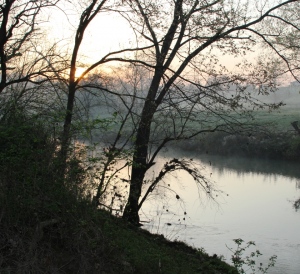
I’m sure a shrink would have a field day with my psyche, given the fact that Madison Woods posts these beautiful pictures of nature, and my mind immediately goes to the Apocalypse. It has to be all those sci-fi B-movies I saw as a kid, but today’s 100-word fiction will just prove I’m eccentric. In a good way.

Here’s the lovely photo:

And here’s yet another end-of-the-world-as-we-know-it story.

Survivor

The beauty of the sunrise let him ignore reality.

Inside his cave, he had supplies to keep him for months, perhaps a year, and the river meant fresh water.

He wondered how long before survivors made it this far. By the time that happened, starvation and survival at all costs would have rendered them something less than human. That thought made him check his weapons and ammunition again.

But he would have some time before he had to face the inevitable. Until then, he had the murmuring river, a soft wind rustling the leaves, and the beauty of the sunrise.

———————-

I’m really not a survivalist, and I don’t really think we’re doomed. Honest. Anyway, go on over to Madison Woods’ blog and read some 100-word fiction from normal people.

A Note to Nikki Haley

Dear Gov. Haley,

You don’t know me, but I feel like I know you. I mean, I’ve known many women politicians who go against their own interests simply to win an election and curry the favor (no pun intended) of men, and not just Republicans like you.

On a recent broadcast of “The View,” you said something to the effect of “Women aren’t concerned about birth control. They’re concerned about the economy and jobs.” Respectfully, ma’am, your chief of staff needs to change the channel on the gubernatorial television from Fox News to some alternative. Then, you will see women are concerned about birth control and the loss of access to it because, well, it’s pretty simple–women can’t participate in the economy and have jobs if they’re perpetually pregnant. And the other, simple matter is that women get to decide whether or not to be pregnant, something I’m sure you’ve done at some point in your life. I suspect you were very careful not to get pregnant during that alleged affair you supposedly had, so I bet you were pretty concerned about birth control then and gave no thought to the economy.

I can understand–but not excuse–your dismissal of the importance of birth control. After all, the country of your heritage once used abortion as birth control when couples discovered they were having a daughter. I can see how that would mark you, that is, if you bothered to acknowledge that heritage. India, by the way, distributes birth control, free of charge, because they’ve grasped the concept of over-population and its deleterious effect on the economy.

Let me tell you a little story about my Irish grandmother. (Ireland is the country just west of England–I remind you because your narrow-mindedness about birth control makes me wonder if you know of anything beyond our shores.) My grandmother was a midwife in Virginia. One of her patients in the 1930’s had married at the age of 15, quite common in rural areas back then, even rural areas of South Carolina. By the time that woman was 30, my grandmother had delivered her 13 children. The thing that stood out for my grandmother, who was only a few years older than her patient, was that this 30 year old woman, who had been “a beautiful child,” according to Gramma, had gray, thin hair, weighed barely 100 pounds, had lost half her teeth, looked 60, and could barely stand. My grandmother tried to teach her the rhythm method of birth control, but the woman explained she couldn’t say no to her husband. She was dead before she was 35 and had three more children. The last one killed her.

Is this what you want us to go back to? Is this what you want for your daughter? Or your son, for that matter?

If you think women aren’t concerned about birth control, you haven’t paid much attention to the polls showing that independent, women voters are not supporting Republican candidates or their policies and are citing the recent birth control brouhaha as their reason. As a Virginia woman’s sign said at a recent protest in Richmond, “I can’t believe I’m still fighting about this shit.”

Women are concerned about birth control because that’s the single thing which has allowed us to be full partners in the economy. We’re concerned about birth control because we understand family planning is to the benefit of the family. You might say birth control is a family value.

Sincerely,

A Post-Menopausal Woman Who Always Will Be Concerned About Birth Control

Oh, To Be in Paris Now that April’s Here

I’m a little behind in my movie-watching, but tonight I watched “Midnight in Paris.” I can take Woody Allen’s movies or leave them. Some have been brilliant, and some are just the same story retold. “Midnight in Paris,” however, is like porn for writers–it gets your writerly blood moving to all the right places. Seriously.

In the movie, an aspiring novelist on vacation in Paris with his fiancée is somehow transported each night to the Paris of the 1920’s. There, he meets every famous author and artist from that period. Gertrude Stein helps him polish his manuscript, and despite a tempting offer to stay in the past from a mistress of both Picasso and Hemingway, he goes back to his present and, ultimately, his future as a writer in Paris.

I started wondering how I would react to meeting the writers I studied in high school and college or the ones I’ve read and admired over the years, other than being speechless with shock. I’ve never been a Hemingway fan, with the exception of the short story, “The Short, Happy Life of Francis Macomber,” and the novel The Old Man and the Sea. So, he and I would probably have little to discuss. He would be a great drinking companion, however.

Fitzgerald, though, would be someone I could talk to all night. He and I could compare notes about how he dealt with Zelda the nutcase and how my father did the same with my mother. And Gertrude Stein–wow, that would be an amazing conversation. We could discuss lost generations–hers and ours in the 1980’s.

Several years ago, for a trip to New York City, I had the opportunity to stay at the Algonquin Hotel–the Dorothy Parker room, no less. I ate dinner there and could almost hear the voices of Parker, Sherwood, Ferber, et. al., at their famous Round Table. (The first editor I worked for as publication assistant was a “adjunct member” of the Round Table, and I loved her stories about those famous lunches.) I felt pretty cool, sitting at table in the Algonquin Hotel dining room, having a delightful dinner and wonderful wine, while jotting story ideas in my Moleskine. Yes, I thought that was an authentic touch.

Do writers imbue places with their essence to inspire future writers? Who knows, but maybe the inspiration comes from walking the same streets or sitting the same room. Maybe the inspiration is ours, and a shared history brings it to the surface.

If you were the 21st Century author in “Midnight in Paris,” which writers would you want to go back in time and meet? Believe it or not, I’d want to meet Thomas Hardy. Why? I’ll write about that some other time.

Friday Fictioneers–Yay!

Friday again, and that means Friday Fictioneers–a great reason to look forward to the weekend.

This week’s story is more personal than my usual fare, but the picture connected precisely with an event in my life that happened thirty years ago. Here’s the photo:

And here’s the story, which, technically, is fiction:

The Last Place Father Was Alive

The Irish in her made her walk the land one last time before it sold.

Liam was at her side, where he always was, camera in hand so she would have memories.

She stopped when she rounded the bend and saw it. Liam jogged ahead, camera up and snapping. He shifted to shoot from different angles.

She thought that damned truck had gone to the junk yard. If she’d known they’d just hauled it down here where she would find it…

“Take a look at this,” Liam called to her.

The shake of her head was slight, and he knew.

———————–
A little cryptic, I know. If you’re curious, contact me by e-mail, and I’ll explain.

In the meantime, check out more Friday Fictioneers at Madison Woods’ blog.

Politics Wednesday – Rhetorical (or not) Questions

Why is it that the health care mandate is infringing upon our freedom but forcing a woman to have a medically unnecessary ultrasound is not?

Why does health insurance cover the cost of Viagra but not birth control? Or vasectomies but not tubal ligations?

Why would we entertain the presidency of a man who needs a car elevator in his oceanside mansion in California?

Why would Rick Santorum call Romney the “worst possible Republican to run against Barack Obama” one day then concede he’d do whatever the country needed for him to do when asked if he’d be Romney’s VEEP?

Why did Justice Clarence Thomas “forget” to include his wife’s income from various right-wing, anti-health care organizations on his financial disclosure statements when the documents clearly ask for that information? Ancillary question: Why wasn’t he disciplined for that? Second ancillary question: Why hasn’t he recused himself? Third ancillary question: Why doesn’t he ever speak during oral arguments?

Did Medicare pay for Dick Cheney’s heart implant? (No, that’s not a typo.) If so, do the Republicans (especially Rep. Paul Ryan) know that?

Can George Zimmerman sleep at night, knowing he stalked and killed a 17-year old holding a can of Arizona Tea and a bag of Skittles? No, seriously, how does he live with himself?

Why does anyone with a vagina support Republicans?

When did conservatives decide being mean, vindictive, and hateful was an election strategy?

Why are we still fighting two wars and contemplating others, because, you know, the others have been so successful? (That was sarcasm.)

Why do people who call themselves Christians act so un-Christ-like to other religions or to Atheists?

Why do Republicans lie about, well, just about anything?

Why does a Presidential candidate need a lobbyist to get his house plans approved by a local government entity?

Has Newt Gingrich forgotten what hypocrisy means? Or does he really just believe that we should listen to him and ignore his actions, past and present?

Is Ron Paul really that cantankerous or is it an act?

Since Rick Santorum is a devout, practicing Catholic who believes that sex is only for the purpose of procreation, have he and his wife stopped having sex? Same question for Newt and Callista.

Don’t you think people who are sanctimonious about religion should be above reproach or else just shut up about it?

Since when did having a college education, something that the Greatest Generation fought to assure for their children, make you a snob?

Why was an Iraq vet who asked a perfectly legitimate question of a Republican governor called an idiot? Is this how we’re supposed to treat the people whose asses were actually in danger while your large posterior occupied any number of creaking chairs?

Why are we blaming an article of clothing for the death of a 17 year-old youth instead of the man who put a 9 mm round in his chest for the audacity of walking in a gated community? Why isn’t anyone talking about the fact that if black Trayvon Martin had shot and killed white George Zimmerman, Martin would be in jail now or, more likely, would have been shot by the police responding to the 9-1-1 calls?

Why do I persist in asking questions that only upset me and should upset you?

Because someone has to.

Plot Versus Character

During the Q&A session for the “Thrilling Me Softly” panel at Virginia Festival of the Book last week, the dreaded question came up almost immediately: Which is more important–plot or character? What ensued reminded me of debates between seasoned flight instructors: when you’re coming in to land, which is more important, power or pitch? (Turns out, it’s a balance, and you have to manage both well, especially if the engine quits.)

“Plot or character?” is a question in the league of “When did you stop beating your spouse?” In other words, there’s no good answer.

The members of the panel gave it a try, though it ended up being three to one, character to plot. One author, who shall remain nameless, disdained the notion that characters take over. “My characters do exactly what I tell them to do,” he declared, and he believed an intricate, well-wrought plot is more important. One panelist countered by saying she gets an idea for the plot, but she has to have the characters fleshed-out before she can bring them together.

I looked over several of the plot proponent’s titles at the book fair and scanned some pages of each. They are well-executed thrillers, with, indeed, intricate, well-wrought plots. Though I didn’t read much of each book, I could see his main character, however, was the stereotype of an unyielding federal law enforcement officer and probably not very complex.

I’m not dissing thrillers. I read a lot of them because they’re great escapist fun, though they seemed to be of a distinct right-wing bent. That alone means I’ve usually forgotten them a day later. A book or short story speaks to me and stays with me if there are multi-layered characters, people I can “see” on the street or in my life. I’m not a big Hemingway fan, but the old man from The Old Man and the Sea has stayed with me for forty years. The plot of a Vince Flynn pot-boiler–nope, can’t remember a thing.

The “thrillers” I have liked are those by John Le Carre or Alan Furst, where the world of espionage is populated by rich, realistic characters you come to know and worry about, and they are involved in a convoluted plot with multiple threads to be tied up at the end. They combine the best aspects of plot and character and are more literary than genre works.

I think, like a well-executed landing, a memorable work of fiction has the perfect balance of character and plot. Weigh in–what do you think? Plot? Character? Or both?


Virginia Festival of the Book – Fourth and Final Day

It seems like yesterday when I attended my first panel at the 18th Virginia Festival of the Book, but here I am done at last and eager for next year.

Today was “Pub Day,” with panels focused on all aspects of publishing from eBooks to agents. Running concurrently were “Crime Wave” panels, featuring authors and publishers of crime fiction, mysteries, and thrillers. I picked some from each.

My first disappointment in a panel for the entire festival was “Pub Day: eBooks,” so I won’t list the panelists. When the first question from the moderator to the panel is “What is an eBook?” and the answer from a panelist is, “It’s a book without pages where the text flows,” you know it’s a waste of your time. I’m certain the vast majority of attendees at the Festival were aware of what an eBook is, given the number of Kindles and Nooks I saw about. Add in the fact that the opening panelist hemmed and hawed and even asked the audience for the word she sought, I decided to leave and prowl the Book Fair.

“Pub Day: Making the Breakout Book” was an interesting offering. On the panel you had Robert Goolrick (A Reliable Wife); his agent Lynn Nesbit; his editor and publisher Chuck Adams of Algonquin Books; and his publicist Kelly Bowan, also of Algonquin Books. This was an in-depth glimpse to the entire process of querying a book, having your agent sell it, editing and revising it, then having it marketed.

I broke away from Pub Day to go to “Crime Wave: Thrilling Me Softly,” which featured four authors of successful suspense, mystery, or thriller books. Jane Bradley (You Believers) based her novel on a true story–after a visit from the dead victim in a dream. John Milliken Thompson found the idea for The Reservoir while researching Richmond, VA’s Civil War history. Gary Kessler also drew on a real event and some local Charlottesville history for What the Spider Saw. John Gilstrap writes a series of books featuring a hostage rescue team, the latest of which is Threat Warning. All four had lots of good tips about pacing, and though there was a difference of opinion about the importance of characters versus plot, each had good suggestions for doing your best on both.

It was back to Pub Day for “Agents Roundtable.” Three agents–Erin Cox of Rob Weisbach Agency, Byrd Leavell of Waxman Agency, and Deborah Grosvenor of Grosvenor Lit–gave a frank and detailed talk about how to approach an agent, how to query them personally, and to “match” your work to a specific agent. The most interesting aspect of this was none of them indicated they would be deterred by a query from someone who had self-published. Each of them stated that with the publishing industry in such turmoil right now,  they couldn’t ignore a prospect from any source. That was more open-minded than I had expected.

And, the day was done for me. It’s hard to believe that this year’s Virginia Festival of the Book was over so quickly. Even though it’s not particularly craft-focused, I got a wealth of helpful information in bits and pieces. I’m glad my Commonwealth supports creativity in this way. I’m already looking forward to next year.

As each of the moderators said, the Festival is free but it’s not free to produce. Please consider going to the Web site and contributing to a great way to bring writers together.

Virginia Festival of the Book – Day Three

Day Three of the Virginia Festival of the Book started early for me. I got up at the crack of dawn to make certain I had time to do my Friday Fictioneers’ 100-word flash fiction post. That done, it was time for breakfast then to hit the road.

The first panel, “Fiction: Crossing Boundaries,” was about family drama, loss, and love. Both Joe Lunievicz and Elzabeth Nunez had been on other panels I attended yesterday. Lunievicz hadn’t read from his work (Open Wounds) the day before, but today he did. The passage he read confirmed that my decision to buy it was a good one. Nunez read from a different book today, Boundaries, and revealed a subtext about the publishing industry in New York, so I purchased it.

Even though I’m not an alumna of the University of Virginia MFA, I attended an alumni reading next. Of particular interest to me was Chad Harbach, who read from his debut novel, The Art of Fielding. I have gone back and forth on buying it because it seemed for every good critique of it, there were three negative. The passage he read convinced me to make the leap to buy it for my Kindle. Brittany Perham read from her book of poetry, but, frankly, she’s a “modern” poet; I thought she was incomprehensible. Eleanor Henderson read from her novel, Ten Thousand Saints, and it was an intriguing glimpse into a family in Vermont that was both fascinating and disturbing. It’s a possibility for the Kindle.

Though the panel “Readers and Social Media” was supposed to be about how to communicate with readers using social media, it was really more about author use of social media in general. However, panelists Susan Gregg Gilmore (Looking for Salvation at the Dairy Queen), Rebecca Hamilton (co-founder of Friday Reads), Bethanne Patrick (An Uncommon History of Common Sense and co-founder of Friday Reads), and Elizabeth McCullough (Book Balloon) clued us in on not just social media resources but additional web sites for networking and marketing.

If “The Art of Short Fiction” sounds familiar, it was the same as a panel on Wednesday but with different authors: Erika Dreifus (Quiet Americans), Jeremy Griffin (Last Resort for Desperate People), Cathryn Hankla (Fortune Teller Miracle Fish), and Tamra Wilson (Dining with Robert Redford). They each read from their works, but the same moderator from Wednesday asked the same questions she had on Wednesday. Griffin’s and Wilson’s works stood out, and I’m thinking about purchasing their short story collections.

I ended the day with “Fiction: Reconstructions” with three novelists who dealt with war and its aftermath. Casey Clabough (Confederado) and Taylor Polites (The Rebel Wife) dealt with post-Civil War reconstruction. Clabough’s novel was based on an ancestor of his who was a member of Mosby’s Rangers. After the Civil War, many of Mosby’s men and many more southerners fled to Brazil, including Clabough’s relative. The novel takes on a little-known aspect of southern history, and I purchased it to add to my “books about/involving Mosby” collection, though this is the first novel. Unfortunately, Polites lost me when he referred to slaves as “devoted servants.” Starnes’ novel deals with a World War II vet who isn’t a particularly nice person, but he has redeeming moments. His novel is also notable for having portions of it in the point of view of a dog. The selection he read was earthy and guttural, and I’m considering purchasing it.

Tomorrow is publishing day–with a little dip into writing thrillers.

Early Morning Flash Fiction

I hate missing Friday Fictioneers, so I’m up early–well, early for me–to participate before I head off to today’s offerings at the Virginia Festival of the Book.

On first look, I thought today’s inspiration photo from Madison Woods’ was going to be a tough one to come up with something. Then, as the alarm jolted me awake this morning, I brought the picture to mind and remembered the perspective; then, it popped into my head. Here’s the photo:

And here’s my 100-word story:

Prey

The leafless branches give me little cover, but at least I can see the ridge.

I should move, but I’m too tired. There is a point where the adrenaline kicks in, pushing you beyond the limits of your body. That, too, has a limit, and I’m there.

I have to keep my eyes open.

My ragged breathing alone probably echoes in the valley and signals my location. I try to be quiet.

My eyes scan the ridge again as the sun dips below it. Soon, it will be deep dark, and I won’t see when they come for me.

—————
For more 100-word fiction, go to Madison Woods’ blog. You could spend the whole day there. 😉