James River Writers Conference 2012

As with anything that’s successful and grows, change can be upsetting to some. James River Writers had held its annual writers conference at the Library of Virginia for several years. As a first-time attendee at last year’s conference, I saw it was obvious the conference had outgrown the Library, wonderful venue that it is. Last minute room switching because some presentations were more popular than others meant clogged hallways and confusion.

The Greater Richmond Convention Center hosted this year’s James River Writers Conference (the tenth!), and I was pleased. Light, roomy, airy, the space almost made the conference seem small, but the meeting rooms were larger, as was the exhibit space. The conference fee this year included lunch for both days of the conference, which was very convenient, and the food wasn’t too bad either. Also, the conference was part of the Virginia Literary Festival this year, and it’s a good fit.

Still, there were plenty of people who lamented not being at the Library of Virginia, but some people just can’t handle change. I, for one, am pleased to see the success of James River Writers’ annual conference. It has the potential to be a showcase event for the Commonwealth–and heaven knows we need to emphasize our contributions to the arts since we’re stuck back in the 19th century in so many other areas.

I attended a total of six workshops over the two days, all good, but one in particular stood out: Writing Diversity. I almost didn’t go to this one, and am I glad I changed at the last minute. I had slated myself to go to “Publishing Industry Issues Demystified,” but when I arrived at the conference on Sunday morning, I realized this would probably be repetition of several articles/blogs I’ve already read on the publishing industry. “Your Day Job and Your Book,” wherein you learn how to apply project management concepts to writing, seemed too much like my old job, and “How to Survive a Plot Collapse” just didn’t sound appealing. So, “Writing Diversity” it was.

The description didn’t do this workshop justice: “Panelists discuss the importance of diversity in fiction and nonfiction, issues of cultural appropriation, and ways they write people of many ages, ethnicities, classes, and more.” It was a powerful discussion of why literature should reflect the make-up of society and a challenge to writers to write outside the boundaries we find so comforting.

The panelists were Jonathan Coleman, Camisha L. Jones, Malinda Lo, and Lila Quintero Weaver. They are, respectively, an older white guy, an African-American poet, an Asian who proudly describes herself as “queer,” and a Latina, who lived the life of a South American immigrant in rural Alabama. That’s probably the most diverse panel I’ve encountered in two years of attending writers conferences.

The panelists told us that by sticking to characters who reflect us (in my case, a middle-aged white woman), we limit our focus as writers, and in that aspect we limit our voice. There was understanding of the reluctance to write a character who’s gay but you’re straight, who’s ethnic but you’re not, but, as Malinda Lo said, you can overcome that by “doing your research.” Lo emphasized that the overall civil rights struggle is ongoing, especially for gay, lesbian, bisexual, or transgender people. “There is a need,” she said, “for stories where it’s okay to be gay, stories that normalize what we now consider the ‘other.'”

Most of the panel directed their remarks to writers of young adult or middle-grade fiction with an emphasis on showing those age groups strong characters who are like them. Jones said by doing this, writers “help people see one another’s humanity” through their stories.

A question from the audience encompassed what many of us were thinking: If you write about a character you’re not, will you be taken seriously? Coleman replied, “If your writing is good, if it’s your best work, you’ll be taken seriously. Just don’t over think it, and take a risk.”

Jones added, “Just because you’re white doesn’t mean you can’t write about diversity. I would like to see stories by white people about the pressure on them to conform to racism. That’s an important story to tell.”

Weaver said, “When you don’t see yourself reflected in literature, it’s not interesting to you. You have to have characters who look like all your potential readers.”

The final question engendered a passionate response from Lo. A writer indicated that she deliberately wrote characters for her middle-grade books so their gender and ethnicity were “ambiguous” and asked if that weren’t the better way, so any child could see themselves in the story.

“Say what a character’s race is,” Lo said, “because ambiguity reads as white. A character should not be a blank person.”

I could have gone to a day-long workshop on this subject with these panelists, and this was one panel whose challenge I’ve accepted. This panel and these writers, more than anything, made this conference a complete success for me.
A Bittersweet Friday Fictioneers

One of the most difficult things in the world is to come up with something unique, and one of the most satisfying things in the world is when that idea grows into something beyond your wildest dreams. In doing so, it can come to consume your life. Add to the fact you have a full-time job that pays the bills, and something has to give.

Friday Fictioneers, founded by Madison Woods, is evolving. Madison has decided to give up the reins to focus more on her own writing. This is something I totally understand. I gave up my dream job and retired to do the same. I should say that Friday Fictioneers won’t be the same without her inspiring photos and her unsurpassed enthusiasm, but in fact it won’t be the same. Change requires adjustment, but it is always good. Rochelle Wisoff-Fields, a Friday Fictioneer from the beginning, or close to it, will take the baton and run with it, and she’ll be a winner.

Madison will still participate as a writer, which is good because I look forward to her 100-word stories as much as I’m looking forward to buying the book she is editing, but I still get a sad sense of “The Queen is dead; long live The Queen.” One thing will always be true: There would have been no Friday Fictioneers, no on-line writing community with that name, no challenge to tell a story in 100 words, and a lot fewer writer friends I’ve made without Madison. This is something she can look back on and declare, with pride, “I did that.” And for that, we Friday Fictioneers are all forever grateful.

Probably because it’s the season, today’s story involves some political commentary. If you’re offended by knee-jerk, bleeding-heart liberalism, then you probably shouldn’t read it–just remember, flame me, and you end up as a character in a story, and in that story you’ll meet a nasty end. Just kidding. A little.

The story is “An Inverse Relationship,” and if you’re the first one to guess, and provide the answer in a comment, which classic work of fantasy I derived the title from, I’ll send you a free copy, signed and personalized, of my book Blood Vengeance. 

If you don’t see the link on the story title above, scroll to the top of this post, click on the Friday Fictioneers tab and select it from the drop-down menu. Support Friday Fictioneers by reading and commenting on others’ stories. You can get to them by clicking on the icon after the end of my story.

Spy Flash – Week 26

When I accepted Jennie Coughlin’s Rory’s Story Cube Challenge six months ago, I really didn’t think I’d still be at it now, but it took on a life of its own.

As I indicated when I started on this adventure, I looked upon it as an opportunity to flesh out back story on two characters I thought I knew pretty well. Suffice it to say, I learned a few things about them, and, despite what some may think, they talked to me and explained many things about their personalities. I never thought I’d turn these vignettes into a book, but when the thought of that struck me, it made the challenge much more exciting.

For example, who knew I’d need to come up with something other than the obvious to deal with the recurring pyramid cube? But it’s all in how you perceive the meaning of the cubes, and sometimes it isn’t as cut and dried as you think.

So, if you’re still reading along, you need to read the story for Week 26 soon because within the next week to ten days, I’m taking down all the existing Spy Flash stories and, well, you’ll have to buy the book. Please? I’m not stopping taking on the challenge, and, who knows, maybe in six more months, there’ll be a Spy Flash 2 collection?

This week’s story, “Cleopatra’s Barge,” features a character from a trilogy I wrote and am editing (A Perfect Hatred) about an act of domestic terrorism based on the Oklahoma City bombing. The character, John Thomas Carroll, is the bomber, in prison and awaiting his execution. One thing we know about the character Mai Fisher is that she keeps her word, and she’s made a promise to the bomber, whom she tried to turn, which she intends to keep. That doesn’t set well with Alexei Bukharin, who is the other significant character in this week’s story, though he’s never named. In the trilogy Carroll never knows Alexei’s name, so I didn’t change that.

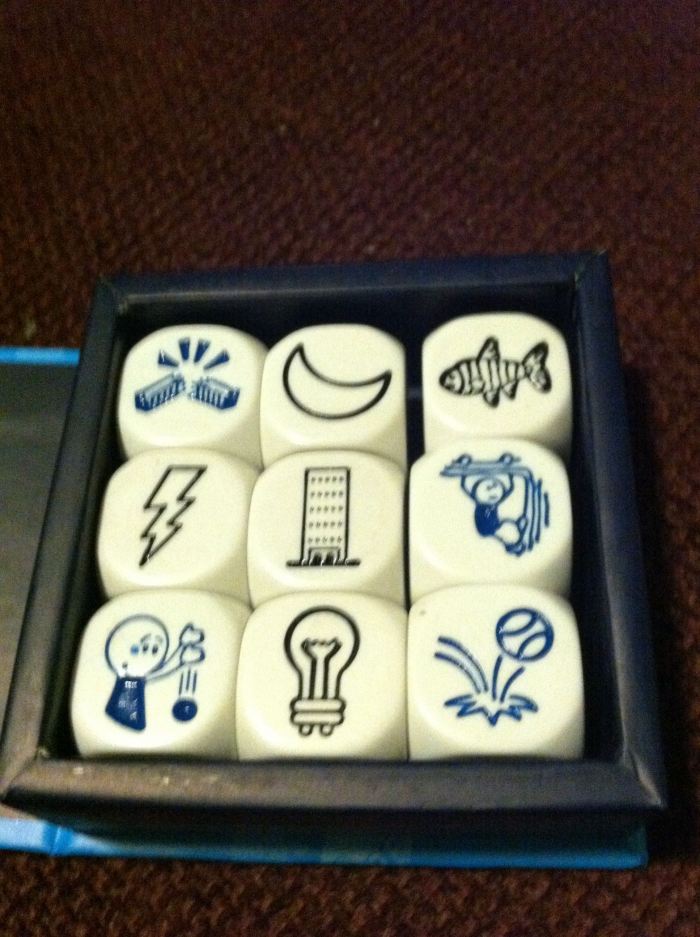
Here’s this week’s roll of the cubes:

And here’s what I saw: l. to r. – breaking; a moon; a fish; a lightning bolt; a building; up in a tree/climbing a tree; dropping the ball; a light bulb; a bouncing ball/playing baseball.

If you don’t see the link on the story title above, then go to the top of this post and click on the Spy Flash tab then select “Cleopatra’s Barge” from the drop-down menu.

Look for Spy Flash in December as a paperback or an eBook on Amazon.com.

Spy Flash – Week 25

Within the next week, I’ll have accumulated half a year of stories in response to Jennie Coughlin’s Rory’s Story Cube Challenge. (I got behind and combed two weeks into one story, which is why there will be twenty-five stories instead of twenty-six.) About three months into the Challenge, I decided I’d amass the stories into a collection and publish the collection via Kindle Direct Publishing. Short story collections are notoriously hard to be picked up by publishers, and add in the fact that these short stories are flash fiction and mostly fall in the “thriller” genre, and Kindle Direct was the only logical answer.

But Kindle Direct has helped in a revival of short stories for both traditionally published writers and self-published ones. Kindle Singles started out as essays, but many publishers, and authors, saw it was an easy to get a short story published. Many traditionally published authors come under pressure from their publishers to keep their name before the reading public between books, and Kindle Singles fit that bill as well.

But I digress. Once I started putting together the manuscript, I saw it had a certain incoherence if I left the stories in the order in which they appeared in this blog. I spent some time deciding when each occurred. For a few that was obvious because the story wouldn’t have context without the date. One story’s title is a date, after all. Once I assembled the stories in more or less chronological order, they had a certain flow. Good decision, that.

The novel in stories is quite popular lately. From Jennifer Egan (A Visit from the Goon Squad) to Molly Ringwald (When It Happens to You), novels in stories have made a mark. Writer friend Cliff Garstang’s new book, What the Zhang Boys Know, is another example of a novel in stories. Basically, each story can stand alone, and, in fact, most of Garstang’s twelve stories in this book were published separately in literary journals before the novel came out. For the work to be considered a novel in stories, each of them has to be a piece of a larger or overarching story arc.

Can you have a novel in flash fiction stories? We’ll see.

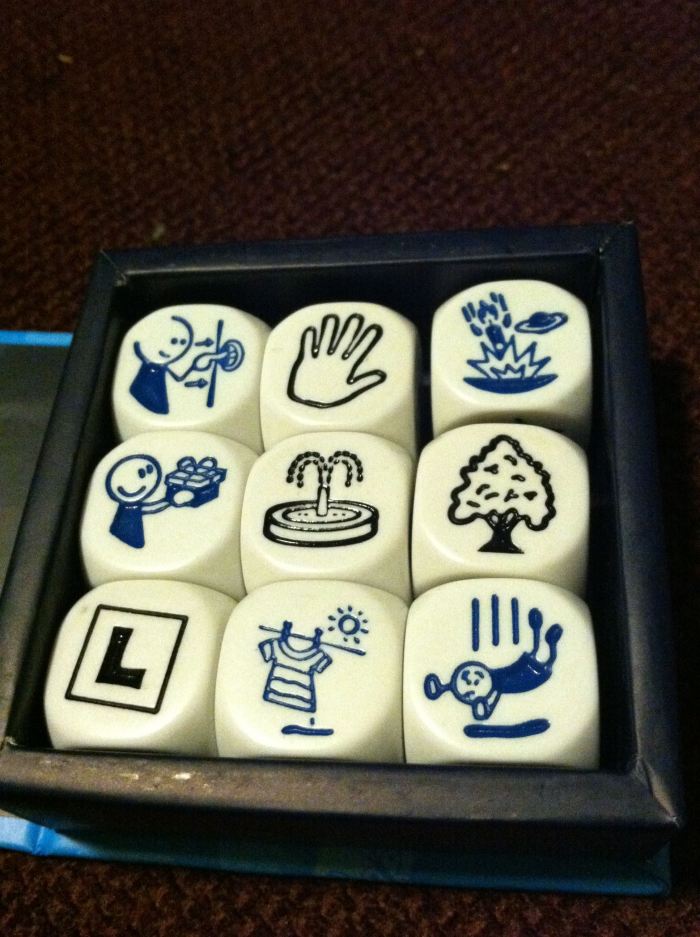
This is last week’s roll of the cubes: 

This is what I saw: l. to r. – ringing a doorbell; a hand; a UFO attacking (this one was tough); gifting/giving a present; a water fountain; a tree; the letter L; clothes drying/clothes hanging on a line; falling.

As a lot of my fiction does, the story, “Closure,” involves a recent historical event, which becomes obvious early if you remember your recent history.

As usual, if you can’t see the link on the title “Closure” above, go to the top of this post and click on the Spy Flash tab then select the story from the drop-down menu.

Friday Fictioneers and Place

All the photos we’ve used for these months of Friday Fictioneers have had a sense of place, but on occasion that “place-ness” is not just the fact that a photo has to be a representation of somewhere. It’s an actual place.

Today’s photo for me evoked exotic locales, narrow streets and alleyways of the Old World. If you look close, in the photo you’ll see footprints, and the great perspective the photographer (fellow Friday Fictioneer Jan Morrill) has captured makes you feel as if you can walk into the picture. I don’t know if that was planned or by accident, but it’s brilliant.

And I don’t mean place in the sense of setting. Every story has a setting, and it’s a key element in story structure. In some stories it’s incidental; in others you wouldn’t have the story without that particular setting.

For me, sometimes “the where” the Friday Fictioneer photo shows is central to the story, i.e., it is the literal setting. Sometimes “the where” is simply a representation of what I want the setting to be. I mean, this picture could be a back ally in Podunk, Iowa, for all I know, but I wanted it to be some Old World city on the Mediterranean, some place where adventure abounds. And so it is.

Add in a couple of bad experiences with on-line dating (I think you’ll figure out which site from the title.), and we have a little story I call “DisHarmony.” (Yes, that spelling is what I intended.)

As usual, if you don’t see the link on the title, “DisHarmony” above, click on the Friday Fictioneers tab at the top of the page, and select the story from the drop-down menu. To read other Friday Fictioneers offerings–and I hope you do–click on the icon at the end of my story.

Feet of Clay

A writer friend lamented over the weekend she had been devastated by something a writer she admired had said on a conference panel. The writer she’d gone to see is a well-known sci-fi/fantasy author of a popular series. (And it’s not George R. R. Martin; I omit the name because I’m not interested in being sued by someone with a gazillion dollars.)

Someone in the audience asked the panel if any of them had ever had the experience where a character took a story in a different direction from what the writer had planned. This well-known and beloved author apparently sneered and said words to the effect that characters in his books are fiction, and the idea that fictional characters “talk” to writers means the writer is nuts.

My writer friend was dismayed at the answer. It actually put her on quite the downer, then she added that she still liked his books and would continue to buy them.

My question is why? Why continue to support someone who is so contemptuous of his audience?

I suppose you can separate a person’s body of work from their personality. I mean, my favorite author is Harlan Ellison, for whom the appellation “curmudgeon” is an understatement. However, Ellison has never dissed his audience. In fact, nearly forty years ago, Ellison picked me from a crowd of fan-boys and -girls to give me some personal writing advice. He was charming and encouraging, and, though his over-sized ego was definitely present, he never once disdained any of my stupid questions. That was twenty minutes of my life I’ll never forget.

When Tom Clancy gave an interview many years ago where he proclaimed that anyone making under $100,000 a year simply couldn’t relate to him or he to them, I was astounded and dismayed. That was the key demographic who bought his books, who made him a rich man, who enabled his first wife to buy him a freaking tank for his birthday. This, from the former insurance salesman who let fame and fortune go far enough to his head that he appeared on Fox as a “terrorism expert.” I stopped buying his books.

The reality is, yes, characters in a novel are fiction, but they are real enough that you hear their voices in your head. If you didn’t, they wouldn’t exist. That isn’t crazy; it’s creativity. And, yes, characters sometimes insist that the story go in an unplanned direction. That isn’t crazy; it’s creativity.

The other reality is successful writers are human beings with personality quirks, and sometimes some of them reach a point where they don’t feel they need to cater to their audience anymore. They don’t have to be nice and indulge a perfectly reasonable question from a fan.

I’m not saying we shouldn’t look up to writers. As writers ourselves, successful writers are whom we aspire to be. Just accept that those successful and popular writers are human beings, too. Admire them, emulate them, but don’t idolize them. Spotting their feet of clay can be so earth-shattering.

How about you? Has a writer you’ve admired said or done something that has made you boycott their books?

Friday Fictioneers Again!

Yet another Friday has rolled around, and the photo prompt for this week was unusual in its normalcy. You wouldn’t think a perfectly decorated and charming room would engender anything odd or outre, but, well, that’s the way my brain works.

I see something normal and think about how I can make it abnormal or macabre. Not horror or gore, but I go to that plane of existence that’s just slightly shifted from reality.

Or a picture can bring back a memory–a good one or one you’d just as soon forget. Even the worst memories can be worked through if you put your writer pants on and make, you know, lemonade.

Without sharing too much, today’s story, “Shuttered,” could have been me if I’d have stayed in my first serious relationship, but I walked away from it and him. That saved my life. I know that, but it was still hard to admit failure.

If you find yourself in a situation similar to that story, call your local domestic violence hotline. There is help out there, and you’re not alone. There is no failure in saving your life.

If you don’t see the link on the title above, go to the top of the page and click on the Friday Fictioneers tab, then select “Shuttered” from the drop down list. To read other Friday Fictioneers stories for this week, click on the icon after the end of the story and enjoy!

What Do You Mean It’s October?

How can it be October? It was just January, wasn’t it?

It’s hard to believe two-thirds of this writing year is behind us, and that NaNoWriMo and the holidays are ahead. I don’t know about you, but writing between Thanksgiving and Christmas/New Year has been almost non-existent for me in past years. Well, except for the Uncle Sam years where I had to write even when my mind was on Christmas carols and snow flakes.

This holiday season, then, will be a test of the writing work schedule I put in place for this year and to which I’ve done a good job of sticking. Holiday shopping, traveling, and all the  seasonal drama, however, can overwhelm even the strictest schedule.

But writing, for me, has always been an escape. Difficult childhood? Write stories about horses and winning the Grand National Steeplechase–no, it was derivative, not plagiarism. Horrid high school experience? Write stories about revolution. Love college? Write a story that wins a prize and gets published in the college literary magazine. Sucky first job? Write an unpublished novel (and that’s a good thing) about a space-faring female explorer who’s in charge of her life. Have a life-changing relationship for twenty-plus years? Write him into a great main character then write a semi-biographical novel about what broke you up.

I think, no, I’m certain, that if I didn’t have that ability to arrange words in an interesting manner on a page, I’d probably have a rap sheet as long as I-95 because I would have put my fist in someone’s face–several someones and repeatedly. It was that kind of life, in other words, a fairly typical one. Reading books carried me through a lot and still does, but there’s nothing like sitting down before the computer and stepping into a world you’ve created or are in the process of creating. The real world falls away, and many times that’s good.

Of course, the shock upon re-entry to reality can be staggering but fodder for future fiction as well. That’s the writer’s burden, curse, and raison d’être. And we love it.

What’s your holiday writing plan? Will you back away until the new year, or will those family get-togethers provide fertile ground for story-telling?


Seat of the Pants Writing?

Blame it on my history degree, but when I write fiction I still research to add that desired verisimilitude (one of my favorite words, by the way). Take today’s Friday Fictioneers photo (click on the story link below to see the photo by fellow Fictioneer Sandra Crook), for instance. I wanted some context–where it’s located, what’s its significance, and so on. On closer examination, there is oriental writing, but is it Japanese, Chinese, Korean?

No one except the photographer seemed to know, and she didn’t enlighten us, preferring, perhaps, not to limit our creativity. However, I don’t want to plunk my two leprechauns (Seamus and Declan) down if I can’t establish a good reason for them to be there. Though, I concede that’s an interesting concept, considering the photo’s contents–Seamus, Declan, and the Buddha.

Since this is about creativity after all, I did what every good pilot does when the instruments fail–fly by the seat of his/her pants.

Eastern religion has fascinated me for a while, and I’m but a dabbler. The journey to enlightenment isn’t easy and isn’t supposed to be, but the struggle is always within yourself, much as with Islam. (Jihad, that much-abused word, is the inner struggle to be a better person.) Dukkha has been misinterpreted as suffering, but it is more a state of un-satisfaction that keeps you from enlightenment. Sukha or happiness is, of course, transitory and unattainable, a lesson that’s sometimes difficult to learn.

Which is the point of this week’s story, “Dukkha.”

If you don’t see the link on the title, click on the Friday Fictioneers tab at the top of the page and select the story from the drop down list. To read more Friday Fictioneers’ offerings, click on the icon at the end of the story, “Dukkha.”


Spy Flash – Week 24

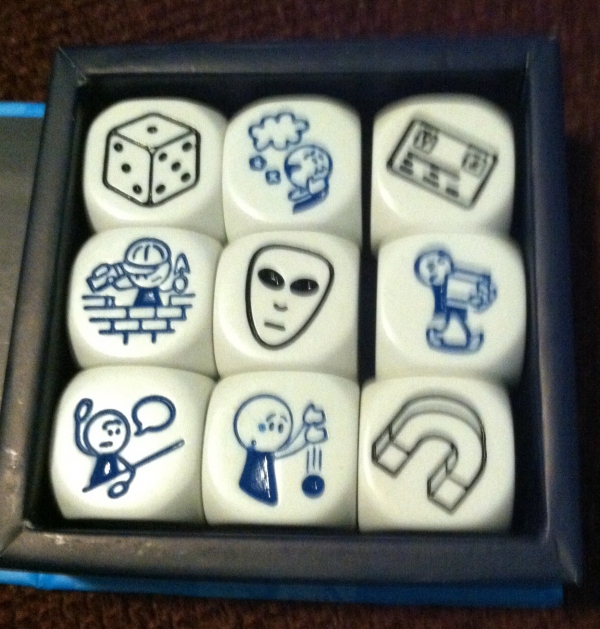
Here is this week’s roll of the Rory Story Cubes:

And here is what I saw: l. to r. – a die; thinking/pondering; credit card; building a wall/laying bricks; an alien; carrying/burden; asking permission to speak; dropping something; a magnet.

From all that, I got the story, “Pep Talk.” If you don’t see the link on the story title, click on the Spy Flash tab at the top of this page and select the story from the drop-down menu.

If you’d like to give the Story Cube Challenge a try, write a story of any length based on the objects and actions above and post a link to it here.

Just two more weeks, and we’ll be half-way through the year of the story cubes challenge, which means Spy Flash will become a manuscript and then, come December, it’ll be available for your Kindle or as a paperback from Amazon.com. I just know you can’t wait. 😉