More Inspiration–Plus Spy Flash 21

I’ve written before about what writers can use as inspiration–a photo, an overheard snippet of conversation, an idea that’s rolled around in your head for years. Some writers are inspired by television programs or popular books and write fan fiction (which some writers then turn into popular, though ill-written, books and make tons of money). Other writers, myself included, get inspiration from actual events and put a fictional twist on them.

This past weekend my Unitarian Universalist fellowship held a used-book sale, and I promised myself I’d be good and not buy any more denizens for my groaning book shelves. Best-laid plans, and all that. A few seconds into browsing, something caught my eye: Intelligence Wars: American Secret History from Hitler to Al-Qaeda by Thomas Powers. Powers’ book is a collection of essays he wrote for various publications on America’s history of spying. At $2.00 for a hardback, how could I, the spy writer, pass that up?

The Table of Contents is a veritable mine of story prompts: “The Conspiracy that Failed,” “Phantom Spies at Los Alamos,” “The Mind of the Assassin,” “Marilyn was the Least of It,” and “The Trouble with the CIA” are just a few examples. Even more than inspiration, this is an excellent reference for delving into the history of the world of intelligence.

However, it wasn’t my new acquisition that inspired me this weekend. Rather, it was a combination of the prompt for Week 21 of the Rory’s Story Cube Challenge and the ghost of executed Romanian Dictator Nicolae Ceausescu. For quite some time now, the ghost of Romania past has bugged me to write about his timely end. I’m not going into length here about Ceausescu and his equally ambitious wife, Elena. You can Google them and get a number of reputable references about Romania under their rule (remember the news stories on Romanian orphans) and how the Eastern European anti-Communist uprisings in 1989 had their bloody culmination in Romania.

And don’t get me wrong. If Ceausescu were still around, he wouldn’t like my portrayal of him or his wife in my story, “Judas Goat.” That just goes to show, you can haunt someone to write about you, but payback’s a bitch.

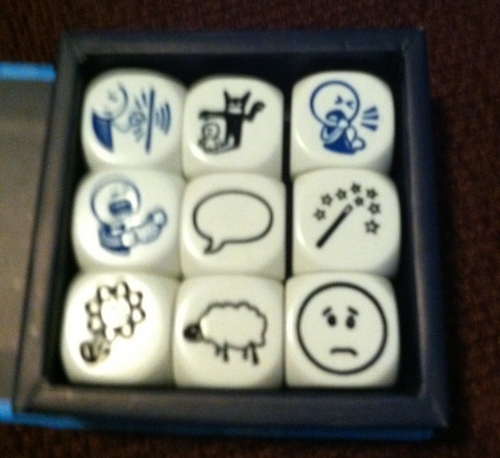
Here is the roll of the cubes for Week 21:

And here is what I saw: l. to r. – knocking on a door; evil; shouting in anger/angry; eating; thought/thinking; magic/magic wand; flower; sheep; sadness/dismay.

The object that stood out for me was the sheep, and you’ll get the connection to the title, when you read the story, of course.

As usual, if you don’t see the link on the story title above, hover your cursor over the Spy Flash tab at the top of the page and select it from the drop-down menu. If you’d like to give the Story Cubes Challenge a try, write a story of any length based on the picture above, then post a link to it here.

The Wee Folk Return to Friday Fictioneers!

I’m not sure where the beautiful photo for this week’s prompt was taken, but its stark beauty really struck a chord with me. An idea of what to write came to me as soon as I saw it. Regardless of where the photo was taken, it said Ireland to me.

There have been many waves of immigration from Ireland to America, but the one we’re most familiar with was the one created by the mid-nineteenth century potato famine. Most farmers then in Ireland rented plots of land from usually absentee landlords. When the potato crop failed, they couldn’t pay rent. The landlords would then raise the rent in an attempt to ensure their income, and eventually so many people wanted a place to live, the landlord’s men would come and evict a family then move another in immediately. They couldn’t grow anything either, and they would be evicted, and the cycle went on and on.

America was the land of opportunity for those Irish immigrants, but they arrived and saw the “No Irish Need Apply” signs when they searched for work. Regardless of which migration, it was usually spurred by poverty, and too many times they migrated to another form of poverty.

That was true of my grandmother, though her migration wasn’t until the first third of the twentieth century. She was convinced, however, that the wee folk had migrated to “A-mer-i-cay” at some point because she left milk and bread out for them every night.

This week’s story is “Diaspora,” and it features two leprechauns–Seamus and Declan–I’ve written about before. Though this is a little more serious topic than the other stories, Declan still thinks only of himself, and Seamus sees the big picture.

If you don’t see the link on the title, click on the Friday Fictioneers tab at the top of the page and select “Diaspora” from the drop-down list. To read other stories (or to post one of your own) from Friday Fictioneers, click on the frog-like icon at the bottom of the story.

By the way, the word “diaspora” is of Greek origin and from the nineteenth century as well, and it meant “a dispersion.” The meaning I’m using in the story is “any group migration or flight from a country or region” or “dispersed outside its traditional homeland.”

Spy Flash – Week 20

Yet again, last week was Week 20 of the Rory’s Story Cube Challenge, and yesterday the prompt for Week 21 got posted. In aviation parlance, it’s called being “behind the power curve”–you’re at a high angle of attack with full power but going no where. That’s what it has to be because I won’t accept the other possibility: that I’m running out of ideas, steam, or inclination.

No, I blame it on the pyramid.

The pyramid showed up again, for the fourth time. I’ve used the pyramids of Giza (twice) and “a pyramid of earth,” as in a pile of dirt as someone dug a hole. I wasn’t sure I could come up with a fourth, original use of the word. Jennie Coughlin, who posts the weekly prompts for the challenge, reminded me that it could be a prism, but since I didn’t come up with that, I thought it might be cheating.

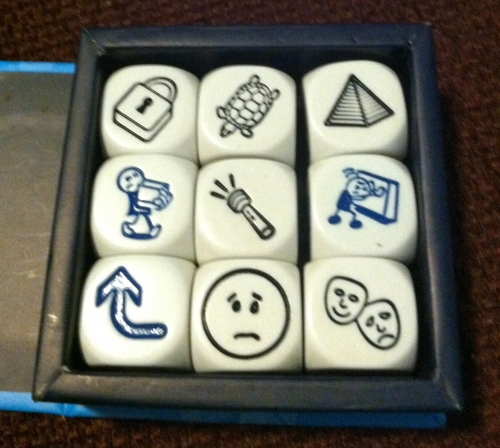
The solution was a New World pyramid but with a bit of a twist. Here’s last week’s role of the cubes: 

And here’s what I saw: l. to r. – lock/padlock; turtle/tortoise/slowness; pyramid; carrying/burden; flashlight/light/illumination; pushing/up against a wall; turn/right turn; dismay/sadness; actors/drama.

The story for this prompt is “The Tortoise and the Hare.” If you don’t see the link on the title, click on the Spy Flash tab at the top of the page and select it from the drop-down list. If you want to give the Story Cubes Challenge a try, write a story of any length based on the objects and actions above, then post a link to that story on Jennie Coughlin’s blog.

Reboot

Yesterday was Labor Day, so in solidarity and in gratitude for weekends, minimum wage, health benefits, and many other positive things organized labor has fought and some died for, I took the day off from writing.

Truth be told, since I returned from Tinker Mountain Writers Workshop two months ago, all I’ve been doing is revising, editing, and revising some more. Every time I faced doing something new–including blog posts–I had a lot more trouble getting started than I usually do. The editing and revising I was doing focused on “fixing” the common mistakes I learned about at Tinker Mountain and the other workshops/conferences I’ve attended this year.

I figured it was just me, having a bit of writer’s block. Then, one of my Tinker Mountain classmates e-mailed our group list and asked, “It is just me, or is anyone having trouble writing since the workshop?”

After a little happy dance that I wasn’t alone in this, several other writer friends from the workshop chimed in with the same lament. Then, our ever-wise instructor, Pinckney Benedict, silenced us all. “That’s the purpose of TMWW,” he said. “We push you and challenge you and wring you out so you have to go home and reboot.”

Oh. [Pushes reset button here.]

And, well, that makes perfect sense because what’s the purpose of a workshop if not to alter you in some positive way, especially something as intensive as Tinker Mountain? I think if we hadn’t come away needing to reboot, it would have been a waste of time and money.

I know some writers will find that scary. You’re satisfied with where your writing is, with your skill level; you don’t see how you could be a better writer. I’d counter that with, as with anything that requires skill, you’re in continual learning mode. I’ve had the same concern about pursuing an MFA: What will that do to the voice I’ve developed as a writer?

Yes, I was pretty happy (read complacent) with my writing before Tinker Mountain, but that reboot was exactly what my writing needed. I look at my work with less subjectivity now, and the revising/rewriting post-reboot is producing much better work.

A reboot can feel a lot like a boot in the ass, but, as with a good, swift kick, sometimes you need just that.

In the Clouds with Friday Fictioneers

For the past several weeks, photo prompts for the Friday Fictioneers have come from among the Fictioneers themselves. As beautiful and challenging as Madison Woods’ photos have always been, I must say the other Fictioneers have challenged us as well.

Last week was my photo, and I thank everyone who wrote fascinating, lovely, thrilling, and engaging stories and poems inspired by it. There were lots of wonderful collaborations.

And we have an equally intriguing photo for today–an unusual cloud formation. I’m moved by clouds myself and have taken hundreds of pictures of them over the Blue Ridge Mountains, but today’s photo has a Jupiter-esque quality about it. I even spotted the equivalent of the great red spot in the lower right of the formation.

So, Jupiter. Space. Space travel. Science Fiction. The result is my story, “For the World is Hollow.” The title alone should tell you which old sci-fi show inspired it as well. (Or you can just look at the tags.)

To read other Friday Fictioneers’ stories, click on the frog-like icon after the story, and, as always, if you don’t see the link above, click on the Friday Fictioneers tab at the top of the page and select the story from the drop-down list.

Spy Flash – Week 19

At least I’m doing better in posting a story for last week’s prompt before this week’s comes out. Again, I made a couple of false starts, but I decided to go back to an early Spy Flash story, which I left open-ended. Last week was a pre-quel of sorts; this is a sequel, even though it’s still a bit open-ended. I have an idea what I want to happen to the Ambassador in this story, so I’ll save it for another roll of the cubes.

That earlier story was “A Little Romance,” and it dealt with a tried and true piece of tradecraft using a “swallow” for a “honey trap.” You hire a woman (the swallow) to compromise an official you want to obtain information from or whom you want to coerce into doing something and take pictures of the encounter. This was a standard piece of Soviet tradecraft, and though the CIA would deny it would ever stoop to something so morally ambiguous, don’t believe it.

So, what happens after you set and trip the honey trap? That’s what you’ll find out in “Honor.”

Here’s the roll of the cubes for this week–a little blurry, but readable. 

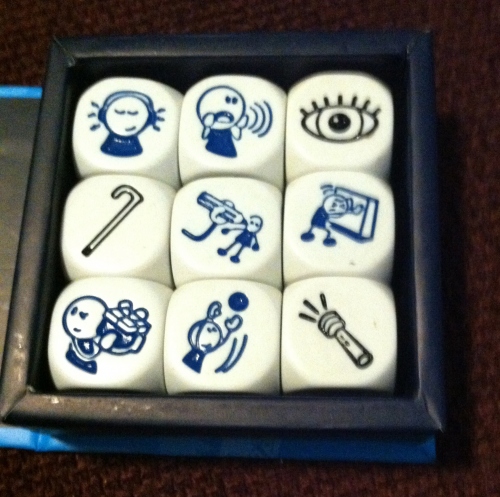
Here’s what I saw: l. to r. – asleep/sleeping; raising a hand/speaking; out on a limb/ climbing a tree; shouting; knocking on a door; scales/balance/justice; scissors/ cutting; bee; headset/earphones/listening.

As usual, if you don’t see the link on the title, “Honor,” above, click on the Spy Flash tab at the top of the page and select it from the drop-down list. And if you want to participate in the challenge, write a story of any length using the objects and actions in the picture above, then post a link to your story on Jennie Coughlin’s blog.

A Gathering of Writers

Sorry to take so long to blog about this, but last week was full of events (none writing-related for me; I gave a book party for a friend’s latest book); and I was fighting off a cold. The one-day writers workshop sponsored by Press 53 and Prime Number Magazine in Winston-Salem was a jam-packed day with great instructors and the opportunity to mix and mingle with other writers–one of my favorite things to do.

Press 53 is a small press based in Winston-Salem, NC, and specializes in publishing collections of short stories and poetry. It is also the publisher of Prime Number Magazine, edited by my writer friend, Cliff Garstang. In just seven years of existence, Press 53 is set to release its 100th title some time in October. For the past few years, it has sponsored “A Gathering of Poets.” Prose writers demanded equal time and got it.

As with A Gathering of Poets, the first-ever Gathering of Writers aimed for 53 attendees. The actual count was in the forties, which was promising for a debut. The workshops offered each featured an author published by Press 53 as the instructor, and the topics covered fiction, nonfiction, and publishing. Each instructor gave his or her workshop twice, in the morning and in the afternoon, so you didn’t have to miss one you wanted. As it was, there was time for only four workshops, and six were offered. There’s always next year.

These were the offered workshops:

Creating Immediacy in Fiction, John McNally
Crafting Dialogue that Moves, Valerie Nieman
Going Vertical in Memoir: How to Move your Creative Nonfiction from Slush Pile to Publication Success, Tracy Crow
Creating the World in a Short Story, Clifford Garstang
Scene Construction: Building a Scene Layer by Layer, Susan Woodring
Your Path to Publication, Kim Wright

I signed up for McNally, Nieman, Garstang, and Wright’s workshops.

McNally provided a handout, “20 Things that Lessen Immediacy,” and went over each. Rather sobering to read through the list and see just how many of the 20 “offenses” I’m guilty of, but no more. Very eye-opening and enlightening but practical as well.

Nieman used screenplay excerpts to demonstrate how dialogue in a non-screenplay should read, but the fun part was these were movies we were all familiar with; and workshop participants got to “act out” the dialogue by reading it aloud. Then, we had a short dialogue exercise to write based on a prompt. The prompt was a snippet of a real conversation Nieman had overheard. A lot of fun and very helpful.

Wright, who has been published by a Big Six press, a small press, and self-published gave us the pro’s and con’s of each type of publishing. It was refreshing to hear someone be honest about each type, rather than being all rah-rah Big Six and boo self-publishing. Wright was careful to balance the presentation without showing any favoritism for one form or the other, but she was able to provide good information to help you choose which version might be appropriate for your work. We ended with an exercise where we paired up and described our current works to each other; then, the other person had to give an elevator pitch of your work. Also great fun and showed us just what is important for an effective pitch.

Garstang’s workshop I had seen bits and pieces of before, but as a whole it was a workshop that offered just the practical information with very little fluff. Key to the presentation: Write what you don’t know from the basis of what you do know, and show AND tell. Of course, it was more in-depth that than, and Garstang provided specific references from other writers’ works to illustrate his points. And we left not only with a reading list but suggested exercises as well.

Between the workshops and at lunch, we all had the opportunity to meet each other and discuss writing. I could do that all day, every day. I came away with new Facebook friends, and after listening to those new friends talk about which literary magazines had recently published them, I realized I hadn’t been living up to my resolution to submit more work. Though that wasn’t really a workshop, it was an example to inspire me.

Sometimes the first of anything can be disappointing, but not this–well organized, well produced, and worth every dime spent. I can’t wait until next year’s Gathering of Writers.


A Special (For Me) Friday Fictioneers

The photo prompt for this week’s Friday Fictioneers is one I took this past Spring when I woke to the epitome of “The fog comes on little cat’s feet.” (For photo buffs, I took the photo on a Nikon Coolpix L110 set on “Landscape.”) I could hear the cattle but couldn’t see them, and since I was up early and the fog was a sound suppressor, the quiet really did make me feel as if I’d woken in another time.

Where I live now, even though I’m a born Virginian, I’m on the wrong side of the Civil War. It’s a place where, when I say “Civil War,” strangers feel obligated to speak up and correct me: “The War of Northern Aggression.” Well, bull… pucky. When a group of citizens from a country fight their own countrymen, it’s a civil war.

So, when I re-looked at this photo again to write something for Friday Fictioneers, I looked over the ridges and valleys and imaged the barriers that presented to an escaping slave. (Granted, slavery wasn’t as widespread in the Shenandoah Valley as it was among the planters of the Piedmont in Virginia, but it existed here.) To get to the famous Underground Railroad, a slave from the Valley would have to go north, probably staying in the mountains, go through a gap in the Blue Ridge Mountains, to a Quaker-settled area in what is now Loudoun County. From there, they’d be smuggled farther north into Maryland and Pennsylvania.

I know only in my intuition some Valley slaves probably tried the trek, and I’m sure it’s unknown how many made it and how many didn’t. I, however, wrote a story where someone did succeed, “Pillar of Salt in the Promised Land.”

The Underground Railroad had a specific “code” known to fleeing slaves to hide what brave men and women, on both sides, accomplished. “The Promised Land” was Canada, where many escaped slaves ended up. Some returned after Emancipation; some didn’t.

To read stories by other Friday Fictioneers, click on the frog-like image at the bottom of the story. I’m eager to see the stories written for my photo. If you don’t see the link on the title, “Pillar of Salt in the Promised Land” above, click on the Friday Fictioneers tab at the top of the page and select it from the drop-down menu.

Spy Flash – Week 18

Week 18 was last week, so I’m a little late. I spent the weekend at a writer’s conference (more about that tomorrow) in Winston-Salem, NC, so I’ll use that for an excuse. That and the teepee. (See below.)

Here’s the roll of the cubes for week 18:

Here’s what I saw: l. to r. – bee; the letter L; striking a match; fork in the road; teepee; digging; walking; crying/weeping; house/home.

There, dead center, is what threw me for days. Yes, a teepee.

I’m using these prompts to write espionage flash fiction, so how on earth was I going to connect that to spies?

Since one of the characters I write about was originally born in the Ukrainian Soviet Socialist Republic, I even researched whether the Scythians, a tribe from the east that conquered most of what became Ukraine, had used yurts (large, well-furnished, collapsible tents moved from campsite to campsite), but I couldn’t confirm it to my satisfaction. (Turns out the Scythians may have been the origin of the Finnish sauna, but that’s another story.)

Then, after an unsuccessful attempt on Monday, I decided that wasn’t a teepee, but a tent. Hey, it’s all about how each person interprets the cubes after all.

The lesson here is sometimes we writers get hung up on a scene, a sentence, a word, which blocks everything else. Once we let go of the hang-up, creativity has room to grow.

This story, “Patience,” is a prequel of sorts to an earlier story, “Here, There be Dragons.”

If you don’t see the link on either title, click on the Spy Flash tab above and select them from the drop-down list. If you want to take the Rory’s Story Cube Challenge, use the photo above and write a story of any length, then post a link to it on Jennie Coughlin’s blog.


Interview, Part 2

To read the second part of Jan Bowman’s interview with me, click here. If you don’t see the link, click on the About Me tab above, and you’ll see the link there.

I always enjoy being interviewed by other writers, and Jan’s insightful questions were great.

Enjoy!