Story Cube Challenge – Week 4

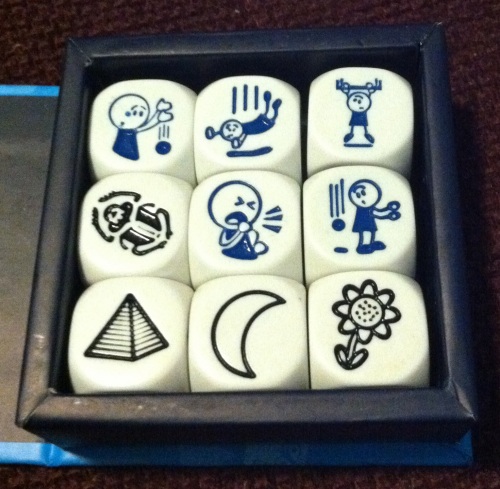
Yesterday’s Rory’s Story Cubes prompt from Jennie Coughlin’s Welcome to Exeter blog put the challenge in the Story Cubes Challenge. At first glance, I thought perhaps Week 4 of the challenge was going to do me in. I wasn’t sure how to work each of these actions or objects into something coherent. And, frankly, perhaps I still haven’t.

Here is the story cubes prompt:

I interpreted the cubes as: (l to r) hit, clothes on a line, agreement, thief/burglar/theft, a present, at a crossroads, shouting, a magic wand, and a padlock.

To read the story I wrote from this, “Resolve,” click here. (Or hover your cursor over Story Book Challenge then click on “Resolve.”)

I’m almost afraid to see what Week 5 will bring.

Enjoy, and, please, leave a comment about what you liked or didn’t like. How else will I learn? ;-D

Inspiration Redux

I’ve written about inspiration in this blog before and talked about the various things that get an idea going in my head. A local writer friend of mine picks up snippets of conversations and jots them down. Maybe they’ll go verbatim in something he’s writing, or maybe they’ll inspire a whole new piece. You never know. You also never know where or when the muse decides to mess with your psyche.

This past week’s Friday Fictioneers’ story was, as are all Friday Fictioneers’ stories, inspired by a photograph. (If you click on the link in the first sentence, you’ll see the picture.) I’ve said before how amazing it is that the same picture can inspire widely different story interpretations of it. Last Friday’s picture lent itself almost universally to “body buried behind a wall” stories, and each one of them was unique. The comments on my story were all ego-strokes–yes, writers need them, too–but one person asked if it were the beginning of a longer piece.

Hmm. I hadn’t given that much thought, since I’m collecting the 100-word stories for inclusion in a fiction chapbook I’m drafting. I copied that story into the manuscript and added a counterpoint 100-word story as well. Then, I pretty much put the comment out of mind since I was about to head to Northern Virginia to get on a train to New York City.

On board the train, I was supposed to be writing a book review for an on-line magazine, but that comment about a longer piece began to nag at me, so much so I had to put the book I was reading for the review aside, pull out the Moleskine, and start making notes. By the time the N. E. Regional rolled into Penn Station in New York, I had a decent amount of notes about a possible new novel–no spies, no intrigue, no terrorists, no sci-fi; what’s up with that?

Throughout my weekend visiting friends on Long Island, I kept coming back to those notes, adding things, asking questions–and answering them–about possible characters and their motivations. I even decided it needed to take place in a town in the Shenandoah Valley very familiar to me, but I also decided that town needed to be fictional. A Google-search later, I had ten or twelve possible town names. Then, I decided that fictional town needed a fictional, private, women’s college, and another Google-search later, I had the name of the college.

I told myself that this idea would be perfect for this year’s National Novel Writing Month, but that’s not until November. I’m telling you, these characters are begging to be brought to life sooner than that.

Or perhaps it was just that a new tale needed to be told. I’ve been writing new short stories for the past two and a half years, but my primary focus has been on editing/revising the trilogy I want to submit to agents. A few weeks ago I had lamented to myself I hadn’t started a brand new novel project in several years.

So, one part suggestion from a reader, one part the desire to start a new project, add in pushy characters (I mean, really, they’re only nascent right now, but they are making themselves known in a big way.), and I’m pretty excited about this idea. Like, giddy and childlike about it. Not bad for an old broad writer.

Friday? It’s Time for Friday Fictioneers!

I was glad Madison Woods previewed today’s photo prompt a little earlier than usual this week. That gave me some time to think about what the photo inspired before I head out to visit friends in New York this weekend. At first glance, you might think the photo uninspiring, especially if you’ve done any remodeling of old houses, but it just goes to show you imagination can be stimulated by most anything.

On Monday I saw the movie The Raven, a fictional portrayal of Edgar Allen Poe’s final days, so it may have been in mind when I sat down to write a 100-word story for today’s photo prompt. If I tell you the title here, I’ll give it away, but let’s just say I went back to the dark side. A really dark side. And since I’m adding stories to a manuscript for a chapbook of 100-word stories where I write an opposing viewpoint for the original story, I’ve already composed in my head what the counterpoint to this one will be. It’ll perhaps take the edge off the darkness of this original story.

So you can read my story by clicking here or hover the cursor over “Friday Fictioneers” above and select the story that begins with “A.” 😉

To read what other Friday Fictioneers have wrought, go to Madison Woods’ blog and have a read.

Monday’s writing post may be a little delayed since I’ll be on a train returning from NYC. Everyone have a great weekend and write–a lot!

Rainy Saturdays and Literary Pursuits

A rainy Saturday is perhaps best for staying in bed, for rolling over and burrowing under the covers to forget that April in your area has had freeze warnings and snow flurries. Rising from that warm bed would require something far more stimulating than a morning cup of coffee. Fortunately, the prospect of meeting and listening to best-selling author Dolen Perkins-Valdez was well worth dodging raindrops this past Saturday in Staunton, VA.

Dr. Dolen Perkins-Valdez, speaking at Mary Baldwin College's Spencer Center. Her appearance was jointly sponsored by Mary Baldwin College and the Staunton/Waynesboro/Augusta Group of Writers (SWAG Writers).

Perkins-Valdez, a professor of writing at several east and west coast universities, became intrigued by a snippet of information she discovered about Xenia, OH. For a few years in the 1850’s, Xenia was home to the Tawawa Resort, a place where southern slaveowners could come for the summer and bring their slave mistresses, living with them in near openness.

As she began to research to confirm this information, she had an epiphany. She could write a scholarly article about this, but her heart was telling her to do something else. As she imagined what those few weeks of near-freedom must have been like for slave women, she decided she could only tell their story in a novel.

Perkins-Valdez spoke of how “protective” she was of her first novel. “I knew I needed an agent, but this was my baby. How could I send it out into the unknown?” That someone might steal her book wasn’t her concern; rather, she feared someone might not understand or appreciate the intent of her work.

That was certainly refreshing to hear from a New York Times Best-selling author–that she could have the same fears as any of us who submit our work into that limbo of acceptance and rejection.

It turns out, she had nothing to worry about. Her agent was able to sell the novel to Amistad, an imprint of Harper Collins. Wench is the story of four women who are slaves and the complex relations among them and with their masters, who are their lovers, rapists, and owners.

Perkins-Valdez’s down-to-earth presentation and openness to questions from the audience was refreshing. She told the story of being at a joint book signing with Terry McMillian, who wouldn’t sign her own books for people unless they bought Wench, too. But it wasn’t a boast. It was the “oh my god, oh my god” reaction any of us gets when someone we admire acknowledges us.

When I asked a question about her presentation at AWP, which I had attended, she asked me what I wrote and asked me to follow her on Twitter, “so I can keep track of your writing.” She was just as generous to every writer and aspiring writer in the audience and at her later book-signing, where she posed for pictures with young, African-American women from Mary Baldwin. For each person who was a writer, she made certain to ask about his or her writing.

I’m in the process of reading Wench, and so far it falls into the “hate to put it down” category. It’s very engaging and authentic, and having met Perkins-Valdez and heard her speak twice now, it is a far more meaningful read. Even without having finished it, I can recommend it.

Perkins-Valdez is working on her second novel, about African-American women in the Civil War. I’m sure that will be on my to-read list as well.

It’s My Birthday, and I’ll Cry if I Want to!

Seriously, today is my birthday. A significant one. One you don’t look forward to, but considering the alternative, I’ll accept that I’m leaving a specific decade behind. And, no, I won’t say which one.

It’s been a great week–the two eBooks of the updated, revised, polished short stories from my 2000 print collection, Rarely Well Behaved, are now available for your Kindle or Kindle App. That was exciting; just as exciting as when the book itself came out nearly twelve years ago; perhaps more so because I had to transcribe it, edit it, and format it myself. Now comes the hard part–all that self-promotion that makes me cringe. Just think of all the “buy my book” Tweets as a necessary evil.

If you want to buy my two, new eBooks–Blood Vengeance and Fences–just click on their images in the sidebar to the right. 😉

To read today’s Friday Fictioneers’ story, hover your cursor over the Friday Fictioneers tab above and click on the story “The Day After.”

I’m an E-Book Author!

I finally cracked the code on uploading my manuscripts to Amazon Publishing without formatting errors. Tucked away on an obscure “Help” page is the phrase, “Converting your file to .htm will help with formatting errors.” What? That couldn’t be in big, bold letters (capital letters) up front? That would have saved a lot of sobbing, hair-pulling, and disconsolate DM’s to writer friends. But discovering that it worked made me do a happy dance. (Good thing the web cam was off.)

Regardless, both books–Blood Vengeance and Fences–are uploaded, and if you look at the sidebar to the right, you can buy them both by clicking on the image.

If you happen to buy them, I can send you a message and a signature through Kindlegraph–who’ll be first?

So, now off to send self-serving Tweets begging people to buy my books. 😉

Formatting an eBook’s a B***h

Before I get into the topic for the provocative title of this post, let me take your time to discuss a few blogging changes.

If you come here on Wednesdays to see “Politics Wednesday,” well, I’ve changed things around again. I’ve decided to separate my political blogging from my writing blogging–not because I’m ashamed of either or because I don’t want them to be associated, but because logistically it makes sense. For months I’ve been putting the same post on this WordPress site and on a Blogger site. That led to a lot of confusion, not to mention work. For me.

People have often commented that they like both sorts of postings, some like only the political, and some like only the writing. Now, it’ll be easier for me and for the reader seeking just one type of post.

From now on, this site remains as “Unexpected Paths,” and will feature my posts about writing and the writing life on Mondays and Fridays. So, if you visit here to read the writing posts, you don’t have to do a thing. However, if you want to see my political commentary, you’ll have to go to my Blogger site and follow “My Musings” there.

Now, on to eBook formatting. I recently transcribed my print book Rarely Well Behaved, published in 2000, and separated it into two files for two eBooks. I finished polishing and editing, had someone proofread, got eBook publishing advice from an experienced indie author, downloaded an excellent guide for formatting your file for eBook publication, spent several hours Saturday night following that guide to the letter, uploaded the first book, Fences, did a preview, and was discouraged beyond description.

Despite my careful following of directions (anyone who knows me, knows I operate from checklists), there were a plethora of formatting errors. Now, I could have been the typical indie author and clicked on “Submit,” but I withdrew the file, went back over the formatting process, and uploaded it again. (No offense intended. I’ve found from reviewing indie published books, the conscientious indie authors are atypical.) The same formatting errors prevailed. I took it down again, and did a Scarlett O’Hara–as in, thinking about it tomorrow, because tomorrow is another day.

Now, it’s two days later, and I’m about to give it another try. The issue may be that the guide was written for MS Word for Windows, and I have Word: Mac. This guide is excellent, as I said, because it includes illustrations for various formatting menus, i.e., “This is what it should look like.” But they are slightly different in the Word for Windows and Word: Mac versions. In some cases, I had to give it my best guess.

The other issue is the file you upload goes through a conversion program, in my case, to make the file viewable on Kindle. (Smashwords, for example, calls its conversion program the Meatgrinder. How apt.) That means you can have some basic formatting–e.g., font type and size, first line indents, and centered text–but not much more. One indie publishing friend who received a discouraged DM from me suggested perhaps I’d left in the “curly quotes” instead of using “straight quotes,” and that may have caused the formatting issue. The formatting problems did involve multiple lines of dialogue; all lines of dialogue were indented, instead of the second line’s being flush left.

Today, then, is attempt number three, from the beginning through 30 steps and uncounted sub-steps and then another upload and preview. Wish me luck. If it doesn’t work this time, I may have to resort to something drastic. Like hire a professional.

As my indie author friend said in trying to console me, “If it were easy, everyone would do it.”