Resolved–to Write

When I retired two-plus years ago, my main goal was to write full time—to produce more short stories, polish the novels I have in various stages of completion, blog more—and to get published. The good news is I can say, with accuracy, that all of that has happened. Just not with the consistency and frequency I expected. And that’s my fault.

I’m most happy when I’m writing, when I go into the world I’ve created in my novels, when I carve out little bits of reality (or fantasy) in a short story. I just don’t do that often enough. I have made a conscious effort to consider and call myself a writer, to get validation from my local writers group and critique group, and to be inspired by the circle of writer friends I’ve cultivated. Again, I can say that, too, has happened.

The problem is, I don’t write enough. I don’t focus myself as well as I should, mainly because I wanted a complete separation from the world of work. Writing is work, and it should be; otherwise, I’d just write cute little stories for my friends and family to read in the annual holiday letter.

A writer friend of mine, Cliff Garstang, has hit the mark for me with a recent blog post. Cliff periodically posts “Tips for Writers,” and his December 9, 2011, post, “Finding the Time to Write,” made me sit up and take notice of how I approach my writing. It wasn’t a pleasant sight.

About the only advice from that post I can’t take is “Get up earlier.” The “Work later” part is easy—I am often most inspired when the day is done. Why can’t I get up earlier? Too many years of rising at oh-dark-hundred for a variety of reasons, but I can work back into it. Gradually. Cliff makes the time to write, and his writing work ethic is inspiring—he shuts away all external distractions and just creates. Though Cliff often goes to writing retreats (something I need to try), he works to re-create that atmosphere at home, which he describes in his December 7, 2011, post, “Bring the Retreat Home.”

Another writer friend of mine, Jennie Coughlin, is in a writing frenzy right now, working on a series of novels about her fictional New England town, Exeter, and its denizens. (Take a look at her blog Welcome to Exeter and marvel at this ambitious schedule she’s set for herself.) She works a full-time job and a part-time job and gives up what free time she has to writing, including publishing the occasional short story as well as character sketches on her blog. Her word output is amazing, and she’s considering a challenge to write a half a million words next year. I’m sure she’ll make it.

You can see I have a lot to live up to. And the pressure on me is mine. I need to do what I said I was going to do when I retired. As Stephen King once said, writing is my job, and I need to stop being a part-timer.

So, I’ve done the dreaded thing, and set up a [shudder] work schedule for writing starting January 1, 2012. It’s a modest start to organizing my free time around what I’ve said is my profession. Right now, it needs to be flexible so I don’t rebel and to accommodate spending time with family and friends and my exercise regimen. It could be a colossal failure—wouldn’t be my first—but it could get me back on track.

Here we go:

Monday            0800 – 1000: Blog about writing or publish a book review on my blog

1400 – 1700: Edit/revise a novel WIP

Tuesday            0800 – 1100: Edit/revise a short story WIP or identify a publication to submit to

1400 – 1700: Edit/revise a novel WIP

Wednesday       0900 – 1100: Blog about politics

1400 – 1700: Edit/revise a novel WIP

Thursday           0800 – 1100: Edit/revise a short story WIP or identify a publication to submit to

1400 – 1700: Something new—a short story or a novel idea

Friday                 0800 – 1000: Blog about writing, publish a book review on my blog, and/or 100-word

flash fiction

1300 – 1500: Submissions—the actual act of doing so—or developing a query letter

Saturday and Sunday: Two to three hours of reading and/or writing reviews

Your job, dear readers, is to point out that I’m not doing what I said I would do. Just think of the possibilities—getting to tell me to get my ass moving. 😉

Interview with an Indie Author – Jennie Coughlin

To coincide with my review of Thrown Out: Stories from Exeter by Indie author Jennie Coughlin, which appears in the December 2011 issue of eFiction Magazine, I interviewed Ms. Coughlin about her works, in print and in progress. To get a better understanding of the interview you might want to read the review. Better yet, buy the book. (Thrown Out is available to download at amazon.com and Smashwords and as a paperback, also from Amazon.)

DuncanIn a way you haven’t used in other interviews, tell me how the concept of Thrown Out came about.
CoughlinThrown Out started as some writing exercises to dig more deeply into the characters and help my editor get a better sense of them. I was posting the exercises on my blog, and, based on the feedback, we decided to go ahead with the collection while I was working on the novels. Once I had “Bones” and “Thrown Out,” the first two stories in the collection, we decided to take another look at the character Joe and his family, which led to “End Run.” Since at this point, the collection had themed itself as an introduction to the characters, Becca and Riordan were the logical choice for the final story. Although at least one of them had appeared in each of the other three stories, neither really was the focus of any of them. Thus, “Intricate Dance” was born.
DuncanThe title story, “Thrown Out,” touches on a timely issue, gay rights, one of which is to be able to live your life without fear. I confess when I saw the title, I was certain the ending wouldn’t be a happy one, but I was glad to be wrong. The fictional town of Exeter seems remarkably progressive in this area. Was that a conscious decision, or did Exeter “reveal” its nature to you in the writing?
CoughlinInteresting take on it, and I think there are a couple of pieces to that answer. First, the title story “Thrown Out” is set in 2001, after Vermont had approved civil unions and shortly after the court case was filed that would lead to gay marriage in Massachusetts. So in that time and that place, it’s certainly a more open climate than in many other states then or now. But really, a theme that came out as I was writing “Thrown Out” was that we accept things in people we know that we might not in people we don’t know.
That cuts both ways — the Exeter residents know Dan as a friend, a neighbor, the star running back on the high school football team, the guy who fixed their front steps, Kevin and Eileen’s son. He happens to be gay. Likewise, Joe is the local insurance agent, the kid who rang up their bread and milk at his dad’s store, somebody active on the Parish Council, a member of the Rotary Club, dad to their kids’ friends. He happens to be homophobic. You can’t exclude either one of them without big ripple effects. And if you already know somebody, already have them in your life, you’re likely to be more accepting of something than if you’ve just met the person. In “Thrown Out,” Dan’s partner Chris has a much different reaction to Joe than Dan, Evan, and Liz, who grew up with him. Likewise, Chris gets a measure of acceptance from the town just because he’s with Dan.
DuncanAs an Irish-American, I can “see” your characters so vividly. I suspect some people without the cultural background might not “get it.” Do you agree or disagree? Why?
Coughlin: Well, I’ve heard the same thing from readers who aren’t Irish-American, so I’m going to generally disagree. I suspect some things might not resonate as much, but that’s also true of the Catholic elements and the New England elements. The character Chris, who’s not from Exeter, serves as the bridge for readers who aren’t familiar with some regional terms, such as jimmies (chocolate sprinkles on ice cream), but there probably are pieces that are less accessible or read differently to people who don’t have some element of those backgrounds.
DuncanYou also touch on a taboo subject among Irish-Americans—the Irish Mob. Why was that important to you? I mean, Irish-Americans will talk easily about the IRA but not the Irish Mob.
Coughlin: I grew up in a town that was heavily settled by Italians, and I’ve heard stories all my life about Mafia ties in the town. The first newspaper where I worked even had a two-inch-thick file on the former police chief, later a Town Council member, who was jailed for perjury when he alibied a mobster back in the 1960s. The Irish mob was further afield, but Whitey Bulger fled when I was in high school, and periodically I’d get stories from home of FBI agents going around questioning people trying to find him. The story that touches on the Irish Mob, “Bones,” I drafted the week after the FBI caught Whitey in Santa Monica earlier this year, so that’s probably why my plot bunnies headed that direction.
DuncanYou went the Indie route for publication, but you used some traditional publishing aspects, e.g., an editor whose input you considered and incorporated. Do you think Indie publishing is at the point where it needs standards? Or would that miss the point of Indie publishing?
Coughlin: I’ve been pretty outspoken about the need for Indie authors to make sure their work is up to traditional publishing standards. I think the opportunities Indie publishing present are amazing, but it’s not a path without pitfalls. If we put out work that’s substandard, it hurts both the overall Indie reputation and the reputation of that author. Once we publish something, we can’t take it back. For those authors who do good work that the publishing industry just deems unsalable, Indie publishing gives a chance to prove that wrong. For those authors who see it as a shortcut to honing their craft, Indie publishing gives us lots of chances to torpedo our career.
That said, I don’t think there’s a way for the Indie community to set and enforce standards. Any mechanism like that becomes a new form of traditional publishing, which some people are doing in new types of small presses.

I do think that for Indie publishing to become a long-term, viable part of the publishing ecosystem, something will have to arise through book bloggers and review sites to provide readers with a place they can go and trust that the books recommended there will, in fact, be quality publications. Not all will be something any given person would want to read, but all meet the standards of good writing and good storytelling.

DuncanYou’ve said writing a short story is the opposite of writing a news story. What’s the journalistic opposite of writing a novel, which you’re now doing?
Coughlin: I don’t know that it’s the form so much as fiction vs. journalism. Whether it’s a short story or a novel, the process I go through is basically the same. That’s what, for me, is reversed from my reporting days. Because I’m not a visual thinker, when I covered events where the scene was integral to the story, I would record lots of details while I was there to help myself re-create it back at the office—this was in the days before mobile reporting was common. All those details painted a picture for me that went beyond what people were saying.
Now, when I sit down to write, I know what the final picture is, and then figure out what it is the readers would need to see to draw that same conclusion. Some scenes flow easily, and it’s an unconscious effort on my part. Others I really have to slow it down to step by step interactions for it to feel real to me.
DuncanThumbnail the Exeter novels for us and give us an idea of how long we need to wait for each installment.
Coughlin: I have at least six in mind, but I’ve been finding that the original first novel keeps getting pushed back—it’s now on track to be novel four of six—because earlier stories bubble up as I dig into the characters. So I’ll give you the first four, but I do plan to do others after those four are done, and others might join the mix as I go.
All That Is Necessary is the novel I’m revising right now, with a plan to release it in late March. While it starts and ends in present time, the bulk of the story starts right before Dan and Evan find the bodies in the marsh as kids [The story “Bones” in Thrown Out.] and goes through the fallout from that, which changes many of the characters in the town. Dan has to stand up to a lot of adults when almost everybody else around him is afraid to rock the boat.
The second novel, as yet untitled, follows from that story. Liz’s nemesis returned in All That Is Necessary, and that causes a lot of problems for her and those around her.
Fate’s Arrow pulls back from Exeter a bit to focus on Ellie, who’s still living in DC. After her annual holiday visit to Becca, she realizes her life has some holes and must figure out how to plug them.
Better The Devil continues some developments from Fate’s Arrow and puts Dan, Liz, and Ellie together for a big project that could alter Exeter’s future forever—if they can figure out who wants to stop them and why.
I have two others beyond that, but last week at the first book club discussion on Thrown Out, several of the members wanted to know what happens with Joe, Annabelle, and their family in more detail, so that’s now higher on my radar than it had been before.
I’d like to release a new novel every six months, but since I have a full-time job as well as a part-time one, some of it depends on those not going too nuts, as well as on my editor’s other commitments. There also will be periodic short stories. Some of the small ones will be posted on my blog, either as Rory’s Story Cubes Challenge entries or just as flash fiction like last week’s “Now What?” Thanksgiving short. Longer ones probably will be released as 99-cent eBooks, and I’m not ruling out future short-story collections.
DuncanDo you see Exeter and its wealth of characters as a story well that is unending? Or do you have plans for non-Exeter stories or novels?
Coughlin: Yes. The beauty of the small town setting is you have a limitless cast of characters and developments with those characters. In present day, I have characters who range from middle school age into their early seventies, so the multiple generations allow me to move forward and backward in time to tell all sorts of stories.
I might branch out from Exeter at some point, but right now I have more stories than I have time to tell in that world.
DuncanWhat’s your advice for people who opt for Indie publishing, i.e., how to go about it as a professional writer, how to deal with flak from fellow writers who don’t see Indie publishing as a viable option?
Coughlin: The biggest advice I can give is to get a good developmental editor who can provide feedback. If you can’t find one, a good critique group also can be invaluable, as well as beta readers. But an editor is the best of the available options if you can find a good one. Also, honestly evaluate your skill set and available time. I’m fortunate that I have a lot of design, graphics, copy editing, web design/HTML, social media, and formatting experience from my journalism background. With all that, plus a group of beta readers, I’m able to produce a quality product.

If you don’t have skills in a particular area, be prepared to hire somebody to handle various elements of each project for you. And if you do have the skills, be prepared to spend the time. In the six months since I started production on Thrown Out (three pre-release, three post-release), probably fifty to sixty percent of my time has been spent on non-writing elements, and that’s including most of the revisions on Thrown Out and all the writing to date on All That Is Necessary.

As for the current debates about the validity of indies, both online and from fellow writers you may know in person, my best advice is to think through why you’re taking this path before you choose it. My two main reasons were the chaos in the publishing industry right now and a concern that my series doesn’t fit neatly enough in a single genre/category to convince a publishing house’s marketing department that it’s salable.
The industry chaos is something I’ve been fairly outspoken on, especially in its parallel to newspapers’ struggles in the past decade. Publishers aren’t learning any lessons from what newspapers went through, and I prefer to stay out of the arena while they’re figuring all of this out the hard way. The salability is something I would disagree with the marketing folks on. By going Indie, I’m betting my career on my being right, not them. And if I’m right, when the industry has finished this eBook-driven shakeout, I’ll be able to pitch to traditional publishers, or whatever the closest approximation to those entities is, with a fan base and solid sales—assuming I want to. It’s possible I could decide that staying Indie is the best bet, and I won’t know that for a few years yet.
As I hope I just demonstrated, I have a reasonable, logical answer for people who hear “Indie” and think “vanity press.” Most people—in the industry and not—who hear my reasons agree with my approach, given my perspective and circumstances. Those who still scoff, I just tune out. As long as each of us taking the Indie path has a reasoned-out approach that can be backed up by facts, I think those who want to denigrate our individual choice can be safely tuned out.
DuncanWho is the one author (non-screenwriter) who inspires you to write? Who is the author (non-screenwriter) you’d like to be compared to, favorably, of course?
Coughlin: Sneaky, to take out my usual answer. 🙂 Once that answer is excluded, the answer to both questions is actually the same—Harper Lee. To Kill A Mockingbird is my favorite book and has been since the first day my freshman English teacher assigned it in high school. I stayed up until midnight that night to finish it, and I’ve read it a couple of dozen times since then. Atticus Finch is one of three lawyers—the other two are real people—who inspire Riordan Boyle’s (from Thrown Out) approach to law.
The other author I would mention is Natalie Goldberg. I’ve never been able to read more than a few pages in herThunder and Lightning: Cracking Open the Writer’s Craft without having to put the book down and starting to write. In terms of inspiration, she’s the non-screenwriter who has the strongest effect.
Lee inspires me to tell great stories, but Goldberg inspires me to put pen to paper and make the words flow.

To visit Exeter while Jennie Coughlin works on her novels, go to her blog: http://jenniecoughlin.wordpress.com/

Friday Flash Fiction Returns!

I took a little break from Friday Flash Fiction last week to do a Veterans Day tribute, though I had some great ideas for the inspiration photo of a budding corpse flower.

Today’s inspiration photo is a subject close to my own heart. The picture evoked great memories of idling summer Saturdays away on horseback or riding the farm with my Dad. So, here’s the photo:

And here’s the 100-word (exactly!) story, which I call, “Constancy.”
Her loyalty had no end. It would transcend death. Always at my side, ready when I’m ready, rests when I need it, offers kindness. We complete each other. We are extensions of each other by choice not demand.
We can have companionable silence, or we can communicate without words, with a touch, a nudge. And, oh, how we’ve traveled. Uncountable miles, over stream and hedge. Fences do not stop us. We love the open field best. Speed, and the desire for it, is the gift we share.
Still, I can’t help wonder how she manages on just two, spindly legs.
———
Questions, comments? To read more 100-word stories, go to Madison Woods blog,http://madisonwoods.wordpress.com/flash-fiction/the-lonely-path/

11/11/11

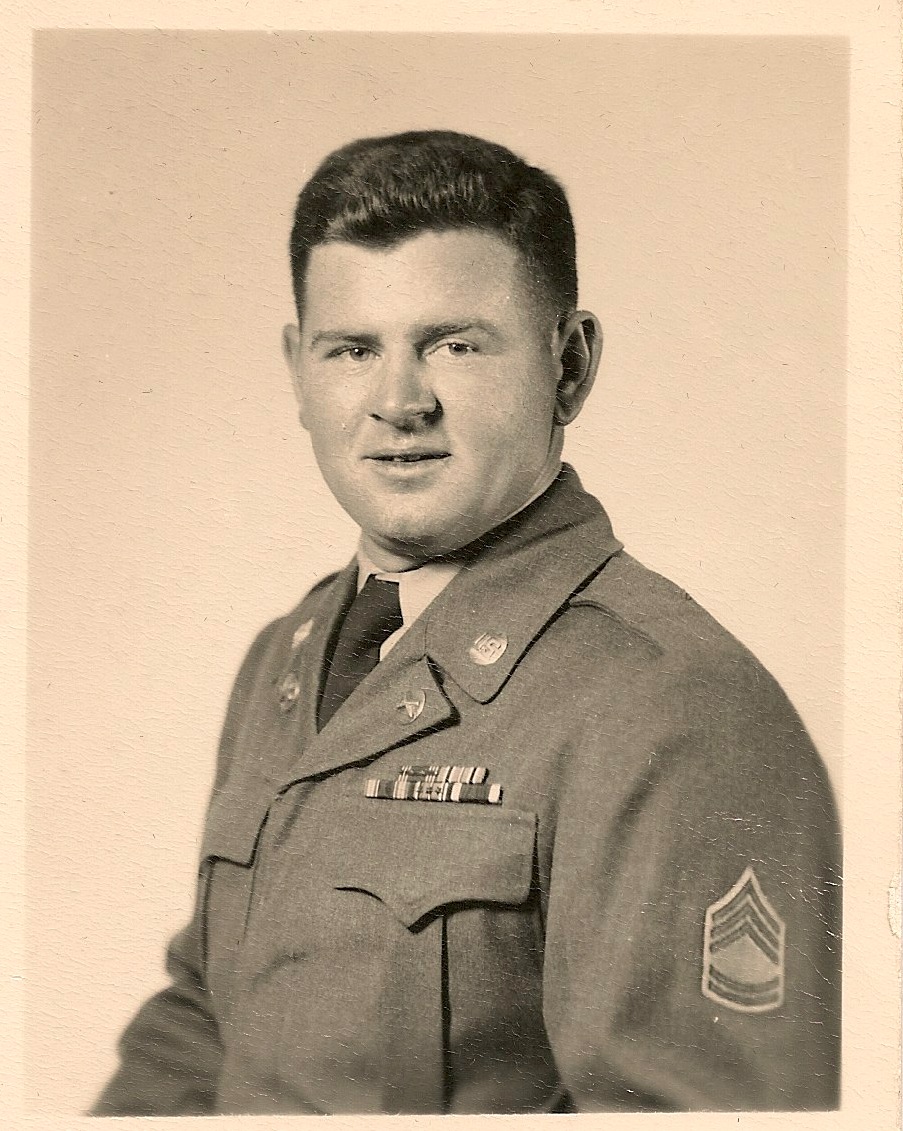
Sgt. First Class Frederick W. Duncan

I can’t remember if I ever thanked my father for being one of the people who saved the world from Adolph Hitler. If I didn’t, I should have, even though he was the type of person, when I was a child, who didn’t want the extra attention. Had he lived longer, now he might have enjoyed the World War II memorial, might have liked being called one of The Greatest Generation, and might have told the real stories instead of the funny ones my brother and I heard.

Though he survived World War II, I always think of him on Remembrance Day–yes, in the U.S. it’s Veterans Day, but my grandmother and parents always called it Remembrance Day. Any soldier back through history to the first gives up their everyday life to go fight for concepts that are sometimes nebulous. I believe that wasn’t so in World War II. I think it was very clear that if we hadn’t stopped the Nazis, there would not be a human race today. Or if there were, we would be unrecognizable as human beings.

As I studied World War II in high school and college and learned about the battles my father was in, I thought he would be my personal resource. He continually turned me back to the books instead. When I learned that an Allied victory wasn’t the sure thing the history books made it out to be, I understood how very close I came to not being born. Even then, he would say it was his job, it had to be done.

He returned home with physical wounds that healed and psychological ones that didn’t, just like soldiers today. When he was in the Battle of the Bulge, he was 18 and a half years old, had been a soldier for almost two years, and was one of the youngest sergeants in the U.S. Army at the time. He loved being an NCO (he eventually became a master sergeant) and turned down all offers to go to officer candidate school. He would wink and say, “The sergeants run the Army anyway. Why would I want to be an officer?”

If I didn’t thank him, I do it now, as I thank everyone who served, who protected us and gave us the freedom to be who we are, and who continue to do so–whether I agree with the reasons or not. Veterans, especially wounded veterans deserve everything we can give them. They don’t deserve elected officials like Sen. Jim DeMint (R-SC) to argue against a veterans employment bill by saying it creates a separate class of individuals, that it’s not egalitarian. Sen. DeMint clearly doesn’t know what he’s talking about, and the rest of us know that we don’t casually call them heroes–because they are.

I’ll close with my favorite poem about the inhumanity of war and what it can do to soldiers, Seamus Heaney’s “Requiem for the Croppies.”

The pockets of our greatcoats full of barley,
No kitchens on the run, no striking camp,
We moved quick and sudden in our own country.
The priest lay behind ditches with the tramp.
A people hardly marching, on the hike,
We found new tactics happening each day:
We’d cut through reins and rider with the pike
And stampede cattle into infantry,
Then retreat through hedges where cavalry must be thrown.
Until, on Vinegar Hill, the final conclave.
Terraced thousands died, shaking scythes at cannon.
The hillside blushed, soaked in our broken wave.
They buried us without shroud or coffin
And in August the barley grew up out of our grave.

Friday Fiction Rolls Around Again!

We had an interesting picture for today’s Friday Fictioneers, but it took all day for some inspiration to hit me. Here’s the picture, of a long-buried stick of dynamite one hopes is inert.
I call this 100-word fiction, “Homeland Security”
“9-1-1. State your emergency.”
“My husband brought a stick of dynamite into the house.”
“Dynamite? Are you certain?”
“Well, that’s what he says it is. Can you send the bomb squad here or something? I mean, it’s old and corroded. Harmless, right?”
“Ma’am, what is your husband doing with dynamite?”
“What? It’s not his dynamite. He found it. If you just send the bomb squad to get it…”
“Just a moment, ma’am.”
“Hello? Hello?”
The front door crashed open. A bright flash and loud bang. Men with guns. Shouting and confusion.
“Hands up!”
Her husband was so in trouble.
—–
Questions, comments? To read more 100-word fiction, go to http://madisonwoods.wordpress.com/flash-fiction/dynamite/

My Interview at Writing.com

Here is the text of an interview with me on Writing.com concerning the upcoming National Novel Writing Month.

Welcome to A NaNoWriMist in the Spotlight, a series of interviews introducing a selection of group members. This week we have a great interview from Maggie Duncan, a full-time writer of fiction and published author.

Hi, Maggie, thanks for agreeing to be interviewed! This year will be your fourth NaNoWriMo – what are you writing?

This year I’m going a little off my usual genre, which is Suspense/Thriller. I’m going to try a piece on a dystopian America in the not-so-far future after a domestic terrorist act, so I’d call it Speculative Fiction. The plot centers around people in a small town trying to survive after a domestic terrorist group destroys the Federal government. I’ve located it in the small city in the Shenandoah Valley where I now live, and the villains are a right-wing, ultra-conservative movement we’ll all recognize.

It’s clear who has inspired your antagonists – what about the protagonists?

The protagonists will be O.D. James, Mallory James, (brother and sister), John-Patrick Yardman, (these three are based on my grandkids), and Anne Donnachy, a retired government worker who writes thriller novels and who is based on me.

So you used to work for the government? How did that fit with your writing?

I’m a former government tech writer and have written stories since I was old enough to write. I retired two years ago to focus on my fiction full-time and just had a short story published. I first tried NaNoWriMo in 2008, while I was still working full time. Because of work travel requirements, I only had seventeen days out of the thirty to produce those 50,000 words. I had chosen to write a semi-autobiographical piece about my life and the recent breakup of a long-term relationship, so when I did have the time to write, the words were all there. It was very cathartic. I decided not to pursue publishing it–mainly because I’d like what’s left of my family to continue to speak to me–but I pick it up on occasion (I got a proof copy from CreateSpace.) to further that healing. After that, I was hooked on NaNoWriMo.

You’re obviously a fan of NaNoWriMo – what do you love about it?

I love the work NaNoWriMo does with kids to get them to use writing as expression or, as it was for me, an escape from a harsh reality. It’s also the best thing around to get me to write something completely new at least once a year. I have literary fiction friends who recoil in horror when I mention NaNoWriMo, but I tell them what they’re missing–a creative exercise that focuses on that one aspect that makes us writers: creativity.

From what I hear, you don’t lack for creativity! Tell us your favourite writing memory.

When I was eight or nine, someone gave me a set of alphabet rubber stamps. I would listen to my mother and her friends gossiping around the kitchen table, then I’d “produce” a newspaper with the rubber stamps with their gossip items as front page stories. I stayed up all night making a dozen or so copies (one letter at a time) and distributed them the next morning–when the you-know-what hit the fan. Needless to say, my rubber stamps got confiscated, and that was the end of my fledgling career in journalism. It was pretty devastating at the time to a nine-year old, but I look back at the memory and laugh at how indignant my mother and her friends were about my writing the truth.

What hints and tips do you have for the rest of the group this November?

Because I was a non-fiction editor before I retired, I tend to get too focused on getting it “right.” I find that if I let go and just let words flow, I’ll increase my daily word count dramatically. If you’ve got people in your household, you have to be adamant about your writing time being sacrosanct. I usually promise my friends and family something chocolate if they just pretend I don’t exist during my writing hours. They’ll do almost anything for chocolate.

I think I would too! Or for hot chocolate. What’s your writing beverage of choice?

If I’m writing in the morning, it’s my second cup of green tea. Afternoons mean Sobe Life Water, and nighttime is Diet Coke. I have been known to give in to my Irish side and sip Jameson’s in the evenings.

Where do you do your writing and tea drinking?

My favorite place is my office/writing room. It’s in the back of my house, and I have an incredible view of the Blue Ridge Mountains. However, when that is distracting, I go to a second writing space in my bedroom–away from the window–so I can focus 100% on writing.

What books or authors inspire you?

The Handmaid’s Tale by Margaret Atwood; anything by Jane Austen; The Mote in God’s Eye by Larry Niven and Jerry Pournelle; The Lacuna by Barbara Kingsolver; anything by Sharyn McCrumb; and The Stand by Stephen King (plus his non-fiction work On Writing). Several authors inspire me, but I’d have to say the predominant one is Margaret Atwood because she can tell such a good story and surround it with a political viewpoint that I can relate to. If I had the talent she has in her little finger, I’d be a happy camper.

How will you celebrate finishing NaNoWriMo? 

With a self-congratulatory pat on the back, followed by a post on Facebook and a Tweet to let my friends know I’m still alive.

Well, best of luck! Thanks again to Maggie for a great interview. 

TGIFriday Fictioneers!

Friday rolls around every week–imagine that. When I worked 60 or 70 hours a week at a “real” job, Friday always seemed unreachable, there but just beyond my grasp. Now, in retirement, it can’t wait to get here and leave me totally uninspired for Friday Fictioneers.

Here’s today’s inspiration photo from Friday Fictioneers’ maven Madison Woods:

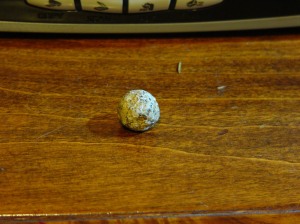
The caption for this picture reads, “This is an artifact marble, once used as a game-piece by early Native Americans who inhabited this area of the Ozarks, known as the Bluff-Dwellers.” Totally fascinating and way beyond my expertise so I’ll just go with the first thing that came into my head when I first woke up this morning–obviously I went to sleep last night with Friday Fictioneers on my mind.

I think I’ll call this one, “Never Judge a Rock.”

“Hey, Honey, come look at this.”

“I’ve got something on the stove.”
“Well, turn it off, ‘cause you gotta see this.”
If a screen door can slam open, she managed it. “What?” The frown on her face made him step back.
“Look at this.” He pointed to a small, round object on the top step of the porch.
She studied it then regarded him with disdain. “It’s a rock.”
“Yeah, but where did it come from?”
“It’s a rock.”
He reached for it.
“No!”
He looked at her and saw terror. He smiled, smug and superior. “It’s just a rock.”
———-
Questions? Comments? Go read some more 100 word flash fiction at http://madisonwoods.wordpress.com/flash-fiction/the-marble-100-words/ 

Thank You, Steve Jobs

I was a late-comer to Apple. I was a PC fan and scoffed at the faintly elitist Apple nerds, but I eventually got tired of constant virus infestations on my PC, despite the fact I had the best virus protection money could buy. I also got tired of carrying a cell phone, a PDA, an MP3 player, and a camera in the same purse. Still, I wasn’t sure about going completely Apple.

Like an addiction it started with something small–the red iPod Nano (center of the picture above). I justified its purchase as being part of the Bono Red project, but never had it been so easy to download music. However, that didn’t eliminate anything from the purse, just swapped the iPod for the MP3 player.

The Nano was soon full to its 8gb capacity, so I upgraded to the iPod Touch, not pictured because I gave it to a friend when I bought the iPhone3 (to the right of the Nano above). Finally, the expiration of a cell phone contract coincided with the release of a new iPhone, and in 2009 I now had merged all my electronic devices into a single device. That wasn’t a leap of faith by Steve Jobs in my mind. Merely, it was the brainchild of a Trekkie like me who couldn’t wait for the day to hold Capt. Kirk’s communicator. To me, it was just natural.

After the 2008 virus-induced crash of my last PC and somewhere between the Nano and the iPhone3, I purchased a MacBook Pro (the laptop on the right of the picture) and gave away all my PC–towers and laptops. I was in love with computers again. When the iPhone4 (far right of the Nano above) came out I was almost first in line. For Christmas of 2010 I gave myself an iMac (background in the picture above), followed a few months later by the iPad1 (not pictured). The iPad1 went to my goddaughter when I bought the iPad2 (on the left of the desk in the picture above). The MacBook Air is on this year’s Christmas list.

As innovative as Windows was in the day, Apple succeeded because of Jobs’ concept of minimalism. Even the first MacIntosh was sleek and futuristic compared to the PCs of the day. The Apple OS was easier to use, more intuitive than Windows’ innumerable iterations. Jobs took an idea for his own personal user needs and made it accessible to the rest of us. You didn’t have to verge on being a programmer to operate Apple products.

Yes, I’m now an Apple geek, thanks to Steve Jobs. So, thank you, Steve Jobs, for making our Star Trek dreams come true, and thank you for the face of courage against that horrid enemy, cancer. Rest in peace, though I’d like to think of you as just plugged into cyperspace forever.

You Say You Want a Revolution?

Some people have said they miss my political commentary. Well, you get what you ask for.

If you’re a fan of the mainstream media (and I used to be), you’ll be surprised to find out that a group of people (upwards of several thousand) have been “occupying” Wall Street (well, Liberty Park). They are now into their third week. You didn’t know that? Not surprising. The MSM (and, yes, I have been tempted to call it the “lamestream” media, but I don’t want the association) have been noticeable in their absence of coverage. Oh, when the arrests started they were quick to point out that the police were handling the “disruptive protesters.” Only Democracy Now!, Free Speech TV, and Current TV have devoted any time to what is motivating this true grassroots movement, as opposed to the various Tea Parties who have been bankrolled by the Koch Brothers.

So, what is motivating the people who call themselves “Occupy Wall Street?”

For one thing, the Wall Street Robber Barons came close to tanking the economy by taking advantage of an almost regulation-free financial environment and got bailed out and not one of them has spent a single minute being held accountable for that.

For another thing, the top one to two percent of this country have decided that they need to keep their wealth–not spend it on job creation, what an effing myth that is–so they can live higher on the hog, and the middle class, which they disdain and have decimated, and the poor–who got that way through all fault of their own–can wallow in the gutter of American Exceptionalism.

For yet another thing…no, I think those two things about cover it.

The minute I saw an NYPD white shirt named Anthony Bologna pepper-spray women who were committing the crime of standing on a sidewalk, I wanted to grab my kaffiyeh and head up there. When I saw a twelve year old girl in handcuffs, I wanted to set fire to the barricades and shut the effing place down. When I watched the police trick demonstrators onto the causeway of the Brooklyn Bridge then arrest 700 of them for blocking traffic, I was ready to tear the place down.

Fortunately, with age, I’ve been able to temper those urges. Forty years ago, I marched in some of the greatest demonstrations in the history of this country, and we turned the opinion of the country on a war, and we brought down a lying, corrupt president. Then, we moved on. We got jobs and houses and mortgages, swelled the middle class, and we let others–though not many of them–do the demonstrating thing.

Now, we find our place in that great middle class has come under attack from people with scads of money who have decided we need to pay for everything–their tax cuts, their wars, their third or fourth house, their new yacht–and we also need to give up our benefits and our rights to collectively bargain because they don’t like those concepts. They want to get rid of Social Security and Medicare because people should pay for their own retirement and health care–that’s what they’d have you believe. The truth is they don’t like letting anyone who really works for a living into the upper class. Only they get to live the high life and how dare we mere peons aspire to emulate them and live comfortably?

I agree that in some ways we need a revolution, but it has to be a revolution of the ninety-nine percent, not that envisioned by the Tea Baggers, who, in their ignorance, believe that the Koch Brothers aren’t using them for their own political ends. We have lost our compassion in this country. We blame the poor and the dwindling middle class for the woes rampant, unregulated capitalism has created. We hate anyone who is not rich, white, male, Christian, and born here. This is the America the Koch Brothers, Rush Limbaugh, Bill O’Reilly, et. al., have made and want to enshrine.

Support Occupy Wall Street by joining them in person or virtually. Wake up and smell the revolution or be crushed by the top one percent’s Humvee.