Friday Fiction Rolls Around Again!

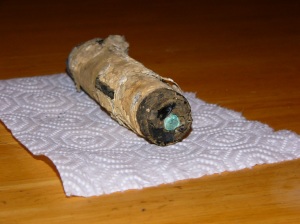
We had an interesting picture for today’s Friday Fictioneers, but it took all day for some inspiration to hit me. Here’s the picture, of a long-buried stick of dynamite one hopes is inert.
I call this 100-word fiction, “Homeland Security”
“9-1-1. State your emergency.”
“My husband brought a stick of dynamite into the house.”
“Dynamite? Are you certain?”
“Well, that’s what he says it is. Can you send the bomb squad here or something? I mean, it’s old and corroded. Harmless, right?”
“Ma’am, what is your husband doing with dynamite?”
“What? It’s not his dynamite. He found it. If you just send the bomb squad to get it…”
“Just a moment, ma’am.”
“Hello? Hello?”
The front door crashed open. A bright flash and loud bang. Men with guns. Shouting and confusion.
“Hands up!”
Her husband was so in trouble.
—–
Questions, comments? To read more 100-word fiction, go to http://madisonwoods.wordpress.com/flash-fiction/dynamite/

My Interview at Writing.com

Here is the text of an interview with me on Writing.com concerning the upcoming National Novel Writing Month.

Welcome to A NaNoWriMist in the Spotlight, a series of interviews introducing a selection of group members. This week we have a great interview from Maggie Duncan, a full-time writer of fiction and published author.

Hi, Maggie, thanks for agreeing to be interviewed! This year will be your fourth NaNoWriMo – what are you writing?

This year I’m going a little off my usual genre, which is Suspense/Thriller. I’m going to try a piece on a dystopian America in the not-so-far future after a domestic terrorist act, so I’d call it Speculative Fiction. The plot centers around people in a small town trying to survive after a domestic terrorist group destroys the Federal government. I’ve located it in the small city in the Shenandoah Valley where I now live, and the villains are a right-wing, ultra-conservative movement we’ll all recognize.

It’s clear who has inspired your antagonists – what about the protagonists?

The protagonists will be O.D. James, Mallory James, (brother and sister), John-Patrick Yardman, (these three are based on my grandkids), and Anne Donnachy, a retired government worker who writes thriller novels and who is based on me.

So you used to work for the government? How did that fit with your writing?

I’m a former government tech writer and have written stories since I was old enough to write. I retired two years ago to focus on my fiction full-time and just had a short story published. I first tried NaNoWriMo in 2008, while I was still working full time. Because of work travel requirements, I only had seventeen days out of the thirty to produce those 50,000 words. I had chosen to write a semi-autobiographical piece about my life and the recent breakup of a long-term relationship, so when I did have the time to write, the words were all there. It was very cathartic. I decided not to pursue publishing it–mainly because I’d like what’s left of my family to continue to speak to me–but I pick it up on occasion (I got a proof copy from CreateSpace.) to further that healing. After that, I was hooked on NaNoWriMo.

You’re obviously a fan of NaNoWriMo – what do you love about it?

I love the work NaNoWriMo does with kids to get them to use writing as expression or, as it was for me, an escape from a harsh reality. It’s also the best thing around to get me to write something completely new at least once a year. I have literary fiction friends who recoil in horror when I mention NaNoWriMo, but I tell them what they’re missing–a creative exercise that focuses on that one aspect that makes us writers: creativity.

From what I hear, you don’t lack for creativity! Tell us your favourite writing memory.

When I was eight or nine, someone gave me a set of alphabet rubber stamps. I would listen to my mother and her friends gossiping around the kitchen table, then I’d “produce” a newspaper with the rubber stamps with their gossip items as front page stories. I stayed up all night making a dozen or so copies (one letter at a time) and distributed them the next morning–when the you-know-what hit the fan. Needless to say, my rubber stamps got confiscated, and that was the end of my fledgling career in journalism. It was pretty devastating at the time to a nine-year old, but I look back at the memory and laugh at how indignant my mother and her friends were about my writing the truth.

What hints and tips do you have for the rest of the group this November?

Because I was a non-fiction editor before I retired, I tend to get too focused on getting it “right.” I find that if I let go and just let words flow, I’ll increase my daily word count dramatically. If you’ve got people in your household, you have to be adamant about your writing time being sacrosanct. I usually promise my friends and family something chocolate if they just pretend I don’t exist during my writing hours. They’ll do almost anything for chocolate.

I think I would too! Or for hot chocolate. What’s your writing beverage of choice?

If I’m writing in the morning, it’s my second cup of green tea. Afternoons mean Sobe Life Water, and nighttime is Diet Coke. I have been known to give in to my Irish side and sip Jameson’s in the evenings.

Where do you do your writing and tea drinking?

My favorite place is my office/writing room. It’s in the back of my house, and I have an incredible view of the Blue Ridge Mountains. However, when that is distracting, I go to a second writing space in my bedroom–away from the window–so I can focus 100% on writing.

What books or authors inspire you?

The Handmaid’s Tale by Margaret Atwood; anything by Jane Austen; The Mote in God’s Eye by Larry Niven and Jerry Pournelle; The Lacuna by Barbara Kingsolver; anything by Sharyn McCrumb; and The Stand by Stephen King (plus his non-fiction work On Writing). Several authors inspire me, but I’d have to say the predominant one is Margaret Atwood because she can tell such a good story and surround it with a political viewpoint that I can relate to. If I had the talent she has in her little finger, I’d be a happy camper.

How will you celebrate finishing NaNoWriMo? 

With a self-congratulatory pat on the back, followed by a post on Facebook and a Tweet to let my friends know I’m still alive.

Well, best of luck! Thanks again to Maggie for a great interview. 
TGIFriday Fictioneers!

Friday rolls around every week–imagine that. When I worked 60 or 70 hours a week at a “real” job, Friday always seemed unreachable, there but just beyond my grasp. Now, in retirement, it can’t wait to get here and leave me totally uninspired for Friday Fictioneers.

Here’s today’s inspiration photo from Friday Fictioneers’ maven Madison Woods:

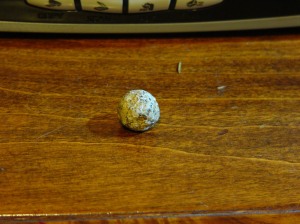
The caption for this picture reads, “This is an artifact marble, once used as a game-piece by early Native Americans who inhabited this area of the Ozarks, known as the Bluff-Dwellers.” Totally fascinating and way beyond my expertise so I’ll just go with the first thing that came into my head when I first woke up this morning–obviously I went to sleep last night with Friday Fictioneers on my mind.

I think I’ll call this one, “Never Judge a Rock.”

“Hey, Honey, come look at this.”

“I’ve got something on the stove.”
“Well, turn it off, ‘cause you gotta see this.”
If a screen door can slam open, she managed it. “What?” The frown on her face made him step back.
“Look at this.” He pointed to a small, round object on the top step of the porch.
She studied it then regarded him with disdain. “It’s a rock.”
“Yeah, but where did it come from?”
“It’s a rock.”
He reached for it.
“No!”
He looked at her and saw terror. He smiled, smug and superior. “It’s just a rock.”
———-
Questions? Comments? Go read some more 100 word flash fiction at http://madisonwoods.wordpress.com/flash-fiction/the-marble-100-words/ 

Thank You, Steve Jobs

I was a late-comer to Apple. I was a PC fan and scoffed at the faintly elitist Apple nerds, but I eventually got tired of constant virus infestations on my PC, despite the fact I had the best virus protection money could buy. I also got tired of carrying a cell phone, a PDA, an MP3 player, and a camera in the same purse. Still, I wasn’t sure about going completely Apple.

Like an addiction it started with something small–the red iPod Nano (center of the picture above). I justified its purchase as being part of the Bono Red project, but never had it been so easy to download music. However, that didn’t eliminate anything from the purse, just swapped the iPod for the MP3 player.

The Nano was soon full to its 8gb capacity, so I upgraded to the iPod Touch, not pictured because I gave it to a friend when I bought the iPhone3 (to the right of the Nano above). Finally, the expiration of a cell phone contract coincided with the release of a new iPhone, and in 2009 I now had merged all my electronic devices into a single device. That wasn’t a leap of faith by Steve Jobs in my mind. Merely, it was the brainchild of a Trekkie like me who couldn’t wait for the day to hold Capt. Kirk’s communicator. To me, it was just natural.

After the 2008 virus-induced crash of my last PC and somewhere between the Nano and the iPhone3, I purchased a MacBook Pro (the laptop on the right of the picture) and gave away all my PC–towers and laptops. I was in love with computers again. When the iPhone4 (far right of the Nano above) came out I was almost first in line. For Christmas of 2010 I gave myself an iMac (background in the picture above), followed a few months later by the iPad1 (not pictured). The iPad1 went to my goddaughter when I bought the iPad2 (on the left of the desk in the picture above). The MacBook Air is on this year’s Christmas list.

As innovative as Windows was in the day, Apple succeeded because of Jobs’ concept of minimalism. Even the first MacIntosh was sleek and futuristic compared to the PCs of the day. The Apple OS was easier to use, more intuitive than Windows’ innumerable iterations. Jobs took an idea for his own personal user needs and made it accessible to the rest of us. You didn’t have to verge on being a programmer to operate Apple products.

Yes, I’m now an Apple geek, thanks to Steve Jobs. So, thank you, Steve Jobs, for making our Star Trek dreams come true, and thank you for the face of courage against that horrid enemy, cancer. Rest in peace, though I’d like to think of you as just plugged into cyperspace forever.

You Say You Want a Revolution?

Some people have said they miss my political commentary. Well, you get what you ask for.

If you’re a fan of the mainstream media (and I used to be), you’ll be surprised to find out that a group of people (upwards of several thousand) have been “occupying” Wall Street (well, Liberty Park). They are now into their third week. You didn’t know that? Not surprising. The MSM (and, yes, I have been tempted to call it the “lamestream” media, but I don’t want the association) have been noticeable in their absence of coverage. Oh, when the arrests started they were quick to point out that the police were handling the “disruptive protesters.” Only Democracy Now!, Free Speech TV, and Current TV have devoted any time to what is motivating this true grassroots movement, as opposed to the various Tea Parties who have been bankrolled by the Koch Brothers.

So, what is motivating the people who call themselves “Occupy Wall Street?”

For one thing, the Wall Street Robber Barons came close to tanking the economy by taking advantage of an almost regulation-free financial environment and got bailed out and not one of them has spent a single minute being held accountable for that.

For another thing, the top one to two percent of this country have decided that they need to keep their wealth–not spend it on job creation, what an effing myth that is–so they can live higher on the hog, and the middle class, which they disdain and have decimated, and the poor–who got that way through all fault of their own–can wallow in the gutter of American Exceptionalism.

For yet another thing…no, I think those two things about cover it.

The minute I saw an NYPD white shirt named Anthony Bologna pepper-spray women who were committing the crime of standing on a sidewalk, I wanted to grab my kaffiyeh and head up there. When I saw a twelve year old girl in handcuffs, I wanted to set fire to the barricades and shut the effing place down. When I watched the police trick demonstrators onto the causeway of the Brooklyn Bridge then arrest 700 of them for blocking traffic, I was ready to tear the place down.

Fortunately, with age, I’ve been able to temper those urges. Forty years ago, I marched in some of the greatest demonstrations in the history of this country, and we turned the opinion of the country on a war, and we brought down a lying, corrupt president. Then, we moved on. We got jobs and houses and mortgages, swelled the middle class, and we let others–though not many of them–do the demonstrating thing.

Now, we find our place in that great middle class has come under attack from people with scads of money who have decided we need to pay for everything–their tax cuts, their wars, their third or fourth house, their new yacht–and we also need to give up our benefits and our rights to collectively bargain because they don’t like those concepts. They want to get rid of Social Security and Medicare because people should pay for their own retirement and health care–that’s what they’d have you believe. The truth is they don’t like letting anyone who really works for a living into the upper class. Only they get to live the high life and how dare we mere peons aspire to emulate them and live comfortably?

I agree that in some ways we need a revolution, but it has to be a revolution of the ninety-nine percent, not that envisioned by the Tea Baggers, who, in their ignorance, believe that the Koch Brothers aren’t using them for their own political ends. We have lost our compassion in this country. We blame the poor and the dwindling middle class for the woes rampant, unregulated capitalism has created. We hate anyone who is not rich, white, male, Christian, and born here. This is the America the Koch Brothers, Rush Limbaugh, Bill O’Reilly, et. al., have made and want to enshrine.

Support Occupy Wall Street by joining them in person or virtually. Wake up and smell the revolution or be crushed by the top one percent’s Humvee.

Learning to Be “Write-Brained”

I posted recently in an on-line writers forum about a class I was taking on how to get published. Someone commented, “Honey, one of these days you need to stop taking classes and just write.”

Well, duh. Except that I can do both at the same time. (And, by the way, a month after finishing that class, one of my short stories got published.)

You can continue to sharpen your writing by writing, but it sometimes helps to get refreshers along the way. I was an editor for eleven years, but I took a grammar or copyediting refresher every couple of years just to sharpen my skills.

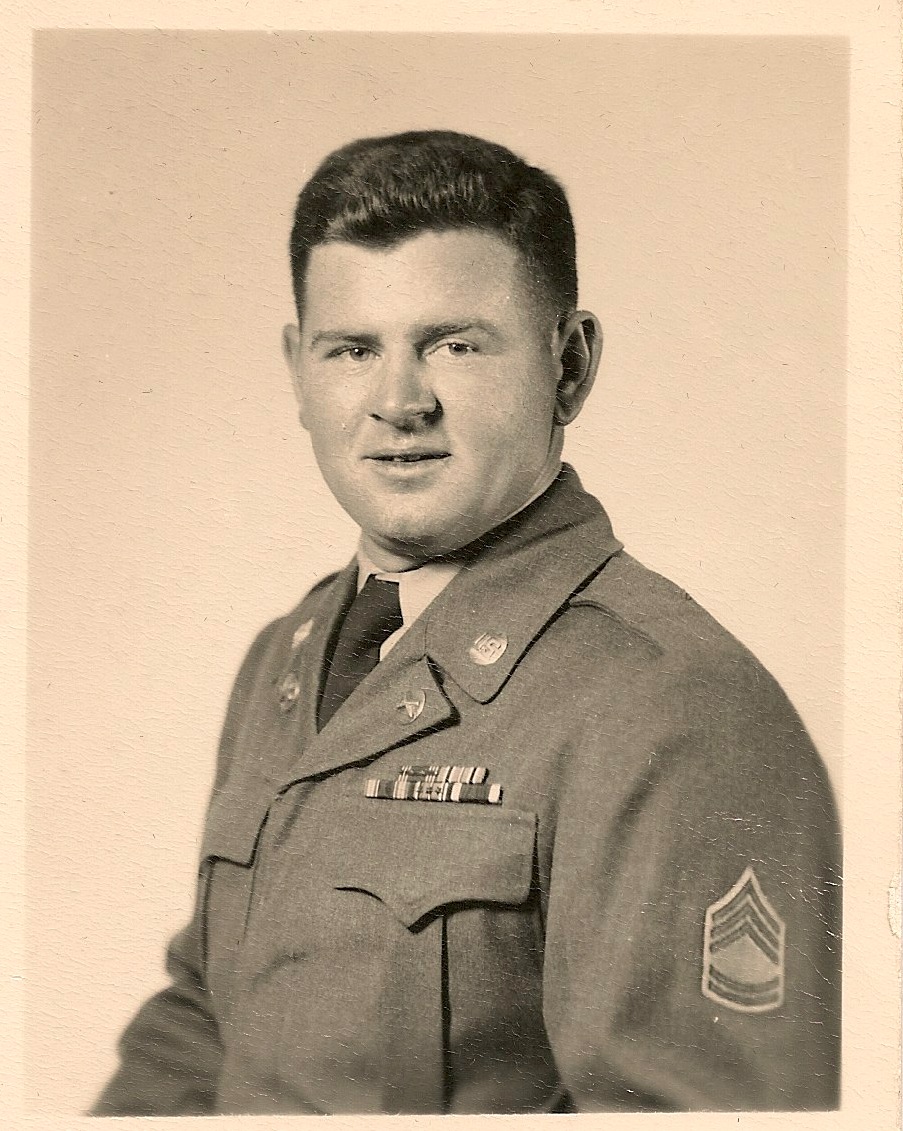
So, when I saw The Write-Brained Network’s information on “A One-Stop Workshop for the Serious Writer: A Roadmap from “How-To” through “I Did!” I couldn’t resist. Add in the fact that it was twenty minutes away in my old college town, how could I not go? The deal-sealer was one of my favorite authors, David Robbins, on the bill. His War of the Rats, about the siege of Stalingrad, was so historically accurate and vivid, you felt as if you were there. The End of the War, told from the Russian soldier’s point of view as the Red Army entered Berlin in 1945, was particularly meaningful to me because my Dad was in on that from the American side.

The workshop began with tips on redlining your writing given by Robbins. He’s a very engaging speaker, and the redlining tips he gave are what we’ve heard before but need to remember—watch your POV, “Show, Don’t Tell,” don’t use redundancies, cut the modifiers, etc. He provided his unique perspective, however, and gave specific examples to bring the points home. When he said, “Write what you know is a lie,” he had me. The story and the telling of it, Robbins emphasized, are separate. You can take a great story in your head then ruin it by the poor telling. I think he should have stopped there because he went on to diss several contemporary writers, some in his genre. I think that’s called “biting the hand…” I mean, perhaps at his next conference, David Baldacci or Dan Brown will point out what he dislikes about David Robbins’ writing. Just sayin’.

The next session made me glad I hadn’t sent in a first page to be critiqued. When I saw that offered, I figured you’d send in a page and you’d get it back marked up. Oh, no. The page got read aloud, followed by an instant critique by Robbins and Tiffany Trent, who writes young adult fiction. Granted, the writer’s name wasn’t read aloud, but you could tell by the squirming when someone was on the grill. Critiquing is always a helpful exercise, but I think this could have been improved by separating the first pages by genre, then having someone familiar with the genre provide the critique. A colleague with me at the workshop was braver than I and submitted a first page. This author, who’s sold two books, writes in a genre where the reader expects flowery words and setting a sense of place and time before delving into the story. Of course, the two panelists skewered it, but neither was familiar with the genre. I also think this would have been better one-on-one, rather than in public. Yes, yes, I know others can learn from a colleague’s critique, but the whole exercise left me queasy.

“Getting Noticed, Getting Paid: How to Build a Platform and Freelance Your Way to an Audience,” was a panel consisting of a writer friend of mine, Cliff Garstang, and Bridgid Gallagher, a freelance and young adult writer, who has a web site, Inky Fresh Press, for new writers to learn the business. Both Garstang and Gallagher emphasized the importance of social media in developing your brand and in increasing your sales. Garstang in particular emphasized the importance of separating personal social media and the social media platform for your work. This was a very meaningful panel—showing how Facebook and Twitter friends who aren’t writers can still help in publicizing your work by mentioning it to their followers. Very practical and down to earth.

After lunch we had a “Query Clinic.” Similar to the first page critiques in the morning, you sent in a query letter, which was again read aloud and publically critiqued by two literary agents, Dawn Dowdle of the Blue Ridge Literary Agency and Lauren MacLeod of Strothman Agency. Again, I think this was an exercise better done one-on-one. However, both this and the first page critiques show that getting published and/or getting an agent to represent you is highly subjective. In particular, trying to find the right agent using a reference list is almost impossible. You have to click, as was proved in a later session.

Two authors—Trent and David Kazzie—and two agents—Dowdle and MacLeod—were the panelists for “Traditional Publishing, Self-Publishing, and E-Publishing.” Kazzie self-published an e-book at the same time he got an agent for a traditionally published work. The consensus of this group was a resounding “no” to self-publishing. The exception was Kazzie, who emphasized, quite rightly, that if you are going to self-publish, you need to adapt some of the aspects of traditional publishing—a copy editor, an editor, a good graphics designer. When one of the panelists said, “I don’t really know much about self-publishing,” but then went on to pontificate against it, I wondered why that person was on the panel to begin with. One of the things not covered was the difference between self-publishing and e-publishing, which most of the panel considered the same. Stephen King has e-published—meaning his work is available for reading on a Kindle or a Nook—but that’s different from self-publishing.

The final panel was MacLeod and Jodi Meadows, one of McLeod’s newest clients, talking about the Author/Agent Relationship. This was an excellent panel, demonstrating just how important it is to have the proper representation. MacLeod and Meadows obviously clicked and just as obviously like each other. MacLeod is enthusiastic about Meadows’ work, and they seem to have the perfect agent/author relationship. That alone gives hope and a better understanding of the process of acquiring the right representation.

With the exception of Robbins and Garstang, most of the talent (on the stage or in the audience) at this workshop was from the YA genre. I have nothing against YA, and I know my path is not that way; but a better mixture from other genres would have made an excellent workshop perfect.

I know I may seem critical of some of the elements of this workshop, but I’m, at least, constructive. Overall, it was money and time well-spent. I love being around other writers, people who understand just what it is to be a writer. The Write-Brained Network understands as well and provided a top-notch workshop with a lot to absorb in a day. Kudos to Write-Brained Network Coordinator Ricki Schultz and her team for a worthwhile day.

September 11, 2001

My first attempt to acknowledge this significant anniversary of an horrific event was far too self-indulgent to post. However, the emotions I had suppressed from September 11, 2001, began to come to the fore in the past two weeks. I wrote them down and will deal with them. Just not here. That would trivialize the deaths of thousands.

The closest I was to anything that happened on 9/11/01 was three miles–the Pentagon was just across the Potomac River from Washington, DC, where I worked for the Federal Aviation Administration. My actions that day and in the weeks after were those of support, and perhaps later I can tell that story.

People often remark that 9/11/01 was such a beautiful day–bright, sunny, cloudless–and that something so horrible shouldn’t have happened on such a glorious day. The fact is, the hijackers kept an eye on the weather; the horrible terror they perpetrated was easier on a visual flight rules day. How might things have changed had that day dawned cloudy and dreary.

The scenario the terrorists opted for could have cost tens of thousands of lives, and some have sighed in relief that it was only 3,000 or so. That is survivor guilt, that is the expostulation of someone relieved they were no where near New York City, Arlington, VA, or Shanksville, PA, that day.

I know the emotion of ten years without a loved one, and it heals; it gets better; but the hole never closes. I was an adult when I lost my parents nearly thirty years ago, so I can’t relate to losing a parent when you’re ten or fifteen or two. The lost opportunities to see school plays, sports events, weddings, births of grandchildren are weights hard to bear.

I hated the fact that religious zealots used as an instrument of destruction the industry I’d given most of my life to preserve, and yet, as I reviewed the pilot records for each of the hijackers, I saw typical men who trained typically as pilots. Nothing jumped off the page to shout “Terrorist!” Life is never that simple.

“Why?” is the question still asked about 9/11/01. As with other acts of terrorism, like, say 4/19/95, we take the easy, un-intellectual route–the perpetrators were evil. We never look beyond, into the black box of the psyche of terrorism so we can stop the next 9/11/01. We react. Restricting the carriage of liquids on board an aircraft, taking your shoes off at the TSA checkpoint, getting groped by perfect strangers doesn’t really prevent anything. It’s a false security. To me it’s a bitter reminder that we gave up freedoms to feel safe. Not be safe. Just to feel as if we are protected. We never once, as a nation, as a government, stopped to reflect on which of our policies or actions contributed to this.

You see, terrorism doesn’t happen in a vacuum. We like the neat package of “Oh, they were evil! That’s why they did it.” We know how and who and where. We’ll never know, nor do we want to, why.

If we want to honor those who died ten years ago today–from the people on Flight 93 who took their destinies into their own hands to the first responders who gave full dedication to their duty to those who died merely because they came to work that day–let’s re-dedicate ourselves to public service, to re-creating a nation of the people, by the people, for the people.

Staunton Jams

There are many positives to living in a small city, chiefly you have all the amenities you had in a larger one, just on a more manageable scale. I loved living in Alexandria, VA, where I was minutes away from all the dining and activities in Old Town and, when the traffic wasn’t a bitch, twenty minutes away from work and the Capital of the United States. Washington, DC, always invigorated me–still does–but the years of mismanaging traffic and growth made me seek something less complex for retirement.

Staunton, VA, fit the bill: a relatively stable population, a good local economy, magnificent views of the mountains, farmers markets where the food really is local, and plenty of cultural amenities. Several weeks ago, I decided on a whim one Thursday to go see “Hamlet” at the American Shakespeare Theatre right in downtown Staunton. I got a remarkable seat, within arm’s reach of the stage, which would not have been the case had I attempted the same at the Kennedy Center or even Arena Stage.

The area is also proud of its “roots music,” in fact, music of any kind. Staunton’s “main” street, which is really Beverly St., boasts many restaurants that feature excellent music. One restaurant has an outdoor concert area, which backs on condominiums in the old YMCA building. A few residents have complained, but I say they need to lighten up and enjoy the music. (Interestingly, the people complaining about the music, which is mostly bluegrass or folk, are “immigrants” to the area like myself. The difference is, I like loud music.) In the summer, in an area of the city called “The Wharf” because, I believe, there used to be a somewhat navigable river there, Staunton hosts “Shakin'” on Thursday evenings. These are all local bands or from nearby, and they always draw a crowd. Why, there are even carriage rides around Staunton–just like Old Town.

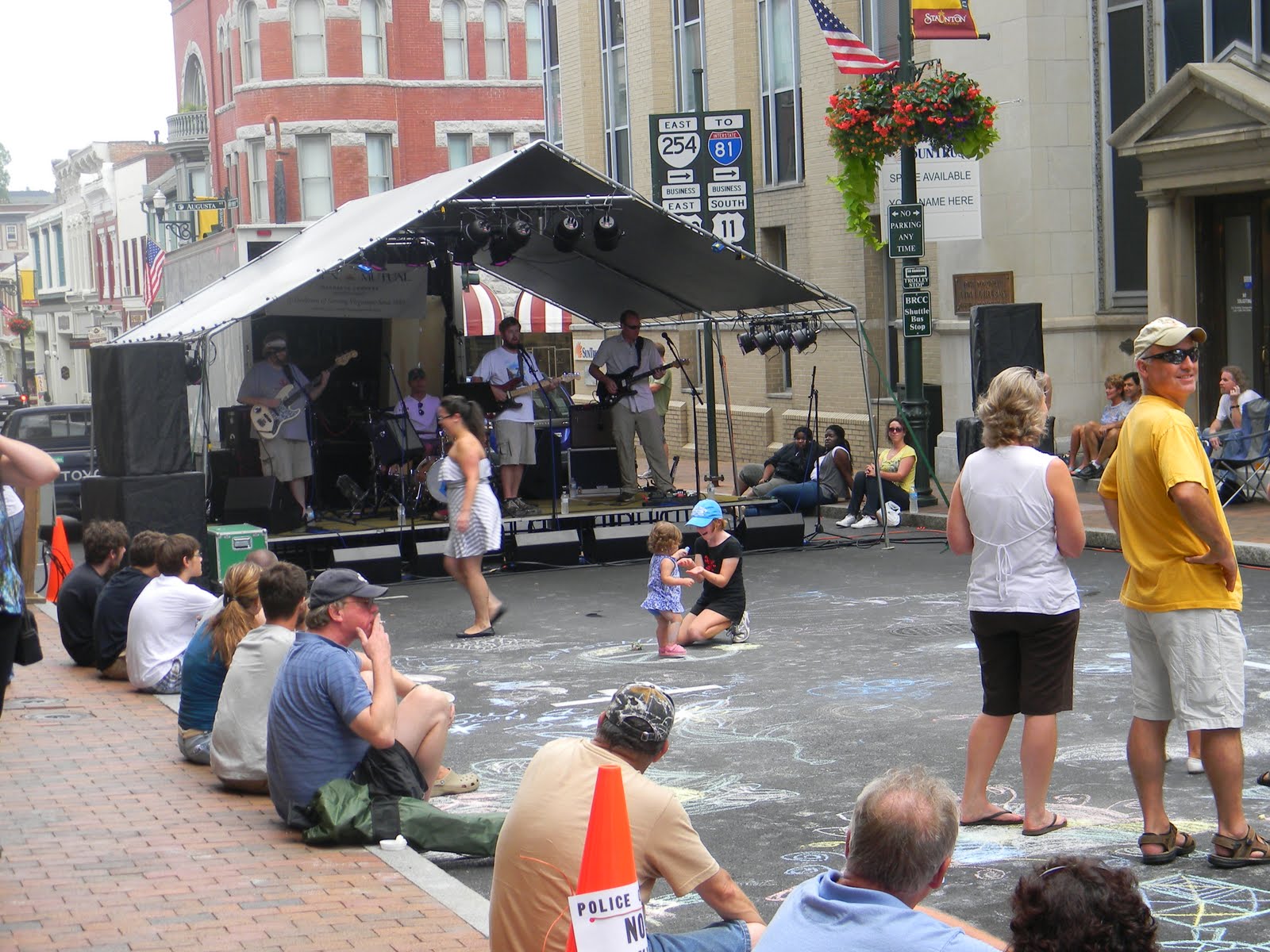
The unofficial end of the outside music scene in Staunton is “Staunton Jams.” Local officials cordon off a block of Beverly street, and from noon until ten at night bands rock the downtown. They range from headbangers (yes!) to new age to cover bands, and they are all good. Imagine blocking off a similar space in Old Town. When that is done for parades in Alexandria, the gridlock backs up miles on the Capital Beltway. In Staunton, that block was easy to circumnavigate, and there was no gridlock. I was able to park a block away, which wouldn’t have been the case in Old Town or DC.

I love my new city, and I hope I don’t turn into an anti-growth NIMBY, but all the things that appealed to me about living in Alexandria and near DC are here, but I can actually enjoy them without battling traffic and crowds. I’d just like it to stay that way, so if that makes me a NIMBY, I’ll deal.

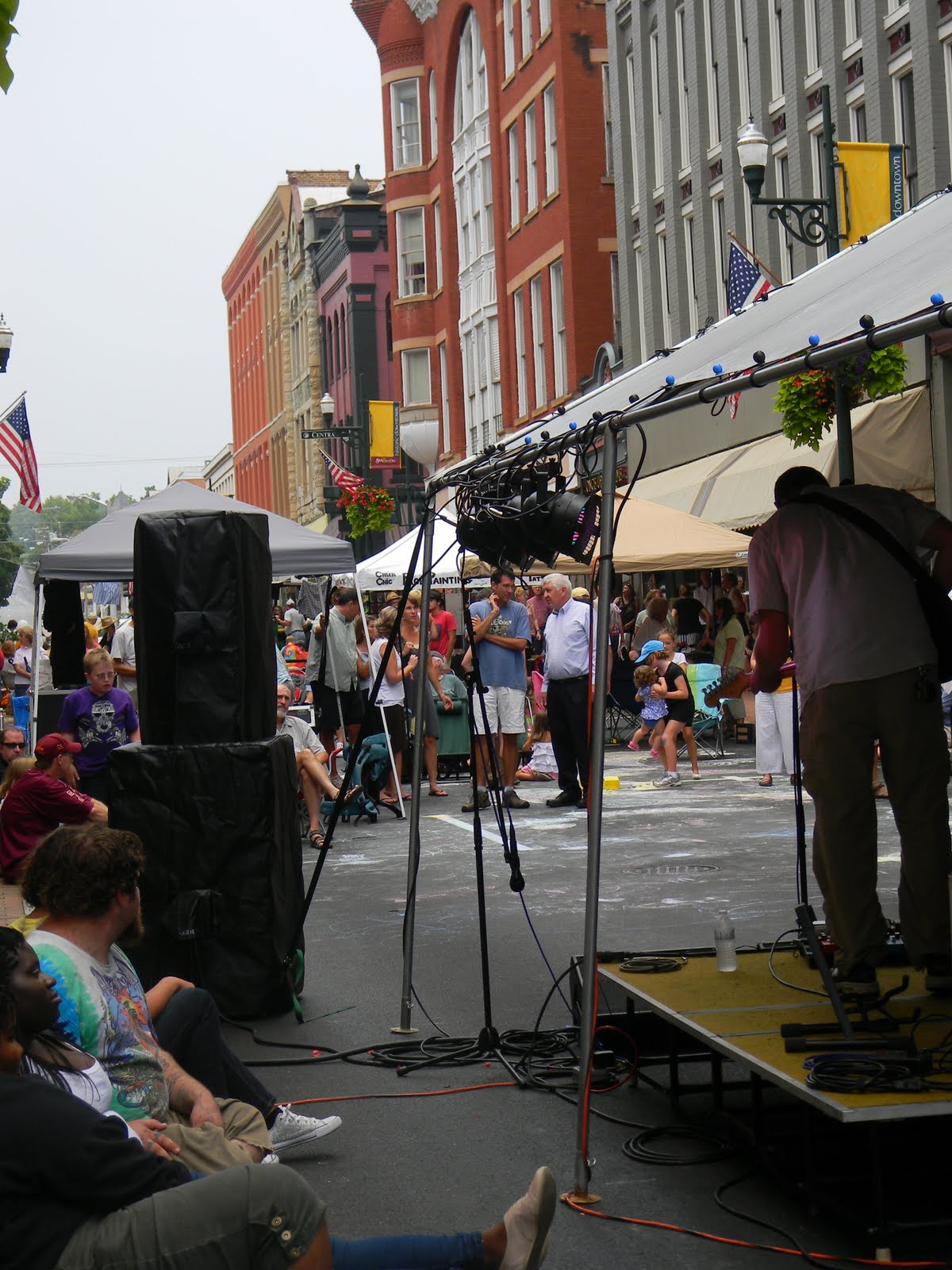
Here are some pictures from Staunton Jams.

This is the extent of blocking off the street. In Old Town or DC
this would mean saw horses, jersey barriers, police tape,
and SWAT.
The stage is ground level, easy for the acts to move in and
out, but also great for interacting with the bands, who didn’t
mind if you shouted requests at them.
Yes, you could get this close to the stage, and in
this picture you can see some of the great downtown architecture.
The children had fun with sidewalk chalk, in this case,
road chalk. The children had lots of activities, and in
addition to taking a seat on the curb, you could bring your
own chairs to sit on–that would never go over in security-
conscious DC.

Rape is Rape

I’ve been a feminist since before I heard the word. When I did hear it, I said, “Oh, so that explains me.” Even then, there were certain feminist concepts I had to grow into. One of those was, “Believe a woman when she says she’s been raped.” This was usually followed by many anecdotes of women who were victimized twice, once by their rapists and then by the justice system who was supposed to be their advocates. I was a bit skeptical. After all, police and the courts are our friends, and I’d heard women in college threaten boyfriends with a cry of rape in order to assure their fidelity or in a fit of post-frat party conscience. I hadn’t yet learned about how the patriarchy socializes young girls with self-loathing. But I digress.

In the early years of my feminism, I didn’t give the rape issue much energy. Focus on equal pay, equal access to jobs, etc. Those were the things important to me as a working woman in a male-dominated profession.

Then, I was raped.

I wish I could say it was the stereotypical slavering madman who accosted me in an alley (though why would I be there?) or followed me from my car. No, it was the man with whom I’d been in a relationship for several years. He was a cop. Now, the occasional use of his handcuffs was mutually stimulating–the  occasional use. All of a sudden it had to be every time, and when I finally said I didn’t want that, I got forcibly handcuffed and dragged to the bed. And raped.

There were days of denial. I didn’t even tell my best friend. If she reads this, this may be the first time she’s heard of it. It was my flight instructor I confided in because he was a big-brother type, and he was furious. He was a policeman, too, and he was the one who told me I had to go to the police department in the location where it happened.

The officer who took my statement–and never processed it–was bored and surly. It couldn’t be rape because he was my boyfriend, and why had I waited days to report it. Obviously, I was pissed at him, so I was making this up. I was wasting valuable police time, and what if, in wasting that time, some woman really got raped. After that dead end, I went to my boyfriend’s department in a different jurisdiction and reported it. I got the same treatment and was also told that cops sometimes need to blow off steam. That’s all it was. Blowing off steam, and I needed to understand the difference between that and rape. I now knew the difference, but I also saw pursuing this was useless.

The good thing I did do was not see him again as part of a relationship. He was friends with my parents, so there were occasional encounters where he expressed puzzlement at why we weren’t together anymore. My mother adored him, and dating him was probably another of my futile attempts to please her. I even fantasized telling my father and imagining my ex-boyfriend’s reaction to the business end of one my father’s guns. But that would mean telling my father his daughter had done things he couldn’t approve of, and I couldn’t do that. To see the disappointment on his face, before his anger, would have been almost as bad as the rape. So, I let it go. I never told anyone else, except the man from the next relationship I was in who showed me what love and love-making truly were.

I reveal all this because today a New York City prosecutor requested that sexual assault charges be dropped against former IMF chief Dominique Strauss-Kahn. This after his alleged (I have to say that) victim begged them to proceed. Because this hotel maid lied on an immigration form by saying she was gang-raped (sometimes the only way women from some areas of the world can get political asylum), because a recording of her speaking with a jailed boyfriend was mis-translated, Mr. Strauss-Kahn walks free. Well, free to face two civil suits from the hotel maid and a woman in France, the daughter of a Strauss-Kahn friend who charges that he assaulted her.

The hotel maid has been on television, and her name has been used with her permission, but I won’t use it. To me, she’s still a victim. Lying to get into a country to make a life for you and your child is not the same as lying about rape. They are not mutually inclusive. And she was obviously far braver than I because she has spoken out about her assault.

Strauss-Kahn’s attorneys strip away the hotel maid’s dignity when they continue to claim the “act” was consensual. The DA is uninformed when he says her stories about what she did in the minutes after the assault are “inconsistent.” I was nearly incoherent for days, so I can understand why she may not have been consistent. She has been consistent about the details of what happened, and so, to me, she should have had her day in court–not to prove she’s a victim but to show that women who have been sexually assaulted should be protected by the justice system not vilified by it. Yes, I know she’s already filed a civil suit, but not until the DA’s office made noise about her credibility.

So, women in or traveling to New York, if you’re going to be raped, make sure it isn’t someone rich and powerful; make sure you’re not poor and working a job where if you speak up you could get fired; make sure you’re white and born right here in America; and make sure you have plenty of witnesses so you won’t be accused of “he said/she said.”

Once again, something I thought we as a modern, civilized culture had put aside rears its disgusting head (and I’m not even talking about making victims pay for their own rape kits). I’ll say it in as few words as possible:  Rape is rape.

The Only Easy Day Was Yesterday

I’m an Army brat through and through. I’ve watched my share of Army-Navy football games with my Dad and rooted for the “right” side. My first flight instructor was an Army helicopter pilot of the Vietnam era who enjoyed challenging Navy pilots to bar fights while I cheered him on. I’m basically anti-war, but I love my Army. I admire people who serve in any of our armed forces. I won’t devolve into cliches here, but, okay, freedom isn’t free, yadda, yadda. Oh, I have my issues with the military because it takes kids and turns them into killing machines, and sometimes it forgets to turn them off. However, I owe my existence–and you do, too–to everyone who served in World War II and saved the world from the most base villainy ever seen.It was only a few months ago we learned that “U.S. Special Forces” had killed Osama bin Laden. My ears perked up at “special forces,” because I have a tremendous amount of respect for them. We ask them to do disgusting things for the country, and they do it without question; most of the time, it makes us safer. (I’ve settled the ethical issues internally and really don’t want to debate them.) Special Forces are the elite, and, frankly, I’ve always felt that if we’d turned the war in Afghanistan completely over to them in the beginning, it would be over now, but for that whole Iraq distraction. I quickly “got over” the fact that it was Navy Seals, not Delta Force, not the Rangers, who stole into Pakistan in the dark, did the deed on bin Laden, and safely evacuated.

“Seal Team Six” became an everyday word. I even had a water treatment system solicitor come to my door a few days’ after all the bin Laden publicity and, when he saw he wasn’t making the sale, pulled the “I’m a former Navy Seal” line on me. Trust me, if he was a Navy Seal, I was, well, someone younger, stronger, and fiercer.

Then came the news over the weekend of the shoot-down by the Taliban of a Chinook helicopter carrying members of Seal Team Six (including a specially trained Seal dog), an Army aircrew, two Airmen, and several Afghan commandos. At first it seemed like a non-military event because what military wants to admit that the rag-tag Taliban could bring down a U.S. helicopter. Just ask the former Soviets how naive that concept is. After the admission that the helicopter had been shot down, some weekend anchors heard “Seal Team Six” and started mourning the crew who had taken out Osama bin Laden, not realizing that a Seal Team has several hundred members. I will admit when I first heard someone say that I wondered what idiot officer (Dad was a career non-com) had put the team members from the bin Laden raid back in a country where keeping secrets isn’t easy. Some anchor then compounded the idiocy by “thanking goodness” it wasn’t the same team. Idiot.

I’ve tried all weekend to come up with words to express my feelings. I feel every loss in both these wars. When the Washington Post prints pictures of the fatalities, I look at each picture. I read each name and home town. No war since World War II has touched my family in that way. Cousins came through Vietnam and Desert Storm physically unscathed, so I felt I owed that to the families who suffered the ultimate loss, an acknowledgement of their sacrifice. I’m a born Virginian (yes, there is a distinction), and Seal Team Six is based in Virginia Beach, VA. In that way, it was a home-state loss, and Virginia will step up and comfort these new widows and fatherless children, these parents who have lost sons who gave the last full measure of devotion.

The Seals would say they were just doing their job. In this instance it was rescuing some Army Rangers who had been pinned down in a Taliban stronghold. Had it all gone successfully, the two groups probably would have met up in the Green Zone and traded jabs about how the Navy had to come to land and rescued the Army. There would have been a lot of macho posturing I have little patience with, but everyone would have understood you don’t leave your people behind, regardless of which service they belong to. And the Rangers would have begrudgingly given the Seals their due. Begrudgingly.

Instead, there will be too many funerals, too many flags pressed into the shaking hands of next of kin, too many 21-gun salutes, too many playings of Taps. Too many tears will be shed, too many nights will be spent alone in a bed meant for two. There will be too many nightmares where children wake wanting their Daddy. In the past ten years, there has already been too much of this, but that’s another matter. Right now, families and a country will come together to mourn and, then, carry on. The Seals would expect nothing less.

The title of this post is an unofficial Seal motto. How apt for the weeks to come as bodies are identified and sent home to be honored and laid to rest. For the families, it can only be a mantra.