Haiku 366-271 (9/26/16) parent killed check school kids shot check like Adam Lanza Haiku 366-272 (9/27/16) weather cools looking forward to a cozy fire gasless oops Haiku 366-273 (9/28/16) On the d…
Source: Haiku 366-271 to -286
Haiku 366-271 (9/26/16) parent killed check school kids shot check like Adam Lanza Haiku 366-272 (9/27/16) weather cools looking forward to a cozy fire gasless oops Haiku 366-273 (9/28/16) On the d…
Source: Haiku 366-271 to -286
Haiku 366-251 (9/6/16) a yellow leaf a hint of orange fall tests the water Haiku 366-252 (9/7/16) (re: our $38 billion—with a b—payment to Israel) our infrastructure sags inconsequential strong Isr…
Source: Haiku 366-251 to -270
Actually, I only want you to pick one of two (now three) choices. Easy, right?
A couple of months ago, I mentioned I’m trying a new type of promotion for my work–giveaway short stories. I have two in print: “Spymaster” and “Blood Cover.” Using canva.com, I came up with great covers for them, which I’ll share in an upcoming post. I have a third story about ready for printing, and this cover is proving to be a challenge. That might be because of the subject matter.
I characterize myself as an “historical/political thriller” writer, meaning my works use history and current events as a basis for the fictional story. With these giveaway stories, I’m practically in present day, i.e., they have been prompted by news items I’ve seen this summer.
For example, “Spymaster” is based on a series of real events where American diplomats in Europe and Moscow have been harassed allegedly by the Russian security services (think, the old KGB). “Blood Cover” is about the perils of living in a theocracy with harsh methods of punishment.
The next giveaway short story to come out is called “Best Served Cold,” and it involves something that invokes either sympathy or ire, the Black Lives Matter movement.
Cultural appropriation aside, I write stories essentially where the characters tell me to write them. Sometimes those characters look or are completely unlike me. I believe a straight person can write about gay issues, a black person can write white characters and vice versa, that cisgender writers can write trans characters, etc. However, it is incumbent upon us to be authentic to all our characters and not to devolve into stereotypes.
I had a painful experience a couple of years ago where a contest-winning story was pulled from publication because I, as a western white woman, had dared to write a story wherein the protagonist was an aboriginal man from Australia. I had carefully and thoroughly researched as I wrote, and that aboriginal man “dictated” his story to me. Someone complained I wasn’t following Australian cultural guidelines, and the publication’s editor caved to a single person’s criticism and removed my story. (Joke’s on them. That story was later published in an anthology.)
All that being said, I was skeptical of my ability to write a story about the murder of a black man without offending anyone. But, sometimes writers have to offend. I did my research, I drew on distasteful things I’ve witnessed in my life, things that have made me angry but which I, as a white person, thought it best to be silent about.
That’s the thing. Silence is tacit acceptance of injustice. So, I wrote the story, “Best Served Cold,” and I took measures to make certain it was authentic.
To help in your choice–coming up in a bit–here’s the back cover copy for “Best Served Cold” to give you an idea what it’s all about:
Nathan Hempstead has long been the United Nations Intelligence Directorate’s cyber-guru. A hack, a tracking app, anti-eavesdropping tech, you name it, he can do it. For nearly four decades he’s worked in an environment that not only honored his genius but also kept him free of bias and racism and let him indulge in his favorite pop-culture fandom, Star Trek.
A critical Directorate mission fails because a dictator’s access to social media didn’t get blocked as planned. In fact, Nathan didn’t bother to show up to monitor the operation. The Directorate’s operational head, Mai Fisher, wants answers, not only for why the mission failed but why a critical employee, and a friend, let her down.
In his office Mai finds Nathan, seething with anger he directs at Mai, but when she presses him for what’s wrong, he has a cardiac emergency.
In hospital Nathan tells Mai about a son he thought no one else knew about and how that son had become another statistic in a deadly standoff between law enforcement and black men.
Mai knows how to get revenge; she’s done it before. Nathan, however, doesn’t want her help. He already has a plan, and it involves the most unlikely ally in the world.
Nathan teaches Mai the subtlety of an old Klingon proverb: “Revenge is a dish best served cold.” She comes to understand, as well, that black lives do matter.
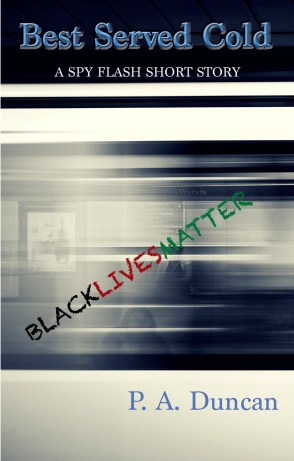
Cover Possibility #1
Let me give you some background on why I picked this as a possibility. I liked the sense of movement, the blurred background, the indistinct human figures. I could write a dissertation on why, but that’s not the point.
The “BLACKLIVESMATTER” overlay is supposed to be graffiti-like, but I’m not one hundred percent happy with how it turned out.
I’ve used blue on the title and my byline to imply cold. I didn’t really want a cover which implied warmth, given the subject matter and the allusion to that famous Klingon proverb.
What I like about it is its modernity and mostly, the movement aspect. That appeals to me for some reason.
What do you think?
This possibility has a number of things going for it. It’s bright and stark.
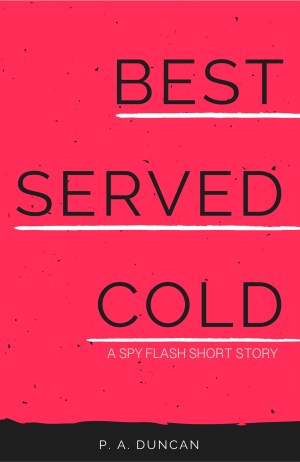
Cover Possibility #2
There’s a scene in the book where someone likens the flow of blood over asphalt to how the ocean flows over sand, and I thought this implied that.
The red on the cover isn’t quite blood red, and, unfortunately, it’s something I can’t change.
The warmth of the cover color contrasts with the title. You don’t look at this and feel cold.
However, the meaning of the “best served cold” proverb is that you’ll enjoy your revenge if you let some time pass, i.e., that the person won’t know what hit them when revenge comes. It’s not a cooling down period; it’s to make the revenge “hotter.”
What do you think?
It’s great when you have friends who are real graphic designers, unlike moi, who is a hopeless wannabe. Thanks to Becky Muth, here’s a third possibility you can vote for:
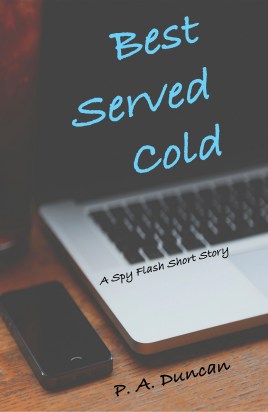
Since computers and hacking figure in the story, this may be the ideal cover for this story.
It’s stark, like the story, has a bit of an air of mystery about it, and ties in more obviously than cover possibility #2 (or #1).
I have a new favorite. What about you?
In the comments below, tell me which cover you like and why. Here’s why you should vote: I’ll pick a winner at random from the commenters and send you a copy of the three giveaway short stories when they’re all in print.
What do you have to lose? You get to express an opinion and have a chance to win free stuff!
I look forward to reading your comments.
 I’ve had few constants in my life, so to have something be part of it for fifty years is certainly a milestone. September 8, 1966, a Thursday, was within the first week of school, and negotia…
Source: To Boldly Go…And I Did

I’ve had few constants in my life, so to have something be part of it for fifty years is certainly a milestone.
September 8, 1966, a Thursday, was within the first week of school, and negotiating with my parents to stay up to watch a new television program was a contentious issue. I persisted, using, I might say, logical arguments: my homework was done and checked; I could use the small TV in my room and not disturb anyone else (though my father preferred all television be supervised); and I may have stretched the truth a little when I said this new show was like a Saturday morning cartoon.
I won, and the rest is personal history.
My mother didn’t like the show because it was that “science fiction” stuff. I’d been a sci-fi fan since my grandmother (her mother) introduced me to Superman comics when I was a pre-schooler and taught me to read using them. I discovered Marvel comics in elementary school, and my local library had a small collection of sci-fi books and magazines.
Back in those ancient times, sci-fi novels and mags had fairly lurid covers: scantily clad women pursued by leering aliens or images of grotesque space monsters. I’d been having nightmares that summer, and my mother attributed it to my reading “all that weird stuff” rather than typical adolescent angst exacerbated by her alcoholism.
My father thought sci-fi wasn’t educational, that it was escaping reality at the least, psyche-damaging at worst. I would read Asimov, Bradbury, Heinlein at the library, returning there to finish books or short stories rather than checking them out and bringing them home.
That summer, my mother had sent me to a Baptist camp in southwest Virginia where a woman confiscated a Heinlein paperback which had cost me my allowance for a month and told me it was a sin to read such “trash.” (A youth minister assured me I’d get my book back when I left, and he was true to his word, perhaps the last minister in my life to be so.)
All of these parental concerns were pretty generally held by people who didn’t understand science fiction. I read on, and I watched Star Trek.
I’ve never done cosplay of any kind. I find nothing wrong with it. I simply don’t have the personality for it. Rather, the philosophy of Star Trek appealed to me more than imitating it. Oh, be assured, I indulged in typical fan behavior. I went to conventions. I tried to buy the shooting script of my favorite episode (“City on the Edge of Forever”) written by my favorite author (Harlan Ellison) and was, thankfully, outbid, because I couldn’t have afforded it anyway. I collected Star Trek novels.
Star Trek got me on the road to writing. My first “coherent” stories I wrote were Star Trek and Man from U.N.C.L.E. fan fiction. It wasn’t called fan fiction then; it was only writing to me. To this day, I wish I could write “good” science fiction, but whenever I try, it comes out dystopian.
Star Trek got me interested in astronomy and physics, but no matter how hard I tried, no matter what logical arguments I used, I couldn’t convince my high school counsellor to let me take physics. Too bad back then I didn’t have this argument: There are doctors today because of Leonard McCoy and Beverly Crusher; engineers because of Montgomery Scott and Geordi LaForge; scientists because of Spock and Data; and astronauts because of the vision of Star Trek’s creator, Gene Roddenberry. We have cell phones and talking computers and medical scanners and ion engines and many, many more things because of Star Trek. We send probes to the planets in our solar system for the sole reason of “Let’s see what’s out there.” I became a pilot because that was the closest I could get to space, and, yes, that Cessna 150 I learned to fly in was my Enterprise.
Mostly, Star Trek showed a young woman who’d grown up in the shadow of the Cold War, who’d participated in nuclear attack drills, that there was a future, a good one, one to strive for.
There was an episode called “Operation: Annihilate,” the final show of the first season, where Mr. Spock is infested with a parasite that causes excruciating pain. He manages to get the pain under control without medication, to Dr. McCoy’s amazement. “Pain is a thing of the mind,” Spock said. “The mind can be controlled.” Later, he struggles to maintain his control, saying, “I am a Vulcan. I am a Vulcan. There is no pain.”
Sometimes the pain of my youth was physical, from a mother who couldn’t manage her own demons; sometimes it was mental, from that same individual. At night, in bed, I would murmur, “Pain is a thing of the mind. The mind can be controlled. There is no pain.” It became my mantra.
Star Trek saved me.
When Star Trek was twenty years old, I was an associate editor of an aviation magazine. We regularly did features called “Famous Flights” and “Famous Flyers,” historical articles and the more obscure the aviation history the better.
In the summer of 1986, the magazine’s editor was on vacation, and I was acting editor. I decided one issue’s “Famous Flight” would be one that, on the space-time continuum, hadn’t happened yet. I wrote a feature about the twentieth anniversary of Star Trek.
Gene Roddenberry was unavailable for interviews, because he was busy trying to convince some studio to produce “Star Trek: The Next Generation,” but at a con in Baltimore, I managed to ambush Majel Barrett-Roddenberry, his wife, to confirm a missing piece of biographical information about “The Great Bird of the Galaxy.” You see, Roddenberry had been a pilot, too. That was my hook for justifying the article in a conventional aviation magazine. We pilots like to talk about the aircraft we’ve flown, and I wanted the readers to know exactly which aircraft Roddenberry had flown for Pan-Am after World War II. (A Connie, by the way.)
All our articles got run through my agency’s public affairs department to make certain we didn’t say anything embarrassing about the agency. That gave me some worry; if the public affairs officer who read our articles decided my Star Trek piece was inappropriate, it wouldn’t get published.
No email then; we passed documents around by hand, and I came back from lunch one day to find the public affairs officer’s comments in my in-box. He hadn’t changed a word, and he’d written a note that said, “This is great! Boldly go!” We published the article in the
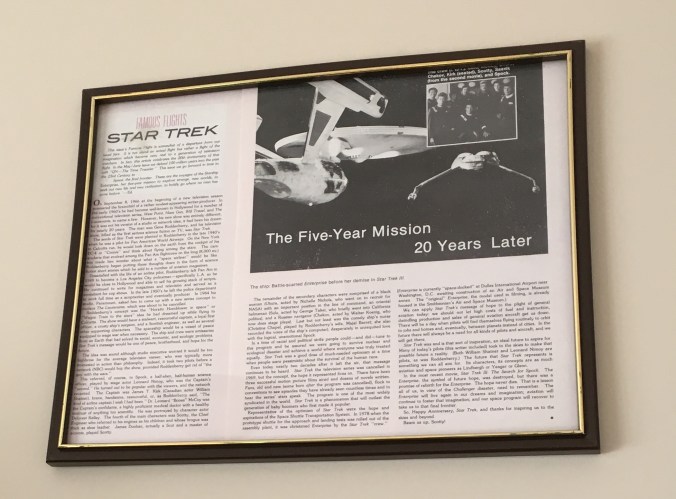
My 20th Anniversary Star Trek article, framed and hanging on the wall of my writer cave.
September-October 1986 issue of FAA General Aviation News.
The editor groused a bit on his return, said it wasn’t aviation related, and didn’t take my word for it that public affairs approved it. We got no negative reaction from our readers. End of story, I thought.
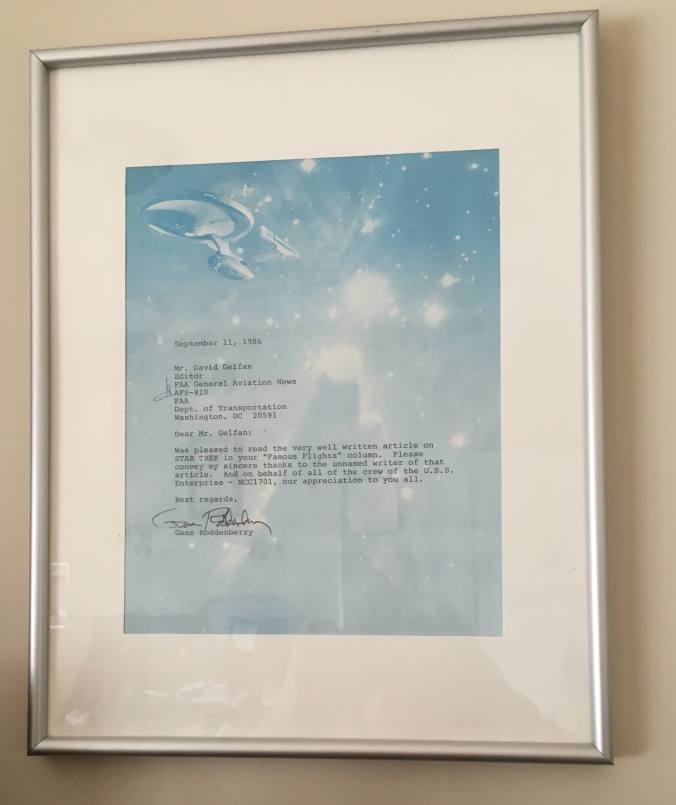
A few weeks later, an envelope arrived from the mail room, addressed to the “Editor, FAA General Aviation News.” The magazine’s assistant editor showed me the envelope. In the upper left corner where the return address usually goes was a small U.S.S. Enterprise and the words, “Paramount Studios.”
Oh, sh*t, I thought, Paramount is suing the magazine for that article (an issue the disgruntled editor had raised). The assistant editor opened it, and this is what was inside:
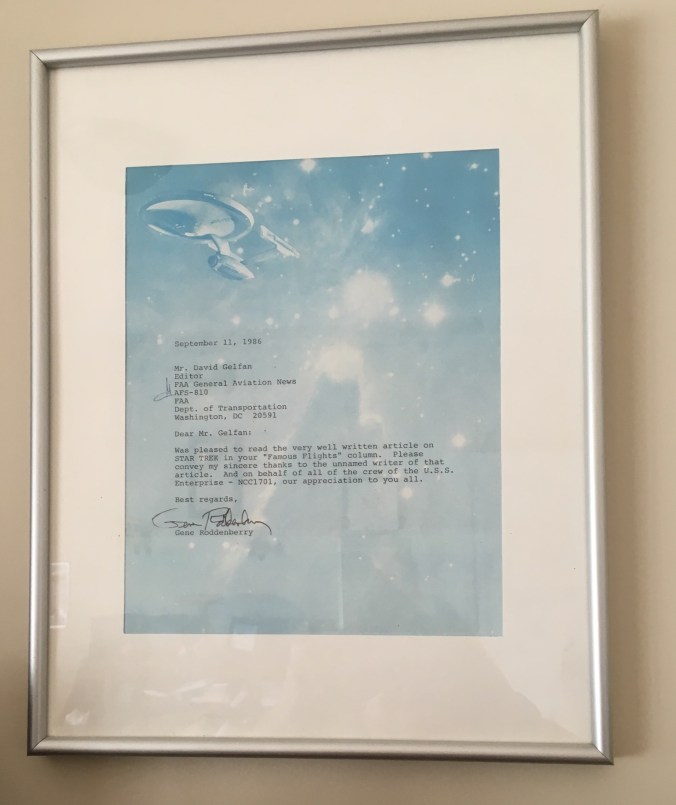
A letter from Gene Roddenberry to the “unnamed writer” (me) of the “very well written article” about Star Trek, also framed and hanging in my writer cave.
Needless to say, I was speechless. How on earth, no pun intended, had Gene Roddenberry seen an article in an under-read, low-circulation government aviation magazine? The assistant editor asked the Government Printing Office for a list of subscribers, and there was Roddenberry’s name. He was a pilot, and he subscribed to our magazine, and he’d read my article, and I was beside myself with many emotions.
You see, because Star Trek saved me, something Roddenberry had probably heard from thousands of fans, but this simple note meant everything to me; it validated twenty years of being a fan.
I see that article and Roddenberry’s letter every day when I sit down to write or edit, and, unbidden, the words come into my mind:
“Space: the final frontier. These are the voyages of the Starship Enterprise,
its five-year mission, to explore strange, new worlds, to seek out new life
and new civilizations, to boldly go where no one has gone before!”
And I write. Because Star Trek saved me.
I learned last week that my short story, “Reset,” about a father and daughter who set out to prove the Warren Commission wrong, had won first place in the Blue Ridge Writers Golden Nib Fiction Contest. “Reset” is one of those stories, which in the writing, becomes something close to you, and I was so proud it won this contest.
I’d always said I wasn’t going to be one of those writers who milks her dysfunctional family for material, but almost every story I’ve written that’s won a contest or been published has had some aspect of my family in it. The best laid plans…
“Reset” now goes into the state-wide Golden Nib contest, and I have my fingers crossed. It’s a good story. It will also appear in the ongoing anthology, Skyline 2017, which should be out in December. (I’ll be on a Virginia Festival of the Book panel in 2017 about the anthology–if the panel proposal is accepted. I have my fingers crossed for that, too.)
The poem I wrote about here a few weeks ago, “Verses for Orlando,” won second place (second-freaking-place!) in the Blue Ridge Writers Golden Nib Poetry Contest. I. Had. A. Poem. Come. In. Second!
It won’t go to the state-wide contest, but it will also appear in Skyline 2017. I. Will. Have. A. Poem. Published!
I’m very excited. You may have noticed.
How about you? Do you use things from your life and background in your writing? Are they some of your best stories or not?
 Eight months or so ago, a friend from UU bought my novella, My Noble Enemy. Her husband was about to have surgery, and she wanted something to read in the waiting room. I warned her it was about a man dying of cancer, but she said that was okay. A week later, I learned her husband had unexpectedly died of complications from the surgery, and I was worried that my novella was the worst possible thing she could have read. I figured she probably hated it and me for writing it.
When she returned to UU the week after her husband’s funeral, she sought me out and told me reading My Noble Enemy had helped her through her husband’s last hours and that it had given her comfort because the character in it who died was surrounded by the people he loved and who loved him. I was stunned and humbled.
Yesterday, all these months later, she told me the story still resonated with her as she continues to undergo her grief process, that she still needed the message of loyalty and compassion I wrote.
I am still stunned and humbled by such praise, and it’s the best thing anyone has ever said about my work. I’ve always said I don’t write for money or acknowledgement but because I have stories I want to tell, that need to be told. That story was the right one at the right time for at least one person, and that’s all I need.
How has something you’ve written resonated in an unexpected way? I’d love to know.
Source: Haiku 366-230 to -250
Haiku 366-223 (8/9/16) stories compel me to write them down they live to be told Haiku 366-224 (8/10/16) award-winning poem but prose is the decision gutless Haiku 366-225 (8/11/16) a son’s b…
Source: Haiku 366-223 to -229
Haiku 366-210 (7/27/16) sixty-four and one-quarter wise beyond years who knew Haiku 366-211 (7/28/16) thirteen years pass milestones missed seems like yesterday Haiku 366-212 (7/29/16) water and ba…
Source: Haiku 366-210 through -222

